
Puck, 1879-08-06 · page 7 of 16
Puck — August 6, 1879 — page 7: what you’re looking at
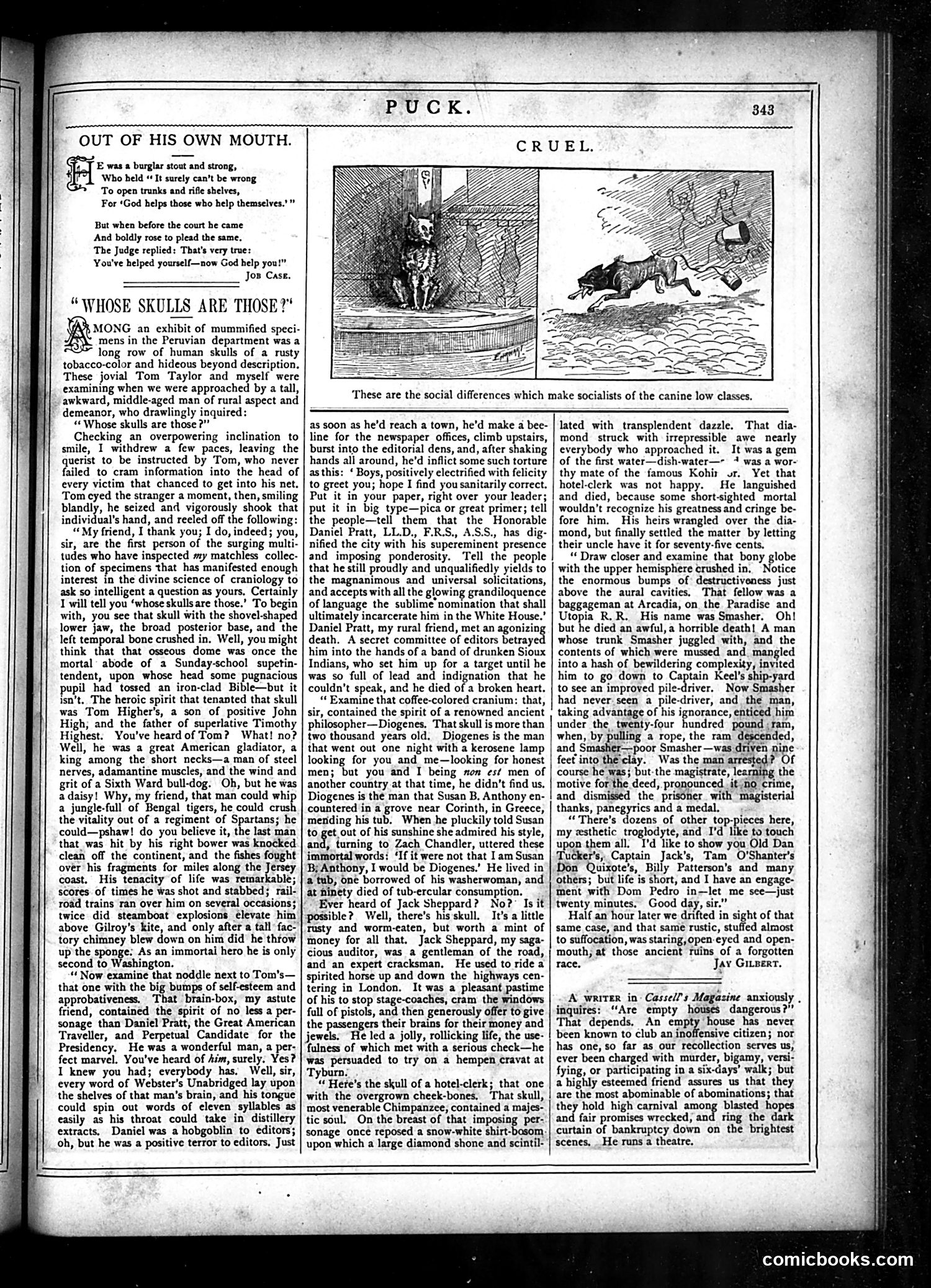
What you’re looking at
This Puck page satirizes class disparities and cruel treatment of animals by the wealthy. The left cartoon depicts a well-dressed man in an upscale setting, while the right shows a man driving a cart pulled by an overworked, exhausted horse. The caption states: "These are the social differences which make socialists of the canine low classes." The satire suggests that just as the poor suffer under the wealthy's indifference, working animals experience similar exploitation. The juxtaposition implies hypocrisy: the upper classes may condemn cruelty in principle (the judge's statement about God helping those who help themselves), yet they perpetuate suffering through their treatment of beasts of burden. This reflects progressive-era concerns about animal welfare and class inequality.
📄 Transcribed text from this page (OCR, searchable)
Machine-transcribed from the original scan — historical spelling and the odd misread are preserved.
OUT OF HIS OWN MOUTH. | ak was a burglar stout and strong, Who held «It surely can’t be wrong | To open trunks and rifle shelves, For ‘God helps those who help themselves.’ ” But when before the court he came ‘And boldly rose to plead the same. The Judge replied: That's very true: You've helped yourself—now God help you!” Jox Case. “WHOSE SKULLS ARE THOSE?" MONG an exhibit of mummified speci- mens in the Peruvian department was a long row of human skulls of a rusty tobacco-color and hideous beyond description, These jovial Tom Taylor and myself were examining when we were approached by a tall, awkward, middle-aged man of rural aspect and demeanor, who drawlingly inquired: “Whose skulls are those ?” Checking an overpowering inclination to smile, I withdrew a few paces, leaving the uerist to be instructed by Tom, who never failed to cram information into the head of every victim that chanced to get into his net. Tom cyed the stranger a moment, then, smiling blandly, he seized and vigorously shook that individual's hand, and reeled off the following: “My friend, I thank you; I do, indeed; you, sir, are the first person of the surging multi- tudes who have inspected my matchless collec- tion of specimens that has manifested enough interest in the divine science of craniology to ask so intelligent a question as yours. Certainly I will tell you ‘whose skulls are those.’ To begin with, you see that skull with the shovel-shaped lower jaw, the broad posterior base, and the left temporal bone crushed in. Well, you might think that that osseous dome was once the mortal’ abode of a Sunday-school supetin- tendent, upon whose head some pugnacious upil had tossed an iron-clad Bible—but it isn’t, The heroic spirit that tenanted that skull was Tom Higher’s, a son of positive John High; and the father of superlative Timothy Highest. You've heard of Tom? What! no? Well, he was a great American gladiator, a king among the short necks—a man of steel nerves, adamantine muscles, and the wind and grit of a Sixth Ward bull-dog. Oh, but he was a daisy! Why, my friend, that man could whi, a jungle-full of Bengal tigers, he could crus the vitality out of a regiment of Spartans; he could—pshaw! do you believe it, the last man that_was hit by his right bower was knocked clean off the continent, and the fishes fought over his fragments for miles along the Jersey coast. His tenacity of life was remarkable; scores of times he was shot and stabbed; rail- road trains ran over him on several occasions; twice did steamboat explosions elevate him above Gilroy's kite, and only after a tall fac- tory chimney blew down on him did he throw up the sponge: As an immortal hero he is only second to Washington. “ Now examine that noddle next to Tom's— that one with the big bumps of self-esteem and approbativeness. That brain-box, my astute friend, contained the spirit of no less a per- sonage than Daniel Pratt, the Great American Traveller, and Perpetual Candidate for the Presidency. He was a wonderful man, a per- fect marvel. You've heard of im, surely. Yes? I knew you had; everybody has. Well, sir, every word of Webster's Unabridged lay upon the shelves of that man’s brain, and his tongue could spin out words of eleven syllables as easily as his throat could take in distillery extracts. Daniel was a hobgoblin to editors; oh, but he was a positive terror to editors. Just These are the social differences which make socialists of the canine low classes. as soon as he'd reach a town, he'd make a bee- line for the newspaper offices, climb upstairs, burst into the editorial dens, and, after shaking hands all around, he'd inflict some such torture asthis: ‘ Boys, positively electrified with felicity to greet you; hope I find you sanitarily correct. Put it in your paper, right over your leader; put it in big type—pica or great primer; tell the people—tell them that the Honorable Daniel Pratt, LL.D., F.R.S., A.S.S., has dig- nified the city with his supereminent presence and imposing ponderosity. Tell the people that he still proudly and unqualifiedly yields to the magnanimous and universal solicitations, and accepts with all the glowing grandiloquence of language the sublime nomination that shall ultimately incarcerate him in the White House.’ Daniel Pratt, my rural friend, met an agonizin, death. A secret committee of editors Betrayed him into the hands of a band of drunken Sioux Indians, who set him up for a target until he was so full of lead and indignation that he couldn't speak, and he died of a broken heart. «« Examine that coffee-colored cranium: that, sir, contained the spirit of a renowned ancient philosopher—Diogenes. That skull is more than two thousand years old. Diogenes is the man that went out one night with a kerosene lamp looking for you and me—looking for honest men; but you and I being non est men of another country at that time, he didn’t find us, Diogenes is the man that Susan B. Anthony en- countered in a grove near Corinth, in Greece, mending his tub. When he pluckily told Susan to get out of his sunshine she admired his style, aul turning to Zach Chandler, uttered these immortal words: ‘If it were not that Iam Susan B; Anthony, I would be Diogenes,’ He lived in a tub, one borrowed of his washerwoman, and at ninety died of tub-ercular consumption. Ever heard of Jack Sheppard? No? Is it possible? Well, there's his skull. It’s a little Tasty and worm-eaten, but worth a mint of money for all that. Jack Sheppard, my saga- cious auditor, was a gentleman of the road, and an expert cracksman, He used to ride a spirited horse up and down the highways cen- tering in London. It was a pleasant pastime of his to stop stage-coaches, cram the windows full of pistols, and then generously offer to give the passengers their brains for their money and jewels. He led a jolly, rollicking life, the use- fulness of which met with a serious check—he was persuaded to try on a hempen cravat at Tyburn. “ Hete’s the skull of a hotel-clerk; that one with the overgrown cheek-bones, ‘That skull, most venerable Chimpanzee, contained a majes- tic soul. On the breast of that imposing per- sonage once reposed a snow-white shirt-bosom- upon which a large diamond shone and scintil- lated with transplendent dazzle. That dia- mond struck with irrepressible awe nearly everybody who approached it. It was a gem of the first water—dish-water—- + was a wor- thy mate of the famous Kohir vr. Yet that hotel-clerk was not happy. He languished and died, because some short-sighted mortal wouldn’t recognize his greatness and cringe be- fore him. His heirs wrangled over the dia- mond, but finally settled the matter by letting their uncle have it for seventy-five cents, “ Draw closer and examine that bony globe with the upper hemisphere crushed in. Notice the enormous bumps of destructiveness just above the aural cavities, That fellow was a baggageman at Arcadia, on the Paradise and Utopia R.R. His name was Smasher. Oh! but he died an awful, a horrible death! A man whose trunk Smasher juggled with, and the contents of which were mussed and mangled into a hash of bewildering complexity, invited him to go down to Captain Keel’s ship-yard to see an improved pile-driver. Now Smasher had never seen a pile-driver, and the man, taking advantage of his ignorance, enticed him under the twenty-four hundred pound ;ram, when, by pulling a rope, the ram descended, and Smasher—poor Smasher —was.driven nine feet into the'clay. Was the man arrested? Of course he was; but-the magistrate, learning the motive for the deed, pronounced. it/no crime, and dismissed the priséner with magisterial thanks, panegyrics and a medal. “‘There’s dozens of other top-pieces here, my wsthetic troglodyte, and I'd like to touch upon them all. I'd like to show you Old Dan Tucker's, Captain Jack’s, Tam O’Shanter’s Don Quixote’s, Billy Patterson’s and many others; but life is short, and I have an engage- ment with Dom Pedro in—let me see—just twenty minutes. Good day, sir.” Half an hour later we drifted in sight of that same case, and that same rustic, stuffed almost to suffocation, was staring,open-eyed and open- mouth, at those ancient ruins of a forgotten race. Jay Gitzert, A writer in- Cassels Magazine anxiously . inquires: ‘Are empty houses dangerous?” That depends, An empty house has never been known to club an inoffensive citizen; nor has one, so far as our recollection serves us, ever been charged with murder, bigamy, versi- fying, or participating in a six-days’ walk; but a highly esteemed friend assures us that they are the most abominable of abominations; that they hold high carnival among blasted hopes aad, fair promises wrecked, and ring the dark curtain of bankruptcy down on the brightest scenes, _ He runs a theatre, comicbooks.com