
Puck, 1879-08-06 · page 11 of 16
Puck — August 6, 1879 — page 11: what you’re looking at
What you’re looking at
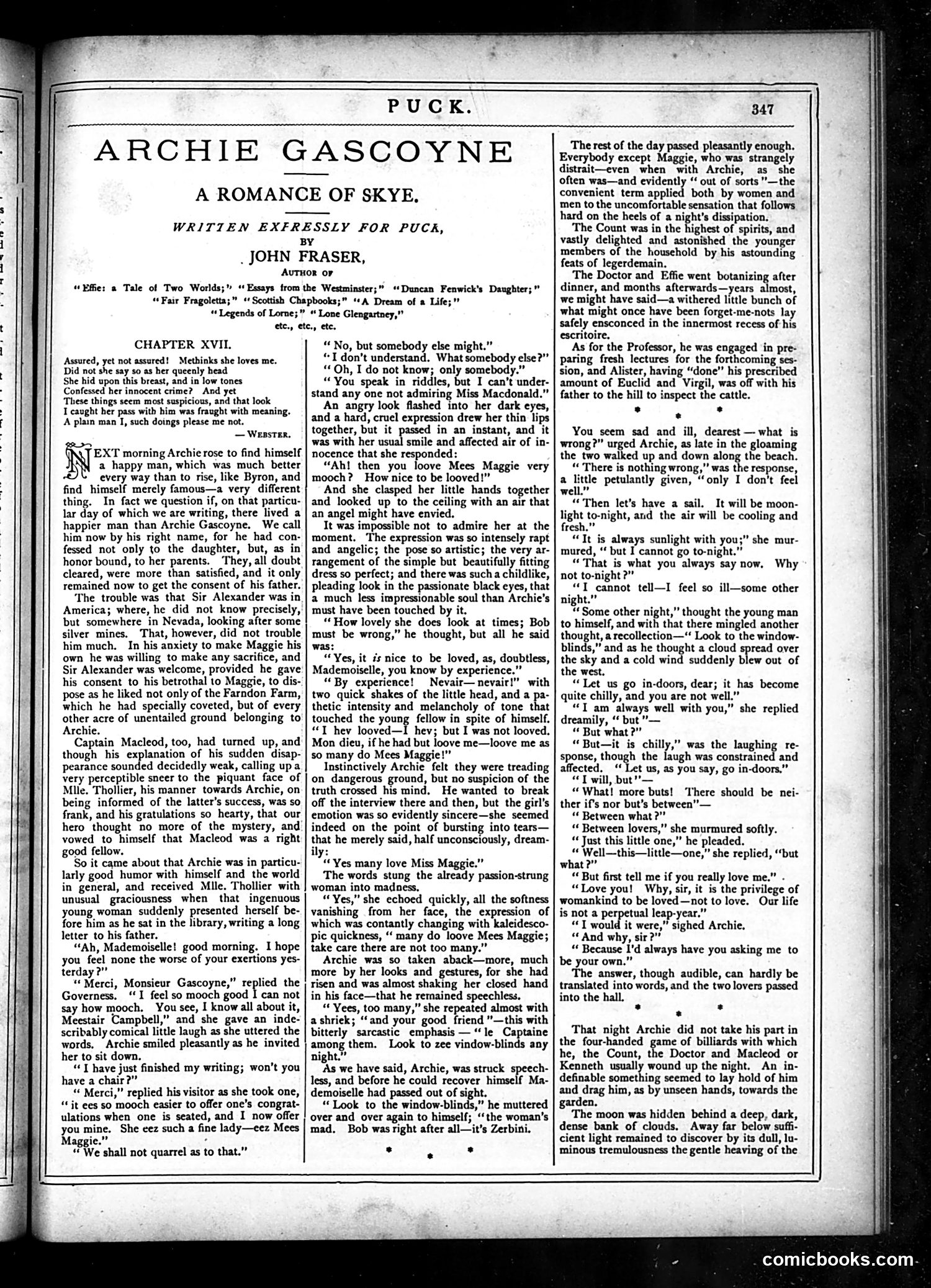
This page contains **fiction, not political satire**. It's Chapter XVII of "Archie Gascoyne: A Romance of Skye," a serialized romantic story by John Fraser written expressly for Puck magazine. The narrative follows Archie's romantic entanglements, particularly involving Miss Macdonald and another woman named Maggie. The text depicts internal conflict—Archie struggles with his feelings while Captain Macleod observes the emotional turmoil. There's dialogue about love, duty, and social obligation typical of Victorian-era romantic fiction. This represents Puck's diversified content strategy: while famous for political satire, the magazine also published serialized fiction to attract broader readership. No political figures or contemporary events appear to be referenced on this particular page.
📄 Transcribed text from this page (OCR, searchable)
Machine-transcribed from the original scan — historical spelling and the odd misread are preserved.
PUCK. 347 ARCHIE GASCOYNE A ROMANCE OF SKYE, WRITTEN EXFRESSLY FOR PUCK, BY . JOHN FRASER, AuTHor oF “Effie: a Tale of Two Worlds; «Essays from the Westminster;" “Duncan Fenwick's Daughter; " «Fair Fragoletta;” «Scottish Chapbooks;" “A Dream of a Lifes!” (© Legends of Lornes? Lone Glengartney,” etc., ete., ete, CHAPTER XVII. Assured, yet not assured! Methinks she loves me. Did not'she say so as her queenly head She hid upon this breast, and in low tones Confessed her innocent crime? And yet These things seem most suspicious, and that look I caught her pass with him was fraught with meaning. A plain man I, such doings please me not. — Wester. EXT morning Archie rose to find himself a happy man, which was much better every way than to rise, like Byron, and find himself merely famous—a very different thing. In fact we question if, on that particu- lar day of which we are writing, there lived a happier man than Archie Gascoyne. We call him now by his right name, for he had con- fessed not only to the daughter, but, as in honor bound, to her parents. They, all doubt cleared, were more than satisfied, and it only remained now to get the consent of his father. ‘The trouble was that Sir Alexander was in. America; where, he did not know precisely, but somewhere in Nevada, looking after some silver mines. That, however, did not trouble him much. In his anxiety to make Maggie his own he was willing to make any sacrifice, and Sir Alexander was welcome, provided he gave his consent to his betrothal to Maggie, to dis- pose as he liked not only of the Farndon Farm, which he had specially coveted, but of every other acre of unentailed ground belonging to Archie. Captain Macleod, too, had turned up, and though his explanation of his sudden disap- pearance sounded decidedly weak, calling up a very perceptible sneer to the piquant face of Mlle. Thollier, his manner towards Archie, on being informed of the latter’s success, was so frank, and his gratulations so hearty, that our hero thought no more of the mystery, and vowed to himself that Macleod was a right good fellow. So it came about that Archie was in particu- larly good humor with himself and the world in general, and received Mlle. Thollier with unusual graciousness when that ingenuous young woman suddenly presented herself be- fore him as he sat in the library, writing a long letter to his father. “Ah, Mademoiselle! good morning. I hope you feel none the worse of your exertions yes- terday ?” “Merci, Monsieur Gascoyne,” replied the Governess. ‘I feel so mooch good I can not say how mooch. You see, I know all about it, Meestair Campbell,” and she gave an inde- scribably comical little laugh as she uttered the words, Archie smiled pleasantly as he invited her to sit down. “1 have just finished my writing; won’t you have a chair?” “ Merci,” replied his visitor as she took one, “it ees so mooch easier to offer one’s congrat- ulations when one is seated, and I now offer ine. She eez such a fine lady—eez Mees Maggie.” 5 “We shall not quarrel as to that.”” “No, but somebody else might.” “I don’t understand. What somebody else?” “Oh, I do not know; only somebody.” “You speak in riddles, but I can’t under- stand any one not admiring Miss Macdonald.” An angry look flashed into her dark eyes, and a hard, cruel expression drew her thin lips together, but it passed in an instant, and it was with her usual smile and affected air of in- nocence that she responded: “Ah! then you loove Mees Maggie very mooch? How nice to be looved!” And she clasped her little hands together and looked up to the ceiling with an air that an angel might have envied. It was impossible not to admire her at the moment. The expression was so intensely rapt and angelic; the pose so artistic; the very ar- rangement of the simple but beautifully fitting dress so perfect; and there was sucha childlike, pleading look in the passionate black eyes, that a much less impressionable soul than Archie’s must have been touched by it. ‘How lovely she does look at times; Bob must be wrong,” he thought, but all he said was: “Yes, it is nice to be loved, as, doubtless, Mademoiselle, you know by experienc: “By experience! Nevair—nevair!” with two quick shakes of the little head, and a pa: thetic intensity and melancholy of tone that touched the young fellow in spite of himself. “I hev looved—I hev; but I was not looved. Mon dieu, if he had but loove me—loove me as so many do Mces Maggie!” Instinctively Archie felt they were treading on dangerous ground, but no suspicion of the truth crossed his mind. He wanted to break off the interview there and then, but the girl's emotion was so evidently sincere—she seemed indeed on the point of bursting into tears— that he merely said, half unconsciously, dream- ily: “Yes many love Miss Maggie." The words stung the already passion-strung woman into madness, “Yes,” she echoed quickly, all the softness vanishing from her face, the expression of which was contantly changing with kaleidesco- pic quickness, “‘ many do loove Mees Maggie; take care there are not too many.” Archie was so taken aback—more, much more by her looks and gestures, for she had risen and was almost shaking her closed hand in his face—that he remained speechless. “ Yees, too many,” she repeated almost with a shriek; ‘‘and your good friend "—this with bitterly sarcastic emphasis —‘‘le Captaine among them. Look to zee vindow-blinds any night.” As we have said, Archie, was struck speech- less, and before he could recover himself Ma- demoiselle had passed out of sight. “Look to the window-blinds,” he muttered over and over again to himself; ‘‘the woman's mad. Bob was right after all—it’s Zerbini. The rest of the day passed pleasantly enough. Everybody except Maggie, Shore "erangely distrait—even when with Archie, as she often was—and evidently ‘‘ out of sorts "—the convenient term applied both by women and men to the uncomfortable sensation that follows hard on the heels of a night's dissipation. The Count was in the fighest of spirits, and vastly delighted and astonished the younger members of the household by his astounding feats of legerdemain. The Doctor and Effie went botanizing after dinner, and months afterwards—years almost, we might have said—a withered little bunch of what might once have been forget-me-nots lay safely ensconced in the innermost recess of his escritoire, As for the Professor, he was engaged in pre- paring fresh lectures for the forthcoming ses- sion, and Alister, having “done” his prescribed amount of Euclid and Virgil, was off with his father to the hill to inspect the cattle. . * * You seem sad and ill, dearest — what is wrong?” urged Archie, as late in the gloaming the two walked up and down along the beach. « There is nothing wrong,” was the response, a little petulantly given, “only I don't feel well.” “Then let’s have a sail. It will be moon- light to-night, and the air will be cooling and fresh.” “Tt is always sunlight with you; she mur- mured, “ but I cannot go to-night.” “That is what you always say now, Why not to-night ?” “TI cannot tell—I feel so ill—some other night.” “Some other night,” thought the young man to himself, and with that there mingled another thought, a recollection—“ Look to the window- blinds,” and as he thought a cloud spread over the sky and a cold wind suddenly blew out of the west, “Let us go in-doors, dear; it has become quite chilly, and you are not well.” “T am always well with you,” she replied dreamily, “ but "— “ But what ?” “But—it is chilly,” was the laughing re- sponse, though the laugh was constrained and affected, “Let us, as you say, go in-doors.”” “T will, but” — “What! more buts! There should be nei- ther ifs nor but’s between” — “ Between what?” “« Between lovers,” she murmured softly. “Just this little one,” he pleaded. “ Well—this—little—one,” she replied, “but what?” “ But first tell me if you really love me.” . “Love you! Why, sir, it is the privilege of womankind to be loved—not to love. Our life is not a perpetual leap-year.”” “I would it were,” sighed Archie, “And why, sir?” “ Because I'd always have you asking me to be your own.” The answer, though audible, can hardly be translated into words, and the two lovers passed into the hall. * * * That night Archie did not take his part in the four-handed game of billiards with which he, the Count, the Doctor and Macleod or Kenneth usually wound up the night. An in- definable something seemed to lay hold of him and drag him, as by unseen hands, towards the garden. The moon was hidden behind a deep, dark, dense bank of clouds. Away far below suffi- cient light remained to discover by its dull, lu- minous tremulousness the gentle heaving of the comicbooks.com.