
Puck, 1879-08-06 · page 4 of 16
Puck — August 6, 1879 — page 4: what you’re looking at
What you’re looking at
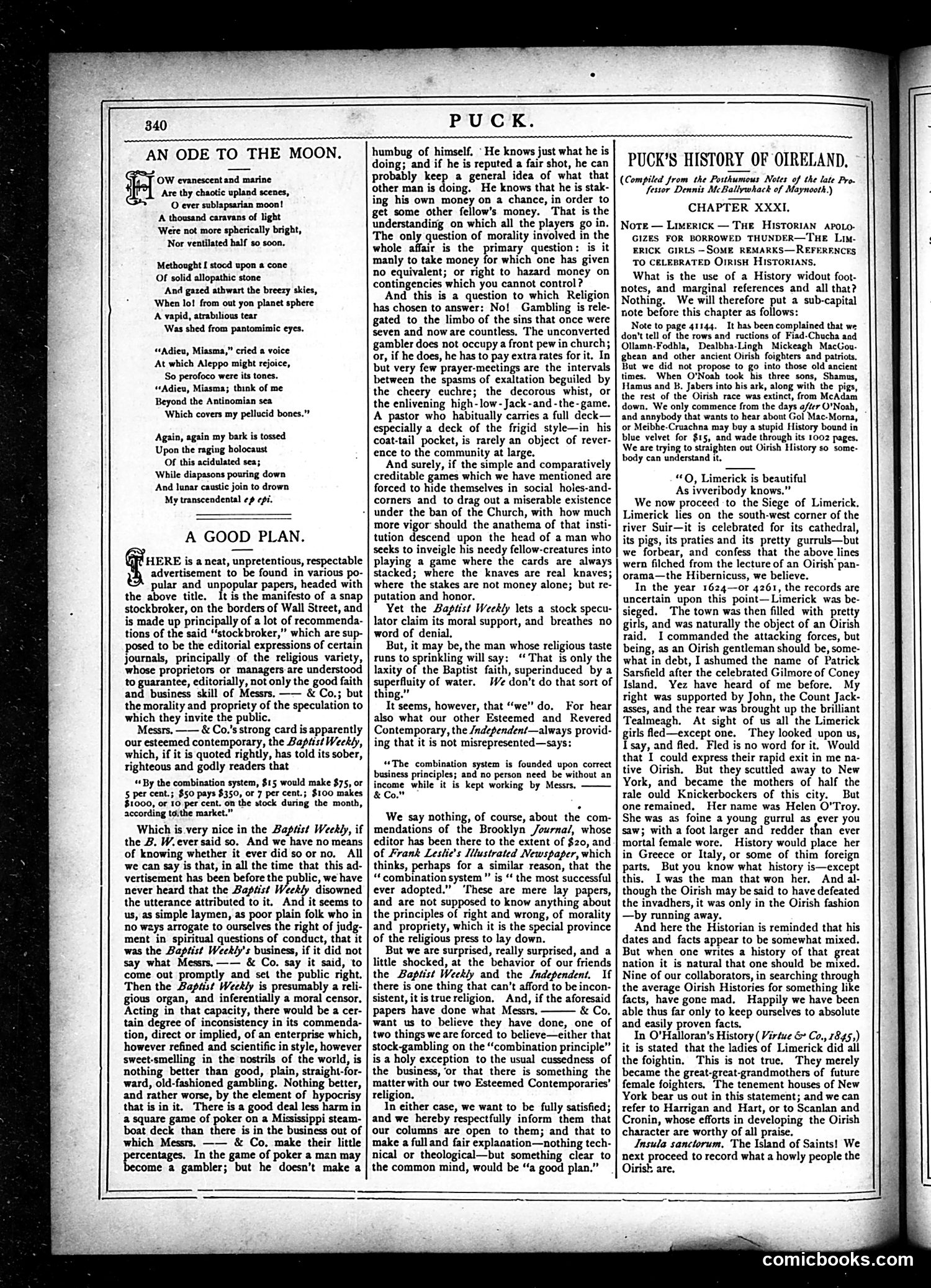
This page contains three distinct pieces: **"An Ode to the Moon"** (a romantic poem), **"A Good Plan"** (an editorial essay), and **"Puck's History of Oireland"** (a satirical history section). The main satirical content targets Irish identity and stereotypes. "Puck's History of Oireland" uses intentional misspelling ("Oireland") to mock Irish dialect and appears to chronicle Irish historical figures and characteristics. The editorial "A Good Plan" critiques religious hypocrisy—specifically how gambling and morality intersect in religious communities, suggesting that religious institutions don't adequately address gambling's moral problems while maintaining strict doctrinal positions. The overall tone reflects 19th-century satirical magazine conventions: irreverent toward institutions, ethnic caricature, and moral commentary disguised as humor.
📄 Transcribed text from this page (OCR, searchable)
Machine-transcribed from the original scan — historical spelling and the odd misread are preserved.
PUCK. AN ODE TO THE MOON. OW evanescent and marine ‘Are thy chaotic upland scenes, O ever sublapsarian moon! ‘A thousand caravans of light Were not more spherically bright, Nor ventilated half s0 soon. Methought f stocd upon a cone Of solid allopathic stone ‘And gazed athwart the breezy skies, When lo! from out yon planet sphere A vapid, atrabilious tear Was shed from pantomimic eyes. “Adieu, Miasma,” cried a voice At which Aleppo might rejoice, So perofoco were its tones. “Adieu, Miasma; think of me Beyond the Antinomian sea Which covers my pellucid bones.”” Again, again my bark is tossed Upon the raging holocaust Of this acidulated seas While diapasons pouring down ‘And lunar caustic join to drown My transcendental ep efi. humbug of himself. ‘He knows just what he is doing; and if he is reputed a fair shot, he can probably keep a general idea of what that other man is doing. He knows that he is stak- ing his own money on a chance, in order to get some other fellow's money. That is the understanding on which all the players go in. The only question of morality involved in the whole affair is the primary question: is it manly to take money for which one has given no equivalent; or right to hazard money on contingencies which you cannot control? And this is a question to which Religion has chosen to answer: No! Gambling is rele- gated to the limbo of the sins that once were seven and now are countless. The unconverted gambler does not occupy a front pew in church; or, if he does, he has to pay extra rates for it. In but very few prayer-meetings are the intervals between the spasms of exaltation beguiled by the cheery euchre; the decorous whist, or the enlivening high-low-Jack-and-the-game. A pastor who habitually carries a full deck— especially a deck of the frigid style—in his coat-tail pocket, is rarely an object of rever- ence to the community at large. And surely, if the simple and comparatively creditable games which we have mentioned are forced to hide themselves in social holes-and- corners and to drag out a miserable existence -| under the ban of the Church, with how much A GOOD PLAN. HERE is a neat, unpretentious, respectable advertisement to be found in various po- ular and unpopular papers, headed with the ve title. It is the manifesto of a snap stockbroker, on the borders of Wall Street, and is made up principally of a lot of recommenda- tions of the said “stockbroker,” which are sup- posed to be the editorial expressions of certain journals, principally of the religious variety, whose proprietors or managers are understood to guarantee, editorially, not only the good faith and business skill of Messrs. —— & Co,; but the morality and propriety of the speculation to which they invite the public. Messrs, —— & Co.’s strong card is apparently our esteemed contemporary, the Baptist Weekly, which, if it is quoted rightly, has told its sober, righteous and godly readers that «By the combination system, $15 would make $75, or 5 per cent.; $50 pays $350, or 7 per cent.; $100 makes $1000, or 10 per cent. on the stock during the month, according tdithe market.” Which is very nice in the Baptist Weekly, if the B. W.ever said so. And we have no means of knowing whether it ever did soorno. All we can say is that, in all the time that this ad- vertisement has been before the public, we have never heard that the Baptist Weekly disowned the utterance attributed to it. And it seems to us, as simple laymen, as poor plain folk who in No ways arrogate to ourselves the right of judg- ment in spiritual questions of conduct, that it was the Baptist Weekly's business, if it did not say what Messrs, —— & Co. say it said, to come out promptly and set the public right. Then the Baptist Weekly is presumably a reli- gious organ, and inferentially a moral censor. Acting in that capacity, there would be a cer- tain degree of inconsistency in its commenda- tion, direct or implied, of an enterprise which, however refined and scientific in style, however sweet-smelling in the nostrils of the world, is nothing better than good, plain, straight-for- ward, old-fashioned gambling. Nothing better, and rather worse, by the element of hypocrisy that isin it. There is a good deal less harm in a square game of poker on a Mississippi steam- boat deck than there is in the business out of which Messrs, —— & Co, make their little Posen: In the game of poker a man may me a gambler; but he doesn’t make a more vigor should the anathema of that insti- tution descend upon the head of a man who seeks to inveigle his needy fellow-creatures into playing a game where the cards are always stacked; where the knaves are real knaves; where the stakes are not money alone; but re- putation and honor. Yet the Baptist Weekly lets a stock specu- lator claim its moral support, and breathes no word of denial. But, it may be, the man whose religious taste runs to sprinkling will say: ‘‘ That is only the laxity of the Baptist faith, superinduced by a superfluity of water. We don't do that sort of thing.” It seems, however, that “we do. For hear also what our other Esteemed and Revered Contemporary, the /ndependent—always provid- ing that it is not misrepresented—says: “The combination system is founded upon correct business principles; and no person need be without an income while it is kept working by Messrs. & Co.” We say nothing, of course, about the com- mendations of the Brooklyn Journa/, whose editor has been there to the extent of $20, and of Frank Leslie's Illustrated Newspaper, which thinks, perhaps for a similar reason, that the “combination system ” is ‘‘ the most successful ever adopted.” ‘These are mere lay papers, and are not supposed to know anything about the principles of right and wrong, of morality and propriety, which it is the special province of the religious press to lay down. But we are surprised, really surprised, and a little shocked, at the behavior of our friends the Baptist Weekly and the Independent. If there is one thing that can’t afford to be incon- sistent, it is true religion, And, if the aforesaid papers have done what Messrs. & Co, want us to believe they have done, one of two things we are forced to believe—either that stock-gambling on the “combination principle” is a holy exception to the usual cussedness of the business, ‘or that there is something the matter with our two Esteemed Contemporaries’ religion, In either case, we want to be fully satisfied; and we hereby respectfully inform them that our columns are open to them; and that to make a fulland fair explanation—nothing tech- nical or theological—but something clear to the common mind, would be “a good plan.” PUCK'S HISTORY OF OIRELAND. (Compiled from the Posthumous Notes of the late Pro. fessor Dennis McBallywhack of Maynooth.) CHAPTER XXXI. Note — Liwerick — THe Historian Apoto- GIZES FOR BORROWED THUNDER—THE Lim- ERICK GIRLS —SOME REMARKS—REFERENCES TO CELEBRATED O1risH HisToRIANs. What is the use of a History widout foot- notes, and marginal references and all that? Nothing. We will therefore put a sub-capital note before this chapter as follows: Note to page 41144. It has been complained that we don’t tell of the rows and ructions of Fiad-Chucha and Ollamn-Fodhla, Dealbha-Lingh Mickeagh MacGou- ghean and other ancient Oirish foighters and patriots. But we did not propose to go into those old ancient times. When O'Noah took his three sons, Shamus, Hamus and B. Jabers into his ark, along with the pigs, the rest of the Oirish race was extinct, from McAdam down, We only commence from the days after O'Noah, and annybody that wants to hear about Gol Mac-Morma, or Meibhe-Cruachna may buy a stupid History bound in blue velvet for $15, and wade through its 1002 pages. We are trying to straighten out irish History so some- body can understand it. “<Q, Limerick is beautiful As ivveribody knows.” We now proceed to the Siege of Limerick. Limerick lies on the south-west corner of the river Suir—it is celebrated for its cathedral, its pigs, its praties and its pretty gurruls—but we forbear, and confess that the above lines wern filched from the lecture of an Oirish’ pan- orama—the Hibernicuss, we believe. In the year 1624—or 4261, the records are uncertain upon this point—Limerick was be- sieged. The town was then filled with pretty girls, and was naturally the object of an Oirish raid. I commanded the attacking forces, but being, as an Oirish gentleman should be, some- what in debt, I ashumed the name of Patrick Sarsfield after the celebrated Gilmore of Coney Island. Yez have heard of me before. My right was supported by John, the Count Jack- asses, and the rear was brought up the brilliant Tealmeagh. At sight of us all the Limerick girls fled—except one. They looked upon us, Isay, and fled. Fled is no word for it. Would that I could express their rapid exit in me na- tive Oirish. But they scuttled away to New York, and became the mothers of half the rale ould Knickerbockers of this city. But one remained, Her name was Helen O’Troy. She was as foine a young gurrul as ever you saw; with a foot larger and redder than ever mortal female wore. History would place her in Greece or Italy, or some of thim foreign parts, But you know what history is—except this. Iwas the man that won her. And al- though the Oirish may be said to have defeated the invadhers, it was only in the Oirish fashion —by running away. And here the Historian is reminded that his dates and facts appear to be somewhat mixed. But when one writes a history of that great nation it is natural that one should be mixed. Nine of our collaborators, in searching through the average Oirish Histories for something like facts, have gone mad. Happily we have been able thus far only to keep ourselves to absolute and easily proven facts. In O'Halloran’s History ( Virtue & Co., 1845,) it is stated that the ladies of Limerick did all the foightin. This is not true. They merely became the great-great-grandmothers of future female foighters, The tenement houses of New York bear us out in this statement; and we can refer to Harrigan and Hart, or to Scanlan and Cronin, whose efforts in developing the Oirish character are worthy of all praise. Jnsula sanclorum, The Island of Saints! We next proceed to record what a howly people the Oirish are, comicbooks.com