
Puck, 1879-08-06 · page 2 of 16
Puck — August 6, 1879 — page 2: what you’re looking at
What you’re looking at
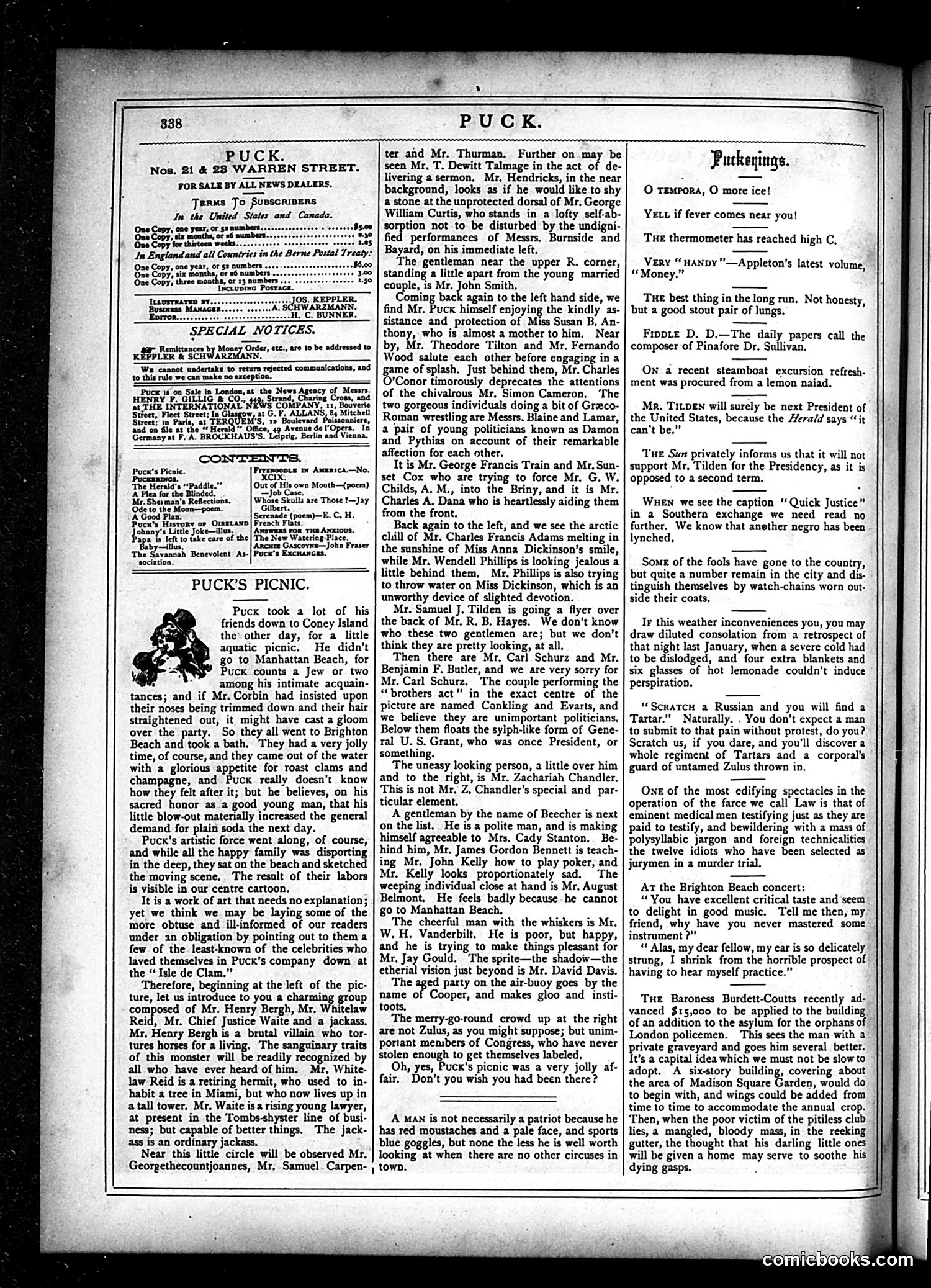
This page consists primarily of **text content rather than political cartoons**. The main feature is "Puck's Picnic," a humorous narrative describing a social outing to Coney Island where various recognizable public figures are observed and satirized. The text mocks attendees including politicians and social figures, commenting on their appearances, behaviors, and relationships. References include criticisms of individuals' physical features, romantic entanglements, and perceived pretensions. A small illustration shows Puck (the magazine's mascot) at the picnic. The satire employs the typical Puck approach: social observation and gentle mockery of prominent New Yorkers' vanities and foibles, rather than sharp political attack. The right column contains brief satirical items called "Puckerings"—short, pithy social commentaries on current events and personalities.
📄 Transcribed text from this page (OCR, searchable)
Machine-transcribed from the original scan — historical spelling and the odd misread are preserved.
PUCK. PUCK. Nos. 21 & 28 WARREN STREET. FOR SALE BY ALL NEWS DEALERS. Terms Jo SUBSCRIBERS In the United States and Canada. pata es some See or eee & a Sor mae eas eeclee ay OS. KEPPLER. ‘HWARZI : Ea i. C, BUNNER. SPECIAL NOTICES. Remittances by Mc ‘Order, etc., are to be addressed to KEPPLER & SCHWARZMANN. ‘We cannot undertake to retura rejected communications, and to this rule we can make 00 exception. ale in Londoo,at the News of Messrs, af Ri StaRe, Gravee, Crgs, and 3 COMPAR a hell Bou ‘Ofice, 49 Avenue del'Opera. In fSpdg: Bevis and Vieanae Fryzwogoce mr Anenict.—No. (Oat of His own Mouth—{poem) —Job Case. Whose Skulls are Those !—Jay Gilbert. ‘Serenade (poem)—E. C. H. ‘The Herald's “Paddle.” A Plea for the Blinded, ‘Mr. Shei man’s Reflections. Ode to the Moon—poem. A Good Plan. Puck's History o Omstanp| French Flats. obany’s Little Joke—illus.. | Axswans rom roe Avxiovs. ‘apa ts left to take care of the | The New Watering-Place. by —illus, | Ancure Gascovxe—Joho Fraser ‘The Savannah Benevolent As-| Puck's Excnances, sociation. PUCK’S PICNIC. Puck took a lot of his friends down to Coney Island the’ other day, for a little aquatic picnic. He didn’t go to Manhattan Beach, for Puck counts a Jew or two re ; among his intimate acquain- tances; and if Mr. Corbin had insisted upon their noses being trimmed down and their hair straightened out, it might have cast a gloom over the party. So they all went to Brighton Beach and took abath. They had a very jolly time, of course, and they came out of the water with a glorious appetite for roast clams and champagne, and Puck really doesn’t know how they felt after it; but he believes, on his sacred honor as a good young man, that his little blow-out materially increased the general demand for plain soda the next day. Puck's artistic force went along, of course, and while all the happy family was disportin, in the deep, they sat on the beach and sketch the moving scene. The result of their labors is visible in our centre cartoon. It is a work of art that needs no explanation; yet we think we may be laying some of the more obtuse and ill-informed of our readers under an obligation by pointing out to them a few of the least-known of the celebrities who laved themselves in Puck’s company down at the ‘Isle de Clam.’ Therefore, beginning at the left of the pic- ture, let us introduce to you a charming group com) of Mr. Henry Bergh, Mr. Whitelaw Reid, Mr. Chief Justice Waite and a jackass, Mr. Henry Bergh is a brutal villain who tor- tures horses for a living. The sanguinary traits of this monster will be readily recognized by all who have ever heard of him. Mr, White- law Reid is a retiring hermit, who used to in- habit a tree in Miami, but who now lives up in atall tower. Mr. Waite isa rising young lawyer, at present in the Tombs-shyster line of busi- ness; but capable of better things. The jack- ass is an ordinary jackass, Near this little circle will be observed Mr. Georgethecountjoannes, Mr. Samuel. Carpen- ter and Mr. Thurman. Further on may be seen Mr. T. Dewitt Talmage in the act of de- livering a sermon, Mr. Hendricks, in the near background, looks as if he would like to shy a stone at the unprotected dorsal of Mr. George William Curtis, who stands in a lofty self-ab- porpticn not to be disturbed by the undigni- fied performances of Messrs, Burnside and Bayard, on his immediate left. The gentleman near the upper R. corner, standing a little apart from the young married couple, is Mr. John Smith, Coming back again to the left hand side, we find Mr. Puck himself enjoying the kindly as- sistance and protection of Miss Susan B. An- thony, who is almost a mother to him. Near by, Mr. Theodore Tilton and Mr. Fernando Wood salute each other before engaging ina game of splash. Just behind them, Mr. Charles O'Conor timorously deprecates the attentions of the chivalrous Mr, Simon Cameron. ‘The two gorgeous individuals doing a bit of Greco- Roman wrestling are Messrs. Blaine and Lamar, a pair of young politicians known as Damon and Pythias on account of their remarkable affection for each other. It is Mr. George Francis Train and Mr. Sun- set Cox who are trying to force Mr. G. W. Childs, A. M., into the Briny, and it is Mr. Charles A. Dana who is heartlessly aiding them from the front. Back again to the left, and we see the arctic chill of Mr. Charles Francis Adams melting in the sunshine of Miss Anna Dickinson's smile, while Mr, Wendell Phillips is looking jealous a little behind them. Mr, Phillips is also trying to throw water on Miss Dickinson, which is an unworthy device of slighted devotion. Mr. Samuel J. Tilden is going a flyer over the back of Mr. R. B, Hayes. We don’t know who these two gentlemen are; but we don’t think they are pretty looking, at all. Then there are Mr. Carl Schurz and Mr, Benjamin F, Butler, and we are very sorry for Mr. Carl Schurz. ‘The couple performing the “brothers act” in the exact centre of the picture are named Conkling and Evarts, and we believe they are unimportant politicians. Below them floats the sylph-like form of Gene- ral U.S. Grant, who was once President, or something. The uneasy looking person, a little over him and to the right, is Mr. Zachariah Chandler. This is not Mr. Z, Chandler's special and par- ticular element. A gentleman by the name of Beecher is next on the list. He is a polite man, and is making himself agreeable to Mrs. Cady Stanton. Be- hind him, Mr, James Gordon Bennett is teach- ing Mr. John Kelly how to play poker, and Mr. Kelly looks proportionately sad. The weeping individual close at hand is Mr. August Belmont. He feels badly because he cannot go to Manhattan Beach, The cheerful man with the whiskers is Mr. W.H. Vanderbilt, He is poor, but happy, and he is trying to make things pleasant for Mr. Jay Gould. The sprite—the shadow—the etherial vision just beyond is Mr. David Davis, The aged party on the air-buoy goes by the name of Cooper, and makes gloo and insti- toots, The merry-go-round crowd up at the right are not Zulus, as you might suppose; but unim- portant members of Congress, who have never stolen enough to get themselves labeled. Oh, yes, Puck's picnic was a very jolly af- fair. Don’t you wish you had been there? A man is not necessarily a patriot because he has red moustaches and a pale face, and sports blue goggles, but none the less he is well worth looking at when there are no other circuses in ; town. Puckenings. O respora, O more ice! Yext if fever comes near you! Tue thermometer has reached high C, Very “HANDY"—Appleton’s latest volume, “Money.” ‘Tue best thing in the long run. Not honesty, but a good stout pair of lungs. Fippte D. D.—The daily papers call the composer of Pinafore Dr. Sullivan, On a recent steamboat excursion refresh- ment was procured from a lemon naiad. Mr. TILDEN will surely be next President of the United States, because the Herald says ‘it can't be.” ‘Tue Sun privately informs us that it will not support Mr. Tilden for the Presidency, as it is opposed to a second term. WueEn we see the caption “Quick Justice” in a Southern exchange we need read no further. We know that another negro has been lynched. Sot of the fools have gone to the country, but quite a number remain in the city and dis- tinguish themselves by watch-chains worn out- side their coats. Ir this weather inconveniences you, you may draw diluted consolation from a retrospect of that night last January, when a severe cold had to be dislodged, and four extra blankets and six glasses of hot lemonade couldn't induce perspiration. “Scratcu a Russian and you will find a Tartar.” Naturally, . You don’t expect a man to submit to that pain without protest, do you? Scratch us, if you dare, and you'll discover a whole regiment of Tartars and a corporal’s guard of untamed Zulus thrown in. One of the most edifying spectacles in the operation of the farce we call Law is that of eminent medical men testifying just as they are paid to testify, and bewildering with a mass of polysyllabic jargon and foreign technicalities the twelve idiots who have been selected as jurymen in a murder trial. Ar the Brighton Beach concert: “You have excellent critical taste and seem to delight in good music. Tell me then, my. friend, why have you never mastered some instrument ?” “ Alas, my dear fellow, my ear is so delicately strung, I shrink from the horrible prospect of having to hear myself practice.” Tue Baroness Burdett-Coutts recently ad- vanced $15,000 to be applied to the building of an addition to the asylum for the orphans of London policemen. This sees the man with a rivate graveyard and goes him several better. {t's a capital idea which we must not be slow to adopt. A six-story building, covering about the area of Madison Square Garden, would do to begin with, and wings could be added from time to time to accommodate the annual crop. © Then, when the poor victim of the pitiless club lies, 2 mangled, bloody mass, in the reeking gutter, the thought that his darling little ones will be given a home may serve to soothe his }f/ dying gasps. E