
Puck, 1879-08-06 · page 3 of 16
Puck — August 6, 1879 — page 3: what you’re looking at
What you’re looking at
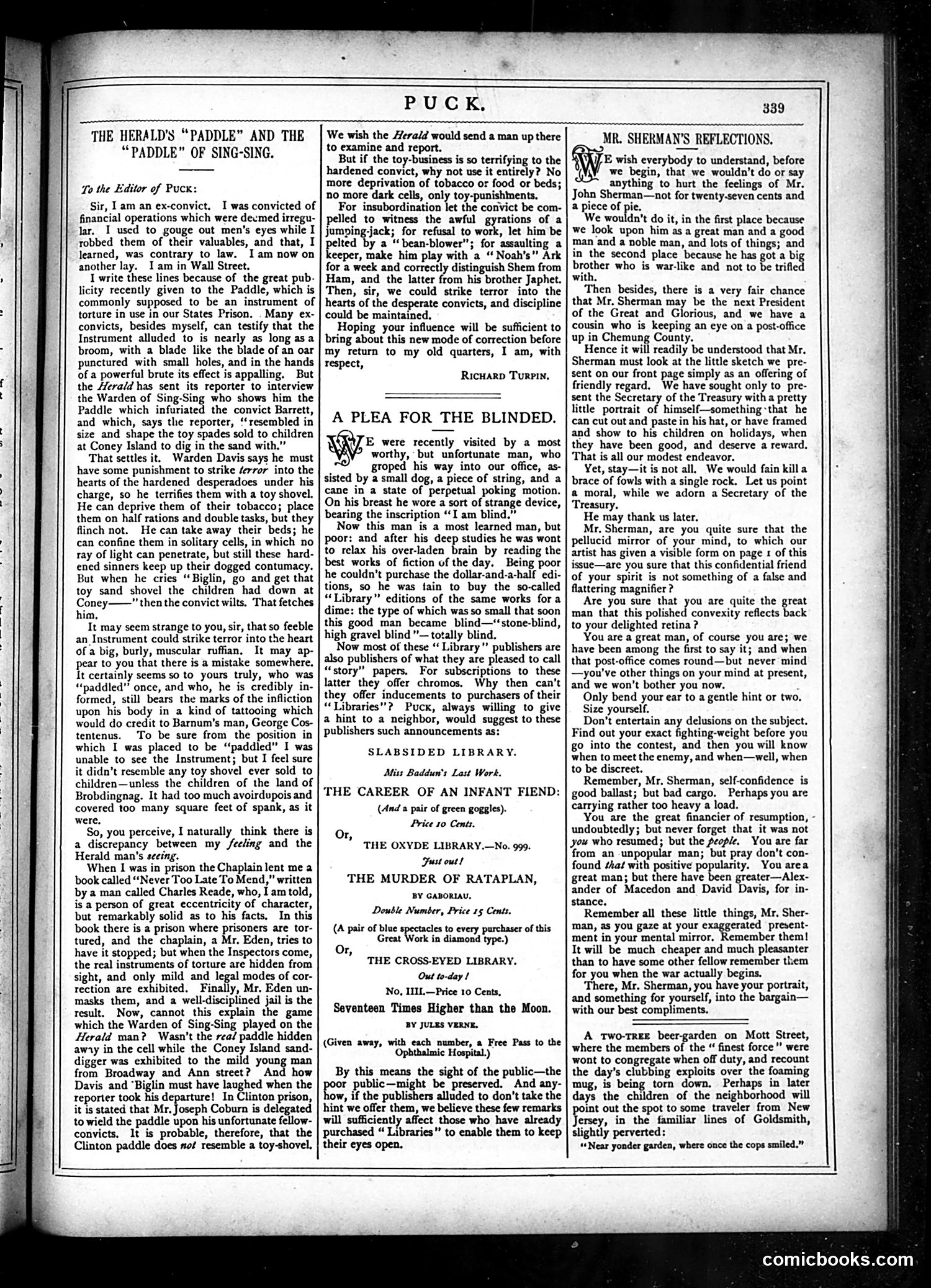
This page contains letters to the editor rather than cartoons. The content addresses prison conditions and reform: **"The Herald's 'Paddle' and the 'Paddle' of Sing-Sing"**: An ex-convict named Richard Turpin criticizes the use of corporal punishment ("paddling") in Sing-Sing Prison. He argues this brutal discipline contradicts claims of rehabilitation and compares it unfavorably to newspaper-style punishment. **"A Plea for the Blinded"**: A blind man describes visiting Puck's office, highlighting that cheap "Libraries" (serialized fiction sold cheaply) are making literature accessible to poor people who couldn't otherwise afford books. The page appears primarily concerned with social commentary on prison reform and literacy access for working-class readers—both progressive concerns of the era.
📄 Transcribed text from this page (OCR, searchable)
Machine-transcribed from the original scan — historical spelling and the odd misread are preserved.
PUCK, 339 THE HERALD'S “PADDLE” AND THE “PADDLE” OF SING-SING. Lo the Editor of Puck: Sir, 1am an ex-convict. I was convicted of financial operations which were decmed irregu- lar. I used to gouge out men’s eyes while I robbed them of their valuables, and that, I learned, was contrary to law. Iam now on another lay. I am in Wall Street. I write these lines because of the great pub- licity recently given to the Paddle, which is commonly supposed to be an instrument of torture in use in our States Prison. . Many ex- convicts, besides myself, can testify that the Instrument alluded to is nearly as long asa broom, with a blade like the blade of an oar punctured with small holes, and in the hands of a powerful brute its effect is appalling. But the Hera/d has sent its reporter to interview the Warden of Sing-Sing who shows him the Paddle which infuriated the convict Barrett, and which, says the reporter, ‘resembled in size and shape the toy spades sold to children at Coney Island to dig in the sand with.” That settles it. Warden Davis says he must have some punishment to strike ferror into the hearts of the hardened desperadoes under his charge, so he terrifies them with a toy shovel. He can deprive them of their tobacco; place them on half rations and double tasks, but they flinch not. He can take away their beds; he can confine them in solitary cells, in which no ray of light can penetrate, but still these hard- ened sinners keep up their dogged contumacy. But when he cries “Biglin, go and get that toy sand shovel the children had down at Coney——” then the convict wilts. That fetches him. It may seem strange to you, sir, that so feeble an Instrument could strike terror into the heart ofa big, burly, muscular roffian, It may ap- pear to you that there is a mistake somewhere, It certainly seems so to yours truly, who was “paddled” once, and who, he is credibly in- formed, still bears the marks of the infliction upon his body in a kind of tattooing which would do credit to Barnum’s man, George Cos- tentenus. To be sure from the position in which I was placed to be “paddled” I was unable to see the Instrument; but I feel sure it didn’t resemble any toy shovel ever sold to children—unless the children of the land of Brobdingnag. It had too much avoirdupois and covered too many square feet of spank, as it were, So, you perceive, I naturally think there is a discrepancy between my feeling and the Herald man's seeing. When I was in prison the Chaplain lent me a book called “Never Too Late To Mend,” written by a man called Charles Reade, who, I am told, is a person of great eccentricity of character, but remarkably solid as to his facts, In this book there is a prison where prisoners are tor- tured, and the chaplain, a Mr. Eden, tries to have it stopped; but when the Inspectors come, the real instruments of torture are hidden from sight, and only mild and legal modes of cor- rection are exhibited. Finally, Mr. Eden un- masks them, and a well-disciplined jail is the result. Now, cannot this explain the game which the Warden of Sing-Sing played on the Herald man? Wasn't the rea/ paddle hidden awry in the cell while the Coney Island sand- digger was exhibited to the mild young man from Broadway and Ann street? And how Davis and “Biglin must have laughed when the reporter took his departure! In Clinton prison, it is stated that Mr. Joseph Coburn is delegated to wield the paddle upon his unfortunate fellow- convicts. It is probable, therefore, that the Clinton paddle does nof resemble a toy-shovel. We wish the Hera/d would send a man up there to examine and report. But if the toy-business is so terrifying to the hardened convict, why not use it entirely? No more deprivation of tobacco or food or beds; no more dark cells, only toy-punishnents, For insubordination let the convict be com- pelled to witness the awful gyrations of a jumping-jack; for refusal to work, let him be pelted by a ‘bean-blower”; for assaulting a keeper, make him play with a “Noah's” Ark for a week and correctly distinguish Shem from Ham, and the latter from his brother Japhet. Then, sir, we could strike terror into the hearts of the desperate convicts, and discipline could be maintained. Hoping your influence will be sufficient to bring about this new mode of correction before my return to my old quarters, I am, with respect, Ricuarp Turpin, A PLEA FOR THE BLINDED. E were recently visited by a most worthy, but unfortunate man, who roped his way into our office, as- sisted by a small dog, a piece of string, and a cane in a state of perpetual poking motion. On his breast he wore a sort of strange device, bearing the inscription “I am blind.” Now this man is a most learned man, but poor: and after his deep studies he was wont to relax his over-laden brain by reading the best works of fiction of the day. Being poor he couldn't purchase the dollar-and-a-half edi- tions, so he was fain to buy the so-called “Library” editions of the same works fora dime: the type of which was so small that soon this good man became blind—‘stone-blind, high gravel blind ”— totally blind. Now most of these “ Library” publishers are also publishers of what they are pleased to call “story” papers. For subscriptions to these latter they offer chromos. Why then can’t they offer inducements to purchasers of their “Libraries”? Puck, always willing to give a hint to a neighbor, would suggest to these publishers such announcements as: SLABSIDED LIBRARY. Afiss Baddun's Last Work. THE CAREER OF AN INFANT FIEND: (And a pair of green goggles). Price 10 Cents, THE OXYDE LIBRARY.—No. 999. Just out! THE MURDER OF RATAPLAN, BY GABORIAU. Double Number, Price 15 Cents, (A pair of blue spectacles to every purchaser of this Great Work in diamond type.) THE CROSS-EYED LIBRARY. Out to-day ! No, IILL.—Price 10 Cents, Seventeen Times Higher than the Moon. BY JULES VERNE, (Given away, with each number, a Free Pass to the Ophthalmic Hospital.) By this means the sight of the public—the pot public—might be preserved. And any- ow, if the publishers alluded to don’t take the hint we offer them, we believe these few remarks will sufficiently affect those who have already purchased “ Libraries” to enable them to keep their eyes open. MR. SHERMAN'S REFLECTIONS. JE wish everybody to understand, before ( we begin, that we wouldn’t do or say anything to hurt the feelings of Mr. John Sherman—not for twenty-seven cents and a piece of pie. We wouldn't do it, in the first place because we look upon him as a great man and a good man and a noble man, and lots of things; and in the second place because he has got a bi; brother who is war-like and not to be trifle with, Then besides, there is a very fair chance that Mr, Sherman may be the next President of the Great and Glorious, and we have a cousin who is keeping an eye on a post-office up in Chemung County. Hence it will readily be understood that Mr. Sherman must look at the little sketch we pre- sent on our front page simply as an offering of friendly regard. We have sought only to pre- sent the Secretary of the Treasury with a pretty little portrait of himself—something-that he can cut out and paste in his hat, or have framed and show to his children on holidays, when they have been good, and deserve a reward. That is all our modest endeavor. Yet, stay—it is not all, We would fain killa brace of fowls with a single rock. Let us point a moral, while we adorn a Secretary of the ‘Treasury. He may thank us later. Mr, Sherman, are you quite sure that the pellucid mirror of your mind, to which our artist has given a visible form on page t of this issue—are you sure that this confidential friend of your spirit is not something of a false and flattering magnifier ? Are you sure that hes are quite the great man that this polished convexity reflects back to your delighted retina? You are a great man, of course you are; we have been among the first to say it; and when that post-office comes round—but never mind —you've other things on your mind at present, and we won't bother you now, Only bend your ear to a gentle hint or two, Size yourself. Don’t entertain any delusions on the subject. Find out your exact fighting-weight before you go into the contest, and then you will know when to meet the enemy, and when—well, when to be discreet. Remember, Mr, Sherman, self-confidence is good ballast; but bad cargo. Perhaps you are carrying rather too heavy a load. You are the great financier of resumption, - undoubtedly; but never forget that it was not you who resumed; but the people. You are far from an unpopular man; but pray don’t con- found that with positive popularity, You area great man; but there have been greater—Alex- ander of Macedon and David Davis, for in- stance. Remember all these little things, Mr. Sher- man, as you gaze at your ¢: erated present- ment in your mental mirror, Remember them! It will be much cheaper and much pleasanter than to have some other fellow remember them for you when the war actually begins, i There, Mr. Sherman, you have your portrait, and something for yourself, into the bargain— with our best compliments. A tTwo-TrEE beer-garden on Mott Street, where the members of the “finest force” were wont to congregate when off duty, and recount the day’s clubbing exploits over the foaming mug, is being torn down. Perhaps in later days the children of the neighborhood will int out the spot to some traveler from New jersey, in the familiar lines of Goldsmith, slightly perverted: “Near yonder garden, where once the cops smiled.” comicbooks.com