
Puck, 1879-08-06 · page 10 of 16
Puck — August 6, 1879 — page 10: what you’re looking at
What you’re looking at
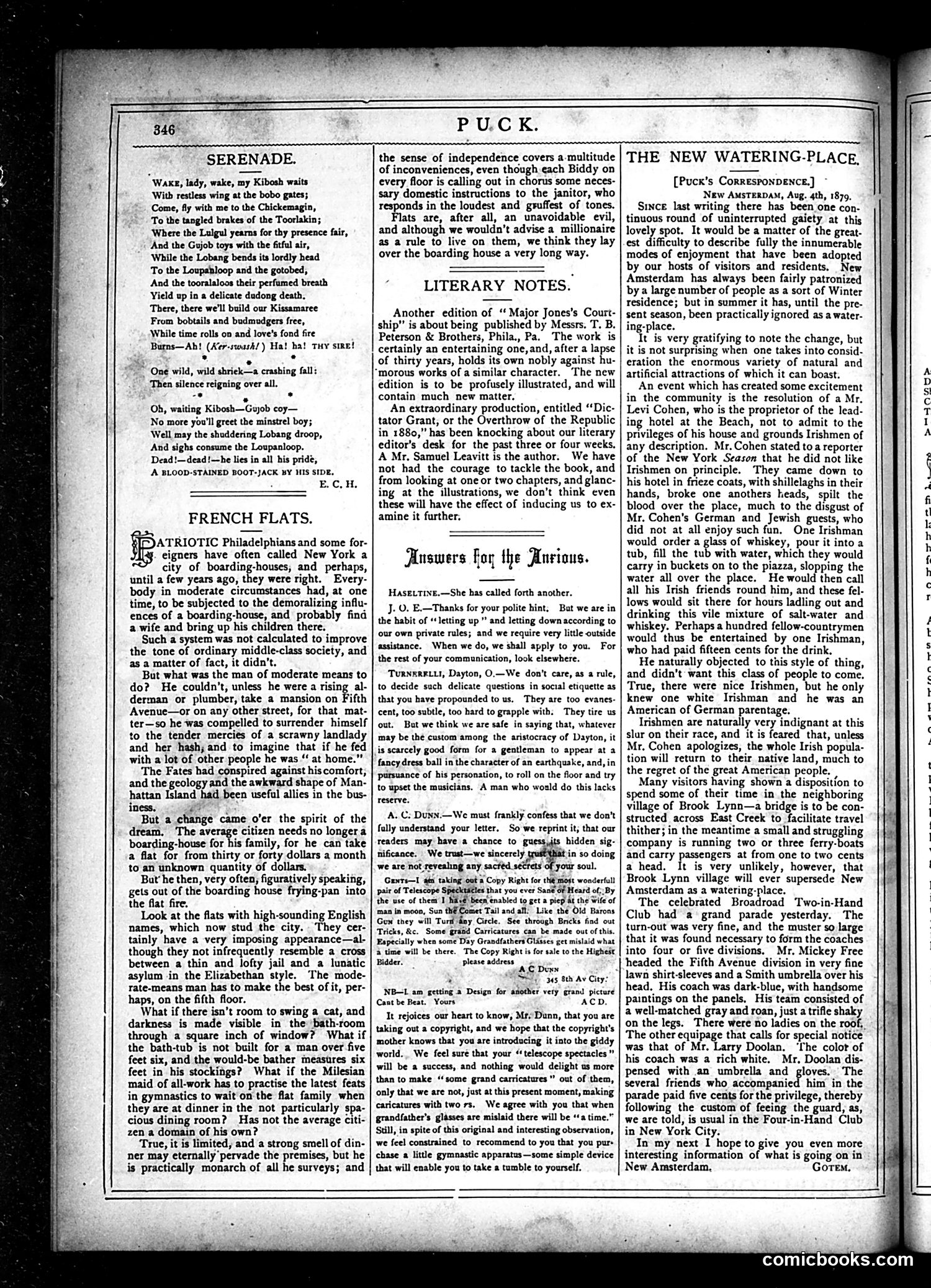
This page contains three sections: a poem titled "Serenade," a "French Flats" cartoon section, and "Literary Notes" with reader correspondence. The "French Flats" section satirizes middle-class Philadelphians renting boarding houses in the city. It mocks the pretentiousness of ordinary people attempting to live like aristocrats in cramped urban quarters, with pointed humor about their awkward attempts at gentility and the practical indignities of flat-dwelling (cats, lack of space, presumptuous neighbors). The "Answers for the Anxious" section provides advice to readers on etiquette questions—addressing concerns about social propriety, dining customs, and proper behavior—reflecting late 19th-century middle-class anxieties about correct conduct. The primary satire targets social aspiration and the gap between middle-class pretense and reality.
📄 Transcribed text from this page (OCR, searchable)
Machine-transcribed from the original scan — historical spelling and the odd misread are preserved.
PU.CK. SERENADE. ‘Waxg, lady, wake, my Kibosh waits With restless wing at the bobo gates; Come, fly with me to the Chickemagin, To the tangled brakes of the Toorlakin; ‘Where the Lulgul yearns for thy presence fair, ‘And the Gujob toys with the fitful air, While the Lobang bends its lordly head To the Loupaloop and the gotobed, ‘And the tooralaloos their perfumed breath Yield up in a delicate dudong death. There, there we'll build our Kissamaree From bobtails and budmudgers free, While time rolls on and love's fond fire Burns—Ab! (Xer-swash/) Ha! ha! THy sine! . . * One wild, wild shriek a crashing fall: ‘Then silence reigning over all. -* * . Oh, waiting Kibosh—Guyob coy— No more you'll greet the minstrel boy; Well may the shuddering Lobang droop, And sighs consume the Loupanloop. Dead!—dead!—he lies in all his pride, A BLOOD-STAINED BOOT-JACK BY HIS SIDE. : E.C.H. FRENCH FLATS. ATRIOTIC Philadelphians and some for- eigners have often called New York a city of boarding Soucy) and perhaps, until a few years ago, they were right. Every- body in moderate circumstances had, at one time, to be subjected to the demoralizing influ- ences of a boarding-house, and probably find a wife and bring up his children there, Such a system was not calculated to improve the tone of ordinary middle-class society, and as a matter of fact, it didn’t. But what was the man of moderate means to do? He couldn’t, unless he were a rising al- derman or plumber, take a mansion on Eitth Avenue—or on any other street, for that mat- ter—so he was compelled to surrender himself to the tender mercies of a scrawny landlady and her hash; and to imagine that if he fed with a lot of other people he was “‘ at home.” ‘The Fates had conspired against his comfort, and the geology and the awkward shape of Man- hattan Island had been useful allies in the bus- iness. we But a change came o’er the spirit of the dream. The average citizen needs no longer a Doarding-house for his family, for he can take a flat for from thirty or forty dollars a month to an unknown quantity of dollars. But he then, very often, figuratively speaking, gets out of the boarding house frying-pan into the flat fire. Look at the flats with high-sounding English names, which now stud the city. They cer- tainly have a very imposing appearance—al- though they not infrequently resemble a cross between a thin and lofty jail and a lunatic asylum in the Elizabethan style. The mode- rate-means man has to make the best of it, per- haps, on the fifth floor. What if there isn’t room to swing a cat, and darkness is made visible in the ‘bath-room through a square inch of window? What if the bath-tub is not built for a man over.five feet six, and the would-be bather measures six feet in his stockings? What if the Milesian maid of all-work has to practise the latest feats in gymnastics to wait on the flat family when they are at dinner in the not particularly spa- cious dining room? Has not the average citi- zen a domain of his own? True, it is limited, and a strong smell of din- ner may eternally ‘pervade the premises, but he is practically monarch of all he surveys; and the sense of independence covers a-multitude of inconveniences, even though each Biddy on every floor is calling out in chorus some neces- sary domestic instructions to the janitor, who responds in the loudest and gruffest of tones. Flats are, after all, an unavoidable evil, and although we wouldn't advise a_ millionaire as a rule to live on them, we think they lay over the boarding house a very long way. LITERARY NOTES. Another edition of ‘Major Jones’s Court- ship” is about being published by Messrs. T. B. Peterson & Brothers, Phila., Pa. The work is certainly an entertaining one, and, after a lapse of thirty years, holds its own nobly against hu- “morous works of a similar character. The new edition is to be profusely illustrated, and will contain much new matter. An extraordinary production, entitled ‘“Dic- tator Grant, or the Overthrow of the Republic in 1880,” has been knocking about our literary editor’s desk for the past three or four weeks, A Mr. Samuel Leavitt is the author. We have not had the courage to tackle the book, and from looking at one or two chapters, and glanc- ing at the illustrations, we don’t think even these will have the effect of inducing us to ex- amine it further, Auswers For the Anrious. Hasewtixe.—She has called forth another. J. O. E.—Thanks for your polite hint, Bat we are in the habit of ‘letting up” and letting down according to our own private rules; and we require very little outside assistance. When we do, we shall apply to you. For the rest of your communication, look elsewhere. TurNerwL1t, Dayton, O.—We don't care, as a rule, to decide sach delicate questions in social etiquette as that you have propounded to us, They are too evanes- cent, too subtle, too hard to grapple with: They tire us out. But we thiok we are safe in saying that, whatever may be the custom among the aristocracy of Dayton, it is scarcely good form for a gentleman to appear at a fancy dress ball in the character of an earthquake, and, in pursuance of his personation, to roll on the floor and try to upset the musicians. A man who woald do this lacks reserve. A. C: DUNN.—We must frankly confess that we don't fally understand your letter, So we reprint it; that our readers may have a chance to guess,jis hidden sig- nificance. We trust—we sincerely La 2 in so doing we are not revealing any. sactéd secrets of your soul, Gunrs—I 4a taking out & Copy Right for thé most wonderfull pair of Telescope Specktatles that you ever Sane of Heard of; By the use of them I hasé been enabled to get a piep at the wife of man in moon, Sun th€ Comet Tail and all: Like the Old Barons Gow they will Turd Any Circle. See through Bricks find out Tricks, &c. Some grasd Carricatures can be made out of this. Especially when some Day Grandfathers Glisses get mislaid what time will be there. The Copy Right is for sale to the Highedt Bidder. please address 2 AS Dexx % POSS has 8th Av City: NB—L am getting a Design for asother vety grand picture Cant be Beat. Yours ACD. It rejoices our heart to know, Mr."Dunn, that you are taking out a copyright, and we hope that the copyright's mother knows that you are introducing it into the giddy world. We feel suré that your ‘telescope spectacles ” will be a success, and nothing would delight us more than to make ‘some grand carricatures” out of them, only that we are not, just at this present moment, making caricatures with two rs, We agree with you that when grandfather's glasses are mislaid there will be ‘*a time.” Suill, in spite of this original and interesting observation, we feel constrained to recommend to you that you pur chase a little gymnastic apparatus—some simple device that will enable you to take a tumble to yourself. THE NEW WATERING-PLACE, [Puck's CorresPoNDENCE,] New AMSTERDAM, Aug. 4th, 1879, Since last writing there has been one con- tinuous round of uninterrupted gaiety at this lovely spot. It would be a matter of the great. est difficulty to describe fully the innumerable modes of enjoyment that have been adopted by our hosts of visitors and residents. New Amsterdam has always been fairly patronized by a large number of people as a sort of Winter residence; but in summer it has, until the pre- sent season, been practically ignored as awater- ing-place. It is very gratifying to note the change, but it is not surprising when one takes into consid- eration the enormous variety of natural and artificial attractions of which it can boast. An event which has created some excitement in the community is the resolution of a Mr, Levi Cohen, who is the proprietor of the lead- ing hotel at the Beach, not to admit to the privileges of his house and grounds Irishmen of any description. Mr. Cohen stated toa reporter of the New York Season that he did not like Irishmen on principle. They came down to his hotel in frieze coats, with shillelaghs in their hands, broke one anothers heads, spilt the blood over the place, much to the disgust of Mr. Cohen's German and Jewish guests, who did not at all enjoy such fun, One Irishman would order a glass of whiskey, pour it into a tub, fill the tub with water, which they would carry in buckets on to the piazza, slopping the water all over the place. He would then call all his Irish friends round him, and these fel- lows would sit there for hours ladling out and drinking this vile mixture of salt-water and whiskey. Perhaps a hundred fellow-countrymen would thus be entertained by one Irishman, who had paid fifteen cents for the drink. He naturally objected to this style of thing, and didn’t want this class of people to come. True, there were nice Irishmen, but he only knew one white Irishman and he was an American of German parentage. Irishmen are naturally very indignant at this slur on their race, and it is feared that, unless Mr. Cohen apologizes, the whole Irish popula- tion will return to their native land, much to the regret of the great American people. Many visitors having shown a disposition to spend some of their time in the neighboring village of Brook Lynn—a bridge is to be con- structed across East Creek to facilitate travel thither; in the meantime a small and struggling company is running two or three ferry-boats and carry passengers at from one to two cents ahead. It is very unlikely, however, that Brook Lynn village will ever supersede New Amsterdam as a watering-place. The celebrated Broadroad Two-in-Hand Club had a grand parade yesterday. The turn-out was very fine, and the muster so large that it was found necessary to form the coaches into four or five divisions. Mr. Mickey Free headed the Fifth Avenue division in very fine lawn shirt-sleeves and a Smith umbrella over his head. His coach was dark-blue, with handsome paintings on the panels, His team consisted of a well-matched gray and roan, just a trifle shaky on the legs. There were no ladies on the roof, The other equipage that calls for special notice was that of Mr. Larry Doolan. ‘The colot of his coach was a rich white. Mr. Doolan dis- pensed with an umbrella and gloves. The several friends who accompanied him in the parade paid five cents for the privilege, thereby following the custom of feeing the guard, as, we are told, is usual in the Four-in-Hand Club in New York City. In my next I hope to give you even more interesting information of what is going on in New Amsterdam, Goren, tic: => MORES iia i a lt: f as