
A complete issue · 16 pages · 1879
Puck — July 30, 1879
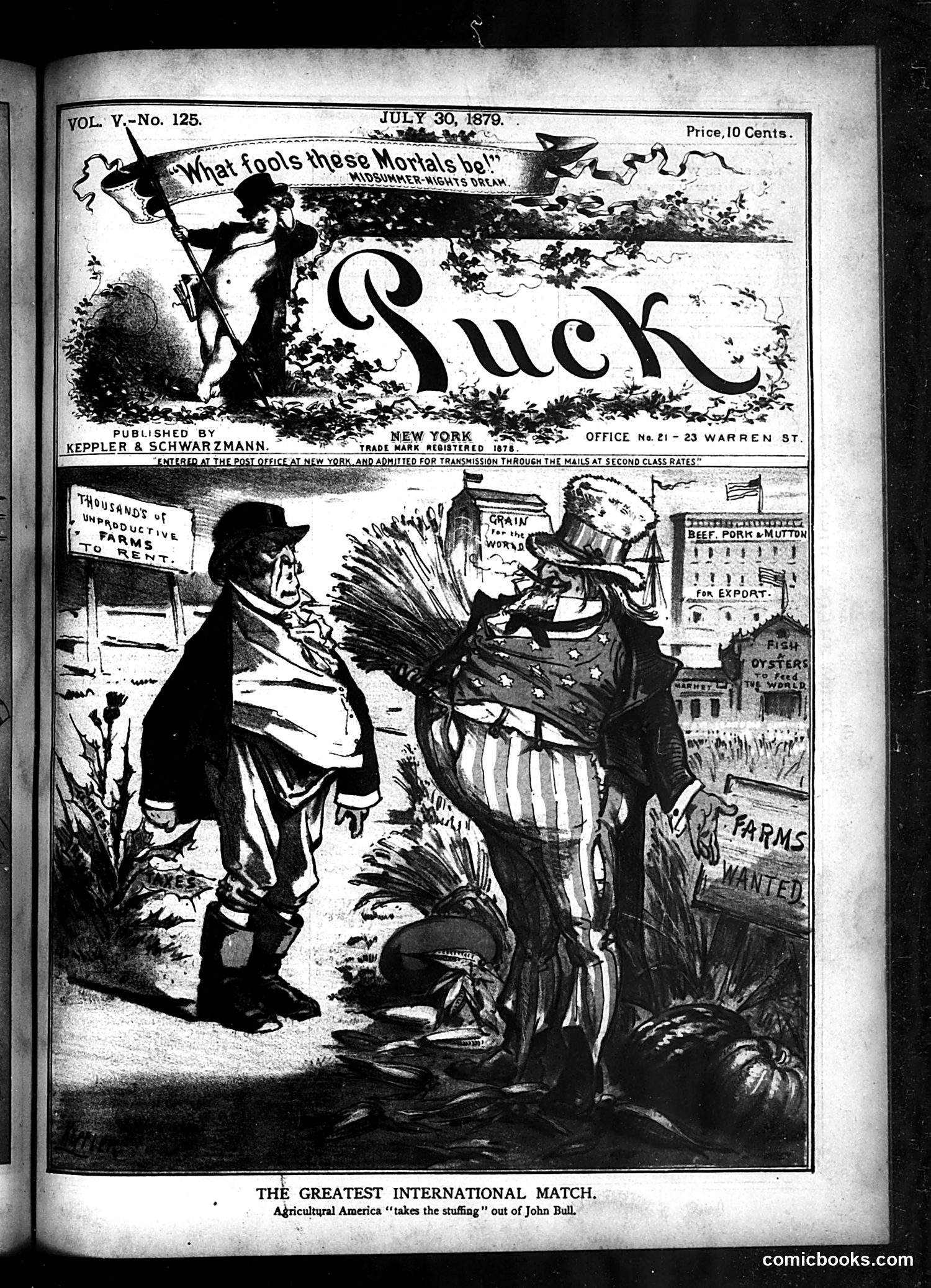
**The Main Cartoon: "The Greatest International Match"** This political satire depicts "Agricultural America" (personified as a figure with wheat/grain) confronting "John Bull" (Britain, shown as a rotund man in a top hat). The caption states Agricultural America is taking "the stuffing" out of John Bull. The surrounding signage references American agricultural exports and trade competition—"Grain," "Beef, Pork & Mutton for Export," and "Farms Wanted"—suggesting this cartoon satirizes Anglo-American trade tensions over agricultural products in the late 1870s. The "international match" metaphor presents commercial competition between the nations as a prize fight, mocking both economic rivalry and nationalist posturing during this period of American agricultural expansion and export growth.
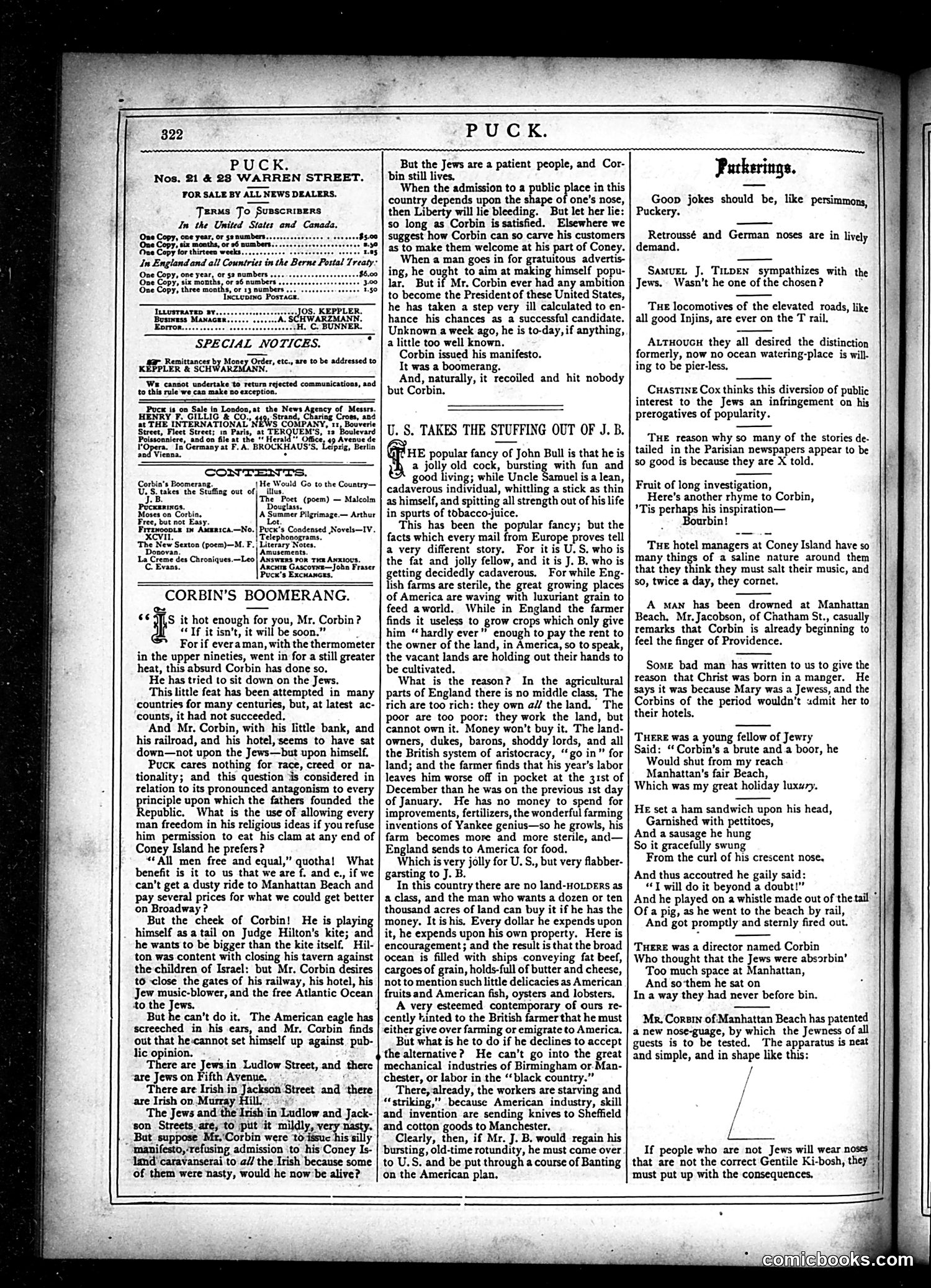
This page contains **satirical commentary rather than illustrated cartoons**. The main article, "Corbin's Boomerang," attacks Mr. Corbin (likely a political or business figure of the era) for his antagonism toward Jews and Republicans, while simultaneously opposing Catholic immigration and Irish populations. The satire's point: Corbin's prejudices are self-contradictory and hypocritical. He criticizes Jewish and Irish immigrants while opposing Republican principles of religious freedom. The "boomerang" metaphor suggests his own bigotry will backfire against him. The surrounding content includes brief jokes mocking various ethnic noses, typical of period satirical humor, though crude by modern standards. The overall tone is critical of Corbin's narrow-mindedness while employing the casual ethnic stereotyping common to 19th-century American satire.
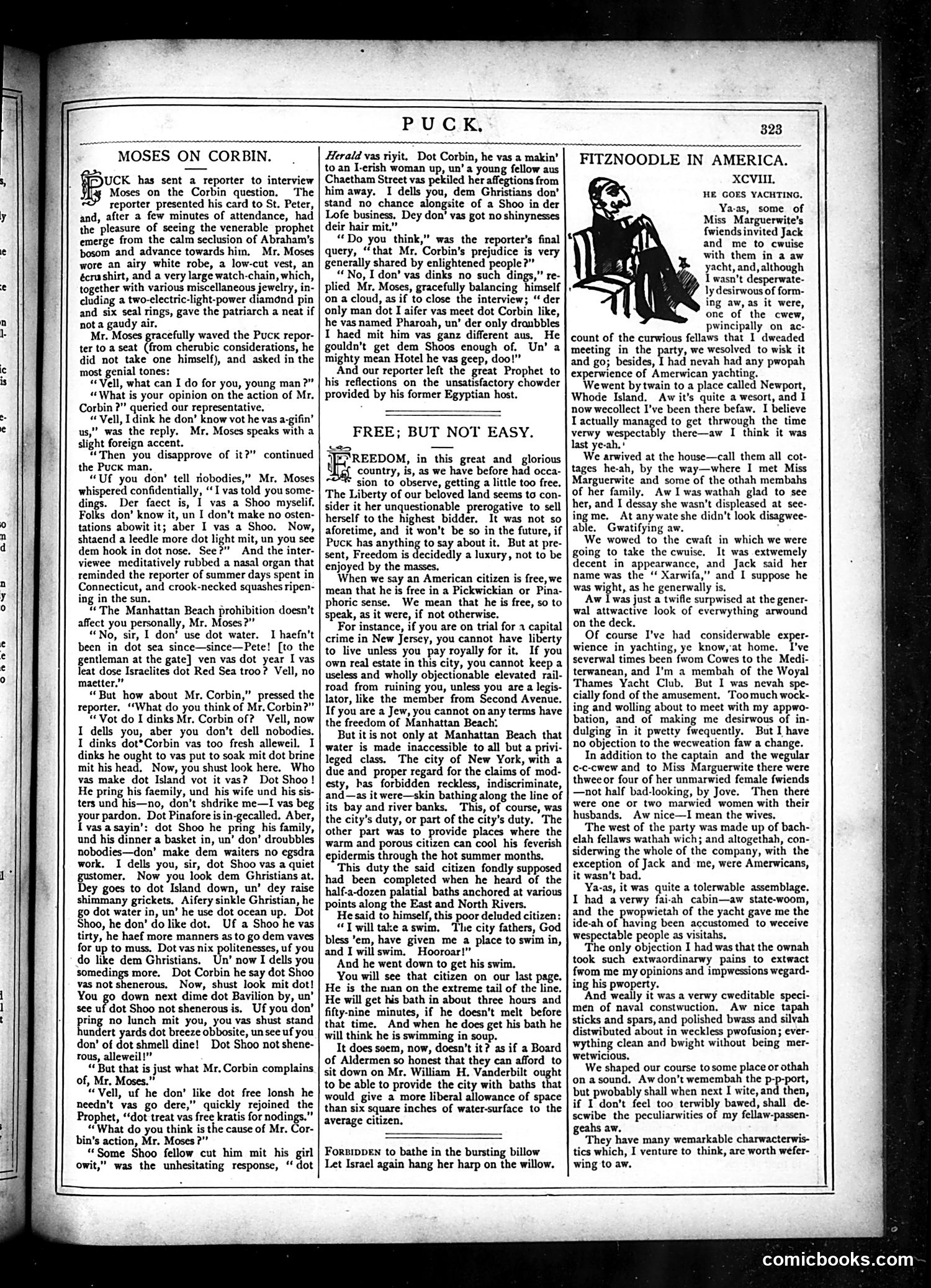
This page contains two distinct pieces: **"Moses on Corbin"** (left): A satirical interview where the biblical prophet Moses comments on railroad magnate James C. Corbin's business practices. The humor relies on Moses's ancient wisdom confronting modern capitalist excess—Moses questions whether Corbin's wealth accumulation aligns with biblical principles, particularly regarding treatment of workers and the poor. The piece uses anachronistic humor by having Moses reference contemporary issues like "Shoos" (likely shanties or poor housing). **"Fitznoodle in America: XVIII—Yachting"** (right): A travel narrative where an English visitor recounts experiences with American yachting culture. The satire mocks both American materialism and the pretensions of wealthy leisure activities, contrasting European sophistication with American excess and social climbing. Both pieces employ Puck's characteristic approach: using outsider perspectives (ancient prophet, foreign visitor) to critique American society.
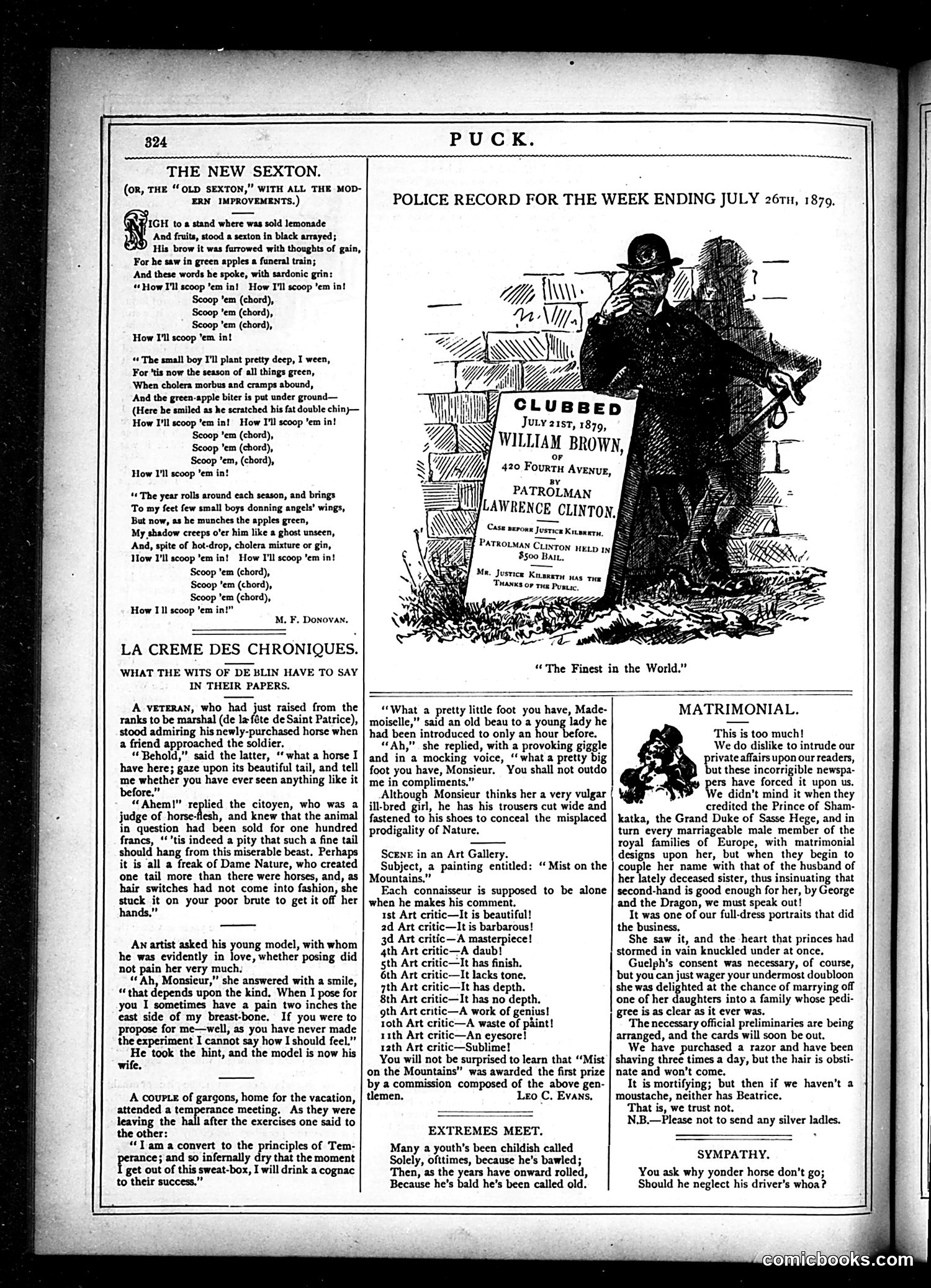
This cartoon satirizes police brutality and corruption. The illustration shows a skeletal Death figure and a brutish policeman standing over a gravestone marking the death of William Brown of Fourth Avenue, who was "clubbed" by Patrolman Lawrence Clinton on July 21st, 1879. The stone notes that "Justice Klueth has the thanks of the Patrolman Clinton held in $500 bail." The satire is bitter: the cartoon equates the patrolman's actions with homicide, while the nominal $500 bail suggests the legal system treats a citizen's death as a minor infraction. The title "The Finest in the World" (referring to the police force) is deeply ironic, highlighting the gap between law enforcement's idealized reputation and its actual violent practices against ordinary citizens.
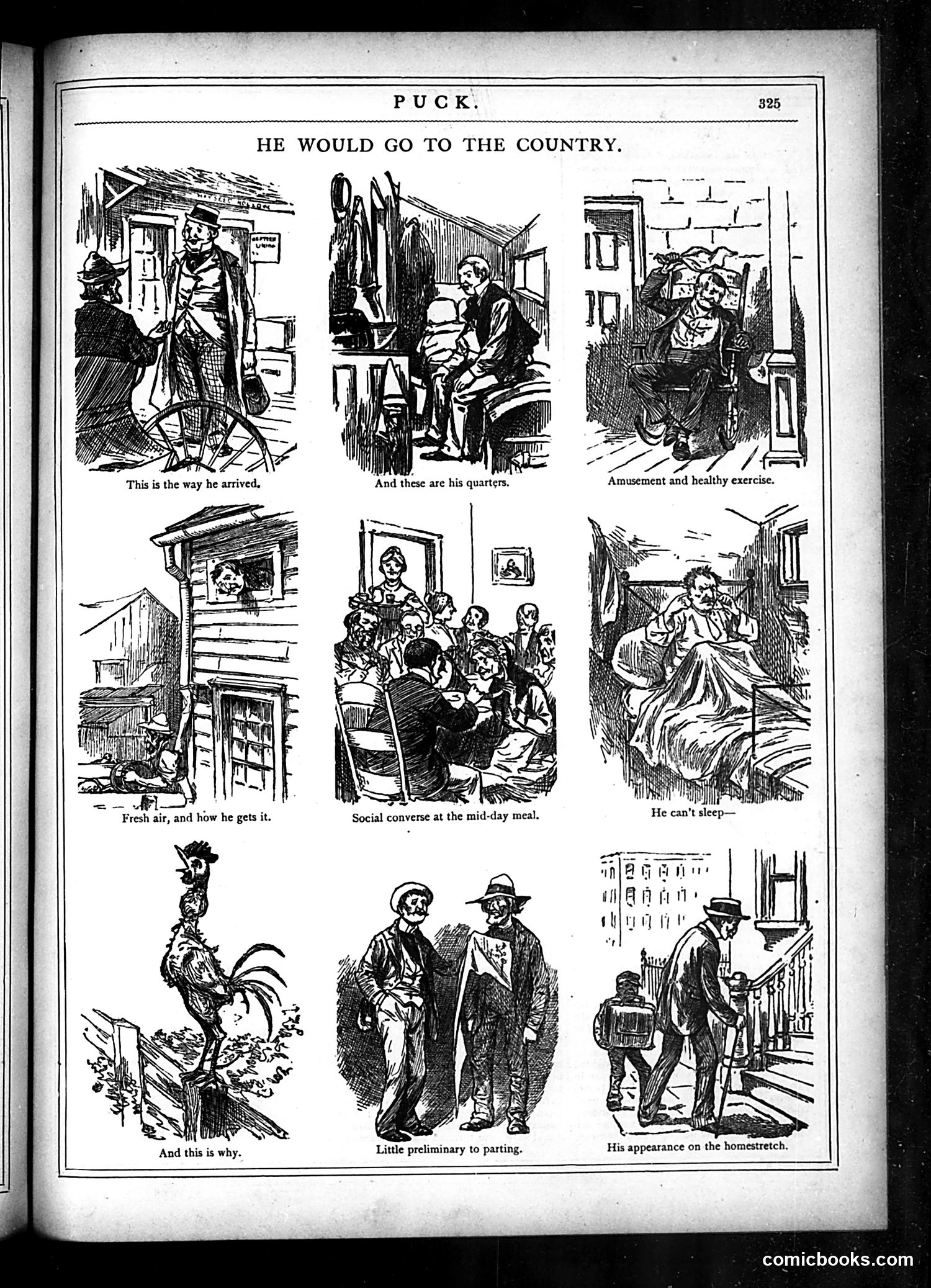
This satirical comic strip mocks a wealthy urban man's attempt at country living. The sequence shows his arrival with grand expectations ("This is the way he arrived"), followed by stark reality: cramped quarters, forced socializing, physical labor ("Fresh air, and how he gets it"), insomnia from roosters crowing at dawn ("And this is why"), and awkward encounters with rural folk ("Little preliminary to parting"). The humor targets class pretension—the gentleman's romanticized notion of pastoral escape colliding with rural hardship, noise, and social discomfort. His final "appearance on the homestretch" suggests his hasty retreat back to the city. The cartoon satirizes both urban naïveté about country life and the incompatibility between city dwellers and rural existence.
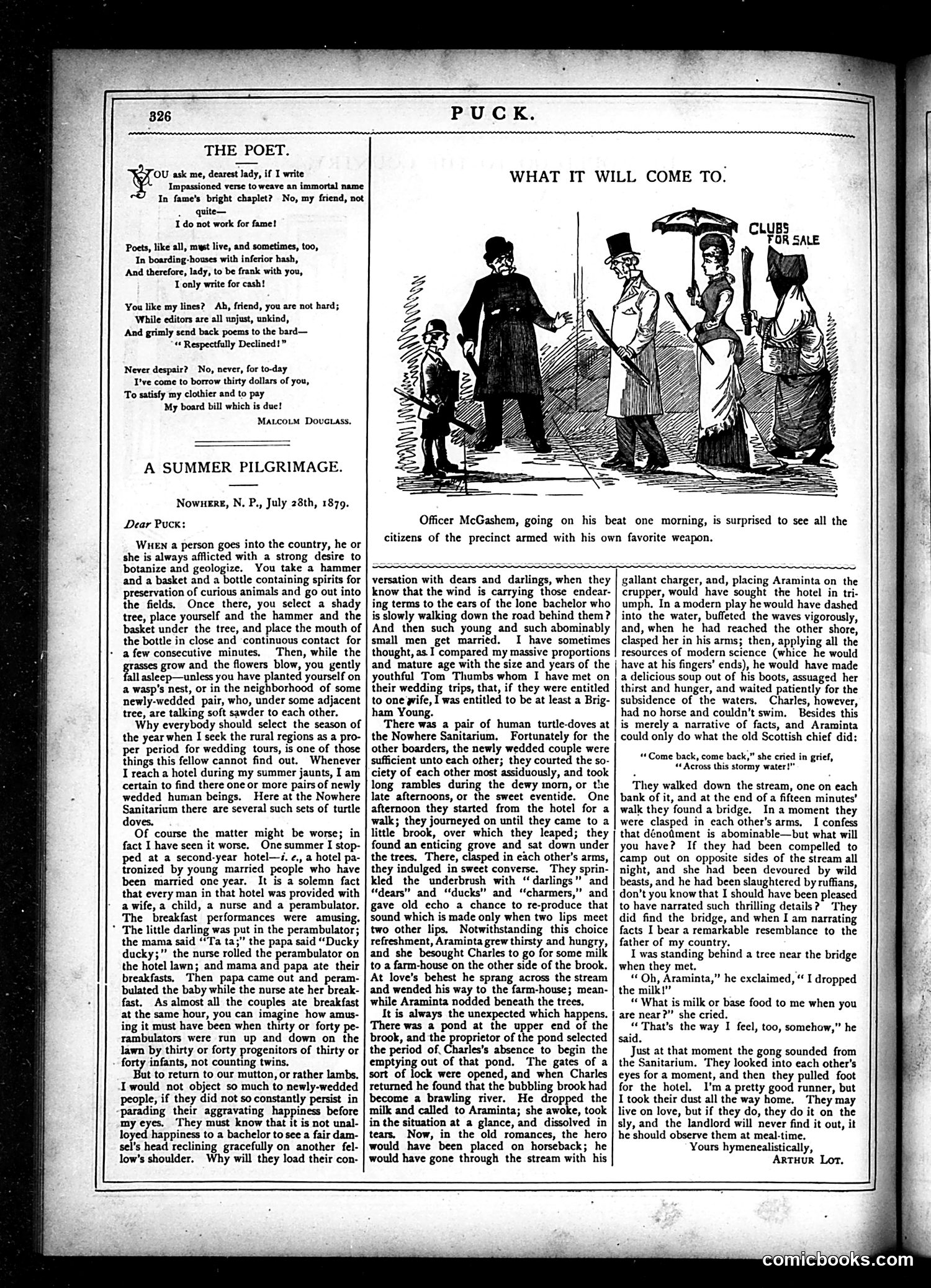
This cartoon satirizes the commercialization of marriage and courtship among the wealthy. The illustration shows a group of elegantly dressed people standing in the rain, with a sign reading "CLUBS FOR SALE." The satire suggests that marriage has become a mere transaction—reduced to a commodity one can purchase like any other good. The figures appear to represent various social classes or types (military officer, gentleman, ladies), implying that even the institution of matrimony itself has become subject to market forces. The rain and outdoor setting emphasize the degradation of something once sacred, now hawked publicly like merchandise. The joke reflects Gilded Age anxieties about wealth's corrupting influence on traditional social institutions and romantic relationships.
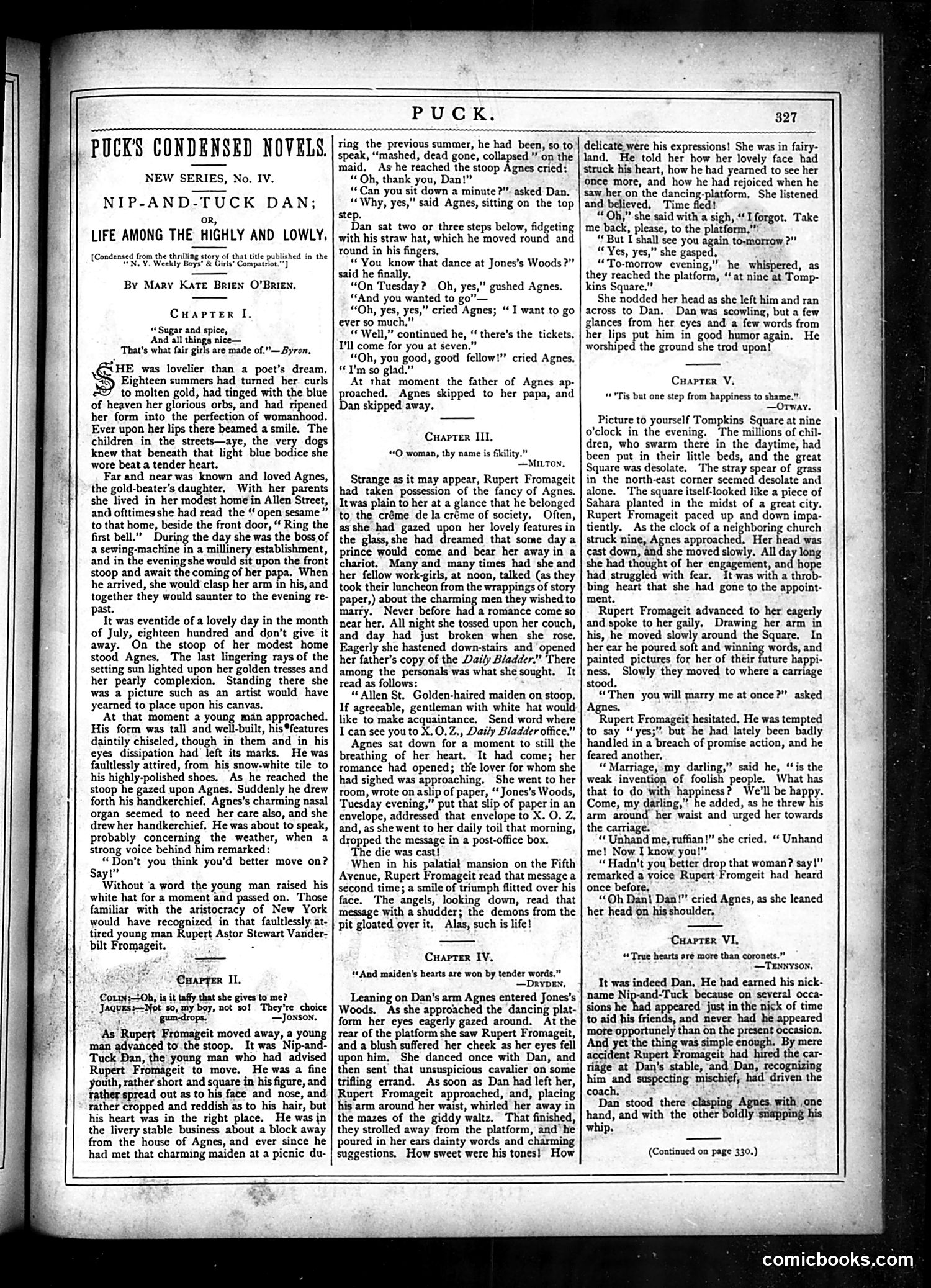
This page contains **no political cartoon**. Instead, it presents the fourth installment of "Nip-and-Tuck Dan; Life Among the Highly and Lowly," a serialized fiction story by Mary Kate Brien O'Brien, continuing from a previous issue of Puck magazine. The narrative follows romantic developments between characters named Dan, Agnes, and Rupert Fromageit. The story involves working-class characters (Agnes as a dance-hall girl, Dan as a livery stable worker) and appears to be a melodramatic romance with social commentary on class differences. The page is purely **literary content**—a serialized novel—rather than satirical commentary or political cartooning, which Puck was primarily known for.
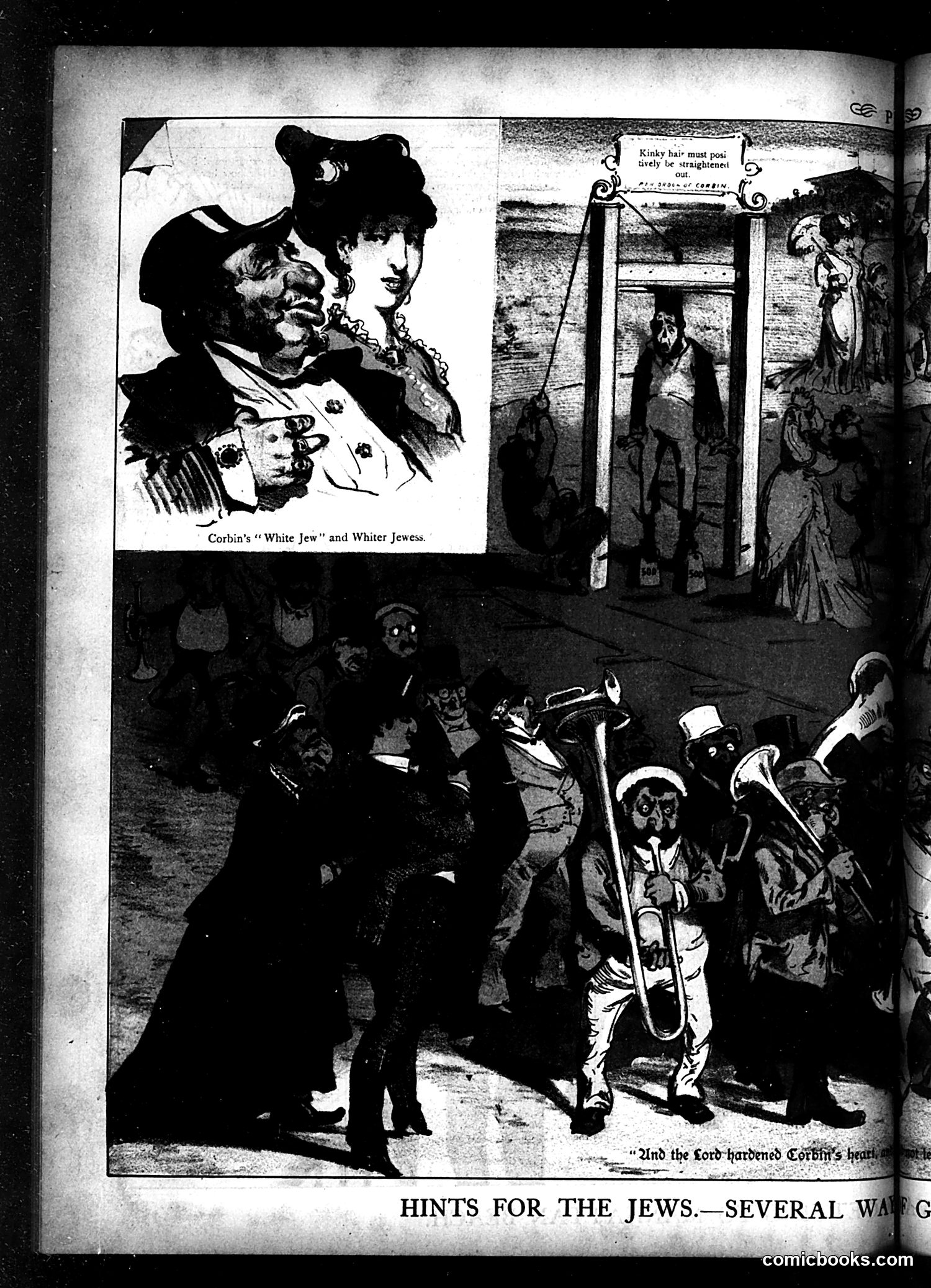
This page contains antisemitic propaganda from *Puck* magazine. The top cartoon, labeled "Corbin's 'White Jew' and Whiter Jewess," appears to reference a specific controversy, though the precise context is unclear without additional documentation. The figure on the left wears military regalia with medals. The lower illustration, captioned "HINTS FOR THE JEWS—SEVERAL WAR[...]," depicts a gallows scene with small figures and musicians, suggesting violent threat. The text at bottom is cut off but clearly indicates hostile content directed at Jewish people. This represents the magazine's use of grotesque caricatures and violent imagery to promote antisemitic stereotypes and hostility—material that would be recognized today as hate propaganda rather than satire.
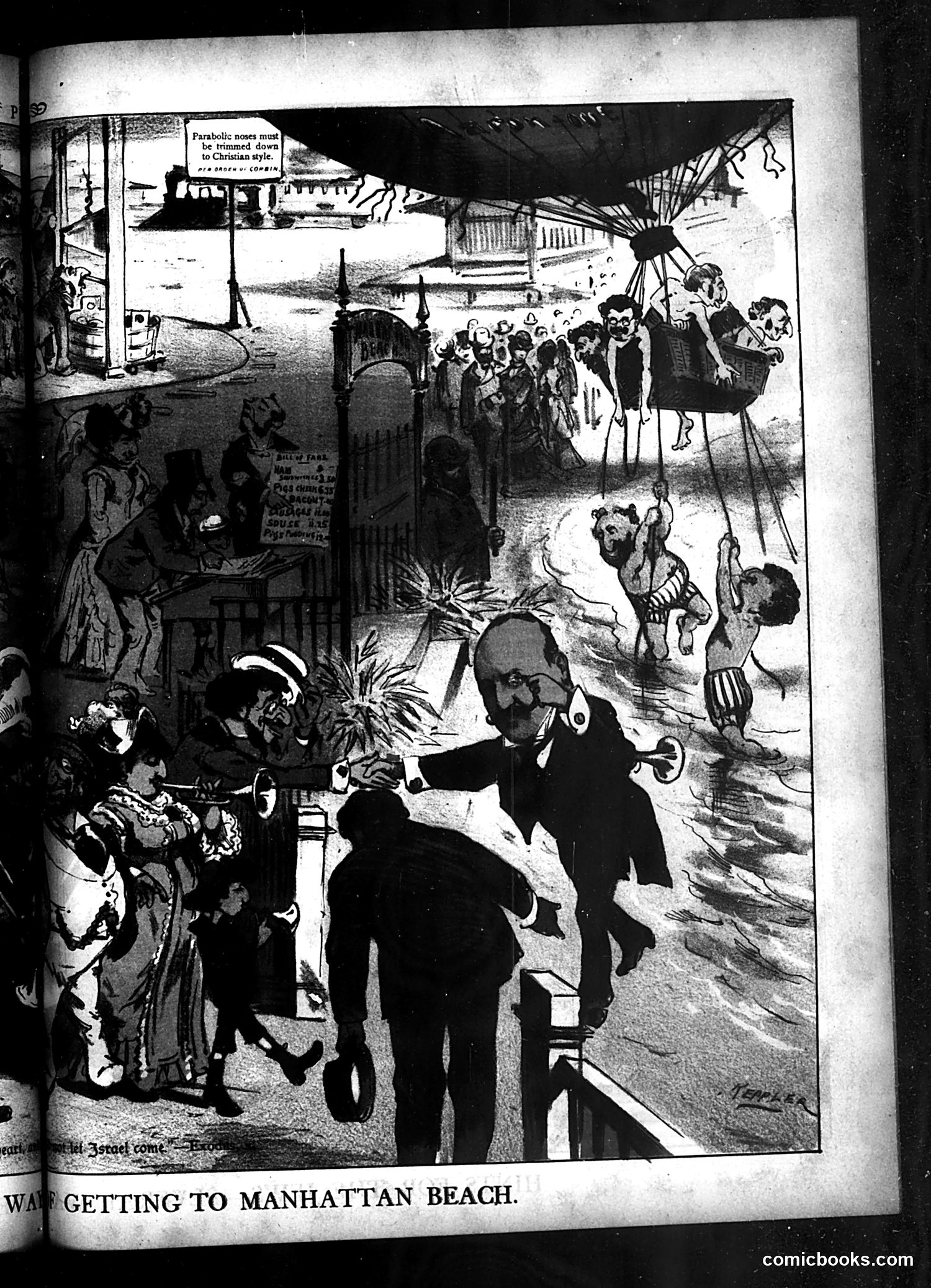
This satirical cartoon depicts the chaos of transporting wealthy New Yorkers to Manhattan Beach (a popular seaside resort). The image shows an elaborate, precarious contraption—a flying machine or suspended transport system—packed with fashionably dressed passengers. The top caption notes that "Parabolic poses must be trimmed down to Christian style," suggesting the cramped, undignified positions required to fit everyone aboard. The satire mocks both the desperation of beachgoers seeking escape and the era's fascination with experimental transportation technology. The crowded, chaotic scene ridicules how far people would go—literally suspending themselves in questionable contraptions—for leisure. It's commentary on the absurdity of modern resort culture and technological excess.
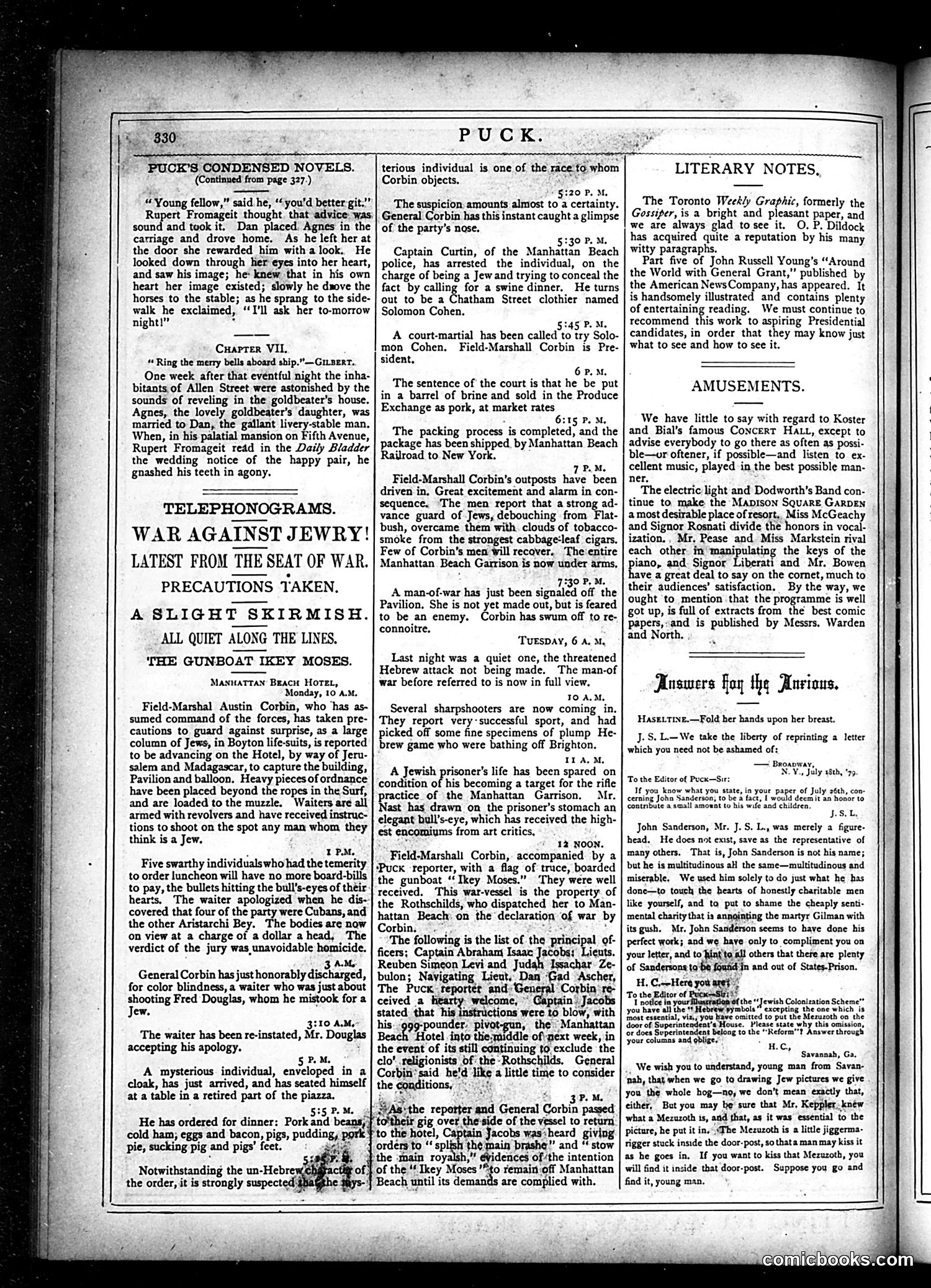
This page from *Puck* magazine consists primarily of **literary serialization and classified sections** rather than political cartoons. The left column continues "Puck's Condensed Novels" (a serialized fiction piece) and includes a section titled **"War Against Jewry"** with subsections like "Latest from the Seat of War" and "Precautions Taken." These appear to be satirical headlines mocking antisemitic rhetoric and military/defensive language, treating bigotry as absurd conflict. The right side contains literary notes about *Toronto Weekly Graphic* and *John Russell Young's work*, followed by an "Amusements" section and reader responses ("Answers for the Anxious"). Without seeing the actual cartoon illustrations, I cannot identify specific caricatures or figures, but the antisemitic satire section suggests *Puck* was critiquing contemporary prejudice through ironic framing.
This page contains the beginning of "Archie Gascoyne: A Romance of Skye," a serialized story by John Fraser written expressly for Puck magazine. The page is primarily **literary fiction, not a political cartoon**. It presents Chapter XVI of a romantic narrative set in Scotland, featuring dialogue between characters including Archie, Miss Macdonald, and Alister discussing romantic entanglements and past events. There is **no visible political or social satire** on this page—it's a straightforward romantic story installment typical of Puck's mixed content combining humor, satire, and serialized fiction. The story appears designed to entertain rather than comment on contemporary political or social issues.
This page consists primarily of **Puck's Perchings** — a humor column collecting brief satirical observations and jokes rather than a single political cartoon. The content targets various social absurdities: mosquito bites, pretentious city youth, women's wedding anxieties, and bourgeois affectations. Multiple items mock contemporary concerns like face-browning preparations, the waste of sauerkraut material, and young men's financial pretensions at fashionable watering holes. One notable item references **Senator David Davis**, suggesting political content, though the specific critique isn't fully clear from this excerpt. The humor is largely **social satire** aimed at middle and upper-class Americans' vanities and pretensions rather than focused partisan critique. The scattered, bite-sized format was typical of Puck's satirical approach to contemporary life.
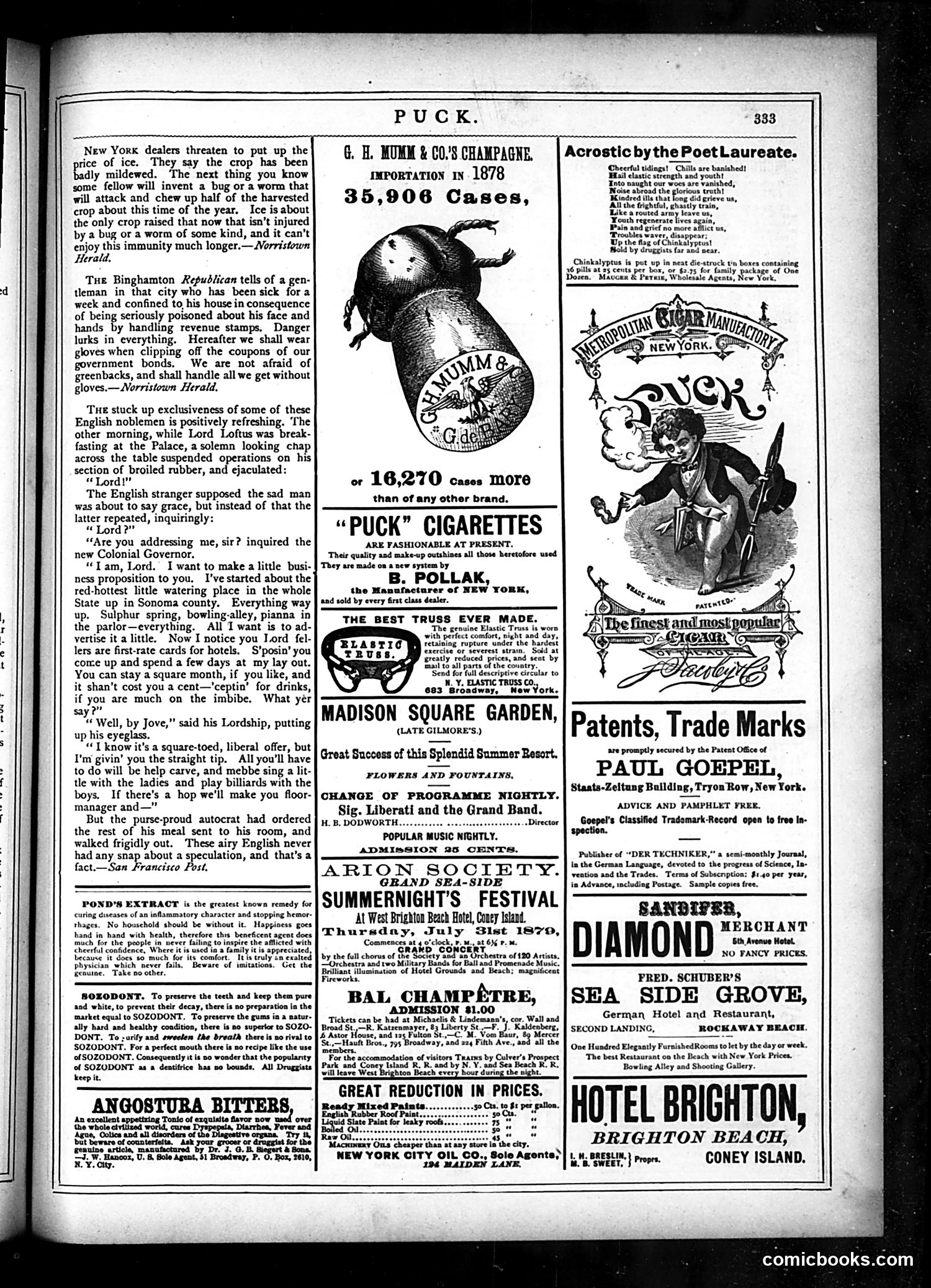
This page is predominantly **advertisements** rather than political satire. The main visual content shows: 1. **G.H. Mumm & Co.'s Champagne ad** - featuring a large bottle illustration claiming superiority over competing brands 2. **"Puck" Cigarettes advertisement** - promoting B. Pollak's cigarettes as "fashionable at present" 3. **Various resort and entertainment ads** - Madison Square Garden, Summernight's Festival, Hotel Brighton 4. The page includes small satirical text snippets about local New York issues (New York dealers, Binghamton Republican), but these are brief filler content between advertisements. **For modern readers:** This reflects 1870s magazine economics, where advertising funded publication. The mix of luxury goods (champagne, cigarettes) and leisure destinations reflects the magazine's affluent audience.
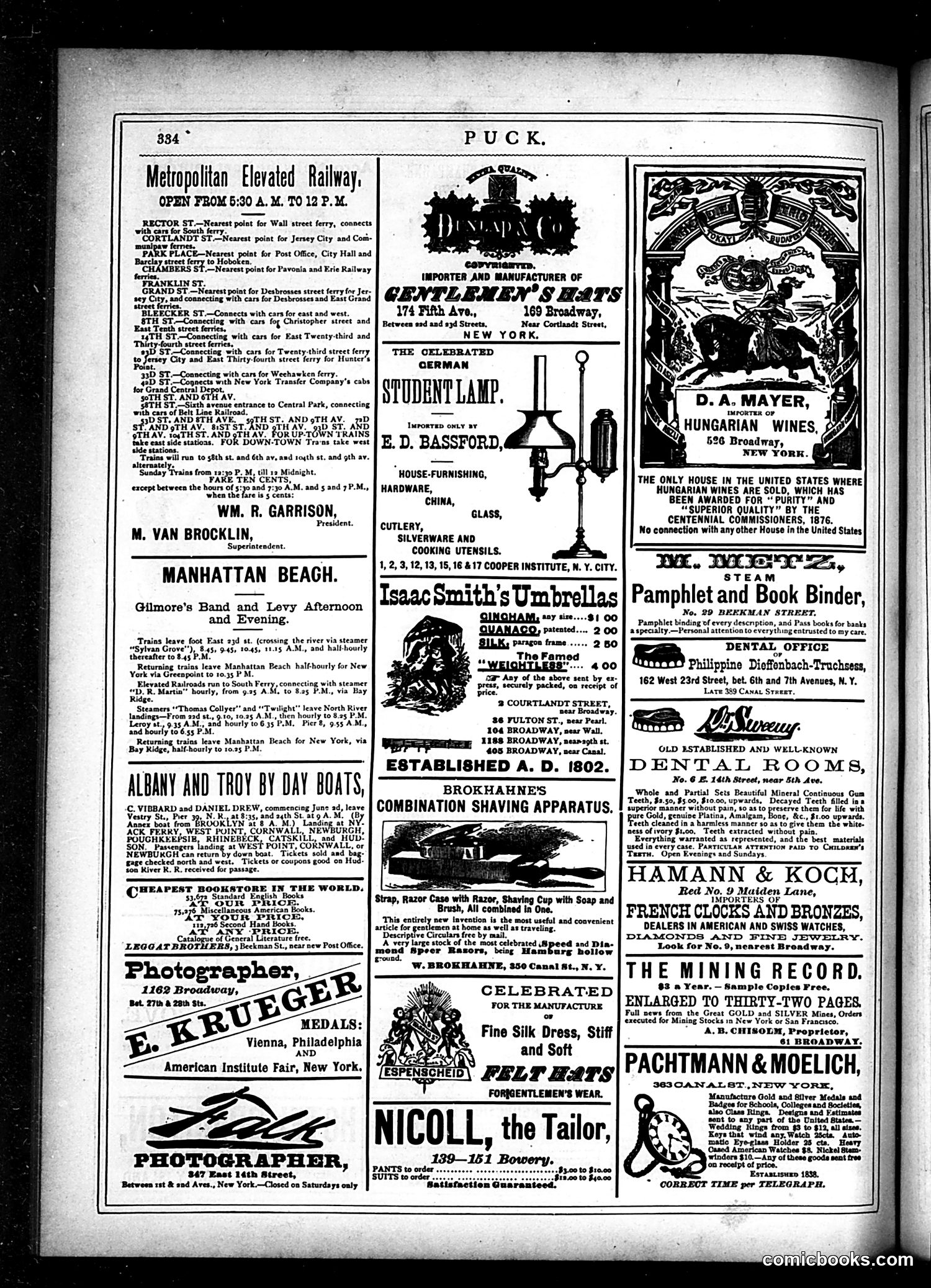
This page is **primarily advertising**, not editorial content or political satire. It contains numerous commercial advertisements for New York City businesses from what appears to be the late 19th century, including: - Transportation services (Metropolitan Elevated Railway, steamboats) - Retail goods (gentlemen's hats, Hungarian wines, umbrellas) - Professional services (photographers, dentists, tailors) - Manufactured items (student lamps, shaving apparatus) The only notable illustrated advertisement is **Brokahnes' Combination Shaving Apparatus**, shown with a device diagram. There are no visible political cartoons or satirical commentary on this particular page—it serves as a revenue-generating advertisement section of the Puck magazine, typical of publications from this era.
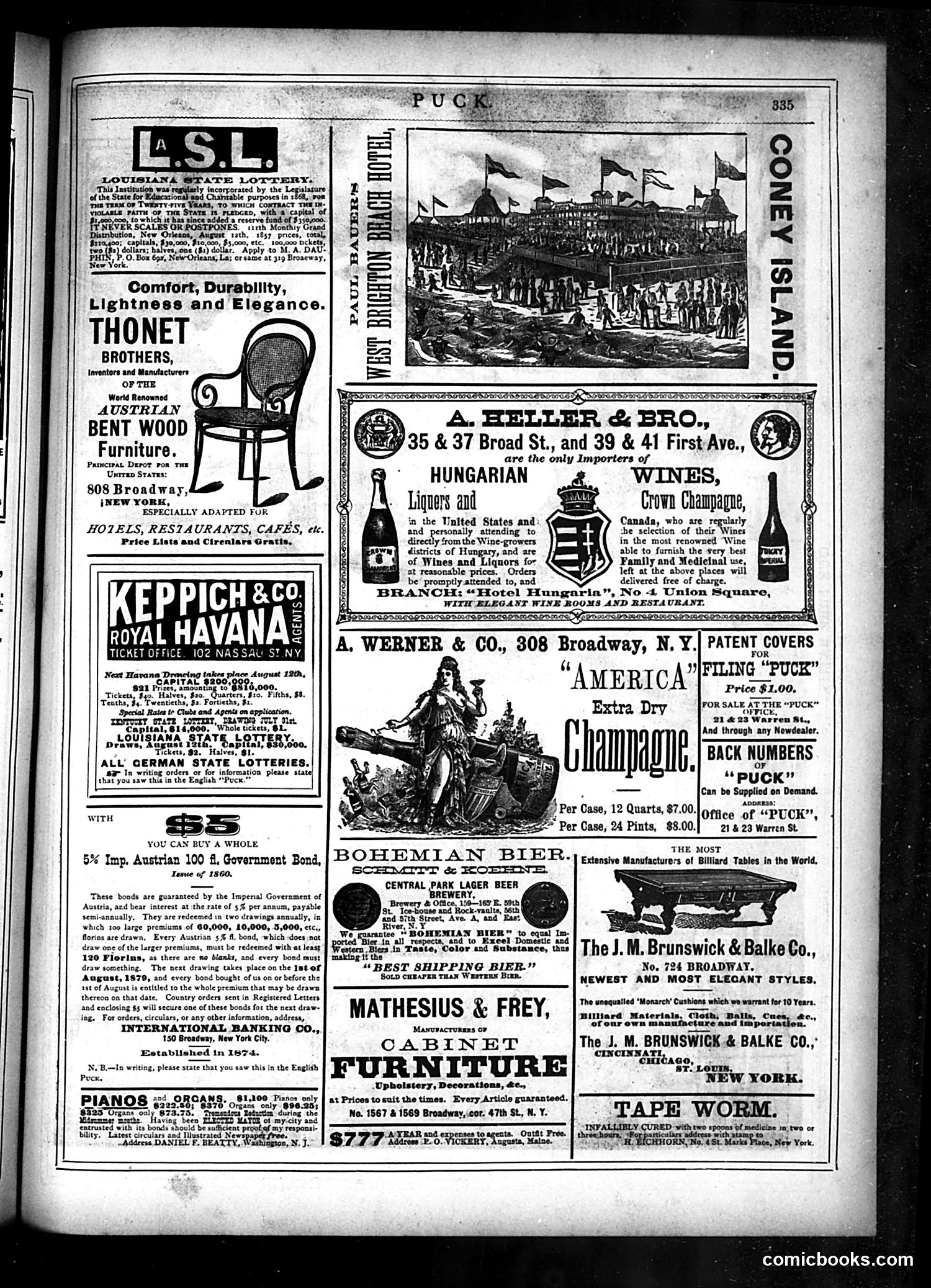
This page is primarily **advertising rather than editorial content**. The visible advertisements promote luxury goods and services typical of the Gilded Age: Thonet bent-wood furniture, Hungarian wines and champagne, billiard tables, cabinet furniture, pianos and organs, and lottery tickets. One small illustration at top-right shows what appears to be a **crowded public gathering or fair**, possibly satirizing mass entertainment or consumer culture. The **Louisiana State Lottery advertisement** is notable—this was a notoriously fraudulent operation that Puck likely mocked editorially elsewhere. The inclusion here suggests the magazine accepted these ads despite their questionable nature. Overall, this page reflects **late 19th-century advertising practices** and consumer interests rather than political satire.
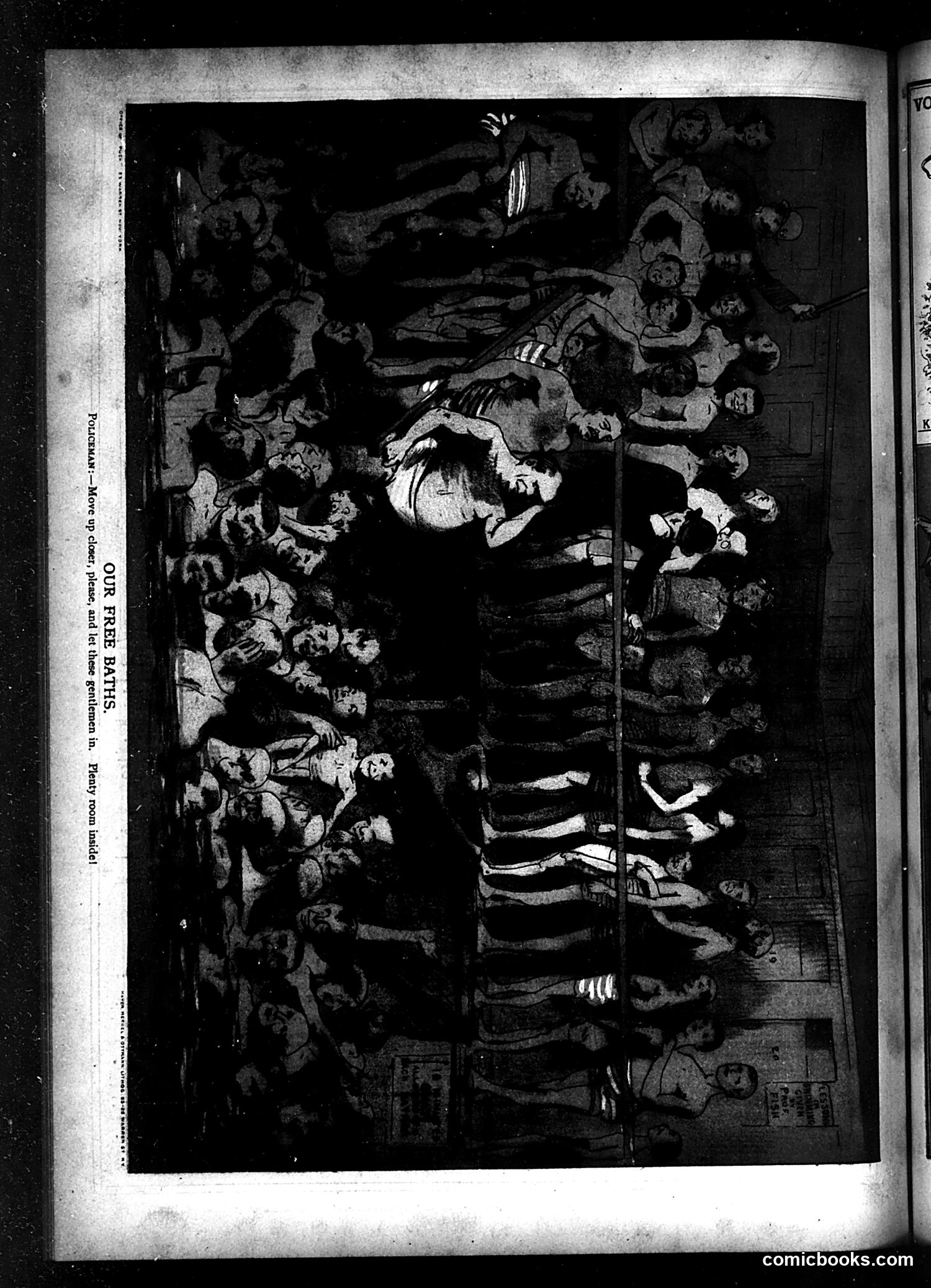
This page from *Puck* magazine appears to show a densely crowded political or social scene rendered in black and white illustration. The caption reads "OUR TRIBE AWAITS" with text mentioning "Parley from Ireland." The cartoon likely satirizes Irish-American political interests or immigration-related debates prominent in late 19th/early 20th-century American politics. The large central figure and surrounding crowd suggest commentary on Irish immigrant communities or their political influence. However, **I cannot confidently identify specific individuals** depicted or the precise political event referenced. The poor image quality and OCR limitations prevent me from reading supporting text that would clarify whether this addresses Irish independence movements, American political patronage, or another contemporary issue affecting Irish communities.