
Puck, 1879-07-30 · page 3 of 16
Puck — July 30, 1879 — page 3: what you’re looking at
What you’re looking at
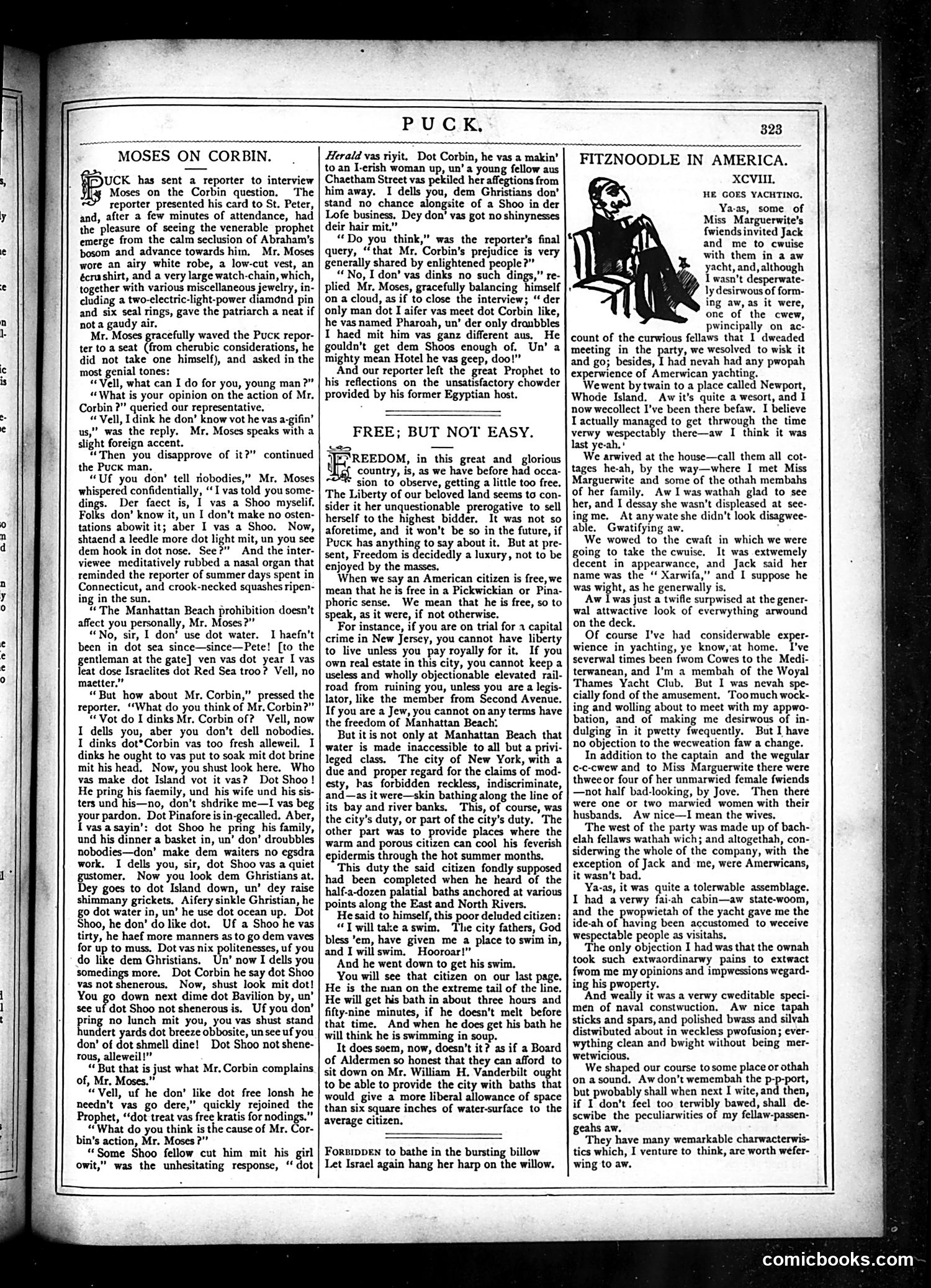
This page contains two distinct pieces: **"Moses on Corbin"** (left): A satirical interview where the biblical prophet Moses comments on railroad magnate James C. Corbin's business practices. The humor relies on Moses's ancient wisdom confronting modern capitalist excess—Moses questions whether Corbin's wealth accumulation aligns with biblical principles, particularly regarding treatment of workers and the poor. The piece uses anachronistic humor by having Moses reference contemporary issues like "Shoos" (likely shanties or poor housing). **"Fitznoodle in America: XVIII—Yachting"** (right): A travel narrative where an English visitor recounts experiences with American yachting culture. The satire mocks both American materialism and the pretensions of wealthy leisure activities, contrasting European sophistication with American excess and social climbing. Both pieces employ Puck's characteristic approach: using outsider perspectives (ancient prophet, foreign visitor) to critique American society.
📄 Transcribed text from this page (OCR, searchable)
Machine-transcribed from the original scan — historical spelling and the odd misread are preserved.
PUCK, 823 MOSES ON CORBIN. JUCK has sent a reporter to interview Moses on the Corbin question. The reporter presented his card to St. Peter, and, after a few minutes of attendance, had the pleasure of seeing the venerable prophet emerge from the calm seclusion of Abraham's bosom and advance towards him. Mr. Moses wore an airy white robe, a low-cut vest, an écrashirt, and a very large watch-chain, which, together with various miscellaneous jewelry, in- cluding a two-clectric-light-power diamond pin and six seal rings, gave the patriarch a neat if not a gaudy air, Mr. Moses gracefully waved the Puck repor- ter to a seat (from cherubic considerations, he did not take one himself), and asked in the most genial tones: “Vell, what can I do for you, young man?” “What is your opinion on the action of Mr. Corbin ?” queried our representative. “Vell, Idink he don’ know vot he vas a-gifin’ us,” was the reply. Mr. Moses speaks with a slight foreign accent. “Then you disapprove of it?” continued the Puck man. “Uf you don’ tell nobodies,” Mr. Moses whispered confidentially, ‘I vas told you some- dings. Der faect is, 1 vas a Shoo myselif. Folks don’ know it, un I don’t make no osten- tations abowit it; aber I vas a Shoo. Now, shtaend a leedle more dot light mit, un you see dem hook in dot nose. See?” And the inter- viewee meditatively rubbed a nasal organ that reminded the reporter of summer days spent in Connecticut, and crook-necked squashes ripen- ing in the sun. “The Manhattan Beach prohibition doesn’t affect you personally, Mr. Moses?” “No, sir, I don’ use dot water. I haefn’t been in dot sea since—since—Pete! [to the gentleman at the gate] ven vas dot year I vas leat dose Israelites dot Red Sea troo? Vell, no matter.” “But how about Mr. Corbin,” pressed the reporter. ‘What do you think of Mr.Corbin?” “Vot do I dinks Mr. Corbin of? Vell, now I dells you, aber you don’t dell nobodies. I dinks dot*Corbin vas too fresh alleweil. I dinks he ought to vas put to soak mit dot brine mit his head. Now, you shust look here. Who vas make dot Island vot it vas? Dot Shoo! He pring his faemily, und his wife und his sis- ters und his—no, don’t shdrike me—I vas beg your pardon. Dot Pinafore is in-gecalled. Aber, I vas asayin’: dot Shoo he pring his family, und his dinner a basket in, un’ don’ droubbles nobodies—don’ make dem waiters no egsdra work, I dells you, sir, dot Shoo vas a quiet tomer. Now you look dem Ghristians at. y goes to dot Island down, un’ dey raise shimmany grickets. Aifery sinkle Ghristian, he go dot water in, un’ he use dot ocean up. Dot Shoo, he don’ do like dot. Uf a Shoo he vas tirty, he haef more manners as to go dem vaves for up to muss. Dot vas nix politenesses, uf you do like dem Ghristians, Un’ now I dells you somedings more. Dot Corbin he say dot Shoo vas not shenerous. Now, shust look mit dot! You go down next dime dot Bavilion by, un’ see uf dot Shoo not shenerous is. Uf you don’ ps no lunch mit you, you vas shust stand undert yards dot breeze obbosite, un see uf you don’ of dot shmell dine! Dot Shoo not shene- rous, alleweil!”” “But that is just what Mr. Corbin complains of, Mr. Moses.” “Vell, uf he don’ like dot free lonsh he needn't ‘vas go dere,” quickly rejoined the Prophet, “dot treat vas free kratis for nodings.”” “What do you think is the cause of Mr. Cor- bin’s action, Mr. Moses ?”” “Some Shoo fellow cut him mit his girl owit,” was the unhesitating response, ‘dot Herald vas riyit. Dot Corbin, he vas a makin’ to an I-erish woman up, un’ a young fellow aus Chaetham Street vas pekiled her affegtions from him away. I dells you, dem Ghristians don’ stand no chance alongsite of a Shoo in der Lofe business. Dey don’ vas got no shinynesses deir hair mit.” “Do you think,” was the reporter's final query, “that Mr, Corbin's prejudice is very generally shared by enlightened people?” “No, I don’ vas dinks no such dings,” re- plied Mr. Moses, gracefully balancing himself on a cloud, as if to close the interview; “der only man dot I aifer vas meet dot Corbin like, he vas named Pharoah, un’ der only draubbles I haed mit him vas ganz different aus. He gouldn’t get dem Shoos enough of. Un’ a mighty mean Hotel he vas geep, doo!” And our reporter left the great Prophet to his reflections on the unsatisfactory chowder provided by his former Egyptian host. FREE; BUT NOT EASY. S25 — ]ESREEDOM, in this great and glorious J country, is, as we have before had occa- sion to observe, getting a little too free. The Liberty of our beloved land seems to con- sider it her unquestionable prerogative to sell herself to the highest bidder. It was not so aforetime, and it won't be so in the future, if Puck has anything to say about it. But at pre- sent, Freedom is decidedly a luxury, not to be enjoyed by the masses, When we say an American citizen is free, we mean that he is free in a Pickwickian or Pina- phoric sense. We mean that he is free, so to speak, as it were, if not otherwise. For instance, if you are on trial for 1 capital crime in New Jersey, you cannot have liberty to live unless you pay royally for it. If you own real estate in this city, you cannot keep a useless and wholly objectionable elevated rail- road from ruining you, unless you are a legis- lator, like the member from Second Avenue. If you are a Jew, you cannot on any terms have the freedom of Manhattan Beach: But it is not only at Manhattan Beach that water is made inaccessible to all but a privi- leged class. The city of New York, with a due and proper regard for the claims of mod- esty, has forbidden reckless, indiscriminate, and—as it were—skin bathing along the line of its bay and river banks, This, of course, was the city’s duty, or part of the city's duty. The other part was to provide places where the warm and porous citizen can cool his feverish epidermis through the hot summer months. This duty the said citizen fondly supposed had been completed when he heard of the half-a-dozen palatial baths anchored at various points along the East and North Rivers. Hesaid to himself, this poor deluded citizen: “Twill take aswim, The city fathers, God bless ’em, have given me a place to swim in, and I will swim. Hooroar!” And he went down to get his swim. You will see that citizen on our last page. He is the man on the extreme tail of the line, He will get his bath in about three hours and fifty-nine minutes, if he doesn’t melt before that time. And when he does get his bath he will think he is swimming in soup. It does seem, now, doesn’t it? as if a Board of Aldermen so honest that they can afford to sit down on Mr. William H. Vanderbilt ought to be able to provide the city with baths that would give a more liberal allowance of space than six square inches of water-surface to the average citizen. ForsippeN to bathe in the bursting billow Let Israel again hang her harp on the willow. FITZNOODLE IN AMERICA. XCVIIL. HE GOES YACHTING. Ya-as, some of Miss Marguerwite’s fwiends invited Jack and me to cwuise with them in a aw yacht, and, although I wasn't desperwate- ly desirwous of form- ing aw, as it were, one of the cwew, pwincipally on ac- count of the curwious fellaws that 1 dweaded meeting in the party, we wesolved to wisk it and go; besides, I had nevah had any pwopah experwience of Amerwican yachting. Wewent by twain to a place called Newport, Whode Island. Aw it’s quite a wesort, and I now wecollect I’ve been there befaw. I believe lL actually managed to get thrwough the time verwy wespectably there—aw I think it was last ye-ah,* We arwived at the house—call them all cot- tages he-ah, by the way—where I met Miss Marguerwite and some of the othah membahs of her family. Aw I was wathah glad to see her, and I dessay she wasn’t displeased at see- ing me. At anywate she didn’t look disagwee- able. Gwatifying aw. We wowed to the cwaft in which we were going to take the cwuise. It was extwemely decent in appearwance, and Jack said her name was the “ Xarwifa,” and I suppose he was wight, as he generwally is, Aw I was just a twifle surpwised at the gener- wal attwactive look of everwything arwound on the deck. Of course I've had considerwable exper- wience in yachting, ye know,-at home. I’ve severwal times been fwom Cowes to the Medi- terwanean, and I’m a membah of the Woyal Thames Yacht Club, But I was nevah spe- cially fond of the amusement. Toomuch wock- ing and wolling about to meet with my appwo- bation, and of making me desirwous of in- dulging in it pwetty fwequently. But I have no objection to the wecweation faw a change. In addition to the captain and the wegular ¢-c-cwew and to Miss Marguerwite there were thwee or four of her unmarwied female fwiends —not half bad-looking, by Jove. Then there were one or two marwied women with their husbands. Aw nice—I mean the wives. The west of the party was made up of bach- elah fellaws wathah wich; and altogethah, con- siderwing the whole of the company, with the exception of Jack and me, were Amerwicans, it wasn’t bad. Ya-as, it was quite a tolerwable assemblage. I had averwy fai-ah cabin—aw state-woom, and the pwopwietah of the yacht gave me the ide-ah of having been accustomed to weceive wespectable people as visitahs, The only objection I had was that the ownah took such extwaordinarwy pains to extwact fwom me my opinions and impwessions wegard- ing his pwoperty. ‘And weally it was a verwy cweditable speci- men of naval constwuction. Aw nice tapah sticks and spars, and polished bwass and silvah distwibuted about in weckless pwofusion ; ever- wything clean and bwight without being mer- wetwicious, We shaped our course to some place or othah on asound, Aw don’t wemembah the p-p-port, but pwobably shall when next I wite, and then, if I don’t feel too terwibly bawed, shall de- sewibe the peculiarwities of my fellaw-passen- geahs aw, 9 ‘They have many wemarkable charwacterwis- tics which, I venture to think, are worth wefer- wing to aw. comicbooks.com