
Puck, 1879-07-30 · page 11 of 16
Puck — July 30, 1879 — page 11: what you’re looking at
What you’re looking at
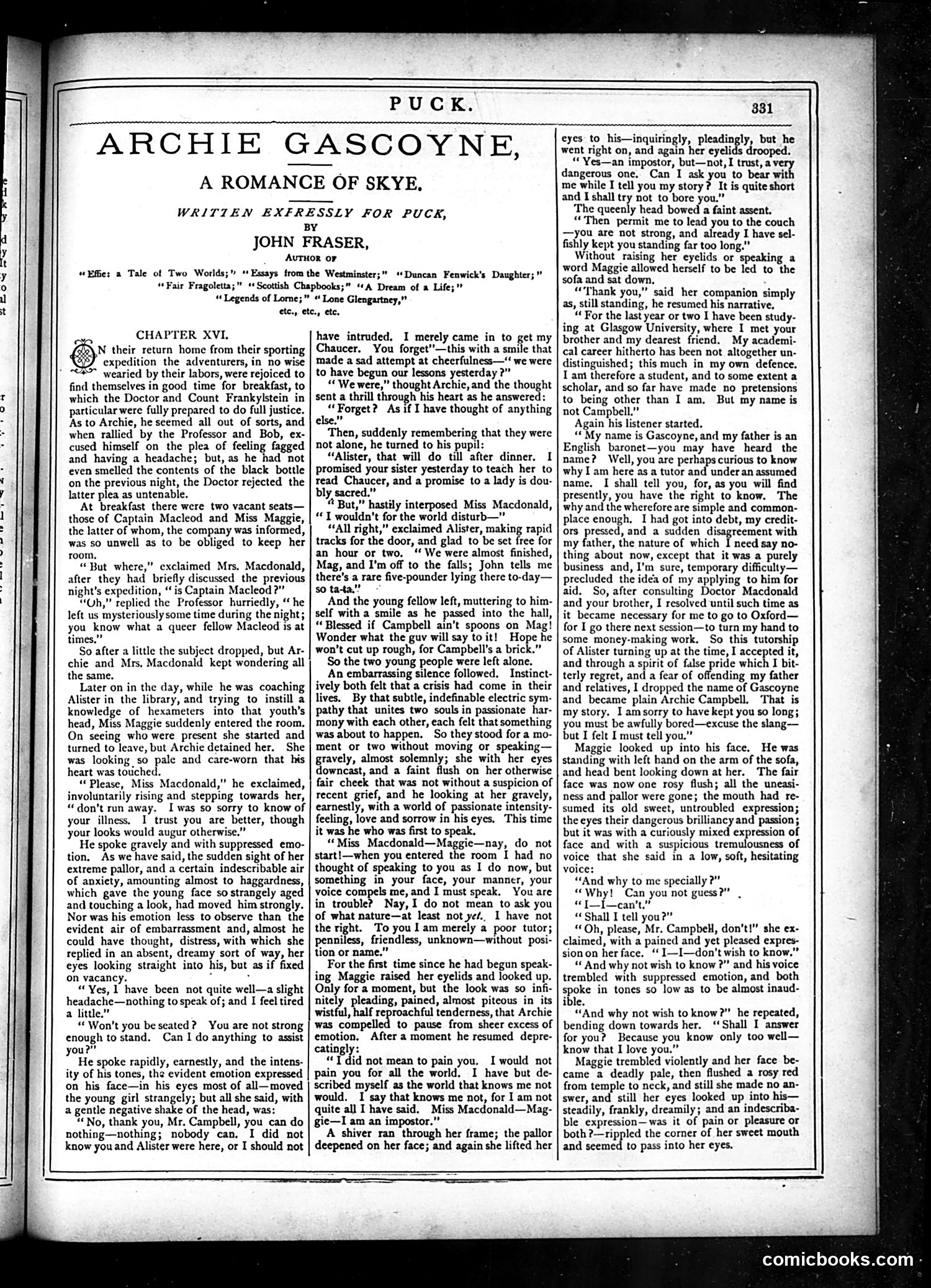
This page contains the beginning of "Archie Gascoyne: A Romance of Skye," a serialized story by John Fraser written expressly for Puck magazine. The page is primarily **literary fiction, not a political cartoon**. It presents Chapter XVI of a romantic narrative set in Scotland, featuring dialogue between characters including Archie, Miss Macdonald, and Alister discussing romantic entanglements and past events. There is **no visible political or social satire** on this page—it's a straightforward romantic story installment typical of Puck's mixed content combining humor, satire, and serialized fiction. The story appears designed to entertain rather than comment on contemporary political or social issues.
📄 Transcribed text from this page (OCR, searchable)
Machine-transcribed from the original scan — historical spelling and the odd misread are preserved.
te Ne dee PUCK. 331 ARCHIE GASCOYNE, A ROMANCE OF SKYE, WRITTEN EXFRESSLY FOR PUCK, BY JOHN FRASER, AuTHOR oF «Effie: a Tale of Two Worlds; ‘Essays from the Westminster; ‘Duncan Fenwick’s Daughter; ” «Fair Fragoletta; “+ Legends of Lorn ** Scottish Chapbooks;” ‘A Dream of a Life;’ Lone Glengartney,” ete., ete., ete, ea CHAPTER XVI. N their return home from their sporting expedition the adventurers, in no wise “A> wearied by their labors, were rejoiced to find themselves in good time for breakfast, to which the Doctor and Count Frankylstein in particular were fully prepared to do full justice. As to Archie, he seemed all out of sorts, and when rallied by the Professor and Bob, ex- cused himself on the plea of feeling fagged and having a headache; but, as he had not even smelled the contents of the black bottle on the previous night, the Doctor rejected the latter plea as untenable. At breakfast there were two vacant seats— those of Captain Macleod and Miss Maggie, the latter of whom, the company was informed, was so unwell as to be obliged to keep her room, “But where,” exclaimed Mrs, Macdonald, after they had briefly discussed the previous night’s expedition, “is Captain Macleod?” “Oh,” replied the Professor hurriedly, “he left us mysteriously some time during the night; you know what a queer fellow Macleod is at So after a little the subject dropped, but Ar- chie and Mrs. Macdonald kept wondering all the same. Later on in the day, while he was coaching Alister in the library, and trying to instill a knowledge of hexameters into that youth's head, Miss Maggie suddenly entered the room, On seeing who were present she started and turned to leave, but Archie detained her. She was looking. 0 pale and care-worn that bis heart was touched. “Please, Miss Macdonald,” he exclaimed, involuntarily rising and stepping towards her, “don't run away. Iwas so sorry to know of your illness. I trust you are better, though your looks would augur otherwise.” He spoke gravely and with suppressed emo- tion, As we have said, the sudden sight of her extreme pallor, and a certain indescribable air of anxiety, amounting almost to haggardness, which gave the young face so strangely aged and touching a look, had moved him strongly. Nor was his emotion less to observe than the evident air of embarrassment and, almost he could have thought, distress, with which she replied in an absent, dreamy sort of way, her eyes looking straight into his, but as if fixed on vacancy. : . “Yes, 1 have been not quite well—a slight headache—nothing to speak of; and I feel tired a little.” “Won't you be seated? You are not strong enough to stand. Can I do anything to assist you?” He spoke rapidly, earnestly, and the intens- ity of his tones, the evident emotion expressed on his face—in his eyes most of all—moved the young girl strangely; but all she said, with a gentle negative shake of the head, was: “No, thank you, Mr. Campbell, you can do nothing—nothing; nobody can, I did not know you and Alister were here, or I should not have intruded. I merely came in to get my Chaucer. You forget"—this with a smile that made a sad attempt at cheerfulness—‘ we were to have begun our lessons yesterday ?” “« We were,” thought Archie, and the thought sent a thrill through his heart as he answered: ise Forget? As if I have thought of anything else.” Then, suddenly remembering that they were not alone, he turned to his pupil: “Alister, that will do till after dinner. I promised your sister yesterday to teach her to read Chaucer, and a promise to a lady is dou- bly sacred.’ ‘@ But,” hastily interposed Miss Macdonald, “I wouldn't for the world disturb—” “All right,” exclaimed Alister, making rapid tracks for the door, and glad to be set free for an hour or two. ‘ We were almost finished, Mag, and I'm off to the falls; John tells me there's a rare five-pounder lying there to-day— so ta-ta,”” And the young fellow left, muttering to him- self with a smile as he passed into the hall, “Blessed if Campbell ain't spoons on Mag! Wonder what the guv will say to it! Hope he won't cut up rough, for Campbell's a brick.” So the two young people were left alone. An embarrassing silence followed. Instinct- ively both felt that a crisis had come in their lives. By that subtle, indefinable electric sym- pathy that unites two souls in passionate har- mony with each other, each felt that something was about to happen. So they stood for a mo- ment or two without moving or speaking— gravely, almost solemnly; she with her eyes downcast, and a faint flush on her otherwise fair cheek that was not without a suspicion of recent grief, and he looking at her gravely, earnestly, with a world of passionate intensity- feeling, love and sorrow in his eyes. This time it was he who was first to speak. “Miss Macdonald—Maggie—nay, do not start!—when you entered the room I had no thought of speaking to you as I do now, but something in your face, your manner, your voice compels me, and I must speak. You are in trouble? Nay, I do not mean to ask you of what nature—at least not ye/., I have not the right. To you I am merely a yr tutor; penniless, friendless, unknown—without posi- tion or name.” For the first time since he had begun speak- ing Maggie raised her eyelids and looked up. Only for a moment, but the look was so infi- nitely pleading, pained, almost piteous in its wistful, half reproachful tenderness, that Archie was compelled to pause from sheer excess of emotion, After a moment he resumed depre- catingly: “Tdid not mean to pain you. I would not pain you for all the world. I have but de- scribed myself as the world that knows me not would. I say that knows me not, for I am not quite all I have said. Miss Macdonald—Mag- gie—I am an impostor.” A shiver ran through her frame; the pallor deepened on her face; and again she lifted her eyes to his—inquiringly, pleadingly, but he went right on, and again her eyelids drooped. “ Yes—an impostor, but—not, I trust, av dangerous one. Can I ask you to bear wit! me while I tell you my story? It is quite short and I shall oy not to bore you.” The queenly head bowed a faint assent. “Then permit me to lead you to the couch —you are not strong, and already I have sel- fishly kept you standing far too long.” Without ‘raising her eyelids or speaking a word Maggie allowed herself to be led to the sofa and sat down, “Thank you,” said her companion simply as, still standing, he resumed his narrative, “For the last year or two I have been study- ing at Glasgow University, where I met your brother and my dearest friend. My academi- cal career hitherto has been not altogether un- distinguished; this much in my own defence. 1 ami therefore a student, and to some extent a scholar, and so far have made no pretensions to being other than I am, But my name is not Campbell.” Again his listener started. “« My name is Gascoyne, and my father is an English baronet—you may have heard the name? Well, you are perhaps curious to know why I am here as a tutor and under an assumed name. I shall tell you, for, as you will find presently, you have the right to know. The why and the wherefore are simple and common- place enough, I had got into debt, my credit- ors pressed, and a sudden disagreement with my father, the nature of which I need say no- thing about now, except that it was a purely business and, I’m sure, temporary difficulty— precluded the idea of my applying to him for aid. So, after consulting Doctor Macdonald and your brother, I resolved until such time as it became necessary for me to go to Oxford— for I go there next session—to turn my hand to some money-making work. So this tutorship of Alister turning up at the time, I accepted it, and through a spirit of false pride which I bit- terly regret, and a fear of offending my father and relatives, I dropped the name of Gascoyne and became plain Archie Campbell. ‘That is my story. Iam sorry to have kept you so long; you must be awfully bored—excuse the slang— but I felt I must tell you.” Maggie looked up into his face, He was standing with left hand on the arm of the sofa, and head bent looking down at her. The fair face was now one rosy flush; all the uneasi- ness and pallor were gone; the mouth had re- sumed its old sweet, untroubled expression; the eyes their dangerous brilliancy and passion; but it was with a curiously mixed expression of face and with a suspicious tremulousness of voice that she said in a low, soft, hesitating voice: “And why to me specially ?” “Why! Can you not guess?” “T—I—can't.” “ Shall I tell you?” “Oh, please, Mr. Campbell, don’t!” she ex- claimed, with a pained and yet pleased expres- sionon her face. ‘ 1—I—don't wish to know.” “ And why not wish to know ?” and his voice trembled with suppressed emotion, and both spoke in tones so low as to be almost inaud- ible. “And why not wish to know?” he repeated, bending down towards her. ‘Shall I answer for you? Because you know only too well— know that I love you.” Maggie trembled violently and her face be- came a deadly pale, then flushed a rosy red from temple to neck, and still she made no an- swer, and still her eyes looked up into his— steadily, frankly, dreamily; and an indescriba- ble expression—was it of pain or pleasure or both ?—rippled the corner of her sweet mouth and seemed to pass into her eyes. comicbooks.com -