
Puck, 1879-07-30 · page 6 of 16
Puck — July 30, 1879 — page 6: what you’re looking at
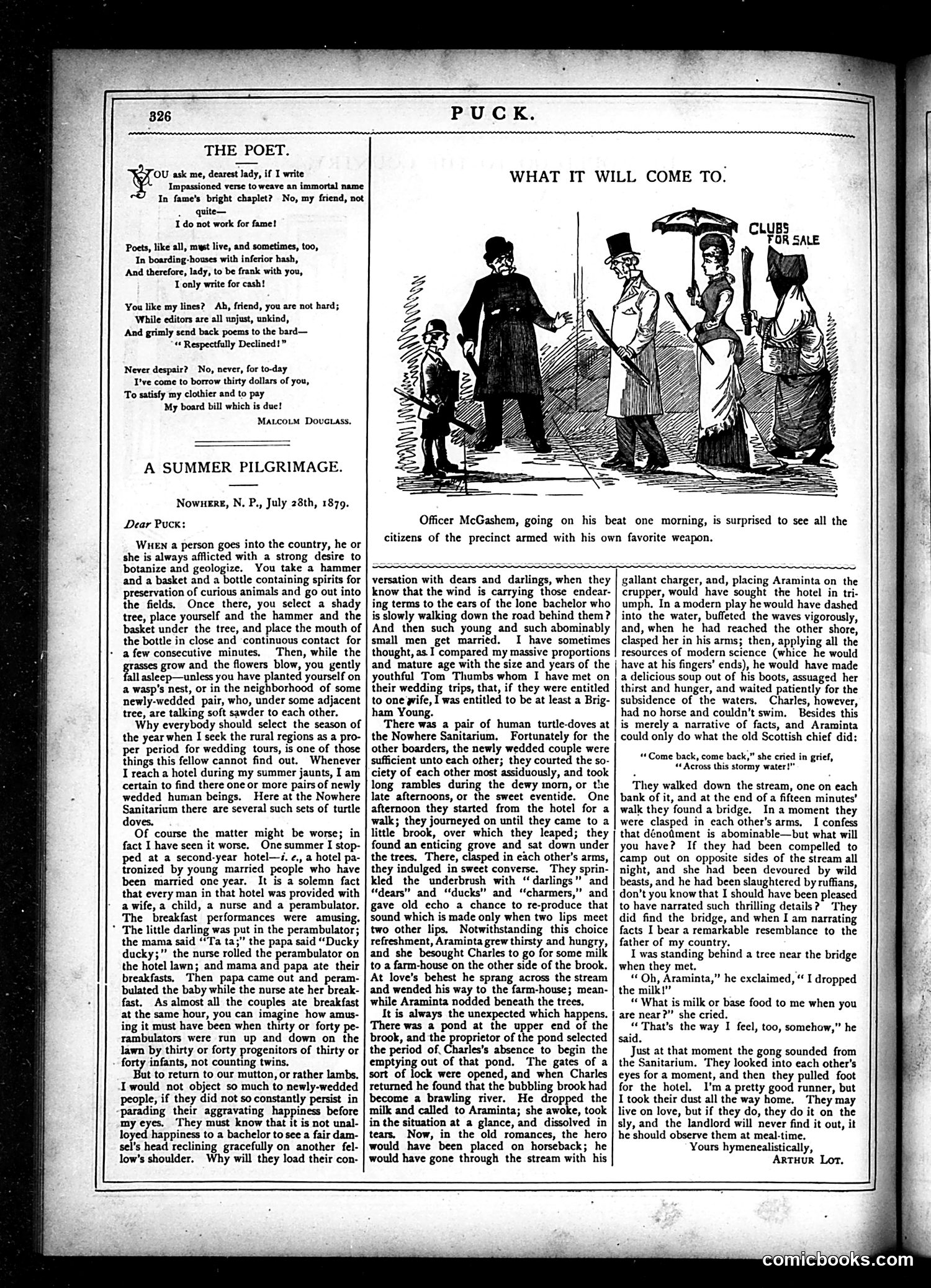
What you’re looking at
This cartoon satirizes the commercialization of marriage and courtship among the wealthy. The illustration shows a group of elegantly dressed people standing in the rain, with a sign reading "CLUBS FOR SALE." The satire suggests that marriage has become a mere transaction—reduced to a commodity one can purchase like any other good. The figures appear to represent various social classes or types (military officer, gentleman, ladies), implying that even the institution of matrimony itself has become subject to market forces. The rain and outdoor setting emphasize the degradation of something once sacred, now hawked publicly like merchandise. The joke reflects Gilded Age anxieties about wealth's corrupting influence on traditional social institutions and romantic relationships.
📄 Transcribed text from this page (OCR, searchable)
Machine-transcribed from the original scan — historical spelling and the odd misread are preserved.
PUCK. THE POET. ‘OU ask me, dearest lady, if I write Impassioned verse to weave an immortal name In fame’s bright chaplet? No, my friend, not - quite— I do not work for fame! Poets, like all, myst live, and sometimes, too, In boarding-houses with inferior hash, ‘And therefore, lady, to be frank with you, T only write for cash! ‘You like my lines? Ab, friend, you are not hard; While editors are all unjust, unkind, ‘And grimly send back poems to the bard— « Respectfully Declined!” Never despair? No, never, for to-day T’ve come to borrow thirty dollars of you, To satisfy my clothier and to pay My board bill which is due! Matcotm Dovuctass. A SUMMER PILGRIMAGE. Nownerg, N, P., July 28th, 1879. Dear Puck: Wuen a person goes into the country, he or she is always afflicted with a strong desire to botanize and geologize. You take a hammer and a basket and a bottle containing spirits for preservation of curious animals and go out into the fields. Once there, you select a shady tree, place yourself and the hammer and the basket under the tree, and place the mouth of the bottle in close and ‘continuous contact for a few consecutive minutes. Then, while the asses grow and the flowers blow, you gently fall asleep—unless you have planted yourself on a wasp’s nest, or in the neighborhood of some newly-wedded pair, who, under some adjacent tree, are talking soft sawder to each other. Why everybody should select the season of the year when I seek the rural regions as a pro- per period for wedding tours, is one of those things this fellow cannot find out. Whenever T reach a hotel during my summer jaunts, I am certain to find there one or more pairs of newly wedded human beings. Here at the Nowhere Sanitarium there are several such sets of turtle doves. Of course the matter might be worse; in fact I have seen it worse. One summer I stop- ped at a second-year hotel—i. ¢., a hotel pa- tronized by young married people who have been married one year. It is a solemn fact that every man in that hotel was provided with awife, a child, a nurse and a perambulator. The breakfast performances were amusing, * The little darling was put in the perambulator; the mama said “Ta ta;” the papa said “Ducky ducky;” the nurse rolled the perambulator on the hotel lawn; and mama and papa ate their breakfasts, Then papa came out and peram- bulated the baby while the nurse ate her break- fast. As almost all the couples ate breakfast at the same hour, you can imagine how amus- ing it must have been when thirty or forty pe- rambulators were run up and down on the lawn by thirty or forty progenitors of thirty or forty infants, not counting twins, Bat to return to our mutton, or rather lambs. I would not object so much to newly-wedded people, if they did not so constantly persist in parading their aggravating happiness before my eyes. They must know that it is not unal- loyed happiness to a bachelor to see a fair dam- sels head reclining gracefully on another fel- low’s shoulder. Why will they load their con- WHAT IT WILL COME TO. Officer McGashem, going on his beat one morning, is surprised to see all the citizens of the precinct armed with his own favorite weapon. versation with dears and darlings, when they know that the wind is carrying those endear- ing terms to the ears of the lone bachelor who is slowly walking down the road behind them? And then such young and such abominably small men get married. I have sometimes thought, as I compared my massive proportions and mature age with the size and years of the youthful Tom Thumbs whom I have met on their wedding trips, that, if they were entitled to one wife, I was entitled to be at least a Brig- ham Young. There was a pair of human turtle-doves at the Nowhere Sanitarium, Fortunately for the other boarders, the newly wedded couple were sufficient unto each other; they courted the so- ciety of each other most assiduously, and took long rambles during the dewy morn, or the late afternoons, or the sweet eventide. One afternoon they started from the hotel for a walk; they journeyed on until they came to a little’ brook, over which they leaped; they found an enticing grove and sat down under the trees. There, clasped in each other’s arms, they indulged in sweet converse. They sprin- kled the underbrush with “darlings” and “dears” and “ducks” and ‘charmers,” and gave old echo a chance to re-produce that sound which is made only when two lips meet two other lips. Notwithstanding this choice refreshment, Araminta grew thirsty and hungry, and she besought Charles to go for some milk to a farm-house on the other side of the brook. At love’s behest he sprang across the stream and wended his way to the farm-house; mean- while Araminta nodded beneath the trees. It is always the unexpected which happens. There was a pond at the upper end of the brook, and the proprietor of the pond selected the period of. Charles's absence to begin the emptying out of that pond. The gates of a sort of lock were opened, and when Charles returned he found that the bubbling brook had become a brawling river. He dropped the milk and called to Araminta; she awoke, took in the situation at a glance, and dissolved in tears. Now, in the old romances, the hero would have been placed on horseback; he would have gone through the stream with his gallant charger, and, placing Araminta on the crupper, would have sought the hotel in tri- umph, In a modern play he would have dashed into the water, buffeted the waves vigorously, and, when he had reached the other shore, clasped her in his arms; then, applying all the resources of modern science (whice he would | have at his fingers’ ends), he would have made a delicious soup out of his boots, assuaged her thirst and hunger, and waited patiently for the subsidence of the waters. Charles, however, had no horse and couldn’t swim. Besides this is merely a narrative of facts, and Araminta could only do what the old Scottish chief did: “Come back, come back,” she cried in grief, “Across this stormy water!" They walked down the stream, one on each bank of it, and at the end of a fifteen minutes’ walk they found a bridge. In a moment they were clasped in cach other's arms, I confess that dénodment is abominable—but what will you have? If they had been compelled to camp out on opposite sides of the stream all night, and she had been devoured by wild beasts, and he had been slaughtered by ruffians, don’t you know that I should have been pleased to have narrated such thrilling details? They did find the bridge, and when I am narrating facts I bear a remarkable resemblance to the father of my country. I was standing behind a tree near the bridge when they met. “Oh, Araminta,” he exclaimed, “ I dropped the milk!” “What is milk or base food to me when you are near?” she cried. “That's the way I feel, too, somehow,” he said. Just at that moment the gong sounded from the Sanitarium. They looked into each other's eyes for a moment, and then they pulled foot for the hotel. I'ma pretty good runner, but I took their dust all the way home. ‘They may live on love, but if they do, they do it on the sly, and the landlord will never find it out, it he should observe them at meal-time. Yours hymenealistically, ARTHUR Lot.