
A complete issue · 16 pages · 1879
Puck — May 28, 1879
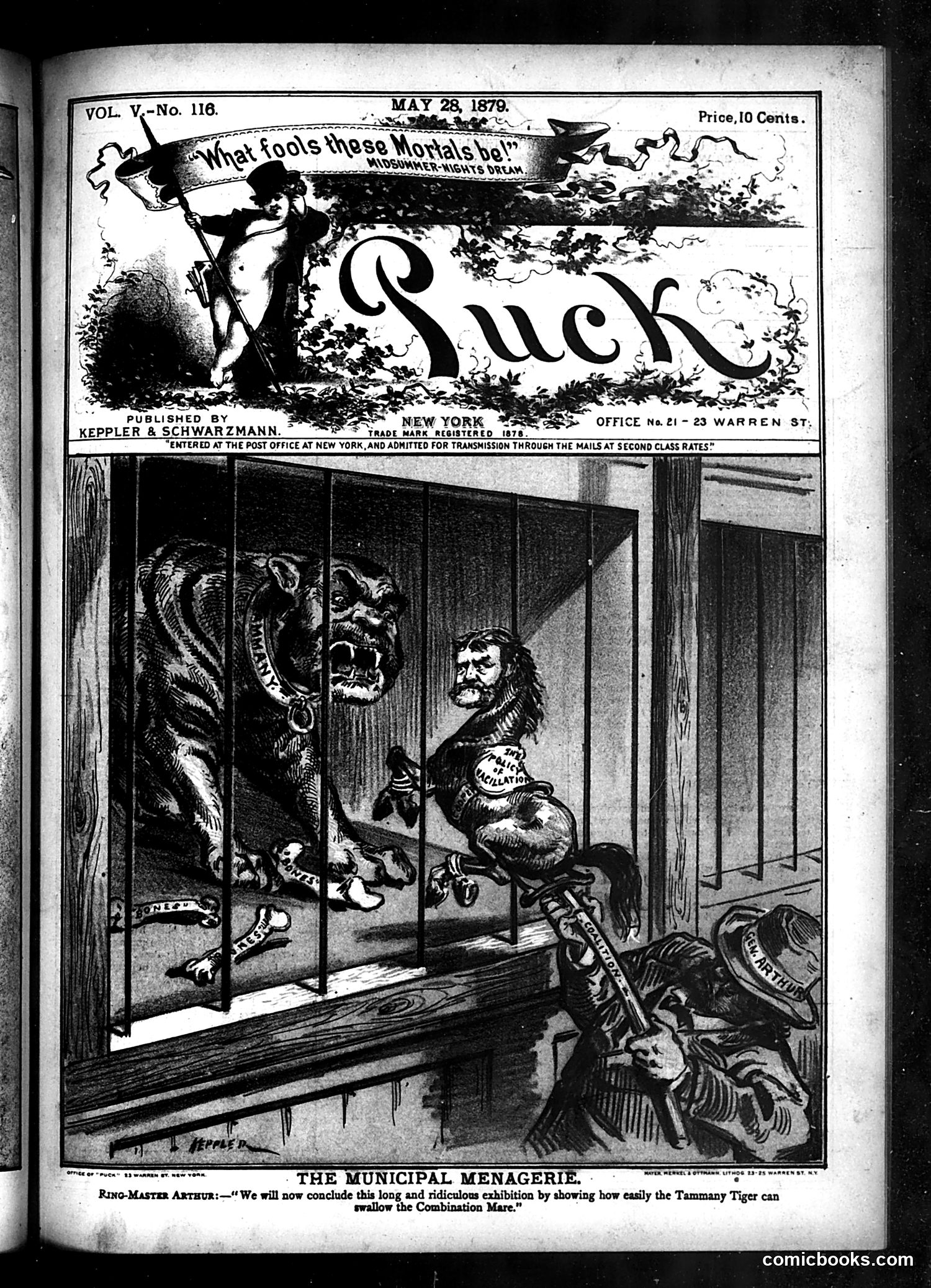
This satirical cartoon depicts New York City politics as a dangerous zoo exhibit. The caption quotes "Ring-Master Arthur" (likely Mayor Arthur), promising to conclude a "long and ridiculous exhibition" by demonstrating "how easily the Tammany Tiger can swallow the Combination Mare." The image shows a man in formal dress (representing the Mayor or city administration) observing a caged tiger attacking a horse—visual metaphors for political factions. The "Tammany Tiger" refers to Tammany Hall, the powerful Democratic machine that dominated NYC politics. The "Combination Mare" likely represents a reform coalition challenging Tammany's control. The cartoon mocks municipal government as a spectacle of competing corrupt interests consuming each other, with city leadership merely watching the destructive show unfold.
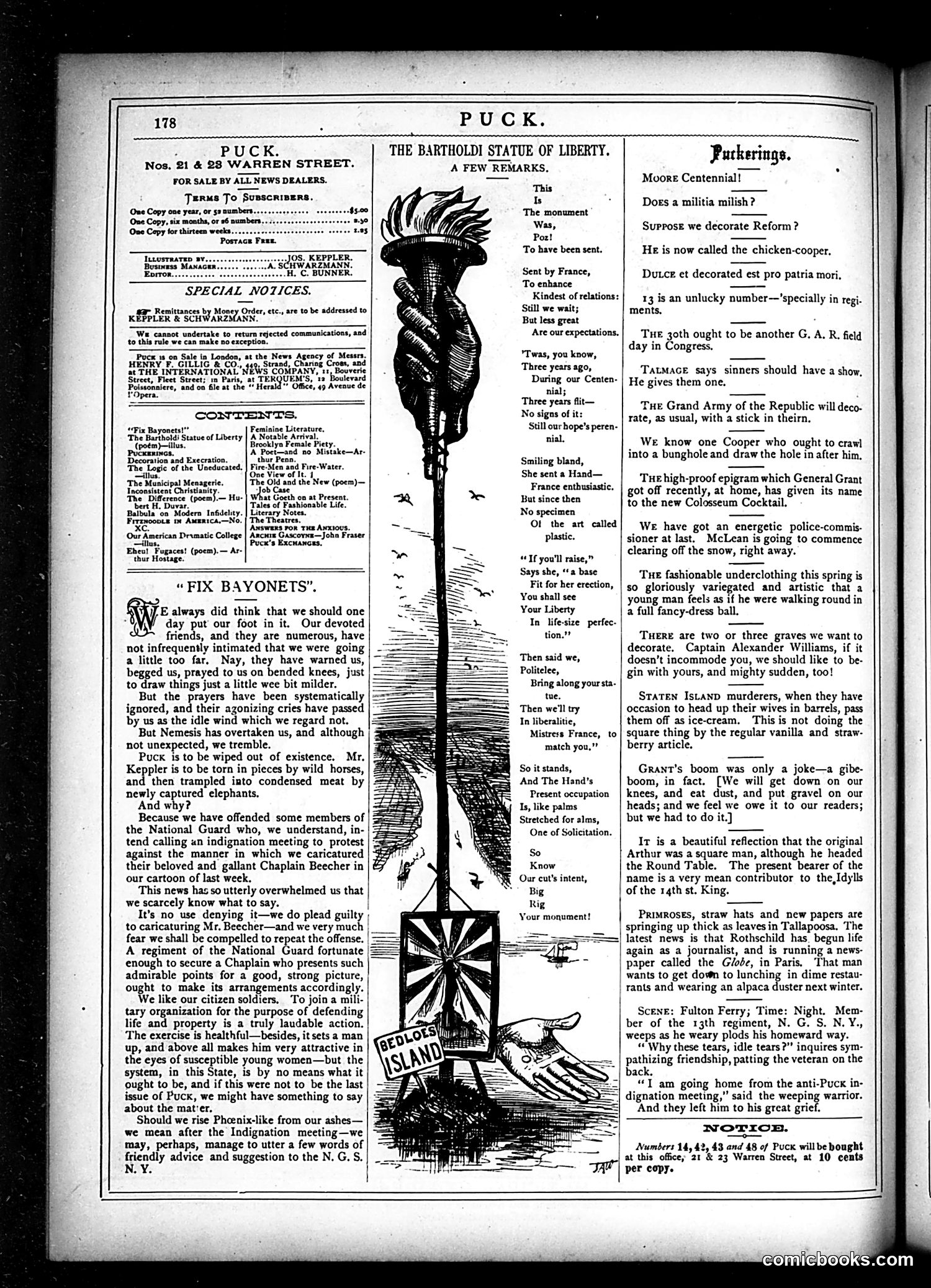
The central image depicts the Statue of Liberty as a torch-bearing figure, accompanied by a poem titled "The Bartholdi Statue of Liberty: A Few Remarks." The satire appears to critique the monument itself—a gift from France that was newly erected or recently debated in America. The poem's tone is ambivalent, describing Liberty as still waiting ("Sent by France, / To enhance / Kindred of relations") yet questioning her effectiveness ("No specimen / Of the art called / plantic"). This likely mocks either the statue's artistic merit, its symbolic relevance to American ideals, or the political implications of accepting such a foreign monument. The accompanying puckerings column offers additional satirical commentary on contemporary social and political matters.
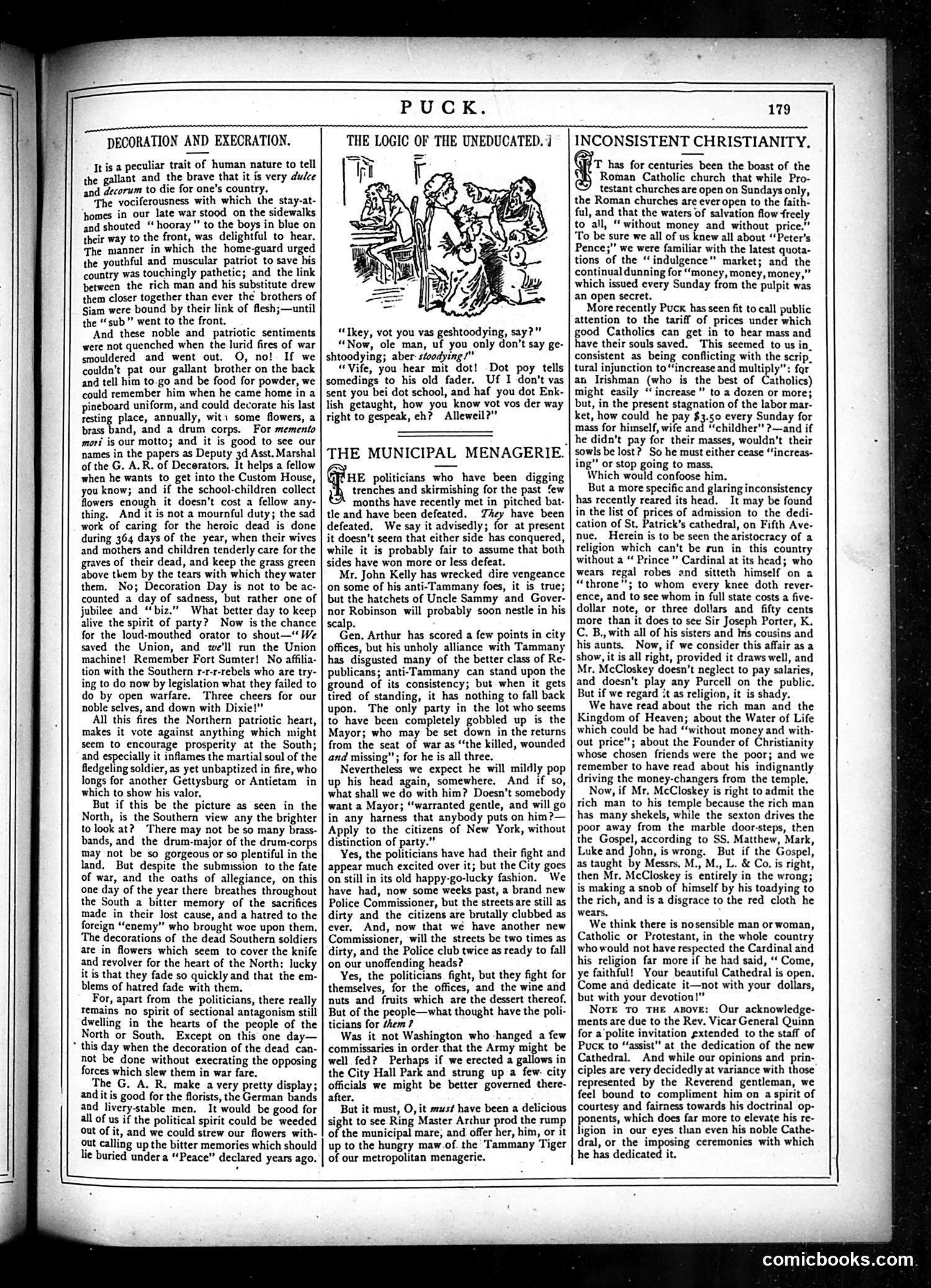
This cartoon depicts a dialogue between what appears to be a working-class man and an educated figure, likely illustrating class differences in reasoning. The uneducated man makes illogical statements ("If you only don't say ge-whooping; aber slooping!"), while his interlocutor responds with patient correction. The satire targets both working-class immigrants (suggested by the broken English dialect) and, ironically, the educated classes who condescend to them. The cartoon mocks the premise that education automatically confers logical thinking, while suggesting that common folk operate from fundamentally different—though not necessarily inferior—reasoning frameworks. This reflects Gilded Age anxieties about immigration, labor, and social hierarchy that Puck frequently satirized.
This page contains two distinct articles rather than political cartoons. "The Difference" presents a debate between two young men about love and marriage—one romantic, one cynical—rendered as humorous verse by Hubert H. Duval. The main content is "Balbula on Modern Infidelity," featuring a priest of Apollo (an imaginary classical god) discussing religion and social progress with a reporter. The satire attacks religious claims to absolute truth by suggesting that Christianity, like worship of Apollo, represents human projection rather than divine revelation. Balbula argues that science and reason, not religious doctrine, explain the world—a critique of organized religion's authority characteristic of late 19th-century skeptical commentary. The "Fitznoodle in America" column appears to be travel humor about American customs.
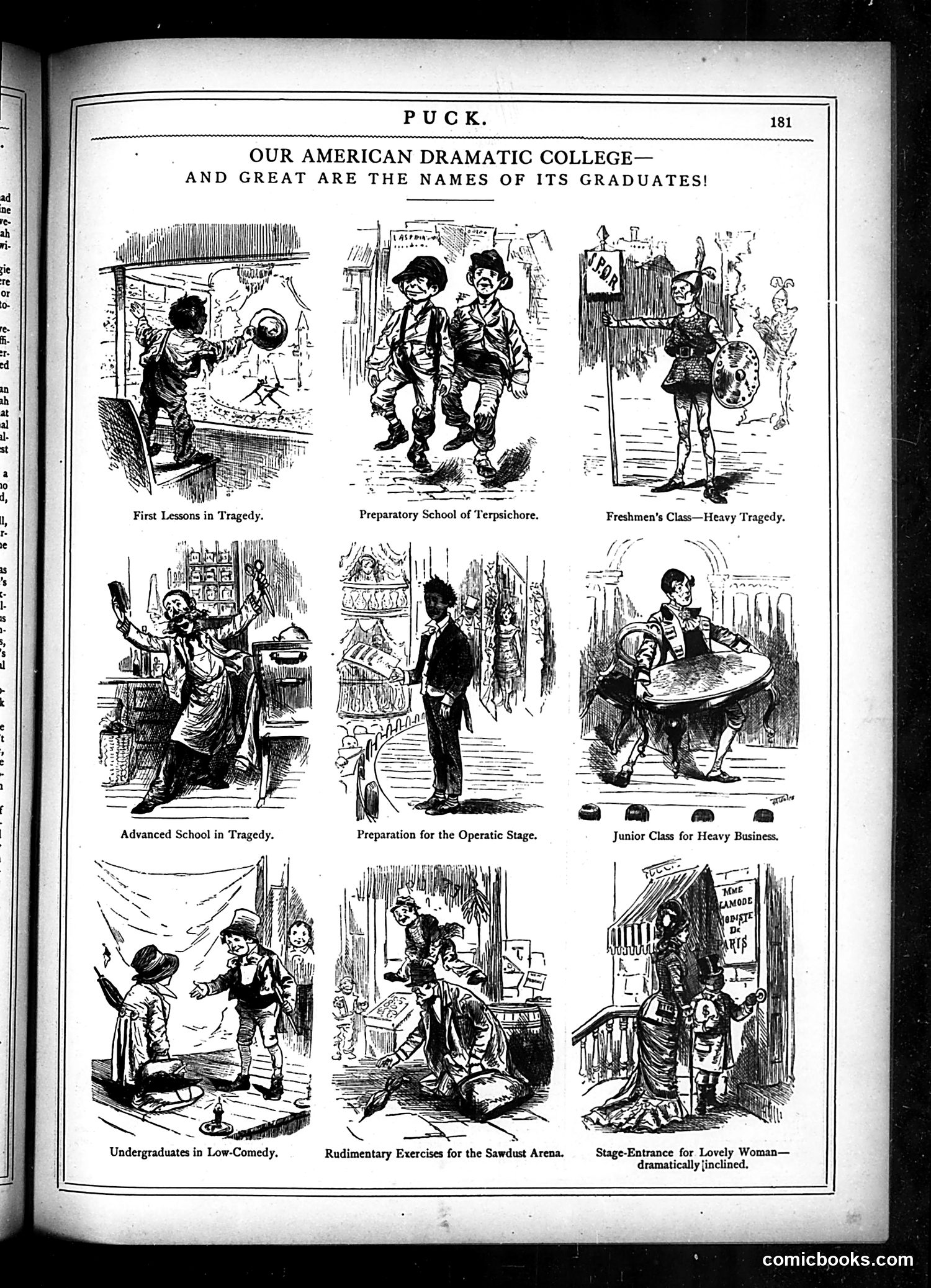
This Puck satirical page mocks American dramatic training through nine vignettes showing absurd "courses" at a fictional drama school. Each illustration depicts exaggerated scenarios with humorous captions: The satire targets theatrical education's pretensions and ineffectiveness. Rather than serious instruction, students receive ridiculous lessons: "First Lessons in Tragedy" shows slapstick mishaps, "Preparatory School of Terpsichore" features clumsy dancing, and "Junior Class for Heavy Business" depicts incompetent acting. The joke suggests American dramatic training produces mediocre performers through absurd methods. The final caption—"Stage-Entrance for Lovely Woman—dramatically inclined"—likely critiques nepotism or unqualified actors gaining roles through appearance rather than talent. This reflects late 19th-century skepticism toward American theatrical institutions compared to European dramatic academies.
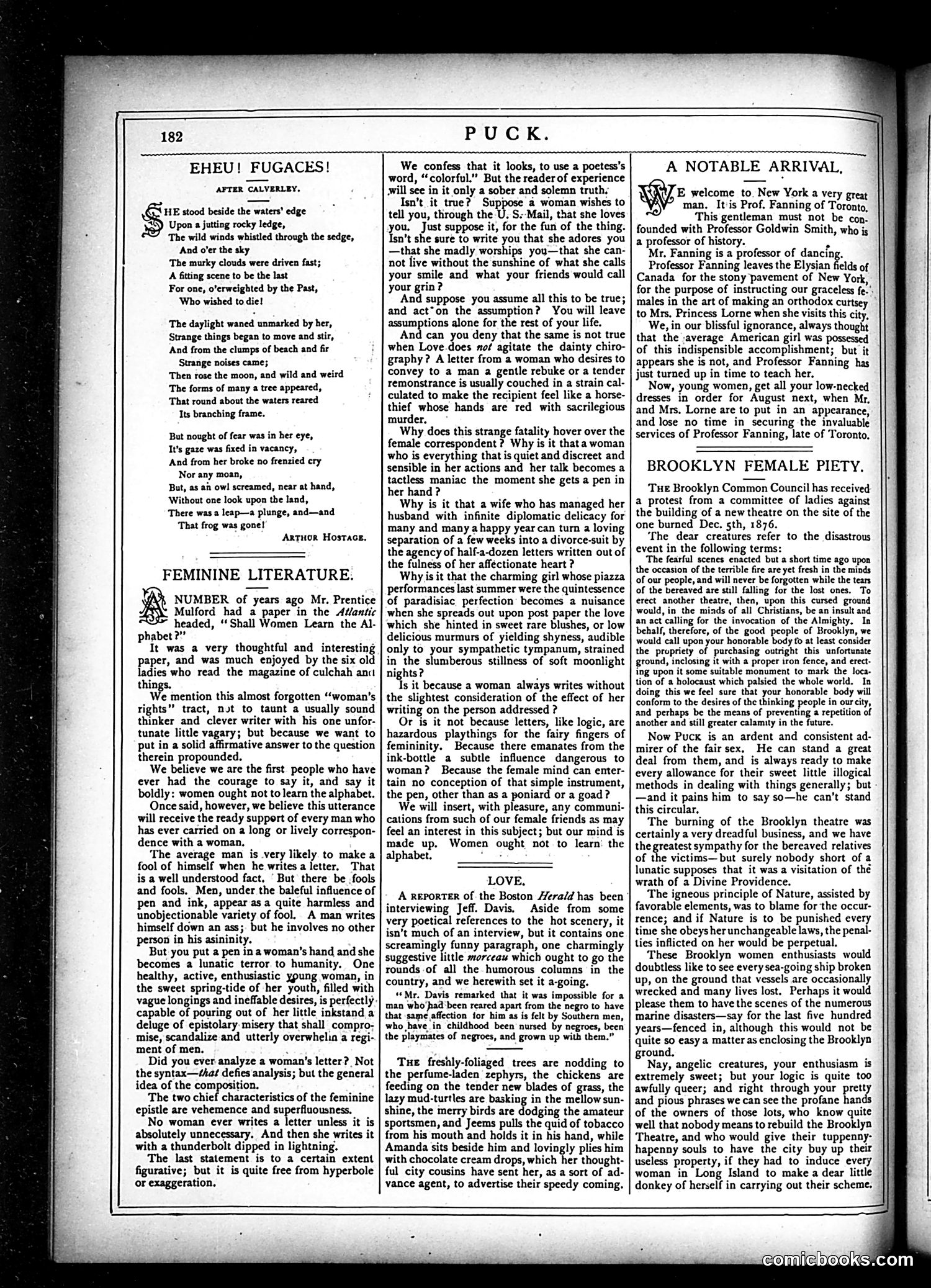
This page contains three distinct articles rather than political cartoons. "Eheu! Fugaces!" is a poem about time's passage and lost youth. "Feminine Literature" is satirical commentary on women's writing, arguing that women should not attempt serious literature because they lack the intellectual rigor of men—a piece reflecting Victorian attitudes toward women's intellectual capacity. "A Notable Arrival" announces Professor Fanning of Toronto, founder of an institute for teaching "graceful deportment" to young women. "Brooklyn Female Piety" satirizes Brooklyn ladies' charity efforts, mocking their enthusiasm for theater renovations while claiming moral superiority. The article suggests their charitable work is performative rather than genuinely compassionate. The overall tone is misogynistic by modern standards, typical of Puck's era.
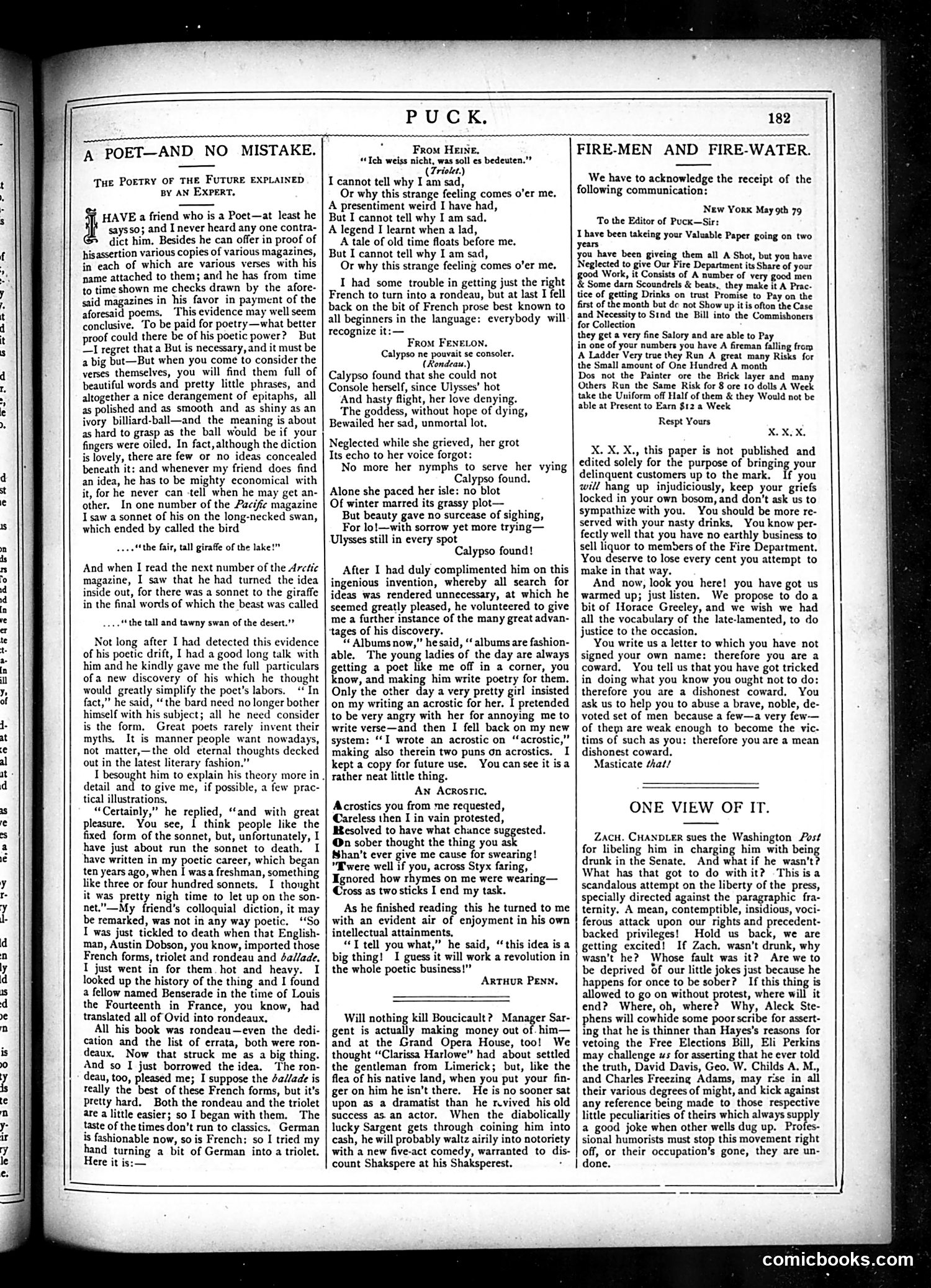
This page contains primarily **text content rather than political cartoons** — it consists of several poems and letters to the editor. The main pieces include: 1. **"A Poet—and No Mistake"** — A humorous essay defending poetry's value, arguing poets deserve recognition for their "beautiful words and pretty little phrases." 2. **"Fire-Men and Fire-Water"** — A letter criticizing New York firefighters for accepting bribes and alcohol while on duty, suggesting corruption in the department. 3. **"One View of It"** — A satirical piece mocking congressional debates over paragraph formatting in press coverage, suggesting politicians obsess over trivial procedural matters rather than substantive issues. The page functions as **editorial commentary** rather than visual satire, typical of Puck's mixed format combining humor with social criticism.
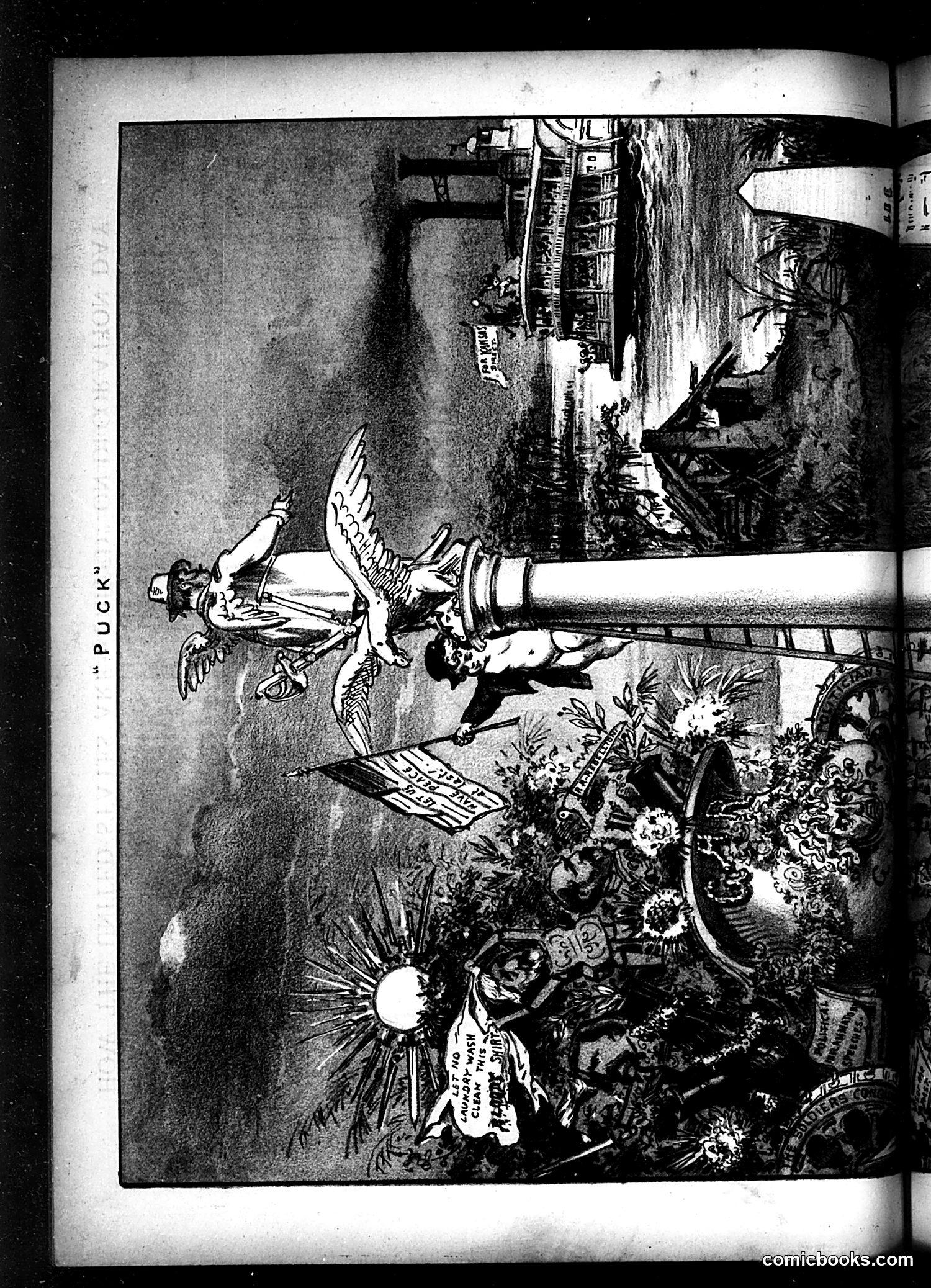
This page contains a political cartoon (rotated 90 degrees) titled "Puck" featuring an allegorical winged figure—likely representing either Puck itself (the satirical spirit of the magazine) or a political/social concept of the era. The figure appears to be interacting with flowers and plants in an elaborate garden or natural setting. The upper portion shows what appears to be an architectural or industrial scene, though details are unclear due to image quality. Without visible text identifying specific political figures or dated events, the exact satirical target remains uncertain. The ornate, fantastical style and floral imagery suggest commentary on aesthetics, nature, or possibly social pretense—common Puck subjects—but the specific contemporary reference cannot be reliably determined from the visible elements alone.
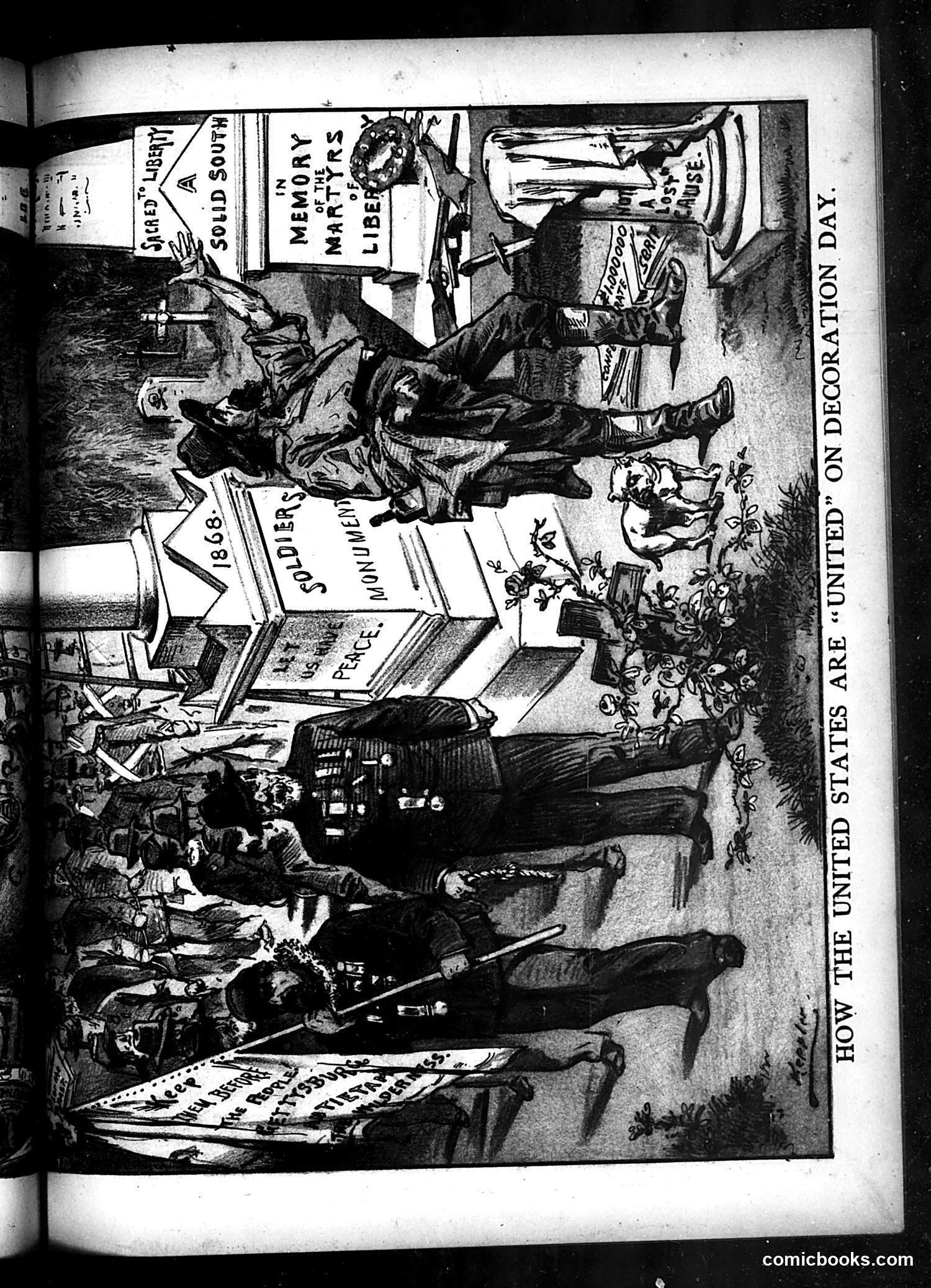
The caption reads: "HOW THE UNITED STATES ARE 'UNITED' ON DECORATION DAY" This is a satirical commentary on American patriotism and national unity, apparently published around Decoration Day (now Memorial Day). The cartoon depicts figures in formal dress examining or displaying patriotic materials and monuments, with visible text referencing "1868" and what appears to be "Soldiers' Monument" or similar. The satire likely critiques the gap between ceremonial patriotism on Decoration Day and actual political division or social conflict in America. The positioning of figures and scattered materials suggests discord masked by official commemorative displays. Without clearer visibility of all figures, the specific political targets remain unclear, but the thrust appears to be: Americans claim unity during patriotic observances while remaining genuinely divided.
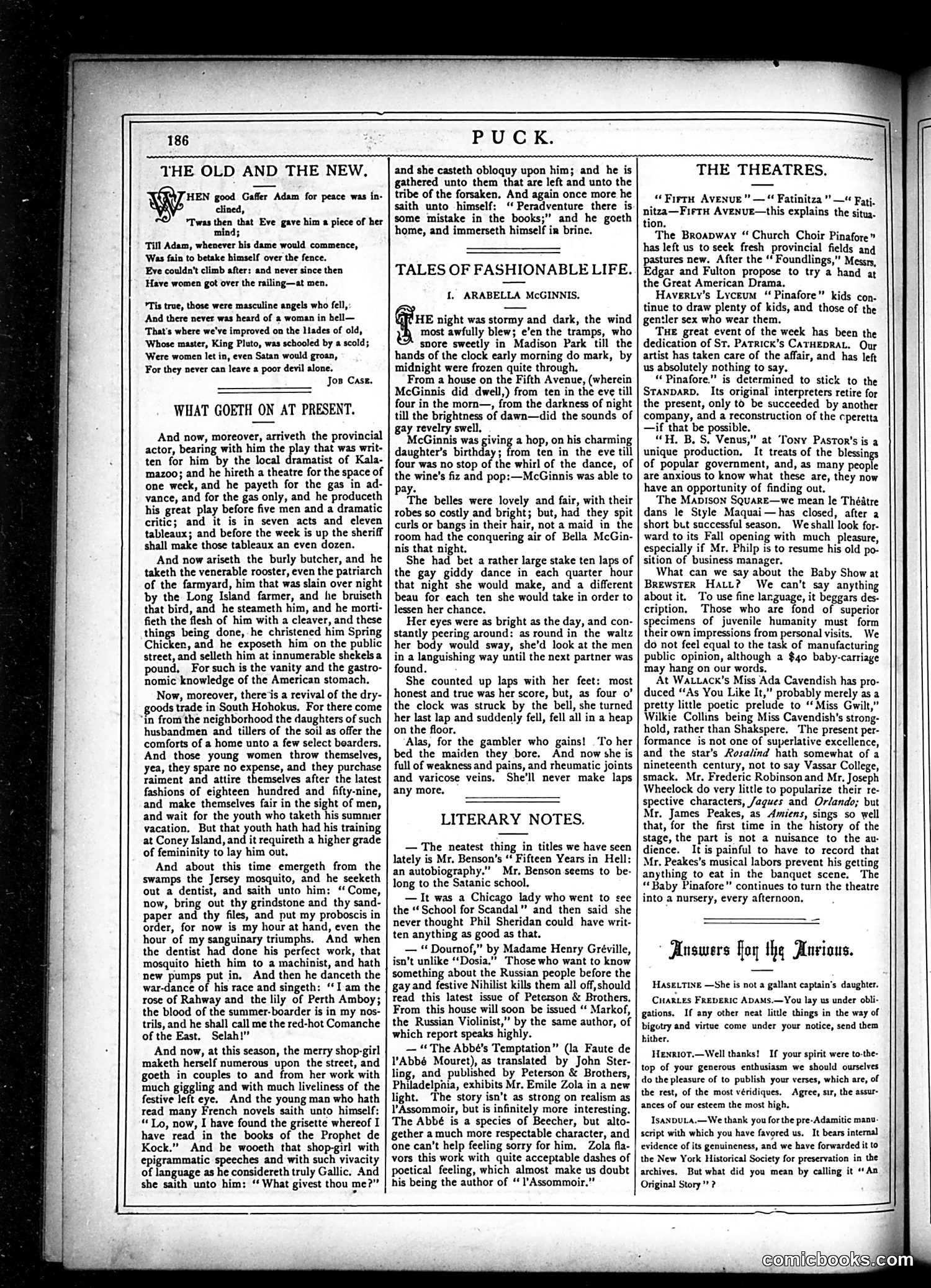
This page contains primarily **literary and theatrical criticism** rather than political satire. The main sections are: 1. **"The Old and the New"** — a poem contrasting past and present 2. **"Tales of Fashionable Life"** — a serialized story about high-society characters in Madison Park and Fifth Avenue 3. **"The Theatres"** — reviews of contemporary Broadway productions 4. **"Literary Notes"** — brief commentary on new books 5. **"Answers for the Anxious"** — an advice column The page focuses on **cultural and social commentary** rather than political cartooning. It satirizes fashionable New York society, theatrical trends, and literary pretensions of the era, typical of Puck's sophisticated urban audience. No specific political figures or events appear to be targeted on this particular page.
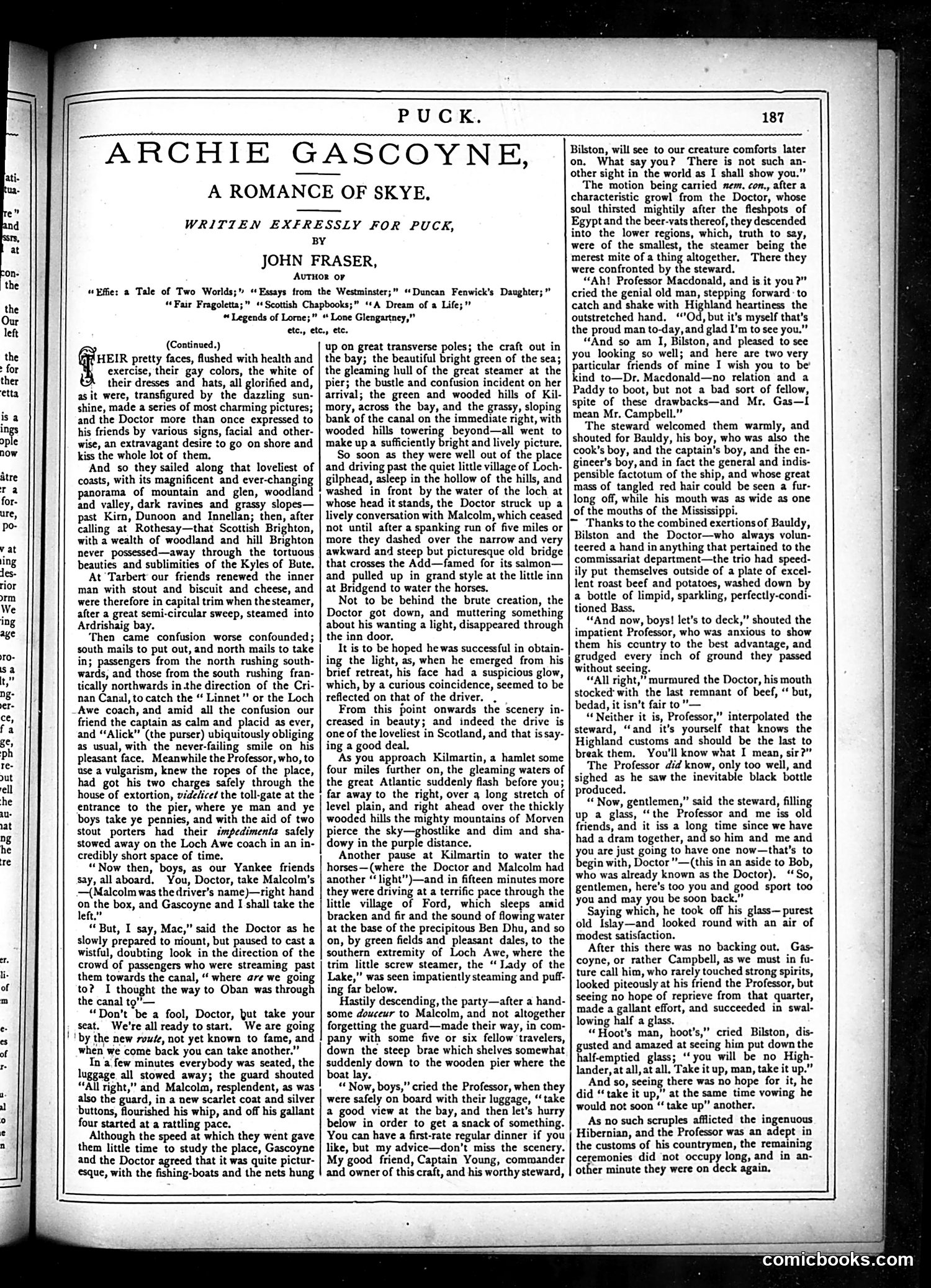
This page contains the continuation of "Archie Gascoyne, A Romance of Skye," a serialized story written by John Fraser for Puck magazine. The text is literary fiction rather than political satire or cartooning. The narrative describes a Scottish Highland journey featuring characters including Professor Macdonald, Bilston, the Doctor, and Malcolm. The story focuses on picturesque landscape descriptions (Kilmartin, Loch Awe, Ben Dhu) and dialogue between traveling companions discussing their journey and accommodations. This appears to be part of Puck's literary content—the magazine published serialized fiction alongside its famous satirical cartoons. No political figures, caricatures, or social satire are evident on this particular page; it's straightforward romantic fiction set in Scotland.
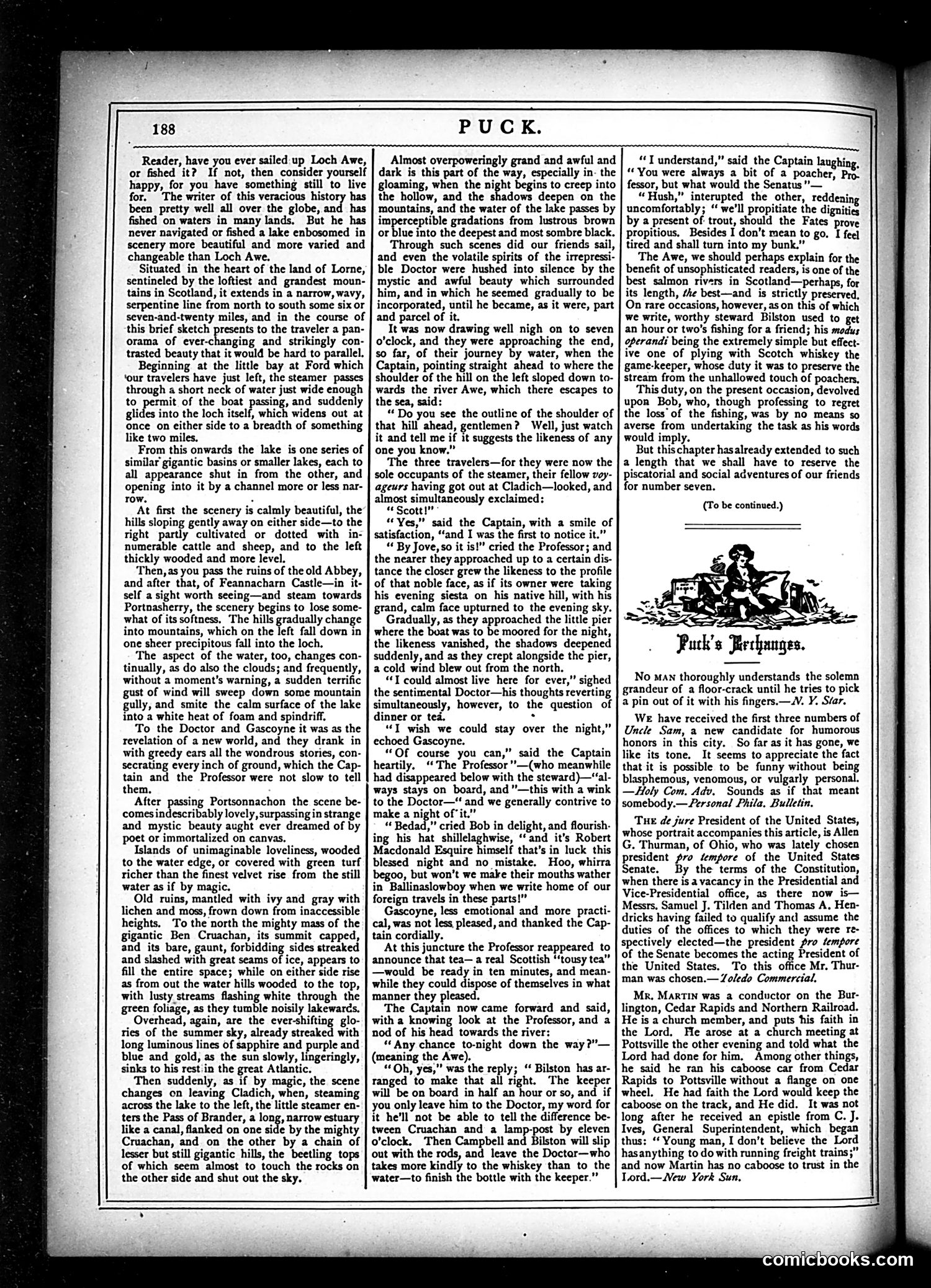
This page continues a serialized travel narrative about sailing Scotland's Loch Awe. The main text describes scenic descriptions of the loch and humorous interactions among travelers—a Captain, Professor, Doctor, and others discussing their evening plans. The sidebar titled "Puck's Afterthoughts" contains brief satirical commentary on contemporary topics. One item mocks President Theodore Roosevelt's recent appointment of new cabinet members (Samuel J. Tilden and Thomas A. Hendricks are mentioned), suggesting uncertainty about their qualifications. Another brief item jokes about a conductor on Northern railroads. The page is primarily text-based rather than illustrated political cartooning. It represents Puck's mixed format of serialized humor and short topical jabs at current events and public figures.
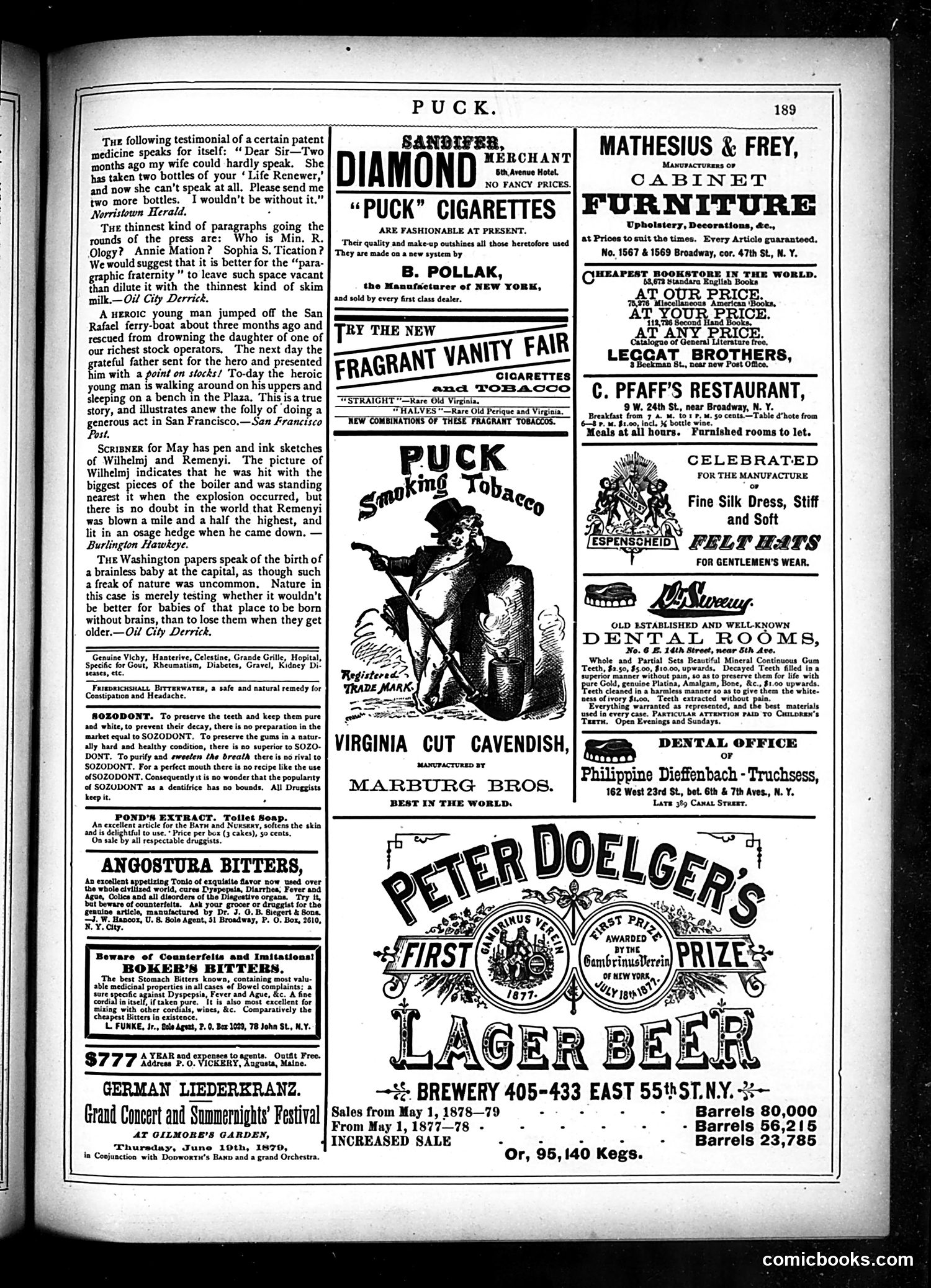
This page is **primarily advertising**, not political satire. It contains commercial advertisements for late 19th-century products and services, including: - Diamond cigarettes and "Puck" brand cigarettes - Furniture and cabinet makers - Restaurants and dental offices - Felt hats for gentlemen - A prominent advertisement for Peter Doelger's Lager Beer (brewery located at 405-433 East 55th Street, New York) The only substantial illustrated content is the Puck Smoking Tobacco advertisement featuring a caricatured figure with an exaggerated face smoking a pipe, advertising Virginia Cut Cavendish tobacco manufactured by Marburg Bros. The page reflects Puck magazine's business model: generating revenue through paid advertising rather than solely political commentary.
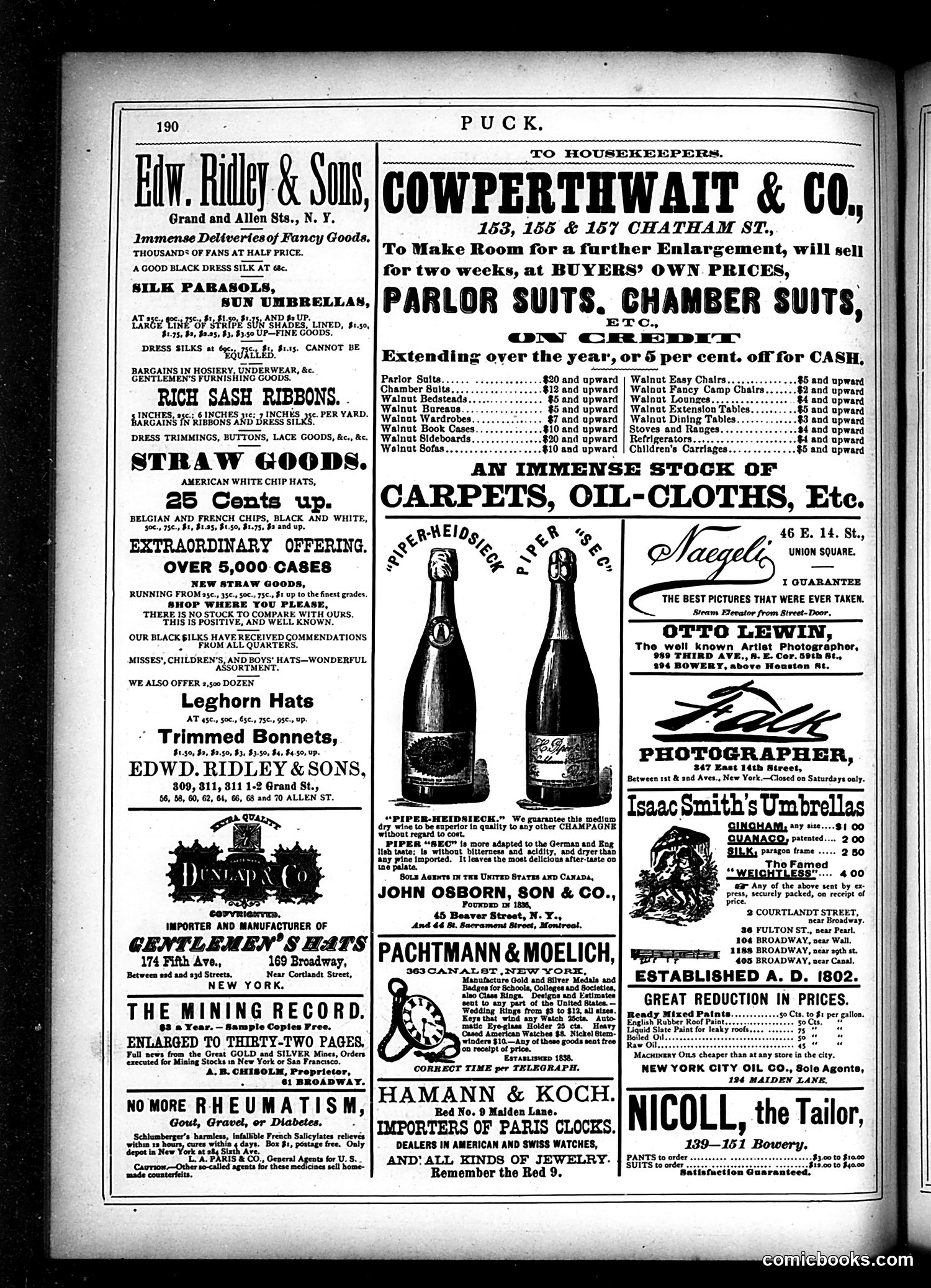
This page is **primarily advertisements**, not editorial cartoons. It features late 19th-century commercial notices for: - Department stores (Ridley & Sons, Cowperthwait & Co.) - Household goods, clothing, and furniture - Champagne brands (Piper-Heidsieck, Piper "Sec") - Photographers and studios - Umbrellas and timepieces - A tailor's services The only notable satirical element is **Dunlap & Co's hat advertisement**, which uses a crown logo—a common visual trope suggesting superiority or quality leadership in competitive markets. The page reflects Puck's business model: satirical content subsidized by luxury advertisements targeting wealthy urban readers. No political cartoons or identifiable caricatures appear here.
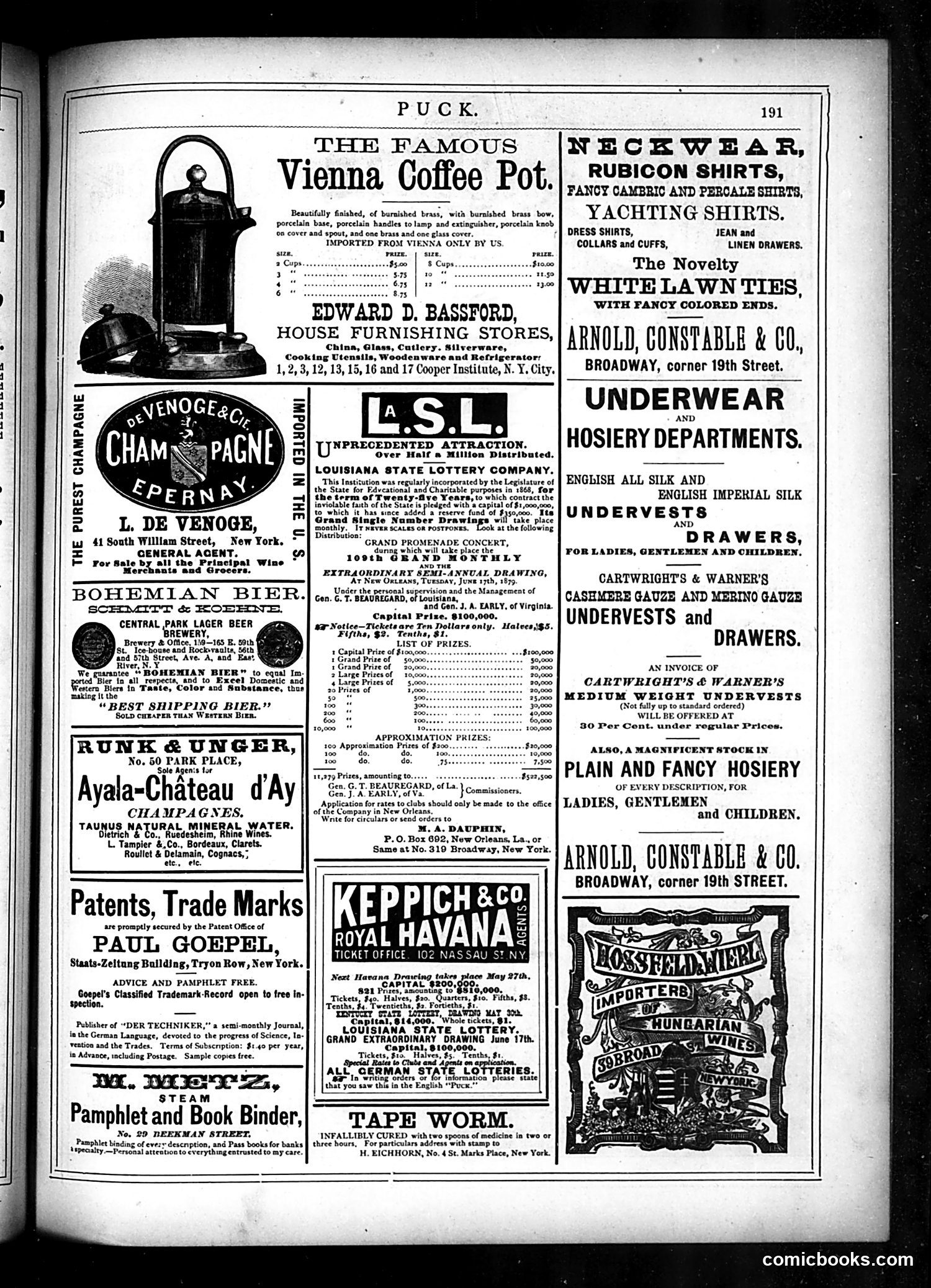
This page is primarily **advertising**, not satirical content. It contains numerous commercial notices for products and services from the 1870s-1890s era, including: - Vienna coffee pots and household goods (Edward D. Bassford) - Champagne and wine (L. de Venoge, Ayala-Chateau d'Ay) - Beer (Bohemian Bier) - Lottery tickets (Louisiana State Lottery Company) - Men's and women's clothing and undergarments (Arnold, Constable & Co.) - Hosiery and fancy goods - Patent and trademark services - Bookbinding services - Various other merchandise The page shows typical Puck magazine advertising layout, with no visible political cartoons or satirical illustrations. It's a straightforward commercial page demonstrating what products and services were marketed to affluent American readers of this period.
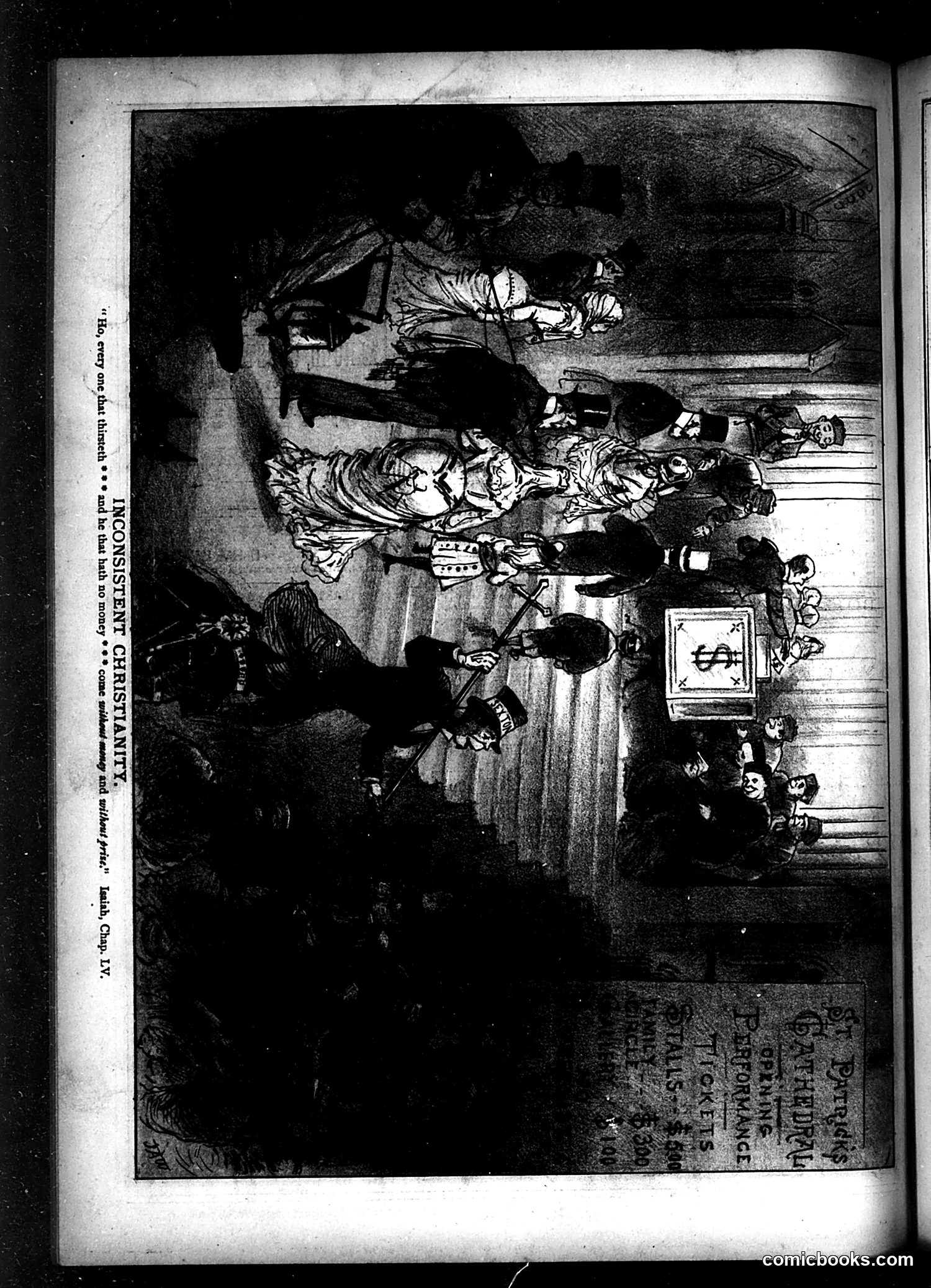
The image is quite dark and difficult to read clearly, but appears to be a satirical illustration oriented sideways on the page. The OCR text is largely illegible in the provided transcription, making precise identification challenging. What's visible suggests this is a **social or political satire** typical of Puck magazine's style—likely depicting a gathering or ceremony of some kind, with multiple figures arranged in a scene. The composition and artistic style are consistent with late 19th or early 20th-century American political cartooning. **Without clearer text or image quality**, I cannot confidently identify the specific figures, historical event, or satirical point being made. To properly explain this to modern readers, I would need either a higher-resolution image or legible OCR text identifying the subject matter, date, and context.