
Puck, 1879-05-28 · page 10 of 16
Puck — May 28, 1879 — page 10: what you’re looking at
What you’re looking at
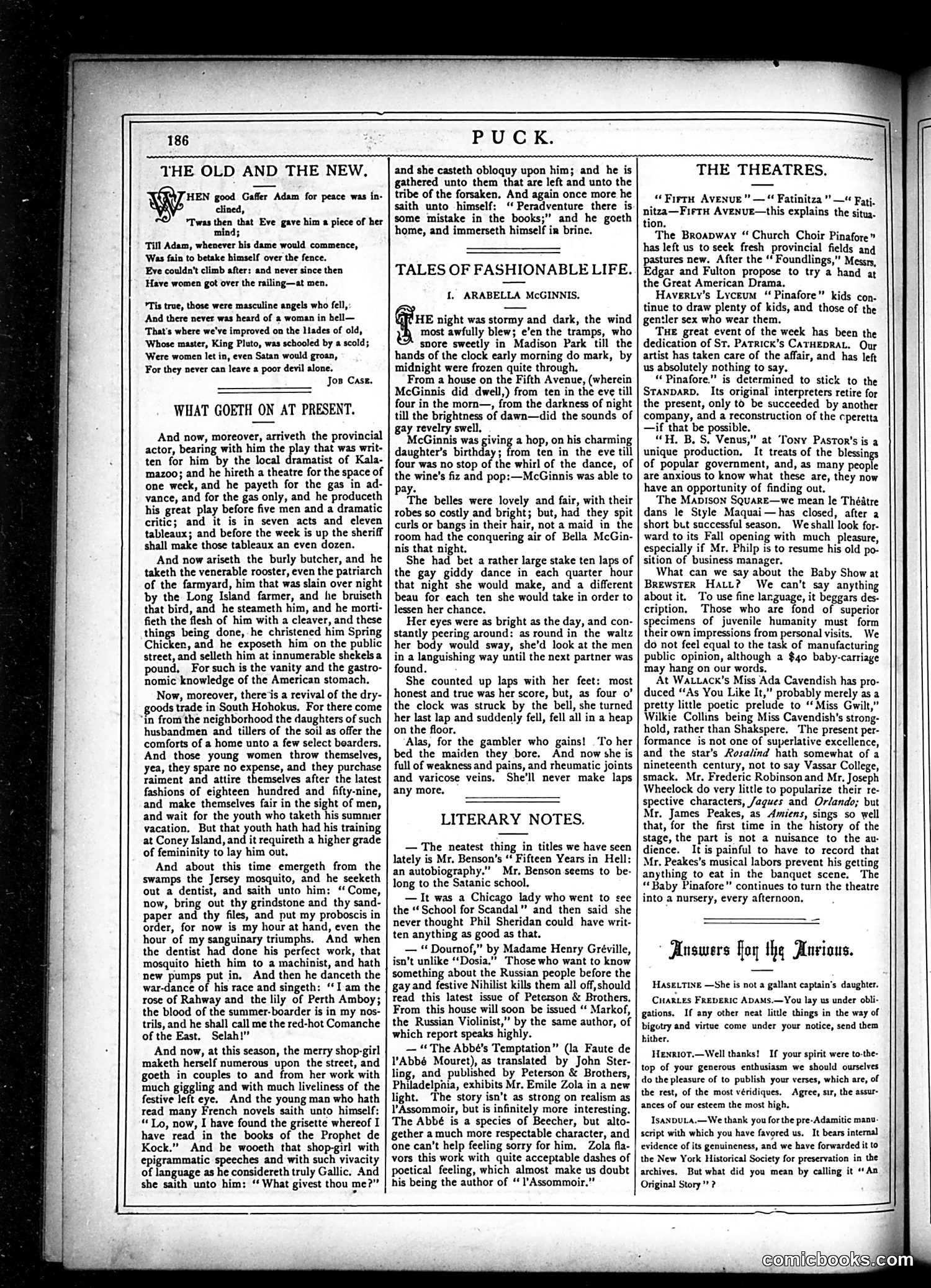
This page contains primarily **literary and theatrical criticism** rather than political satire. The main sections are: 1. **"The Old and the New"** — a poem contrasting past and present 2. **"Tales of Fashionable Life"** — a serialized story about high-society characters in Madison Park and Fifth Avenue 3. **"The Theatres"** — reviews of contemporary Broadway productions 4. **"Literary Notes"** — brief commentary on new books 5. **"Answers for the Anxious"** — an advice column The page focuses on **cultural and social commentary** rather than political cartooning. It satirizes fashionable New York society, theatrical trends, and literary pretensions of the era, typical of Puck's sophisticated urban audience. No specific political figures or events appear to be targeted on this particular page.
📄 Transcribed text from this page (OCR, searchable)
Machine-transcribed from the original scan — historical spelling and the odd misread are preserved.
186 PUCK. THE OLD AND THE NEW. HEN good Gaffer Adam for peace was in- clined, "Twas then that Eve gave him a piece of her mind; Till Adam, whenever his dame would commence, ‘Was fain to betake himself over the fence. Eve couldn't climb after: and never since then Have women got over the railing—at men, "Tis true, those were masculine angels who fell, ‘And there never was heard of a woman in hell— That's where we've improved on the Mades of old, ‘Whose master, King Pluto, was schooled by a scold; ‘Were women let in, even Satan would groan, For they never can leave a poor devil alone. Jon Case. WHAT GOETH ON AT PRESENT. And now, moreover, arriveth the provincial actor, bearing with him the play that was writ- ten for him by the local dramatist of Kala- mazoo; and he hireth a theatre for the space of one week, and he payeth for the gas in ad- vance, and for the gas only, and he produceth his great play before five men and a dramatic critic; and it is in seven acts and eleven tableaux; and before the week is up the sheriff shall make those tableaux an even dozen. And now ariseth the burly butcher, and he taketh the venerable rooster, even the patriarch of the farmyard, him that was slain over night by the Long Island farmer, and he bruiseth that bird, and he steameth him, and he morti- fieth the flesh of him with a cleaver, and these things being done, he christened him Spring Chicken, and he exposeth him on the public street, and selleth him at innumerable shekelsa pound, For such is the vanity and the gastro- nomic knowledge of the American stomach, Now, moreover, there‘is a revival of the dry- goods trade in South Hohokus, For there come “in from the neighborhood the daughters of such husbandmen and tillers of the soil as offer the comforts of a home unto a few select bearders. And those young women throw themselves, yea, they spare no expense, and they purchase raiment and attire themselves after the latest fashions of eighteen hundred and fifty-nine, and make themselves fair in the sight of men, and wait for the youth who taketh his summer vacation. But that youth hath had his training at Coney Island, and it requireth a higher grade of femininity to lay him out. And about this time emergeth from the swamps the Jersey mosquito, and he seeketh out a dentist, and saith unto him: ‘Come, now, bring out thy grindstone and thy sand- paper and thy files, and put my proboscis in order, for now is my hour at hand, even the hour of my sanguinary triumphs. And when the dentist had done his perfect work, that mosquito hieth him to a machinist, and hath new pumps put in, And then he danceth the war-dance of his race and singeth: ‘‘I am the rose of Rahway and the lily of Perth Amboy; the blood of the summer-boarder is in my nos- trils, and he shall call me the red-hot Comanche of the East. Selah!” And now, at this season, the merry shop-girl maketh herself numerous upon the street, and goeth in couples to and from her work with much giggling and with much liveliness of the festive left eye. And the young man who hath read many French novels saith unto himself: “Lo, now, I have found the grisette whereof I have read in the books of the Prophet de Kock.” And he wooeth that shop-girl with epigrammatic speeches and with such vivacity of language as he considereth truly Gallic, And she saith unto him: ‘ What givest thou me?” and she casteth obloquy upon him; and he is gathered unto them that are left and unto the tribe of the forsaken. And again once more he saith unto himself: ‘ Peradventure there is some mistake in the books;” and he goeth home, and immerseth himself in brine. TALES OF FASHIONABLE LIFE. 1. ARABELLA McGINNIS. HE night was stormy and dark, the wind most awfully blew; e’en the tramps, who snore sweetly in Madison Park till the hands of the clock early morning do mark, by midnight were frozen quite through. From a house on the Fifth Avenue, (wherein McGinnis did dwell,) from ten in the eve till four in the morn—, from the darkness of night till the brightness of dawn—did the sounds of gay revelry swell, McGinnis was giving a hop, on his charming daughter’s birthday; from ten in the eve till four was no stop of the whirl of the dance, of the wine's fiz and pop:—McGinnis was able to pay. The belles were lovely and fair, with their robes so costly and bright; but, had they spit curls or bangs in their hair, not a maid in the room had the conquering air of Bella McGin- nis that night. She had bet a rather large stake ten laps of the gay giddy dance in each quarter hour that night she would make, and a different beau for each ten she would take in order to lessen her chance, Her eyes were as bright as the day, and con- stantly peering around: as round in the waltz her body would sway, she'd look at the men in a languishing way until the next partner was found. She counted up laps with her feet: most honest and true was her score, but, as four o’ the clock was struck by the bell, she turned her last lap and suddenly fell, fell all in a heap on the floor. ‘Alas, for the gambler who gains! ‘To her bed the maiden they bore. And now she is full of weakness and pains, and rheumatic joints and varicose veins, She'll never make laps any more. LITERARY NOTES. — The neatest thing in titles we have seen lately is Mr, Benson's “ Fifteen Years in Hell: an autobiography.” Mr, Benson seems to be- long to the Satanic school. — It was a Chicago lady who went to see the “School for Scandal" and then said she never thought Phil Sheridan could have writ- ten anything as good as that. — “ Dournof,” by Madame Henry Greville, isn’t unlike ‘‘Dosia,” Those who want to know something about the Russian people before the gay and festive Nihilist kills them all off, should read this latest issue of Peterson & Brothers. From this house will soon be issued ‘‘ Markof, the Russian Violinist,” by the same author, of which report speaks highly. — ‘The Abbé’s Temptation” (la Faute de VAbbé Mouret), as translated by John Ster- ling, and published by Peterson & Brothers, Philadelphia, exhibits Mr. Emile Zola in a new light. The story isn’t as strong on realism as l’Assommoir, but is infinitely more interesting. The Abbé is a species of Beecher, but alto- gether a much more respectable character, and one can’t help feeling sorry for him. Zola fla- vors this work with quite acceptable dashes of poetical feeling, which almost make us doubt his being the author of ‘]'Assommoir.”” THE THEATRES. “Firth Avenue ” — “ Fatinitza " —« Fat, nitza—FietH Avenue—this explains the situa. tion, The Broapway “ Church Choir Pinafore” has left us to seek fresh provincial fields and pastures new. After the ‘‘ Foundlings,” Messrs, Edgar and Fulton propose to try a hand at the Great American Drama. Haverty's Lyceum “Pinafore” kids con- tinue to draw plenty of kids, and those of the gentler sex who wear them. ‘Tue great event of the week has been the dedication of St. Patrick's CATHEDRAL. Our artist has taken care of the affair, and has left us absolutely nothing to say. “Pinafore.” is determined to stick to the Stanparv. Its original interpreters retire for the present, only to be succeeded by another company, and a reconstruction of the cperetta —if that be possible. “—. B.S, Venus,” at Tony Pastor's is a unique production, It treats of the blessin; of popular government, and, as many people are anxious to know what these are, they now have an opportunity of finding out, The Mapison Square—we mean le Théatre dans le Style Maquai—has closed, after a short but successful season. We shall look for- ward to its Fall opening with much pleasure, especially if Mr. Philp is to resume his old po. sition of business manager. What can we say about the Baby Show at Brewster Hatt? We can't say anything about it. To use fine language, it beggars des- cription, Those who are fond of superior specimens of juvenile humanity must form their own impressions from personal visits. We do not feel equal to the task of manufacturing public opinion, although a $40 baby-carriae may hang on our words. At WaLLack’s Miss Ada Cavendish has pro- duced ‘As You Like It,” probably merely as a pretty little poetic prelude to “Miss Gwilt,” Wilkie Collins being Miss Cavendish’s strong- hold, rather than Shakspere. The present per- formance is not one of superlative excellence, and the star’s Rosalind hath somewhat of a nineteenth century, not to say Vassar College, smack. Mr. Frederic Robinson and Mr. Joseph Wheelock do very little to popularize their re- spective characters, /agues and Orlando; but Mr. James Peakes, ‘as Amiens, sings so well that, for the first time in the history of the stage, the part is not a nuisance to the au- dience. It is painful to have to record that Mr. Peakes's musical labors prevent his getting anything to eat in the banquet scene. The “Baby Pinafore” continues to turn the theatre into a nursery, every afternoon, ‘Answers Foy the Anrious. HAsELTINE —She is not a gallant captain's daughter. CHARLES FREDERIC ADAMS.—You lay us under obli- gations, If any other neat little things in the way of bigotry and virtue come under your notice, send them hither. Hewrior.—Well thanks! If your spirit were to-the- top of your generous enthusiasm we should ourselves do the pleasure of to publish your verses, which are, of the rest, of the most véridiques. Agree, sir, the assur~ ances of our esteem the most high. IsaNDULA.—We thank you for the pre-Adamitic manu: script with which you have favored us. It bears internal evidence of its genuineness, and we have forwarded it to the New York Historical Society for preservation in the archives. But what did you mean by calling it “An Original Story”? comichooks, icom