
Puck, 1879-05-28 · page 3 of 16
Puck — May 28, 1879 — page 3: what you’re looking at
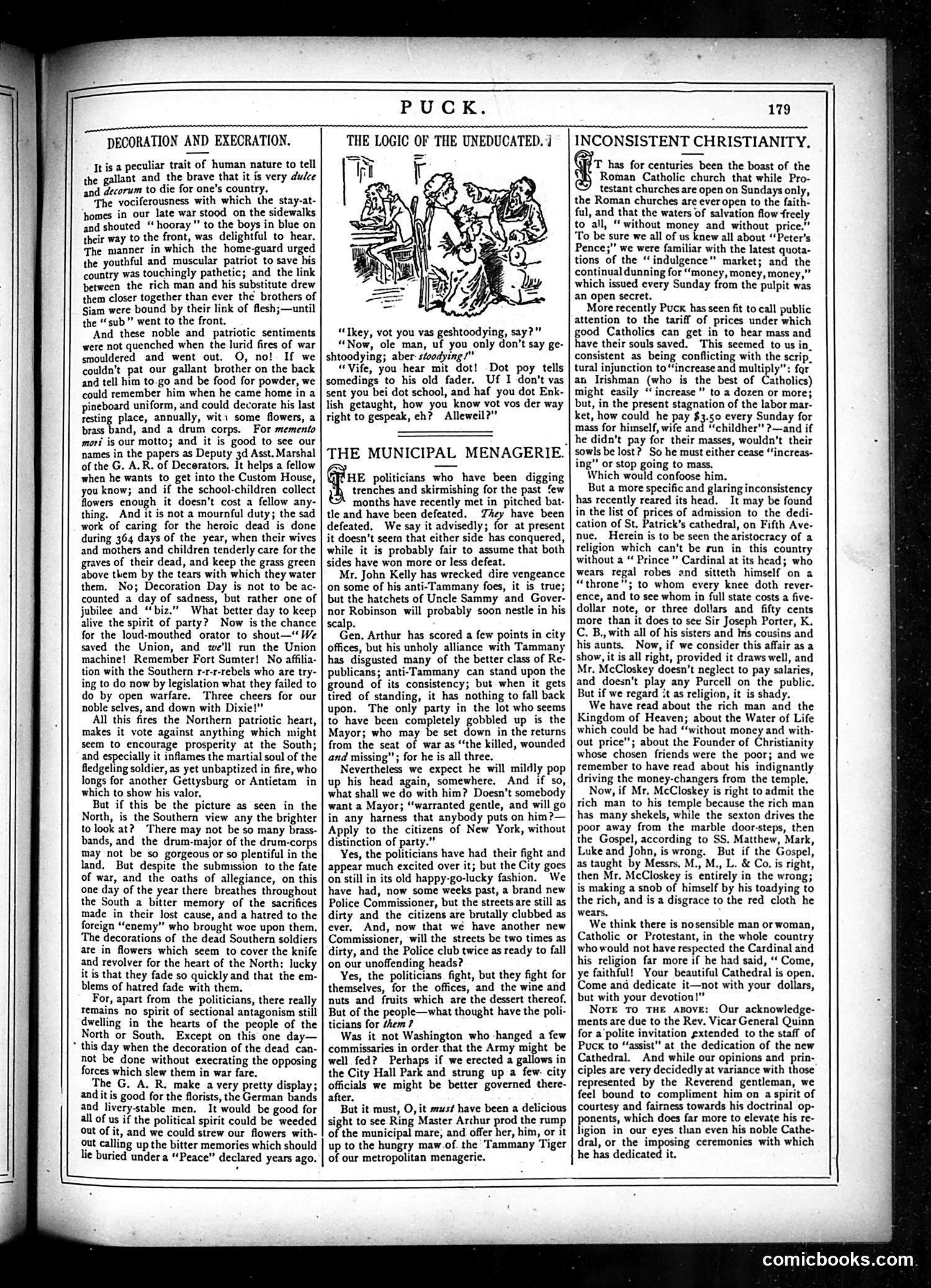
What you’re looking at
This cartoon depicts a dialogue between what appears to be a working-class man and an educated figure, likely illustrating class differences in reasoning. The uneducated man makes illogical statements ("If you only don't say ge-whooping; aber slooping!"), while his interlocutor responds with patient correction. The satire targets both working-class immigrants (suggested by the broken English dialect) and, ironically, the educated classes who condescend to them. The cartoon mocks the premise that education automatically confers logical thinking, while suggesting that common folk operate from fundamentally different—though not necessarily inferior—reasoning frameworks. This reflects Gilded Age anxieties about immigration, labor, and social hierarchy that Puck frequently satirized.
📄 Transcribed text from this page (OCR, searchable)
Machine-transcribed from the original scan — historical spelling and the odd misread are preserved.
PUCK. DECORATION AND EXECRATION. It is a peculiar trait of human nature to tell the gallant and the brave that it is very dulce and decorum to die for one’s country. ‘The vociferousness with which the stay-at- homes in our late war stood on the sidewalks and shouted “hooray " to the boys in blue on their way to the front, was delightful to hear. The manner in which the home-guard urged the youthful and muscular patriot to save his country was touchingly pathetic; and the link between the rich man and his substitute drew them closer together than ever the brothers of Siam were bound by their link of flesh;—until the “sub” went to the front. And these noble and patriotic sentiments were not quenched when the lurid fires of war smouldered and went out. O, no! If we couldn’t pat our gallant brother on the back and tell him to.go and be food for powder, we could remember him when he came home in a pineboard uniform, and could decorate his last resting place, annually, wita some flowers, a brass band, and a drum corps. For memento mori is our motto; and it is good to see our names in the papers as Deputy 3d Asst. Marshal of the G. A.R. of Decerators. It helps a fellow when he wants to get into the Custom House, you know; and if the school-children collect flowers enough it doesn't cost a fellow any- thing. And it is not a mournful duty; the sad work of caring for the heroic dead is done during 364 days of the year, when their wives and mothers and children tenderly care for the graves of their dead, and keep the grass green above them by the tears with which they water them. No; Decoration Day is not to be ac- counted a day of sadness, but rather one of jubilee and “biz.” What better day to keep alive the spirit of party? Now is the chance for the loud-mouthed orator to shout—‘ We saved the Union, and we'll run the Union machine! Remember Fort Sumter! No affilia- tion with the Southern r-r-r-rebels who are try- ing to do now by legislation what they failed to do by open warfare. Three cheers for our noble selves, and down with Dixie!” All this fires the Northern patriotic heart, makes it vote against anything which might seem to encourage prosperity at the South; and especially it inflames the martial soul of the fledgeling soldier, as yet unbaptized in fire, who longs for another Gettysburg or Antietam in which to show his valor, But if this be the picture as seen in the North, is the Southern view any the brighter to look at? There may not be so many brass- bands, and the drum-major of the drum-corps may not be so gorgeous or so plentiful in the land. But despite the submission to the fate of war, and the oaths of allegiance, on this one day of the year there breathes throughout the South a bitter memory of the sacrifices made in their lost cause, and a hatred to the foreign “enemy” who brought woe upon them. The decorations of the dead Southern soldiers are in flowers which seem to cover the knife and revolver for the heart of the North: lucky it is that they fade so quickly and that the em- blems of hatred fade with them. For, apart from the politicians, there really Temains no spirit of sectional antagonism still dwelling in the hearts of the people of the North or South. Except on this one day— * this day when the decoration of the dead can- not be done without execrating the opposing forces which slew them in war fare. The G. A. R. make a very pretty display; and it is good for the florists, the German bands and livery-stable men. It would be good for all of us if the political spirit could be weeded out of it, and we could strew our flowers with- out calling up the bitter memories which should lie buried under a “Peace” declared years ago. THE LOGIC OF THE UNEDUCATED. “Tkey, vot you vas geshtoodying, say?” “Now, ole man, uf you only don’t say ge- shtoodying; aber séoodying/" “‘Vife, you hear mit dot! Dot poy tells somedings to his old fader. Uf I don't vas sent you bei dot school, and haf you dot Enk- lish getaught, how you know vot vos der way right to gespeak, eh? Alleweil?”” THE MUNICIPAL MENAGERIE. trenches and skirmishing for the past few months have recently met in pitched bat- tle and have been defeated. They have been defeated. We say it advisedly; for at present it doesn’t seem that either side has conquered, while it is probably fair to assume that both sides have won more or less defeat. Mr. John Kelly has wrecked dire vengeance on some of his anti-Tammany foes, it is true; but the hatchets of Uncle Sammy and Gover- nor Robinson will probably soon nestle in his scalp. Gen. Arthur has scored a few points in city offices, but his unholy alliance with Tammany has disgusted many of the better class of Re- publicans; anti-Tammany can stand upon the ground of its consistency; but when it gets tired of standing, it has nothing to fall back upon. The only party in the lot who seems to have been completely gobbled up is the Mayor; who may be set down in the returns from the seat of war as “‘the killed, wounded and missing” ; for he is all three. Nevertheless we expect he will mildly pop up his head again, somewhere, And if so, what shall we do with him? Doesn't somebody want a Mayor; “warranted gentle, and will go in any harness that anybody puts on him?— Apply to the citizens of New York, without distinction of party.” Yes, the politicians have had their fight and appear much excited over it; but the City goes on still in its old happy-go-lucky fashion. We have had, now some weeks past, a brand new Police Commissioner, but the streets are still as dirty and the citizens are brutally clubbed as ever, And, now that we have another new Commissioner, will the streets be two times as dirty, and the Police club twice as ready to fall on our unoffending heads? Yes, the politicians fight, but they fight for themselves, for the offices, and the wine and nuts and fruits which are the dessert thereof. But of the people—what thought have the poli- ticians for them ? Was it not Washington who -hanged a few commissaries in order. that the Army might be well fed? Perhaps if we erected a gallows in the City Hall Park and strung up a few: city officials we might be better governed there- after. But it must, O, it must have been a delicious sight to see Ring Master Arthur prod the rump of the municipal mare, and offer her, him, or it up to the hungry maw.of. the Tammany Tiger of our metropolitan menagerie. ie politicians who have been digging INCONSISTENT CHRISTIANITY. T has for centuries been the boast of the Roman Catholic church that while Pro- testant churches are open on Sundays only, the Roman churches are ever open to the faith- ful, and that the waters of salvation flow freely to all, “without money and without price.” To be sure we all of us knew all about ‘“Peter’s Pence;” we were familiar with the latest quota- tions of the “indulgence” market; and the continual dunning for “money, money, money,” which issued every Sunday from the pulpit was an open secret. More recently Puck has seen fit to call public attention to the tariff of prices under which good Catholics can get in to hear mass and have their souls saved. This seemed to us in_ consistent as being conflicting with the scrip, tural injunction to “increase and multiply”: far an Irishman (who is the best of Catholics) might easily “ increase” to a dozen or more; but, in the present stagnation of the labor mar- ket, how could he pay $3.50 every Sunday for mass for himself, wife and “‘childher” ?—and if he didn’t pay for their masses, wouldn’t their sowls be lost? So he must either cease “‘increas- ing" or stop going to mass. Which would confoose him. But a more specific and glaring inconsistency has recently reared its head. It may be found in the list of prices of admission to the dedi- cation of St, Patrick’s cathedral, on Fifth Ave- nue. Herein is to be seen the aristocracy of a religion which can't be run in this country without a “ Prince " Cardinal at its head; who wears regal robes and sitteth himself on a “throne”; to whom every knee doth rever- ence, and to see whom in full state costs a five- dollar note, or three dollars and fifty cents more than it does to see Sir Joseph Porter, K. C. B., with all of his sisters and Ins cousins and his aunts. Now, if we consider this affair as a show, it is all right, provided it draws well, and Mr, McCloskey doesn’t neglect to pay salaries, and doesn't play any Purcell on the public. But if we regard it as religion, it is shady. We have read about the rich man and the Kingdom of Heaven; about the Water of Life which could be had ‘without money and with- out price’; about the Founder of Christianity whose chosen friends were the poor; and we remember to have read about his indignantly driving the money-changers from the temple. Now, if Mr. McCloskey is right to admit the rich man to his temple because the rich man has many shekels, while the sexton drives the poor away from the marble door-steps, then the Gospel, according to SS. Matthew, Mark, Luke and John, is wrong. But if the Gospel, as taught by Messrs. M., M., L. & Co. is right, then Mr. McCloskey is entirely in the wrong; is making a snob of himself by his toadying to the rich, and is a disgrace to the red cloth he wears, We think there is nosensible man or woman, Catholic or Protestant, in the whole country who would not have respected the Cardinal and his religion far more if he had said, “ Come, ye faithful! Your beautiful Cathedral is open, Come and dedicate it—not with your dollars, but with your devotion!” Note To THE Avove: Our acknowledge- ments are due to the Rev. Vicar General Quinn for a'polite invitation gxtended to the staff of Puck to “‘assist” at the dedication of the new Cathedral. And while our opinions and prin- ciples are very decidedly at variance with those represented by the Reverend gentleman, we feel bound to compliment him on a spirit of courtesy and fairness towards his doctrinal op- ponents, which does far more to elevate his re- ligion in our eyes than even his noble Cathe- dral, or the imposing ceremonies with which he has dedicated it. comicbooks.com