
Puck, 1879-05-28 · page 11 of 16
Puck — May 28, 1879 — page 11: what you’re looking at
What you’re looking at
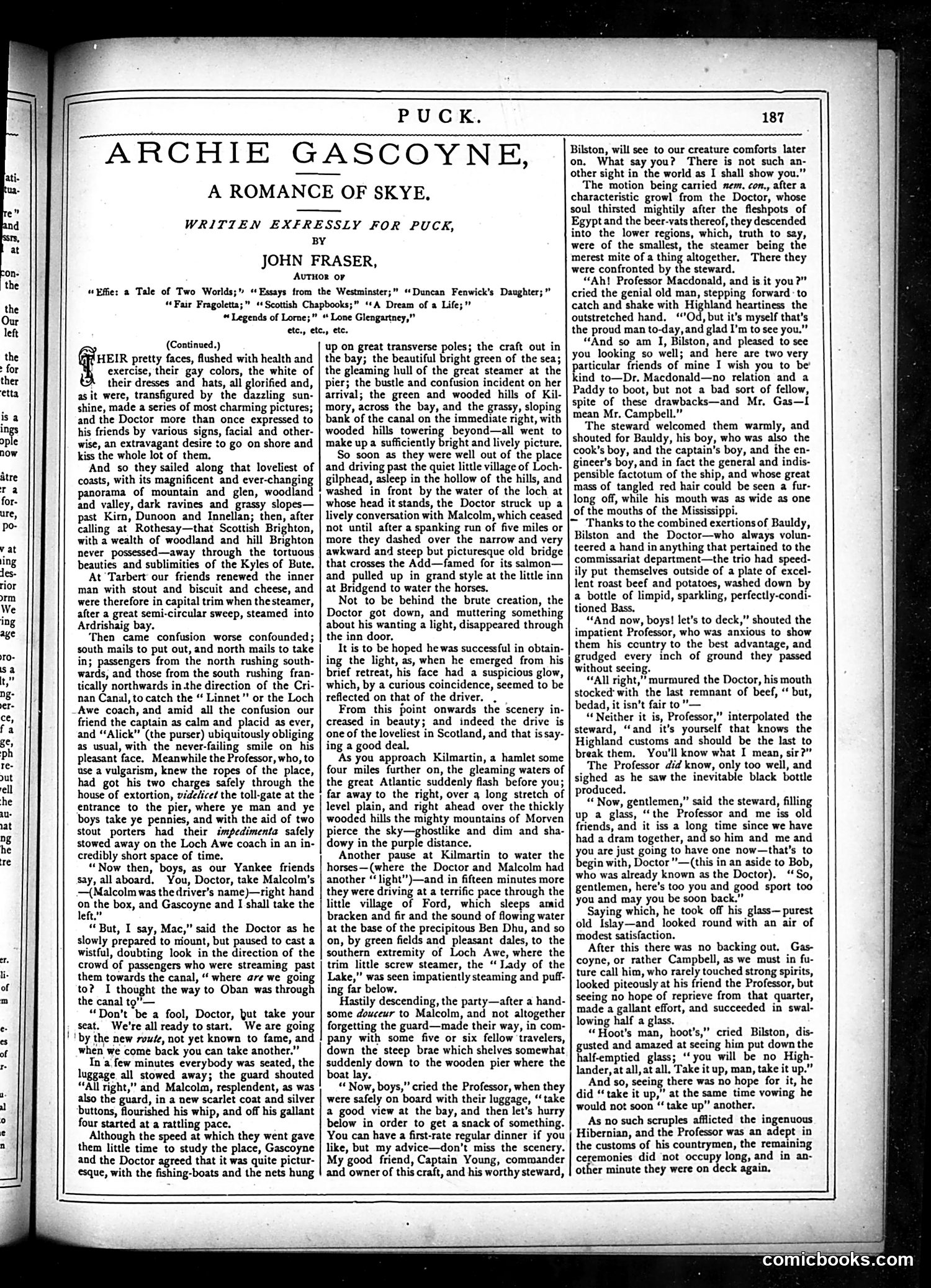
This page contains the continuation of "Archie Gascoyne, A Romance of Skye," a serialized story written by John Fraser for Puck magazine. The text is literary fiction rather than political satire or cartooning. The narrative describes a Scottish Highland journey featuring characters including Professor Macdonald, Bilston, the Doctor, and Malcolm. The story focuses on picturesque landscape descriptions (Kilmartin, Loch Awe, Ben Dhu) and dialogue between traveling companions discussing their journey and accommodations. This appears to be part of Puck's literary content—the magazine published serialized fiction alongside its famous satirical cartoons. No political figures, caricatures, or social satire are evident on this particular page; it's straightforward romantic fiction set in Scotland.
📄 Transcribed text from this page (OCR, searchable)
Machine-transcribed from the original scan — historical spelling and the odd misread are preserved.
PUCK. 187 ARCHIE GASCOYNE, A ROMANCE OF SKYE, WRITIEN EXFRESSLY FOR PUCK, BY JOHN FRASER, AUTHOR oF “Effie: a Tale of Two Worlds; ‘Essays from the Westminster;” ‘Duncan Fenwick’s Daughter; ” “Fair Fragoletta;” ‘Scottish Chapbooks;” ‘*A Dream of a Life;" Legends of Lorne;” “Lone Glengartney,” ete, etc., etc. (Continued) HEIR pretty faces, flushed with health and exercise, their gay colors, the white of their dresses and hats, all glorified and, asit were, transfigured by the dazzling sun- shine, made a series of most charming pictures; and the Doctor more than once expressed to his friends by various signs, facial and other- wise, an extravagant desire to go on shore and kiss the whole lot of them. And so they sailed along that loveliest of coasts, with its magnificent and ever-chan; jing panorama of mountain and glen, woodban and valley, dark ravines and grassy slopes— past Kirn, Dunoon and Innellan; then, after calling at Rothesay—that Scottish Brighton, with a wealth of woodland and hill Brighton never possesses way through the tortuous beauties and sublimities of the Kyles of Bute. At ‘Tarbert our friends renewed the inner man with stout and biscuit and cheese, and were therefore in capital trim when thesteamer, after a great semi-circular sweep, steamed into Ardrishaig bay. ‘Then came confusion worse confounded; south mails to put out, and north mails to take in; passengers from the north rushing south- wards, and those from the south rushing fran- tically northwards in the direction of the Cri- nan Canal, to catch the “ Linnet” or the Loch Awe coach, and amid all the confusion our friend the captain as calm and placid as ever, and “Alick” (the purser) ubiquitously obliging as usual, with the never-failing smile on his pleasant face. Meanwhile the Professor, who, to use a vulgarism, knew the ropes of the place, had got his two charges safely through the house of extortion, videdicet the toll-gate at the entrance to the pier, where ye man and ye boys take ye pennies, and with the aid of two stout porters had their impedimenta safely stowed away on the Loch Awe coach in an in- credibly short space of time. “Now then, boys, as our Yankee friends say, all aboard. You, Doctor, take Malcolm's —{Malcolm was the driver’s name)—right hand fe the box, and Gascoyne and I shall take the left.” “But, I say, Mac,” said the Doctor as he slowly prepared to niount, but paused to cast a wistful, doubting look in the direction of the crowd of passengers who were streaming past them towards the canal, “ where are we going to? I thought the way to Oban was through the canal to” — “Don’t be a fool, Doctor, but take your seat. We're all ready to start. We are going ‘by the new rouse, not yet known to fame, and when we come back you can take another.” Ina few minutes everybody was seated, the luggage all stowed away; the guard shouted “All right,” and Malcolm, resplendent, as was also the d, in a new scarlet coat and silver buttons, flourished his whip, and off his gallant four started at a rattling pace. Although the speed at which they went gave them little time to study the place, Gascoyne and the Doctor agreed that it was quite pictur- esque, with the fishing-boats and the nets hung up on great transverse poles; the craft out in the bay; the beautiful bright green of the sea; the gleaming hull of the great steamer at the pier; the bustle and confusion incident on her arrival; the green and wooded hills of Kil- mory, across the bay, and the grassy, sloping bank of the canal on the immediate right, with wooded hills towering beyond—all went to make up a sufficiently bright and lively picture. So soon as they were well out of the place and driving past the quiet little village of Loch- gilphead, asleep in the hollow of the hills, and washed in front by the water of the loch at whose head it stands, the Doctor struck up a lively conversation with Malcolm, which ceased not until after a spanking run of five miles or more they dashed over the narrow and very awkward and steep but picturesque old bridge that crosses the Add—famed for its salmon— and pulled up in grand style at the little inn at Bridgend to water the horses, Not to be behind the brute creation, the Doctor got down, and muttering something about his wanting a light, disappeared through the inn door. It is to be hoped hewas successful in obtain- ing the light, as, when he emerged from his brief retreat, his face had a suspicious glow, which, by a curious coincidence, seemed to be reflected on that of the driver. From this point onwards the scenery in- creased in beauty; and indeed the drive is one of the loveliest in Scotland, and that is say- ing a good deal. As you approach Kilmartin, a hamlet some four imiles further on, the gleaming waters of the great Atlantic suddenly flash before you; far away to the right, over a long stretch of level plain, and right ahead over the thickly wooded hills the mighty mountains of Morven pierce the sky—ghostlike and dim and sha- dowy in the purple distance. Another pause at Kilmartin to water the horses—(where the Doctor and Malcolm had another “light"’)—and in fifteen minutes more they were driving at a terrific pace through the little village of Ford, which sleeps amid bracken and fir and the sound of flowing water at the base of the precipitous Ben Dhu, and so on, by green fields and pleasant dales, to the southern extremity of Loch Awe, where the trim little screw steamer, the “ Lady of the Lake,” was seen impatiently steaming and puff- ing far below. Hastily descending, the party—after a hand- some douceur to Malcolm, and not altogether forgetting the guard—made their way, in com- pany with some five or six fellow travelers, down the steep brae which shelves somewhat suddenly down to the wooden pier where the boat lay. “ Now, boys,” cried the Professor, when they were safely on board with their luggage, “take a good view at the bay, and then let’s hurry below in order to get a snack of something. You can have a first-rate regular dinner if you like, but my advice—don't miss the scenery. My good friend, Captain Young, commander and owner of this craft, and his worthy steward, Bilston, will see to our creature comforts later on, What say you? There is not such an- other sight in the world as I shall show you.” The motion being carried nem. con., after a characteristic growl from the Doctor, whose soul thirsted mightily after the fleshpots of Egypt and the beer-vats thereof, they descended into the lower regions, which, truth to say, were of the smallest, the steamer being the merest mite of a thing altogether, There they were confronted by the steward. “Ah! Professor Macdonald, and is it you?” cried the genial old man, stepping forward :to catch and shake with Highland heartiness the outstretched hand, ‘Od, but it’s myself that’s the proud man to-day, and glad I’m to see you.” “And so am I, Bilston, and pleased to see you looking so well; and here are two very ticular friends of mine I wish you to be’ Find to—Dr. Macdonald—no relation and a Paddy to boot, but not a bad sort of fellow, spite of these drawbacks—and Mr, Gas—I mean Mr. Campbell.” The steward welcomed them warmly, and shouted for Bauldy, his boy, who was also the cook's boy, and the captain's boy, and the en- gineer’s boy, and in fact the general and indis- pensible factotum of the ship, and whose great mass of tangled red hair could be seen a fur- long off, while his mouth was as wide as one of the mouths of the Mississippi. ~ Thanks to the combined exertions of Bauldy, Bilston and the Doctor—who always volun- teered a hand in anything that pertained to the commissariat department—the trio had speed- ily put themselves outside of a plate of excel- lent roast beef and potatoes, washed down by a bottle of limpid, sparkling, perfectly-condi- tioned Bass. “And now, boys! let’s to deck,” shouted the impatient Professor, who was anxious to show them his ccuntry to the best advantage, and grudged every inch of ground they passed without secing. “All right,” murmured the Doctor, his mouth stocked’ with the last remnant of beef, ‘‘ but, bedad, it isn’t fair to""— “Neither it is, Professor,” interpolated the steward, “and it's yourself that knows the Highland customs and should be the last to break them, You'll know what I mean, sir?” The Professor did know, only too well, and sighed as he saw the inevitable black bottle produced, “Now, gentlemen,” said the steward, filling up a glass, “the Professor and me iss old friends, and it iss a long time since we have had a dram together, and so him and me and you are just going to have one now—that's to begin with, Doctor ”—(this in an aside to Bob, who was already known as the Doctor). So, gentlemen, here's too you and good sport too you and may you be soon back.” Saying which, he took off his glass—purest old Islay—and looked round with an air of modest satisfaction. After this there was no backing out. Gas- coyne, or rather Campbell, as we must in fu- ture call him, who rarely touched strong spirits, looked piteously at his friend the Professor, but seeing no hope of reprieve from that quarter, made a gallant effort, and succeeded in swal- lowing half a glass. “Hoot’s man, hoot’s,” cried Bilston, dis- gusted and amazed at secing him put down the half-emptied glass; “you will be no High. lander, at all, at all, Take it up, man, take it up. And so, seeing there was no hope for it, he did “take it up,” at the same time vowing he would not soon “ take up” another. As no such scruples afflicted the ingenuous Hibernian, and the Professor was an adept in the customs of his countrymen, the remaining ceremonies did not occupy long, and in an- other minute they were on deck again, co micbooks.com