
Puck, 1879-05-28 · page 6 of 16
Puck — May 28, 1879 — page 6: what you’re looking at
What you’re looking at
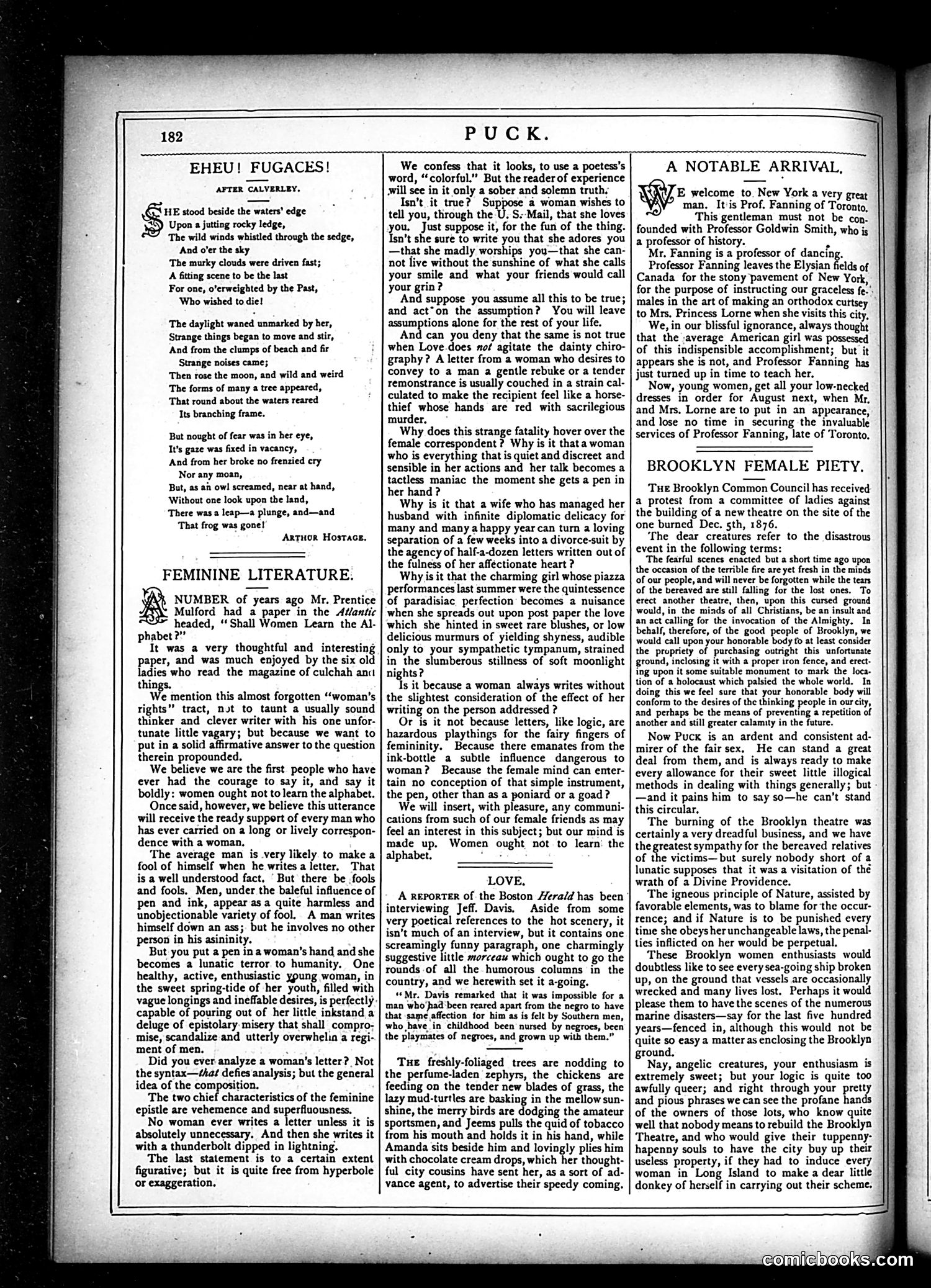
This page contains three distinct articles rather than political cartoons. "Eheu! Fugaces!" is a poem about time's passage and lost youth. "Feminine Literature" is satirical commentary on women's writing, arguing that women should not attempt serious literature because they lack the intellectual rigor of men—a piece reflecting Victorian attitudes toward women's intellectual capacity. "A Notable Arrival" announces Professor Fanning of Toronto, founder of an institute for teaching "graceful deportment" to young women. "Brooklyn Female Piety" satirizes Brooklyn ladies' charity efforts, mocking their enthusiasm for theater renovations while claiming moral superiority. The article suggests their charitable work is performative rather than genuinely compassionate. The overall tone is misogynistic by modern standards, typical of Puck's era.
📄 Transcribed text from this page (OCR, searchable)
Machine-transcribed from the original scan — historical spelling and the odd misread are preserved.
PUCK. EHEU! FUGACES! AFTER CALVERLEY. HE stood beside the waters’ edge Upon a jutting rocky ledge, ‘The wild winds whistled through the sedge, ‘And o'er the sky The murky clouds were driven fast; A fitting scene to be the last For one, o'erweighted by the Past, Who wished to die! The daylight waned unmarked by her, Strange things began to move and stir, ‘And from the clumps of beach and fir Strange noises came; ‘Then rose the moon, and wild and weird ‘The forms of many a tree appeared, ‘That round about the waters reared Its branching frame. But nought of fear was in her eye, It’s gaze was fixed in vacancy, ‘And from her broke no frenzied cry Nor any moan, But, as at owl screamed, near at hand, Without one look upon the land, There was a leap—a plunge, and—and ‘That frog was gone! Antior Hostace. FEMININE LITERATURE. NUMBER of years ago Mr. Prentice Mulford had a paper in the Ad/antic headed, ‘Shall Women Learn the Al- phabet ?” It was a very thoughtful and interesting paper, and was much enjoyed by the six old ladies who read the magazine of culchah anit things. ‘e mention this almost forgotten ‘“‘woman’s rights” tract, not to taunt a usually sound thinker and clever writer with his one unfor- tunate little vagary; but because we want to put in a solid affirmative answer to the question therein propounded. We believe we are the first people who have ever had the courage to say it, and say it boldly: women ought not to learn the alphabet. Once said, however, we believe this utterance will receive the ready support of every man who has ever carried on a long or lively correspon- dence with a woman, The average man is very likely to make a fool of himself when he writes a letter. That is a well understood fact, ‘But there be fools and fools, Men, under the baleful influence of pen and ink, appear as a quite harmless and unobjectionable variety of fool. A man writes himself down an ass; but he involves no other person in his asininity. But you put a pen in a woman's hand and she becomes a lunatic terror to humanity. One healthy, active, enthusiastic ypung woman, in the sweet spring-tide of her youth, filled with vague longings and ineffable desires, is perfectly capable of pouring out of her little inkstand.a deluge of epistolary misery that shall compro- mise, scandalize and utterly overwhelia a regi- ment of men. : Did you ever. analyze a woman’s letter?. Not the syntax—‘hat defies analysis; but the general idea of the composition. The two chief characteristics of the feminine epistle are vehemence and superfluousness. No woman ever writes a letter unless it is absolutely unnecessary. And then she writes it with a thunderbolt dipped in lightning. The last statement is to a certain extent figurative; but it is quite free from hyperbole or exaggeration. We confess that it looks, to use a poetess’s word, “colorful.” But the reader of experience will see in it only a sober and solemn truth, Isn't it true? Supf a woman wishes to tell you, through the U, S- Mail, that she loves you. Just suppose it, for the fun of the thing. Isn’t she sure to write you that she adores you —that she madly worships you—that she can- not live without the sunshine of what she calls your smile and what your friends would call your grin? And suppose you assume all this to be true; and act*on the assumption? You will leave assumptions alone for the rest of your life, And can you deny that the same is not true when Love.does nof agitate the dainty chiro- graphy? A letter from a woman who desires to convey to a man a gentle rebuke or a tender remonstrance is usually couched in a strain cal- culated to make the recipient feel like a horse- thief whose hands are red with sacrilegious murder, Why does this strange fatality hover over the female correspondent ? Why is it that a woman who is everything that is quiet and discreet and sensible in her actions and her talk becomes a tactless maniac the moment she gets a pen in her hand? Why is it that a wife who has managed her husband with infinite diplomatic delicacy for many and many a happy year can turn a loving separation of a few weeks into a divorce-suit by the agency of half-a-dozen letters written out of the fulness of her affectionate heart ? Why is it that the charming girl whose piazza performances last summer were the quintessence of paradisiac perfection’ becomes a nuisance when she spreads out upon post paper the love which she hinted in sweet rare blushes, or low delicious murmurs of yielding shyness, audible only to your sympathetic tympanum, strained in the slumberous stillness of soft moonlight nights? . Is it because a woman always writes without the slightest consideration of the effect of her writing on the person addressed ? Or is it not because letters, like logic, are hazardous playthings for the fairy fingers of femininity. Because there emanates from the ink-bottle a subtle influence dangerous to woman? Because the female mind can enter- tain no conception of that simple instrument, the pen, other than as a poniard or a goad? We will insert, with pleasure, any communi- cations from such of our female friends as may feel an interest in this subject; but our mind is made up. Women ought not to learn: the alphabet. : LOVE, A REPORTER of the Boston Hera/d has been interviewing Jeff. Davis. Aside from some very poetical references to the hot scenery, it isn’t much of an interview, but it contains one screamingly funny paragraph, one charmingly suggestive little morceau which ought to go the rounds of all the humorous columns in the country, and we herewith set it a-going. “Mr. Davis remarked that it was impossible for a man who‘had:been reared apart from the negro to have that same affection for him as is felt by Southern men, who,bave in childhood been nursed by negroes, been the playmates of negroes, and grown up with them.” Tue freshly-foliaged trees are nodding to the perfume-laden zephyrs, the chickens are feeding on the tender new blades of grass, the lazy mud-turtles are basking in the mellow sun- shine, the merry birds are dodging the amateur sportsmen, and Jeems pulls the quid of tobacco from his mouth and holds it in his hand, while Amanda sits beside him and lovingly plies him with chocolate cream drops, which her thought- ful city cousins have sent her, as a sort of ad- vance agent, to advertise their speedy coming. A NOTABLE ARRIVAL, E welcome to. New York a very great man. Itiis Prof, Fanning of Toronto, This gentleman must not be con. founded with Professor Goldwin Smith, who is a professor of history. . Mr. Fanning is a professor of dancing. Professor Fanning leaves the Elysian elds of Canada for the stony pavement of New York, for the purpose of instructing our graceless fe.’. males in the art of making an orthodox curtsey to Mrs. Princess Lorne when she visits this city, We, in our blissful ignorance, always thought that the average American girl was possessed of this indispensible accomplishment; but it appears she is not, and Professor Fanning has just turned up in time to teach her, Now, young women, get all your low-necked dresses in order for August next, when Mr, and Mrs. Lorne are to put in an appearance, and lose no time in securing the invaluable services of Professor Fanning, late of Toronto, BROOKLYN FEMALE PIETY. Tue Brooklyn Common Council has received. a protest from a committee of ladies against the building of a new theatre on the site of the one burned Dec. sth, 1876. ‘The dear creatures refer to the disastrous event in the following terms: The fearful scenes enacted but a short time ago upon the occasion of the terrible fire are yet fresh in the minds of our people, and will never be forgotten while the tears of the bereaved are still falling for the lost ones. To erect another theatre, then, upon this cursed ground would, in the minds of all Christians, be an insult and an act calling for the invocation of the Almighty, In behalf, therefore, of the good people of Brooklyn, we would call upon your honorable body fo at least consider the propriety of. purchasing outright this unfortunate ground, inclosing it with a proper iron fence, and erect- ing upon it some suitable monument to’ mark the loca- tion of a holocaust which palsied the whole world. In doing this we feel sure that your honorable body will conform to the desires of the thinking people in our city, and perhaps be the means of preventing a repetition of another and still greater calamity in the future. Now Puck is an ardent and consistent ad- mirer of the fair sex, He can stand a great deal from them, and is always ready to make every allowance for their sweet little illogical methods in dealing with things generally; but —and it pains him to say so—he can’t stand this circular. The burning of the Brooklyn theatre was certainly a very dreadful business, and we have the greatest sympathy for the bereaved relatives of the victims—but surely nobody short of a lunatic supposes that it was a visitation of thé wrath of a Divine Providence. ‘The igneous principle of Nature, assisted by favorable elements, was to blame for the occur- rence; and if Nature is to be punished every time she obeys her unchangeable laws, the penal- ties inflicted on her would be perpetual. These Brooklyn women enthusiasts would doubtless like to see every sea-going ship broken up, on the ground that vessels are occasionally wrecked and many lives lost. Perhaps it would please them to have the scenes of the numerous marine disasters—say for the last five hundred years—fenced in, although this would not be quite so easy a matter as enclosing the Brooklyn ground. Nay, angelic creatures, your enthusiasm is extremely sweet; but your logic is quite too awfully queer; and right through your pretty and pious phrases we can see the profane han: of the owners of those lots, who know quite well that nobody means to rebuild the Brooklyn Theatre, and who would give their tuppenny- hapenny souls to have the city buy up their useless property, if they had to induce every woman in Long Island to make a dear little donkey of herself in carrying out their scheme.