
Puck, 1879-05-28 · page 4 of 16
Puck — May 28, 1879 — page 4: what you’re looking at
What you’re looking at
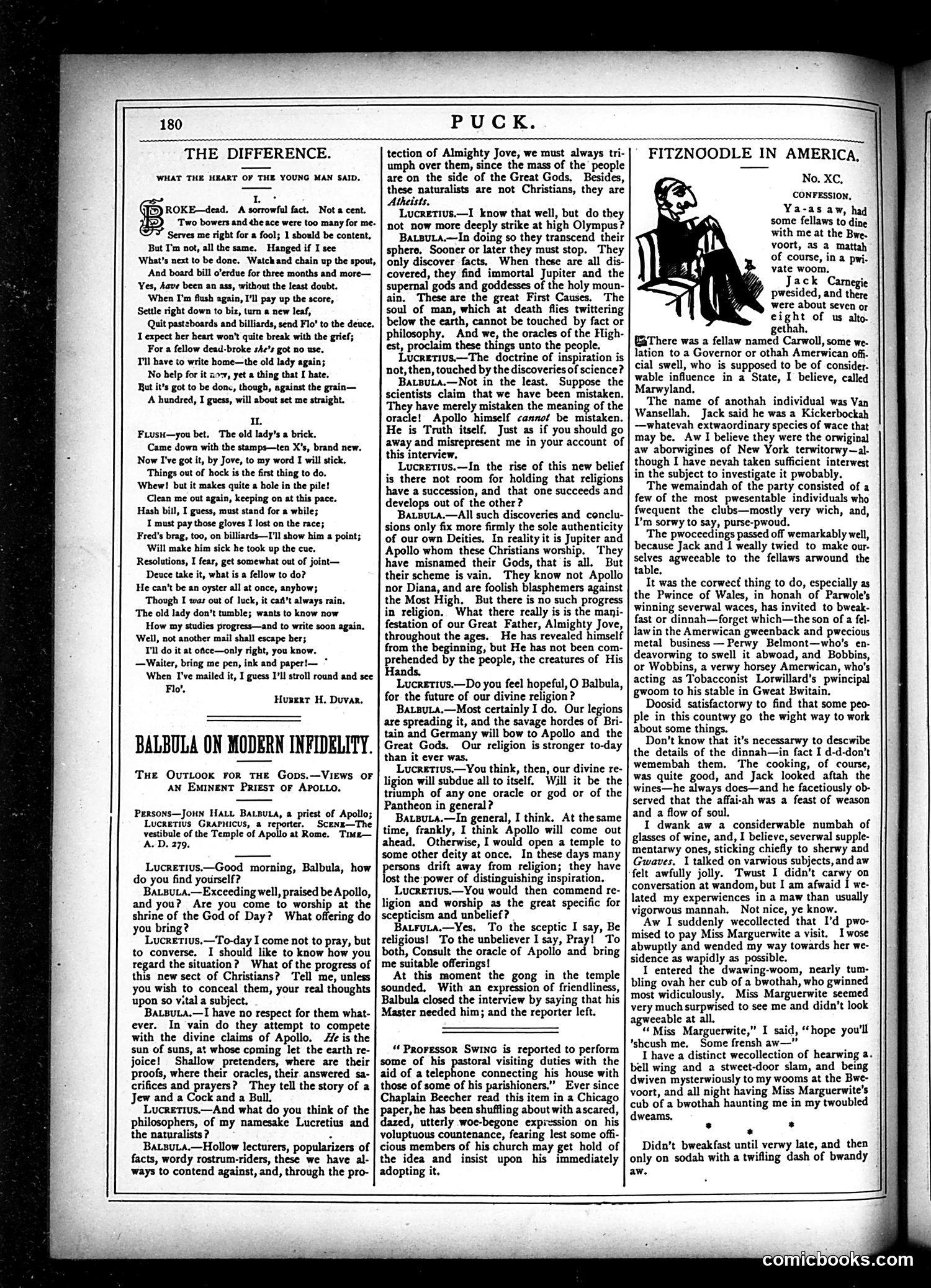
This page contains two distinct articles rather than political cartoons. "The Difference" presents a debate between two young men about love and marriage—one romantic, one cynical—rendered as humorous verse by Hubert H. Duval. The main content is "Balbula on Modern Infidelity," featuring a priest of Apollo (an imaginary classical god) discussing religion and social progress with a reporter. The satire attacks religious claims to absolute truth by suggesting that Christianity, like worship of Apollo, represents human projection rather than divine revelation. Balbula argues that science and reason, not religious doctrine, explain the world—a critique of organized religion's authority characteristic of late 19th-century skeptical commentary. The "Fitznoodle in America" column appears to be travel humor about American customs.
📄 Transcribed text from this page (OCR, searchable)
Machine-transcribed from the original scan — historical spelling and the odd misread are preserved.
180 PUCK. THE DIFFERENCE. WHAT THE HEART O¥ THE YOUNG MAN SAID, Le: ROKE—dead. A sorrowful fact. Not a cent. ‘Two bowers and che ace were too many for me. Serves me right for a fool; 1 should be content, But I'm not, all the same, Hanged if I see ‘What's nest to be done. Watch and chain up the spout, ‘And board bill o'erdue for three months and more— Yes, Aave been an ass, without the least doubt. ‘When I'm flush again, I'll pay up the score, Settle right down to biz, tum # new leaf, Qait pasteboards and billiards, send Flo’ to the deuce. T expect her heart won't quite break with the grief; For a fellow dead-broke she's got no use, Till have to write home—the old lady again; No help for it nov, yet a thing that I hate. But it’s got to be donc, though, against the grain— A hundred, I guess, will about set me straight. 1. Frusn—you bet, The old lady’s a brick. Came down with the stamps—ten X's, brand new. Now I've got it, by Jove, to my word I will stick. Things out of hock is the first thing to do. Whew! but it makes quite a hole in the pile! Clean me out again, keeping on at this pace, Hash bill, I guess, must stand for a while; I must pay those gloves I lost on the race; Fred's brag, too, on billiards—I'll show him a point; Will make him sick he took up the cue, Resolutions, I fear, get somewhat out of joint— Deuce take it, what is a fellow to do? He can’t be an oyster all at once, anyhow; ‘Though I was out of luck, it caf" always rain, ‘The old lady don’t tumble; wants to know now How my studies progress—and to write soon again, Well, not another mail shall escape her; T'll do it at ofce—only right, you know, —Waiter, bring me pen, ink and paper!— * When I’ve mailed it, I guess I'll stroll round and see Flo’. Husert H, Duvar. BALBULA ON MODERN INFIDELITY. Tue OvutLoox ror THE Gops.—ViEWs oF AN EMINENT Priest OF APOLLO. Persons—Joun Haut Batsuta, a priest of Apollo; Lucretius Grarnicus, a reporter. Scenx—The vestibule of the Temple of Apollo at Rome. Timz— A. D. 279. Lucretius.—Good morning, Balbula, how do you find yourself? Batsuta.—Exceeding well, praised be Apollo, and you? Are you come to worship at the shrine of the God of Day? What offering do you bring? Lucretius.—To-day I come not to pray, but to converse, I should like to know how you regard the situation? What of the progress of this new sect of Christians? Tell me, unless you wish to conceal them, your real thoughts upon so vital a subject. Batsuta.—I have no respect for them what- ever. In vain do they attempt to compete with the divine claims of Apollo. He is the sun of suns, at whose coming let the earth re- joice! Shallow pretenders, where are their proofs, where their oracles, their answered sa- crifices and prayers? They tell the story of a Jew and a Cock and a Bull, Lucretius.—And what do you think of the philosophers, of my namesake Lucretius and the naturalists? . Batsuta.—Hollow lecturers, popularizers of facts, wordy rostrum-riders, these we have al- ways to contend against, and, through the pro- tection of Almighty Jove, we must always tri- umph over them, since the mass of the people are on the side of the Great Gods, Besides, these naturalists are not Christians, they are Abheists, Lucretivs.—I know that well, but do they not now more deeply strike at high Olympus? Batsuta.—lIn doing so they transcend their sphere, Sooner or later they must stop. They only discover facts, When these are all dis- covered, they find immortal Jupiter and the supernal gods and goddesses of the holy moun- ain, These are the great First Causes. The soul of man, which at death flies twittering below the earth, cannot be touched by fact or philosophy. And we, the oracles of the High- est, proclaim these things unto the people. Lucretius.—The doctrine of inspiration is not, then, touched by the discoveries of science? Barsuta.—Not in the least, Suppose the scientists claim that we have been mistaken. They have merely mistaken the meaning of the oracle! Apollo himself cannot be mistaken. He is Truth itself, Just as if you should go away and misrepresent me in your account of this interview. Lucretius.—In the rise of this new belief is there not room for holding that religions have a succession, and that one succeeds and develops out of the other? Batsuta.—All such discoveries and conclu- sions only fix more firmly the sole authenticity of our own Deities. In reality it is Jupiter and Apollo whom these Christians worship. They have misnamed their Gods, that is all. But their scheme is vain. They know not Apollo nor Diana, and are foolish blasphemers against the Most High. But there is no such progress in religion, What there really is is the mani- festation of our Great Father, Almighty Jove, throughout the ages. He has revealed himself from the beginning, but He has not been com- prehended by the people, the creatures of His Hands, Lucretius.—Do you feel hopeful, O Balbula, for the future of our divine religion? Batsuta.—Most certainly I do. Our legions are spreading it, and the savage hordes of Bri- tain and Germany will bow to Apollo and the Great Gods. Our religion is stronger to-day than it ever was. Lucretius.—You think, then, our divine re- ligion will subdue all to itself. Will it be the triumph of any one oracle or god or of the Pantheon in general? Batsuta.—In general, I think. At thesame time, frankly, I think Apollo will come out ahead. Otherwise, I would open a temple to some other deity at once, In these days many persons drift away from religion; they have lost the-power of distinguishing inspiration. Lucretius.—You would then commend re- ligion and worship as the great specific for scepticism and unbelief? Batruta.—Yes, To the sceptic I say, Be religious! To the unbeliever I say, Pray! To both, Consult the oracle of Apollo and bring me suitable offerings! ‘At this moment the gong in the temple sounded. With an expression of friendliness, Balbula closed the interview by saying that his Master needed him; and the reporter left. “ Proressor Swinc is reported to perform some of his pase visiting duties with the aid of a telephone connecting his house with those of some of his parishioners.” Ever since Chaplain Beecher read this item in a Chicago paper,he has been shuffling about with ascared, dazed, utterly woe-begone expression on his voluptuous countenance, fearing lest some offi- cious members of his church may get hold of the idea and insist upon his immediately adopting it. FITZNOODLE IN AMERICA, No. XC. CONFESSION, Ya-as aw, had some fellaws to dine with me at the Bwe. voort, as a mattah of course, in a pwi- vate woom, Jack Carnegie pwesided, and there were about seven or ei ght of us alto. gethah, GaThere was a fellaw named Carwoll, some we. lation to a Governor or othah Amerwican offi- cial swell, who is supposed to be of consider. wable influence in a State, I believe, called Marwyland. The name of anothah individual was Van Wansellah. Jack said he was a Kickerbockah —whatevah extwaordinary species of wace that may be. Aw I believe they were the orwiginal aw aborwigines of New York terwitorwy—al- though I have nevah taken sufficient interwest in the subject to investigate it pwobably. The wemaindah of the party consisted of a few of the most pwesentable individuals who fwequent the clubs—mostly very wich, and, I'm sorwy to say, purse-pwoud. The proceedings passed off wemarkably well, because Jack and I weally twied to make our- selves agwecable to the fellaws arwound the table, It was the corwecf thing to do, especially as the Pwince of Wales, in honah of Parwole's winning severwal waces, has invited to bweak- fast or dinnah—forget which—the son of a fel- lawin the Amerwican gweenback and pwecious metal business —Perwy Belmont—who's en- deavorwing to swell it abwoad, and Bobbins, or Wobbins, a verwy horsey Amerwican, who's acting as Tobacconist Lorwillard’s pwincipal gwoom to his stable in Gweat Bwitain. Doosid satisfactorwy to find that some peo- ple in this countwy go the wight way to work about some things. Don’t know that it’s necessarwy to descwibe the details of the dinnah—in fact I d-d-don’t wemembah them, The cooking, of course, was quite good, and Jack looked aftah the wines—he always does—and he facetiously ob- served that the affai-ah was a feast of weason and a flow of soul. I dwank aw a considerwable numbah of glasses of wine, and, I believe, severwal supple- mentarwy ones, sticking chiefly to sherwy and Gwaves. 1 talked on varwious subjects, and aw felt awfully jolly. Twust I didn’t carwy on conversation at wandom, but I am afwaid I we- lated my experwiences in a maw than usually vigorwous mannah. Not nice, ye know. ‘Aw I suddenly wecollected that I'd pwo- mised to pay Miss Marguerwite a visit. I wose abwuptly and wended my way towards her we- sidence as wapidly as possible. 1 entered the dwawing-woom, nearly tum- bling ovah her cub of a bwothah, who gwinned most widiculously. Miss Marguerwite seemed very much surpwised to see me and didn’t look agweeable at all. «Miss Marguerwite,” I said, “hope you'll 'shcush me. Some frensh aw—” I have a distinct wecollection of hearwing a. bell wing and a stweet-door slam, and being dwiven mysterwiously to my wooms at the Bwe- voort, and all night having Miss Marguerwite’s cub of a bwothah haunting me in my twoubled dweams, * * Didn’t bweakfast until verwy late, and then only on sodab with a twifling dash of bwandy | aw.