
Puck, 1879-05-28 · page 7 of 16
Puck — May 28, 1879 — page 7: what you’re looking at
What you’re looking at
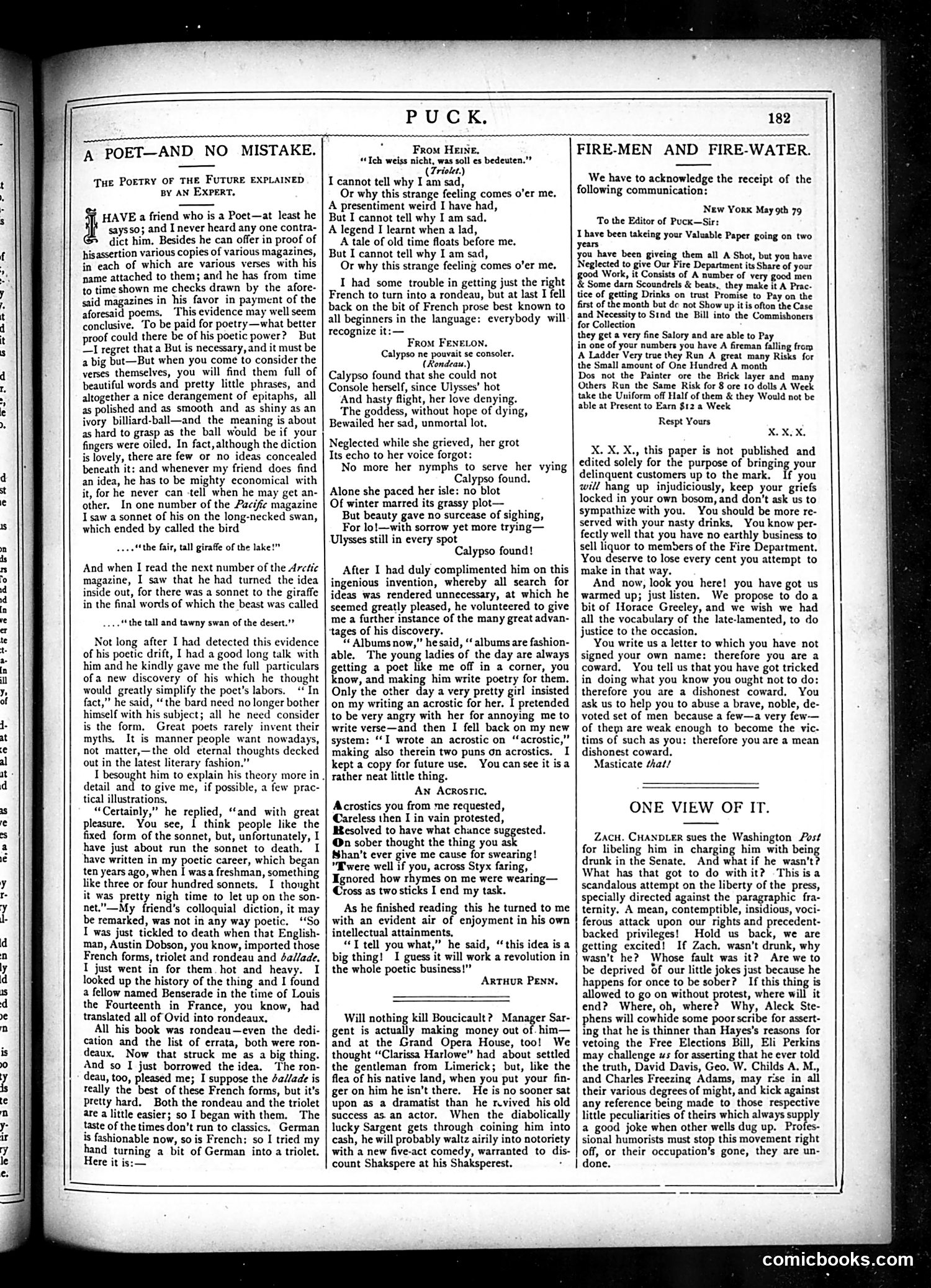
This page contains primarily **text content rather than political cartoons** — it consists of several poems and letters to the editor. The main pieces include: 1. **"A Poet—and No Mistake"** — A humorous essay defending poetry's value, arguing poets deserve recognition for their "beautiful words and pretty little phrases." 2. **"Fire-Men and Fire-Water"** — A letter criticizing New York firefighters for accepting bribes and alcohol while on duty, suggesting corruption in the department. 3. **"One View of It"** — A satirical piece mocking congressional debates over paragraph formatting in press coverage, suggesting politicians obsess over trivial procedural matters rather than substantive issues. The page functions as **editorial commentary** rather than visual satire, typical of Puck's mixed format combining humor with social criticism.
📄 Transcribed text from this page (OCR, searchable)
Machine-transcribed from the original scan — historical spelling and the odd misread are preserved.
PUCK. 182 A POET—AND NO MISTAKE, ‘THe PorTRY OF THE FUTURE EXPLAINED BY AN EXPERT. HAVE a friend who is a Poet—at least he saysso; and I never heard any one contra- dict him. Besides he can offer in proof of hisassertion various copies of various magazines, in each of which are various verses with his name attached to them; and he has from time to time shown me checks drawn by the afore- said magazines in his favor in payment of the aforesaid poems. ‘This evidence may well seem conclusive, To be paid for poetry—what better proof could there be of his poetic power? But —lI regret that a But is necessary, and it must be a big but—But when you come to consider the verses themselves, you will find them full of beautiful words and pretty little phrases, and altogether a nice derangement of epitaphs, all as polished and as smooth and as shiny as an ivory billiard-ball—and the meaning is about as hard to grasp as the ball would be if your fingers were oiled, In fact, although the diction is lovely, there are few or no ideas concealed beneath it: and whenever my friend does find an idea, he has to be mighty economical with it, for he never can -tell when he may get an- other, In one number of the Pacific magazine I saw a sonnet of his on the long-necked swan, which ended by called the bird ++ the fair, tall giraffe of the lake!” And when I read the next number of the Arcti¢ magazine, I saw that he had turned the idea inside out, for there was a sonnet to the giraffe in the final words of which the beast was called -.¢the tall and tawny swan of the desert.”” Not long after I had detected this evidence of his poetic drift, I had a good long talk with him and he kindly gave me the full particulars ofa new discovery of his which he thought would greatly simplify the poet’s labors. ‘In fact,” he said, “the bard need no longer bother himself with his subject; all he need consider is the form. Great poets rarely invent their myths, It is manner people want nowadays, not matter,—the old eternal thoughts decked out in the latest literary fashion.” T besought him to explain his theory more in detail and to give me, if possible, a few prac- tical illustrations, “Certainly,” he replied, “and with great pleasure. You see, 1 think people like the fixed form of the sonnet, but, unfortunately, I have just about run the sonnet to death. I have written in my poetic career, which began ten years ago, when I wasa freshman, something like three or four hundred sonnets. I thought it was pretty nigh time to let up on the son- net."—My friend’s colloquial diction, it may be remarked, was not in any way poetic. ‘So I was just tickled to death when that English- man, Austin Dobson, you know, imported those French forms, triolet and rondeau and da//ade, I just went in for them. hot and heavy. I looked up the history of the thing and I found a fellow named Benserade in the time of Louis the Fourteenth in France, you know, had translated all of Ovid into rondeaux, All his book was rondeau—even the dedi- cation and the list of errata, both were ron- deaux, Now that struck me as a big thing. And so I just borrowed the idea. The ron- deau, too, pleased me; I suppose the dad/ade is Teally the best of these French forms, but it’s Pretty hard. Both the rondeau and the triolet are a little easier; so I began with them. The taste of the times don’t run to classics. German is fashionable now, so is French: so I tried my hand turning a bit of German into a triolet. Here it is:— From HEINE. “Ich weiss nicht, was soll es bedeuten.’” (Triokt.) I cannot tell why I am sad, Or why this strange feeling comes o’er me. A presentiment weird I have had, But I cannot tell why I am sad. A legend I learnt when a lad, A tale of old time floats before me. But I cannot tell why I am sad, Or why this strange feeling comes o’er me, I had some trouble in getting just the right French to turn into a rondeau, but at last I fell back on the bit of French prose best known to all beginners in the language: everybody will recognize it:— From FeNneLon. Calypso ne pouvait se consoler. (Rondeau. Calypso found that she could not Console herself, since Ulysses’ hot ‘And hasty flight, her love denying. ‘The goddess, without hope of dying, Bewailed her sad, unmortal lot. Neglected while she grieved, her grot Its echo to her voice forgot: No more her nymphs to serve her vying Calypso found, Alone she paced her isle: no blot Of winter marred its grassy plot— But beauty gave no surcease of sighing, For lo!—with sorrow yet more trying— Ul still in every spot me % Pe Calypso found! After I had duly complimented him on this ingenious invention, whereby all search for ideas was rendered unnecessary, at which he seemed greatly pleased, he volunteered to give me a further instance of the many great advan- tages of his discovery. “ Albums now,” he said, ‘‘ albums are fashion- able. The young ladies of the day are always getting a poet like me off in a corner, you know, and making him write poetry for them, Only the other day a very pretty girl insisted on my writing an acrostic for her. I pretended to be very angry with her for annoying me to write verse—and then I fell back on my new system: ‘¢I wrote an acrostic on ‘acrostic,” making also therein two puns on acrostics. I kept a copy for future use. You cansee it isa rather neat little thing. An Acrosric, Acrostics you from me requested, Careless then I in vain protested, Mesolved to have what chance suggested. @n sober thought the thing you asl Nhan’t ever give me cause for swearing! "Ewere well if you, across Styx faring, Ignored how rhymes on me were wearing— Cross as two sticks I end my task. As he finished reading this he turned to me with an evident air of enjoyment in his own intellectual attainments, “T tell you what,” he said, ‘this idea is a big thing! I guess it will work a revolution in the whole poetic business!” ARTHUR PENN, Will nothing kill Boucicault? Manager Sar- gent is actually ing money out of. him— and at the Grand Opera House, too! We thought “Clarissa Harlowe” had about settled the gentleman from Limerick; but, like the flea of his native land, when you put your fin- ger on him he isn’t there. He is no sooner sat upon as a dramatist than he revived his old success as an actor. When the diabolically lucky Sargent gets through coining him into cash, he will probably waltz airily into notoriety with a new five-act comedy, warranted to dis- count Shakspere at his Shaksperest. FIRE-MEN AND FIRE-WATER. We have to acknowledge the receipt of the following communication: New York May 9th 79 To the Editor of Puck—Sir: Ihave been takeing your Valuable Paper going on two years you have been giveing them all A Shot, but you have Neglected to gi Fi tice of getting Drinks on trust Promise to Pay on the first of the month but de not Show up itis ofton the Case and Necessity to Sind the Bill into the Commishoners for Collection they get a very fine Salory and are able to Pay in one of your numbers you have A fireman falling from A Ladder Very true they Run A great many Risks for the Small amount of One Hundred A month Dos not the Painter ore the Brick layer and many Others Run the Same Risk for 8 ore 10 dolls A Week take the Uniform off Half of them & they Would not be able at Present to Earn $12 a Week Respt Yours XXX, X. X. X., this paper is not published and edited solely for the purpose of bringing your delinquent customers up to the mark, fr you will hang up injudiciously, keep your griefs locked in your own bosom, and don’t ask us to sympathize with you. You should be more re- served with your nasty drinks, You know per- fectly well that you have no earthly business to sell liquor to members of the Fire Department. You deserve to lose every cent you attempt to make in that way, And now, look you here! you have got us warmed up; just listen. We propose to doa bit of Horace Greeley, and we wish we had all the vocabulary of the late-lamented, to do justice to the occasion. You write us a letter to which you have not signed your own name: therefore you are a coward, You tell us that you have got tricked in doing what you know you ought not to do: therefore you are a dishonest coward. You ask us to help you to abuse a brave, noble, de- voted set of men because a few—a very few— of them are weak enough to become the vic- tims of such as you: therefore you are a mean dishonest coward, Masticate that! ONE VIEW OF IT. Zack. CHANDLER sues the Washington Fost for libeling him in charging him with bein; drunk in the Senate. And what if he wasn't? What has that got to do with it? This isa scandalous attempt on the liberty of the press, specially directed : against the paragraphic fra- ternity. A mean, contemptible, insidious, voci- ferous attack upon our rights and precedent- backed privileges! Hold us back, we are getting excited! If Zach, wasn’t drunk, why wasn’t he? Whose fault was it? Are we to be deprived Of our little jokes just because he happens for once to be sober? If this thing is allowed to go on without protest, where will it end? Where, oh, where? Why, Aleck Ste- hens will cowhide some poor scribe for assert- ing that he is thinner than Hayes’s reasons for vetoing the Free Elections Bill, Eli Perkins may challenge ws for asserting that he ever told the truth, David Davis, Geo. W. Childs A. M., and Charles Freezing Adams, may rise in all their various degrees of might, and kick against any reference being made to those respective little peculiarities of theirs which always supply a good joke when other wells dug up. Profes- sional humorists must stop this movement right off, or their occupation’s gone, they are un- | done. comicbooks.com