
A complete issue · 16 pages · 1879
Puck — May 7, 1879
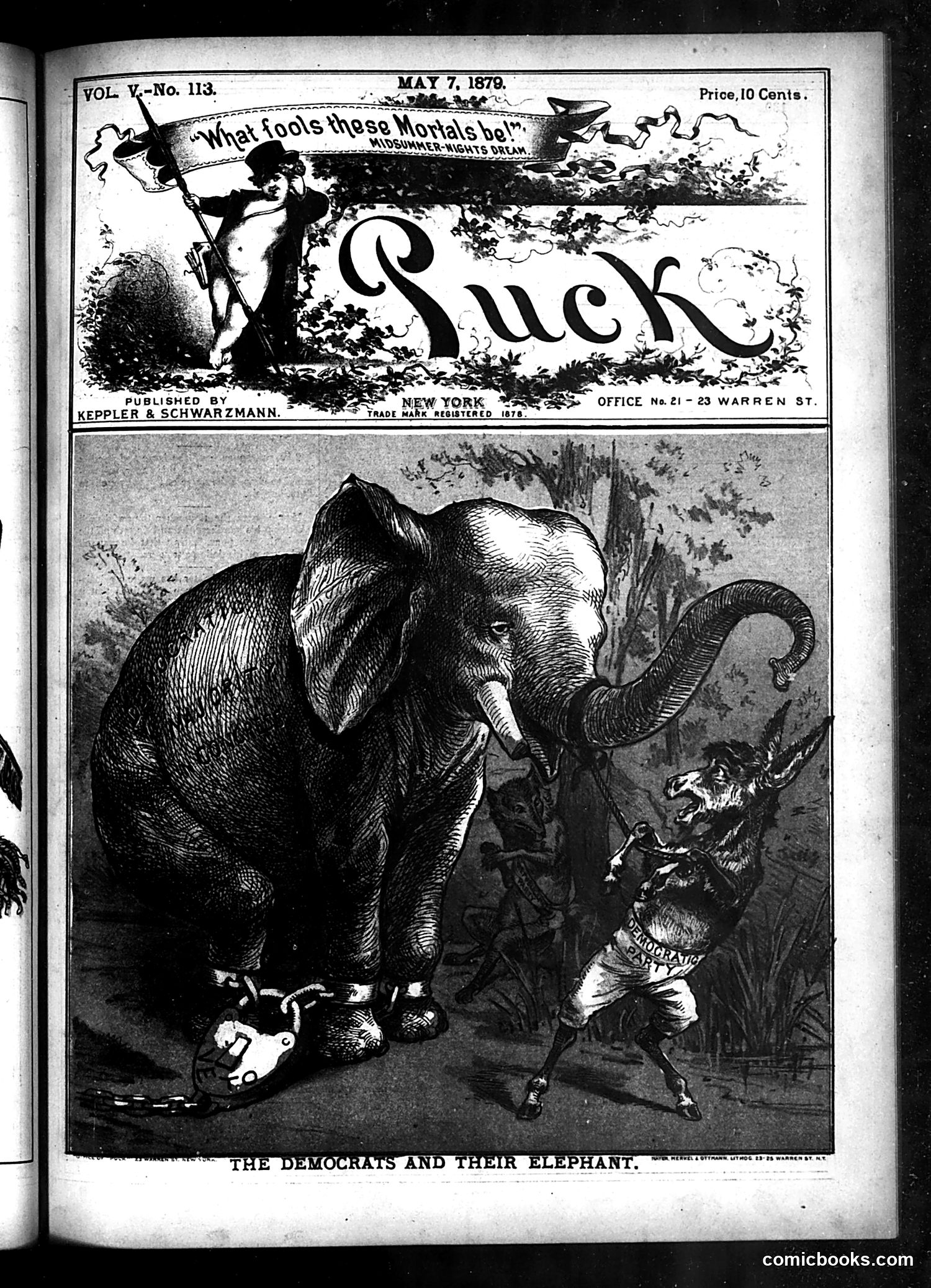
This 1878 *Puck* cartoon satirizes the Democratic Party's relationship with a large elephant. The caption "The Democrats and Their Elephant" suggests the party is being controlled by or dependent upon this beast—likely representing a powerful political force, wealthy backer, or problematic ideology the Democrats were associated with. The small demon-like figure on the right appears to be goading or manipulating the elephant, suggesting external forces driving Democratic policy. The chain around the elephant's leg indicates constraint or control. Without additional context, the specific political issue referenced is unclear—it could relate to Reconstruction politics, currency debates, or patronage scandals of the 1870s. The cartoon's point seems to be that Democrats are either slaves to powerful interests or dangerously controlled by forces they cannot fully master.
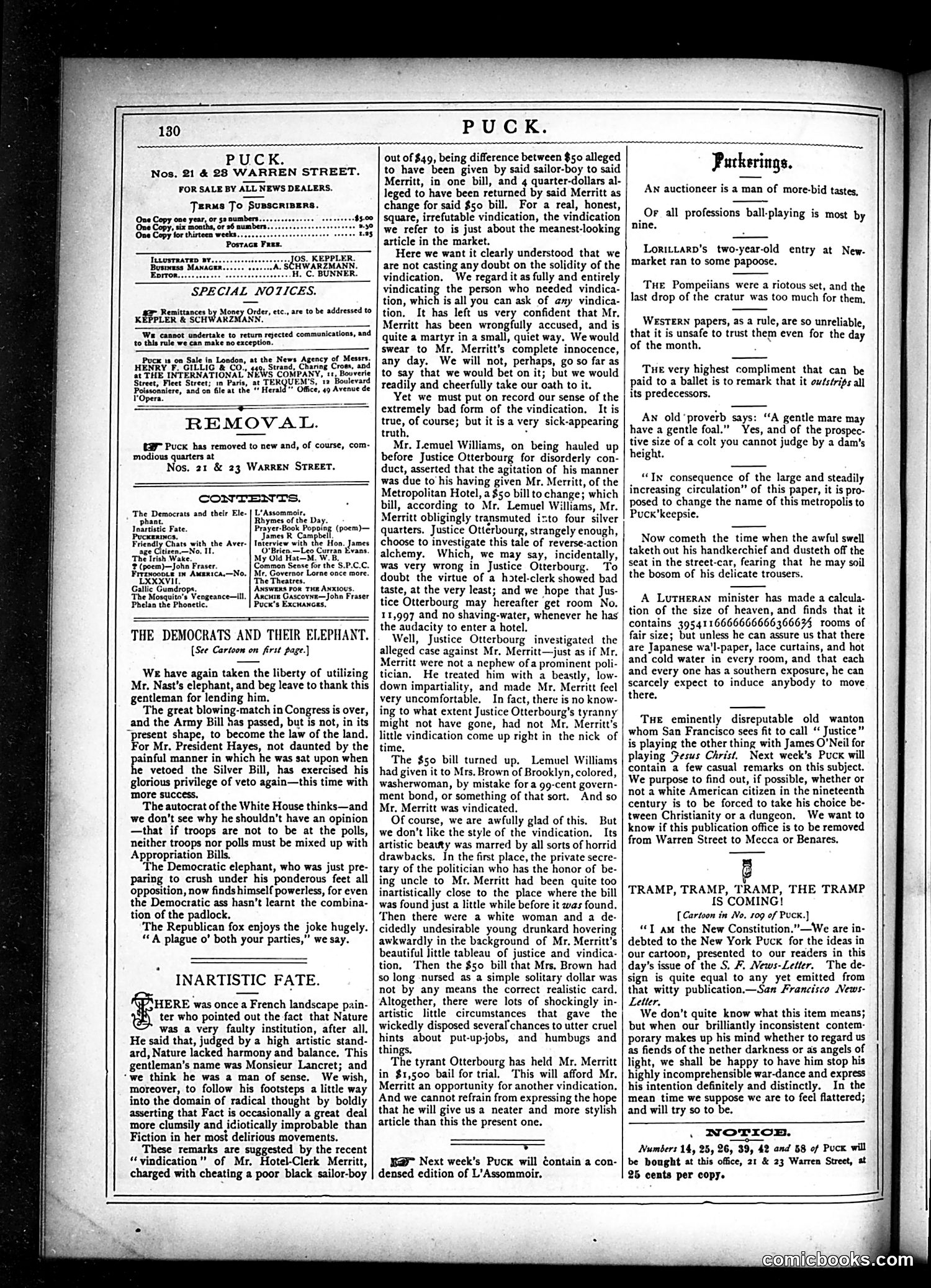
This page is primarily **text-based editorial content** rather than illustrated cartoons. The main article, "The Democrats and Their Elephant," discusses a recent Congress and criticizes both political parties' use of propaganda and tactics. A smaller piece titled "Inartistic Fate" discusses a French artist named Monsieur Lancet and debates about realistic versus radical artistic movements. The page also contains notices about removals, subscriptions, and upcoming content. **No major political figures or caricatures are clearly identifiable** in the visible image portion. The "elephant" reference likely alludes to Republican symbolism, while the Democrats are criticized for their own political maneuvers. The overall tone is satirical toward partisan politics generally, though without visible illustrations, the specific satirical targets remain unclear from this page alone.
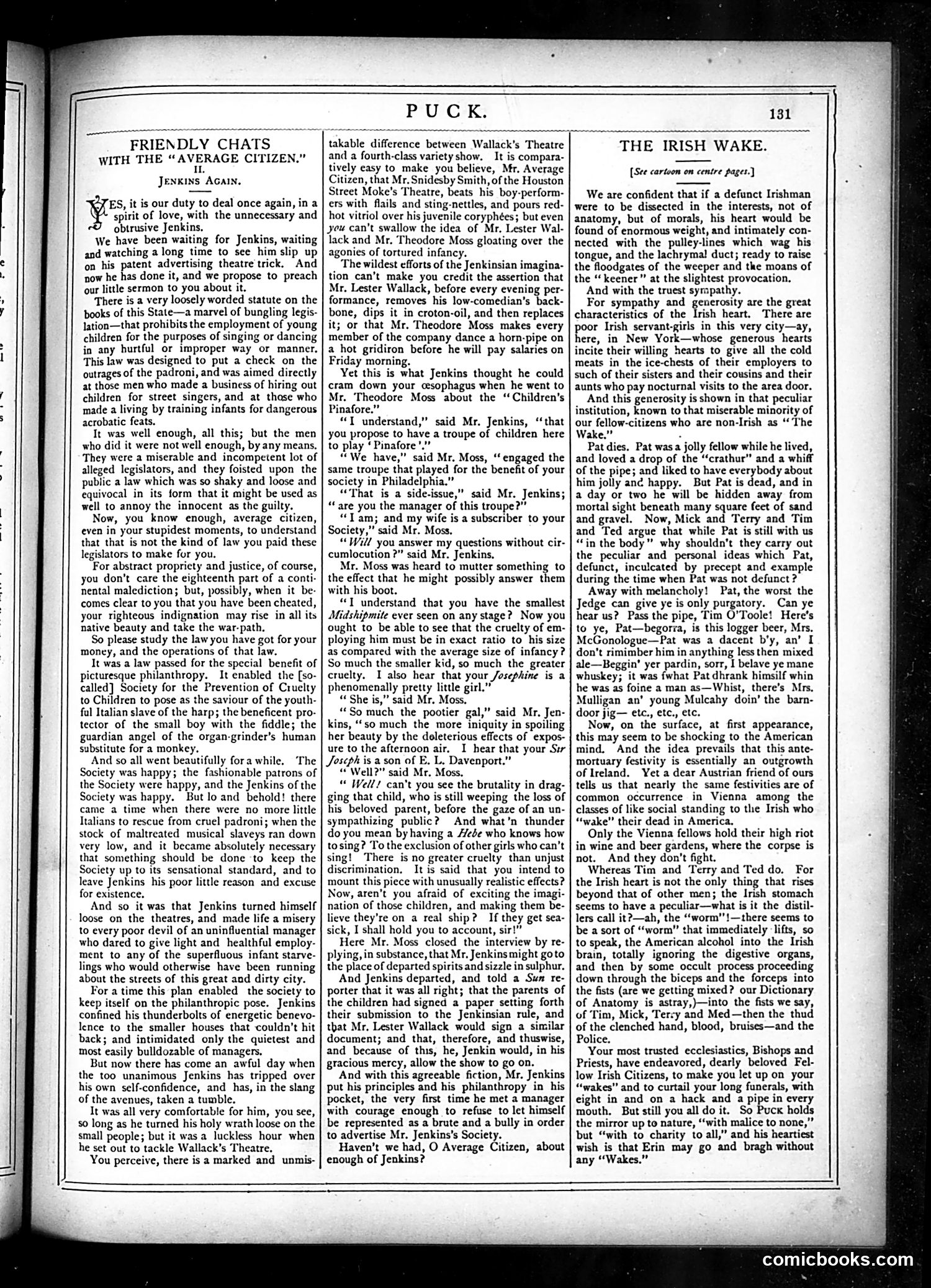
This page contains two distinct articles. The left column features "Friendly Chats with the Average Citizen," a satirical interview with Jenkins criticizing theatrical manager Lester Wallack's production choices. The satire mocks Wallack's decision to stage children performing acrobatic acts rather than traditional drama, calling it exploitation of youth for profit. The right column, "The Irish Wake," is a humorous piece celebrating Irish-American generosity and distinctive cultural characteristics. It uses gentle ethnic humor to praise Irish immigrants' charitable nature and their convivial social traditions, positioning Irish-Americans as valued contributors to American society despite occasional stereotyping about drinking and rowdiness. Both pieces reflect Puck's characteristic blend of social criticism and ethnic humor typical of late 19th-century American satire.
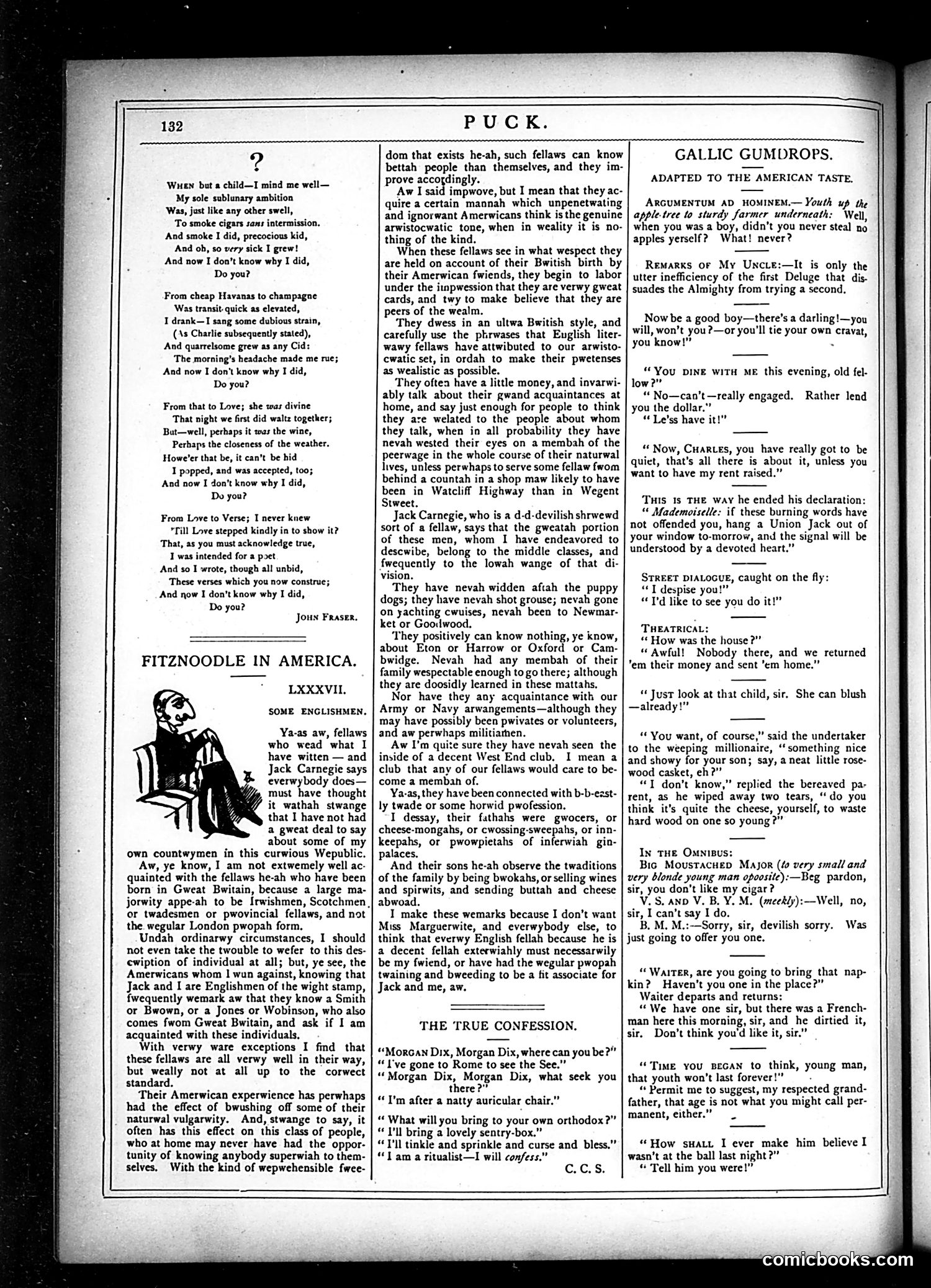
This page contains three distinct sections: **"Fitznoodle in America"** (main cartoon): A satirical piece mocking English visitors' attitudes toward America. The text critiques English travelers who arrive in America claiming superior knowledge and connections, name-dropping prestigious British institutions (Eton, Oxford, Cambridge) while actually knowing nothing. The cartoon illustrates this type of pretentious Englishman. The satire targets both the English visitors' snobbery and Americans' tendency to be impressed by such false claims of sophistication. **"Gallic Gumdrops"** and **"The True Confession"**: Shorter humorous pieces with dialogue, appearing to be social comedy sketches rather than political satire. The overall theme mocks cross-cultural pretension and class affectation among English travelers in America during the Gilded Age.
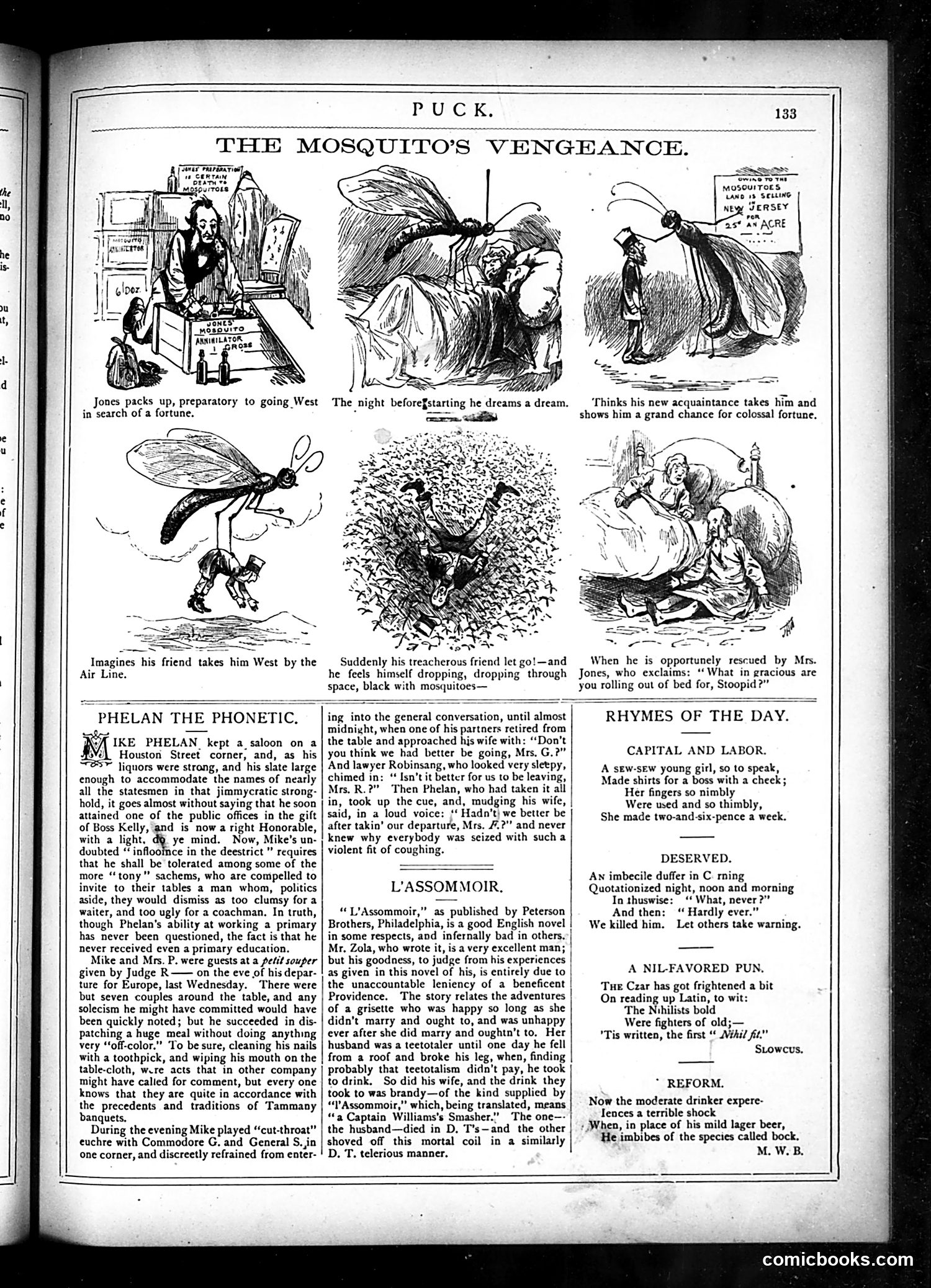
This comic strip satirizes a man named Jones who dreams of westward fortune-seeking. A giant mosquito repeatedly torments him—carrying him away, dropping him through space, and ultimately rescuing him from drowning (which Jones finds humiliating). The satire appears to mock the get-rich-quick mentality of westward expansion and frontier dreams popular in America's Gilded Age. The mosquito symbolizes nature's harsh realities that undermine such aspirations. Jones's alternating hope and misfortune—punctuated by an unwanted rescue by Mrs. Jones—suggests the futility and embarrassment of chasing illusory dreams. The remaining page content includes unrelated satirical pieces and poetry about social topics, typical of Puck's miscellaneous format.
This page contains three distinct pieces: "Prayer-Book Popping" (a poem), "My Old Hat" (a story), and "Interview of the Committee of the Irish Historical Society with Hon. James O'Brien." The visible content is primarily **literary rather than cartoon-based**. "My Old Hat" is a nostalgic narrative about cherishing a worn hat through seasons and mishaps—a sentimental piece with gentle humor about domestic life. The Irish Historical Society interview appears to be satirical commentary on Irish-American politics and cultural institutions, though the specific targets are unclear from the OCR'd text alone. The page exemplifies Puck's mixed format: combining satirical prose, poetry, and interviews alongside visual humor.
This page contains primarily **text articles and theater reviews** rather than political cartoons. The main content includes: 1. **"Common Sense for the S.P.C.C."** - A defense of Governor Lorne against criticism regarding *Pinafore* performances and the Society for the Prevention of Cruelty to Children's involvement in theater censorship. 2. **"Mr. Governor Lorne Once More"** - Further commentary on Lorne's social policies and public administration, defending him against charges of unfairness in attacking critics. 3. **"The Theatres"** - Reviews of current theatrical productions, including *Pinafore* and other performances. The satirical tone targets theater censorship practices and political figures involved in arts regulation during this period. Without visible illustrations, the humor relies on written argument rather than visual caricature.
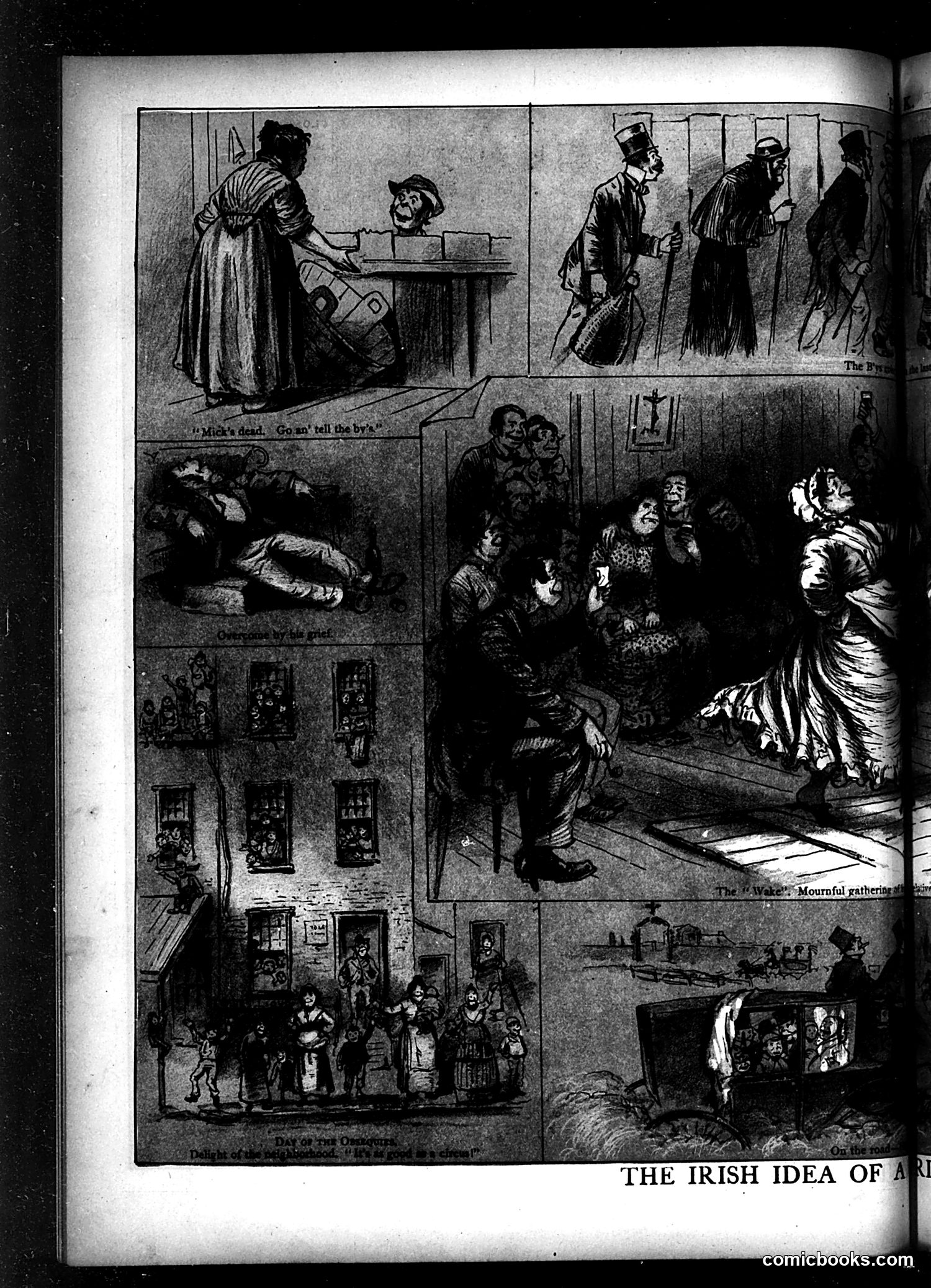
This appears to be a multi-panel satirical comic from Puck magazine depicting Irish immigrants or Irish-American life. The top panels show what appears to be official or legal proceedings, with dialogue including "Mick's dead. Go on' tell the b'ys." The narrative moves downward, showing increasingly crowded scenes of tenement life and gatherings of working-class Irish people. The title, "The Irish Idea of a..." (text cut off), combined with the visual progression from officialdom to densely-packed urban poor communities, suggests this is satirizing Irish-American culture or immigration—likely mocking Irish funeral customs, family size, tenement living conditions, or community behaviors. The stereotyping and tone are typical of late 19th-century anti-Irish American satire.
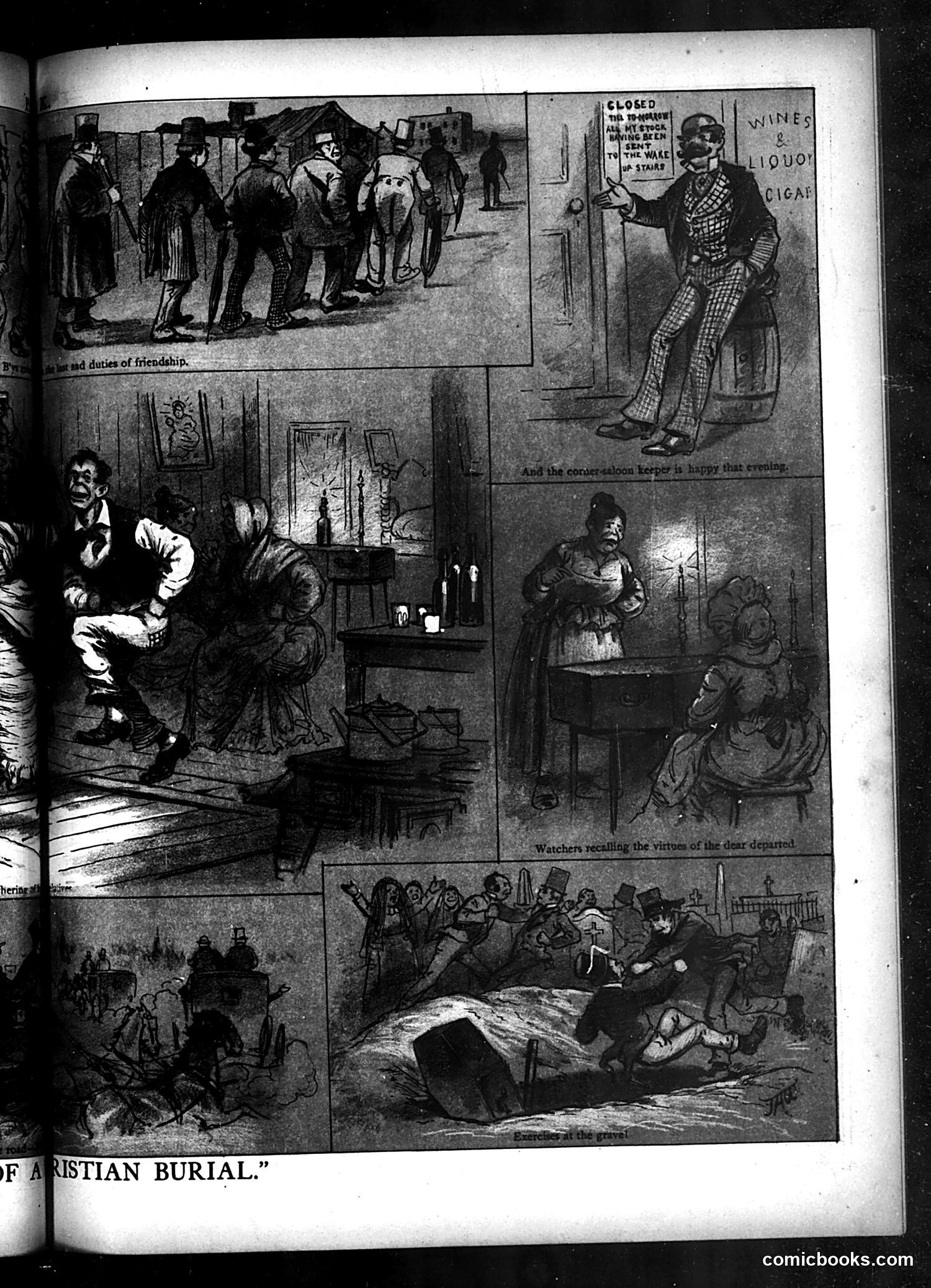
This appears to be a satirical narrative sequence depicting the aftermath of a death, likely social commentary on funeral practices or mourning rituals in late 19th-century America. The page shows: a closed establishment (top right, marked "CLOSED"), mourners gathering outdoors, an indoor domestic scene with figures around what appears to be a deathbed or body, watchers "recalling the virtues of the dear departed," and a final burial scene with multiple mourners. The title's reference to "Christian burial" combined with the sequence suggests Puck is satirizing either: hypocrisy in mourning (people praising the deceased despite previous indifference), funeral industry practices, or social pretense surrounding death. The specificity of which contemporary event or target is unclear without additional context from the magazine's issue.
This page is **not a political cartoon** but rather the continuation of a serialized fiction story titled "Archie Gascoyne: A Romance of Skye," written by John Fraser expressly for Puck magazine. The page reproduces a letter from "Alexander Gascoyne" to his son, discussing financial matters related to selling the Fardon farm and Isabella Silver Mines shares in Nevada. The narrative involves family inheritance disputes, estate management, and personal correspondence between father and son. This represents Puck's literary content—serialized romantic fiction rather than satirical commentary. The magazine mixed humor, cartoons, and serialized stories for entertainment purposes.
This page is primarily text—a chapter from a serialized story called "Puck" rather than a political cartoon. The narrative focuses on a character named Bob, described as a charming but somewhat aimless Irishman of modest means who has pursued various occupations including journalism and music. The text discusses Bob's talents, his romantic appeal, and his eventual success in theater and journalism in Dublin and Glasgow. The passage emphasizes Bob's good nature, social charm, and musical abilities while gently satirizing his lack of direction and tendency toward opportunism. Without visible cartoons on this page, the satire operates through character portrayal rather than visual caricature.
This page is primarily text-based content rather than political cartoons. It contains: 1. **"Puck's Briefings"** — A column of short satirical observations on contemporary issues, including commentary on dust pollution, trade practices, and social conditions. 2. **Poetry section** — Including "The Terrible Dust" (likely about urban pollution) and "To a School Girl." 3. **"Last Month"** — A note about April being the seventh month of the year after Julius Caesar's calendar reform, with folkloric observations about the month's characteristics. 4. **Various quoted observations** — Satirical one-liners and witticisms about topics like marriage, coachmen, blacksmiths, and hotel life, sourced from various newspapers. The content reflects late 19th/early 20th-century urban American concerns: industrial pollution, social etiquette, and everyday absurdities. The overall tone is humorous critique of contemporary society.
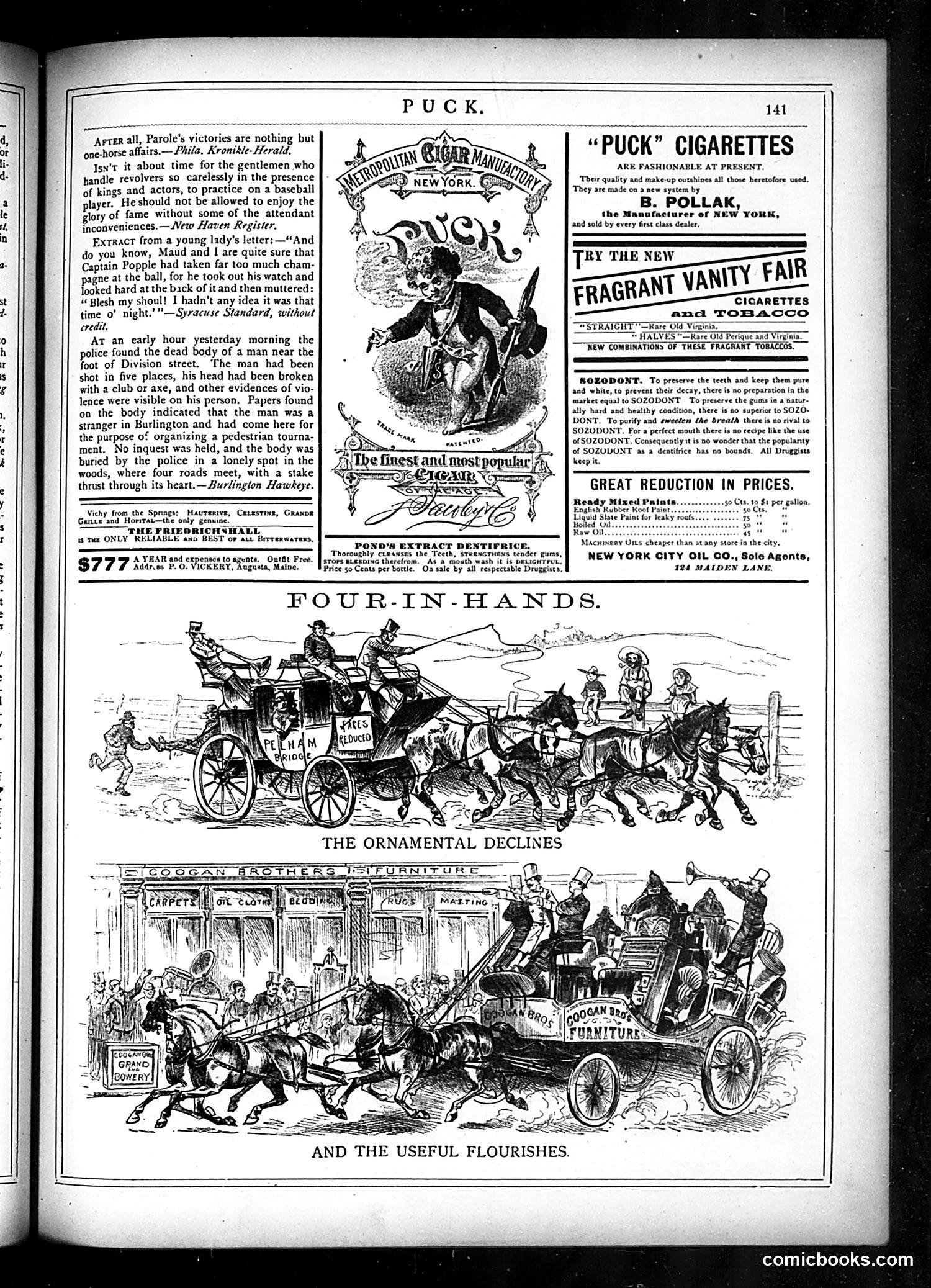
This page is primarily **advertising and commercial content** rather than political satire. The top half features ads for "Puck" cigarettes by B. Pollak, "Fragrant Vanity Fair" cigarettes and tobacco, dental products (Sozodont), and paint supplies—typical late 19th-century commercial notices. The bottom half contains two illustrated satirical sections titled "Four-in-Hands": "The Ornamental Declines" and "And the Useful Flourishes." These appear to contrast fancy, decorative horse-drawn carriages with practical, utilitarian vehicles. The cartoons likely satirize contemporary debates about function versus ornamentation in design or transportation—a common Puck theme—though specific political references aren't clearly evident in the visible text.
This page is predominantly filled with late 19th-century advertisements rather than editorial cartoons. The ads promote various goods and services: umbrellas, hats, champagne, clocks, jewelry, furniture, photography, champagne, dental services, beer, and tailoring. The only substantial illustration is a centered engraving labeled "D. A. MAYER" showing Hungarian wine merchants' advertisement, featuring a classical allegorical figure. The image includes text emphasizing the purity and awards of Hungarian wines sold in America. There is no significant political or social satire visible on this particular page. It represents typical Puck magazine content from this era, where advertising revenue subsidized the publication's satirical journalism and cartoons found elsewhere in the magazine.
This page is predominantly **advertisements** rather than political satire or editorial cartoons. The content includes: - **Arnold, Constable & Co.** ads promoting furniture, drapery, novelties, neckwear, handkerchiefs, and dress shirts - **Lord & Taylor** advertisement for colored silks - **Vienna Coffee Pot** product illustration and pricing - **A. Heller & Bro.** wine and liquor merchant advertisement - **Keppich & Co.** Royal Havana cigars promotion (with lottery information) - Various patent and medical remedy advertisements (felt hats, rheumatism cures, tapeworm treatments) There are **no discernible political cartoons or satirical illustrations** visible on this page. It represents standard late 19th-century magazine advertising practices, with multiple merchants and patent medicine promoters purchasing space.
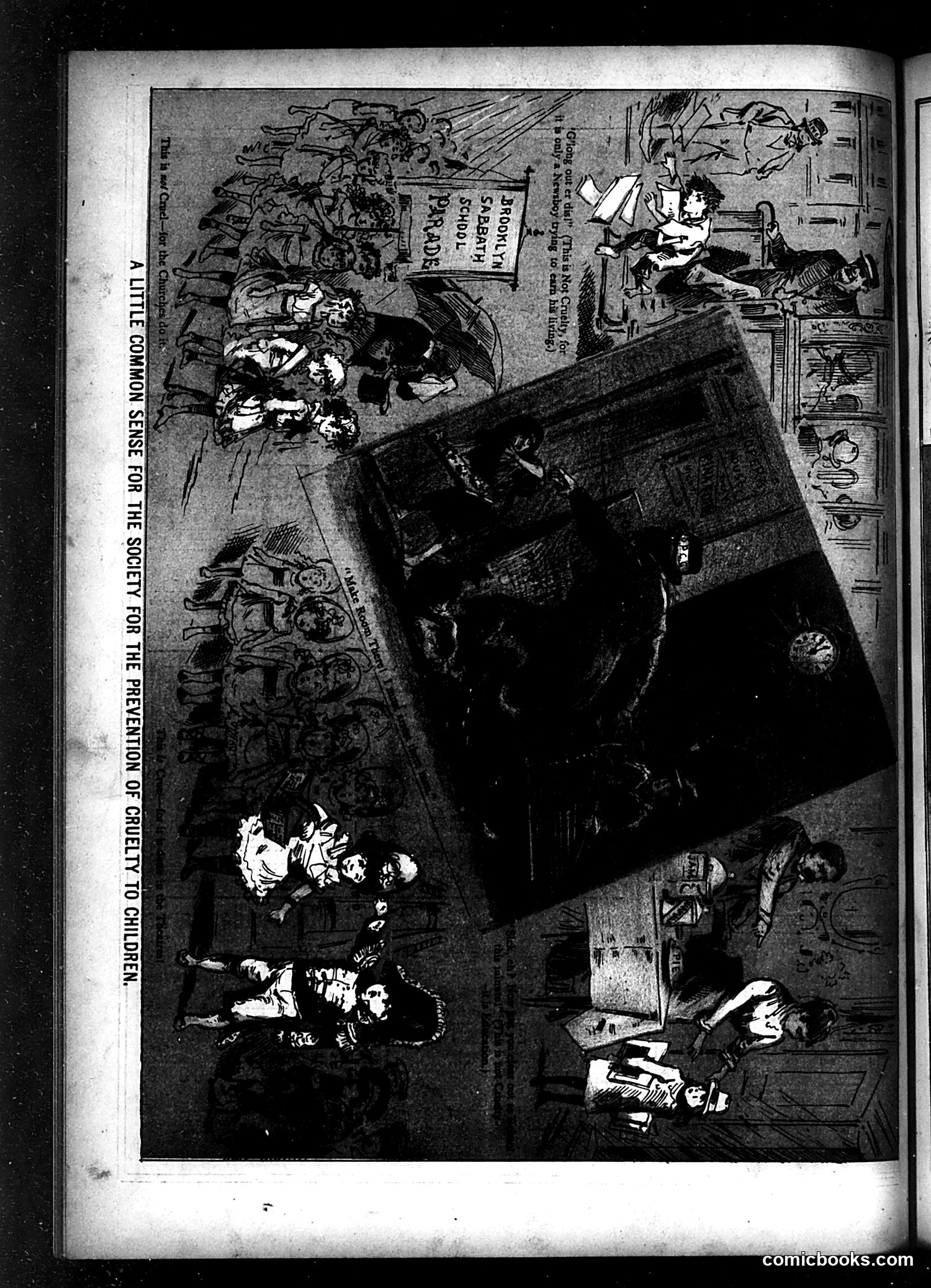
This appears to be a satirical cartoon from Puck magazine critiquing the relationship between society and the prevention of cruelty to children. The visible text references "A LITTLE COMMON SENSE FOR THE SOCIETY FOR THE PREVENTION OF CRUELTY TO CHILDREN." The cartoon likely depicts a contrast between institutional efforts to protect children and real-world neglect or hypocrisy. Without clearer image resolution, the specific figures are difficult to identify with certainty, but the composition suggests multiple scenes showing either the gap between stated charitable intentions and actual practice, or the inadequacy of formal organizations in addressing child welfare. The satire appears to critique Victorian-era child protection movements, suggesting they were ineffective, performative, or controlled by people indifferent to genuine suffering. This reflects common Puck themes questioning whether charitable institutions truly served their stated purposes.