
Puck, 1879-05-07 · page 6 of 16
Puck — May 7, 1879 — page 6: what you’re looking at
What you’re looking at
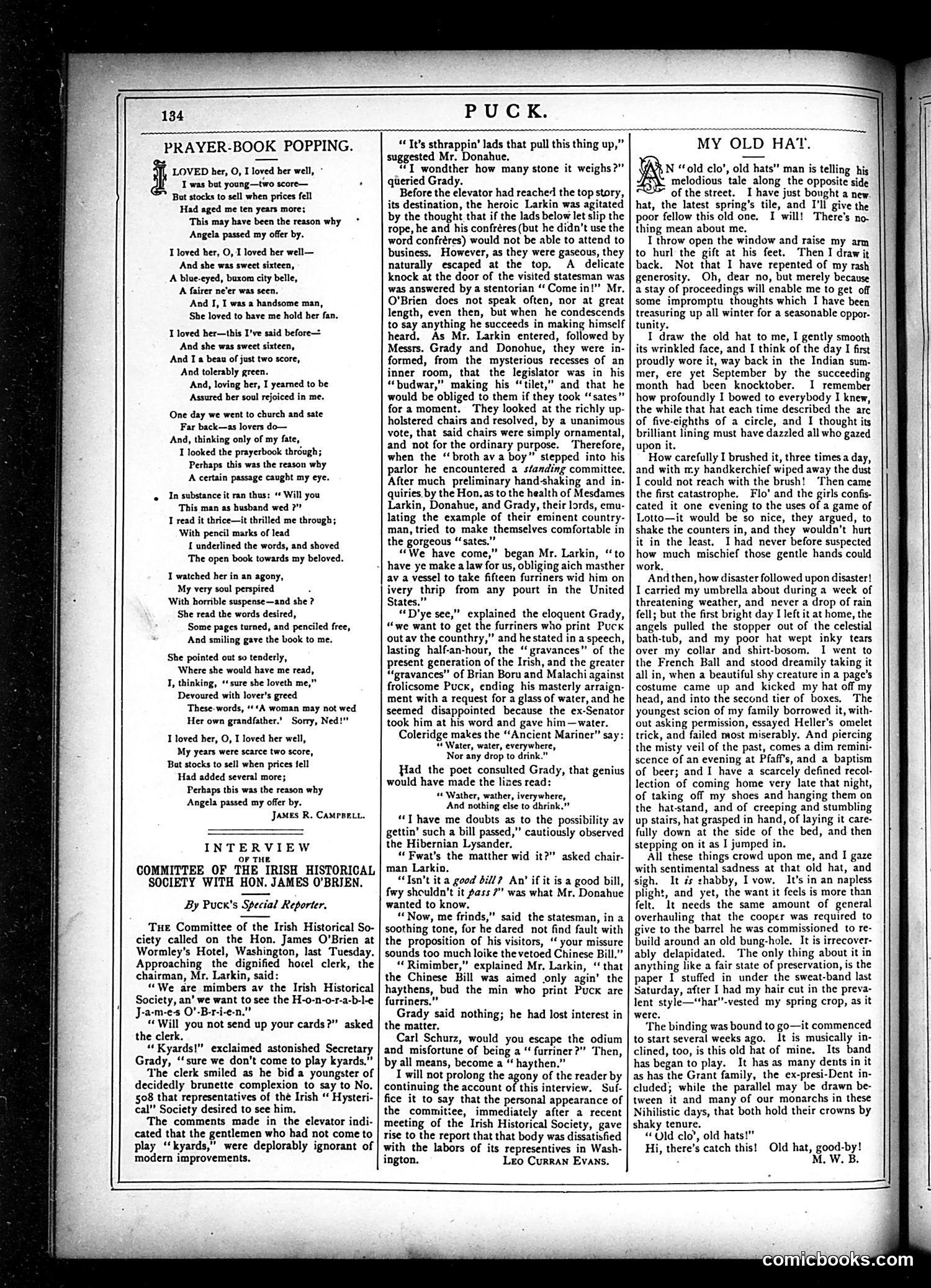
This page contains three distinct pieces: "Prayer-Book Popping" (a poem), "My Old Hat" (a story), and "Interview of the Committee of the Irish Historical Society with Hon. James O'Brien." The visible content is primarily **literary rather than cartoon-based**. "My Old Hat" is a nostalgic narrative about cherishing a worn hat through seasons and mishaps—a sentimental piece with gentle humor about domestic life. The Irish Historical Society interview appears to be satirical commentary on Irish-American politics and cultural institutions, though the specific targets are unclear from the OCR'd text alone. The page exemplifies Puck's mixed format: combining satirical prose, poetry, and interviews alongside visual humor.
📄 Transcribed text from this page (OCR, searchable)
Machine-transcribed from the original scan — historical spelling and the odd misread are preserved.
PUCK. PRAYER-BOOK POPPING. LOVED her, O, I loved her well, * T was but young—two score— Bat stocks to sell when prices fell Had aged me ten years more: This may have been the reason why * Angela passed my offer by. I loved her, O, I loved her well— ‘And she was sweet sixteen, A blue-eyed, buxom city belle, A fairer ne'er was seen. And I, I was a handsome man, She loved to have me hold her fan. I loved her—this I've said before— And she was sweet sixteen, And T a beau of just two score, And tolerably green. ‘And, loving her, I yearned to be Assured her soul rejoiced in me. One day we went to church and sate Far back—as lovers do— And, thinking only of my fate, I looked the prayerbook through; Perhaps this was the reason why A certain passage caught my eye. In substance it ran thus: “ Will you This man as husband wed ?”” I read it thrice—it thrilled me through; With pencil marks of lead { underlined the words, and shoved The open book towards my beloved. I watched her in an agony, My very soul perspired : With horrible suspense—and she ? She read the words desired, Some pages turned, and penciled free, And smiling gave the book to me. She pointed out so tenderly, Where she would have me read, I, thinking, “sure she loveth me,” Devoured with lover's greed These-words, “**A woman may not wed Her own grandfather.’ Sorry, Ned!” I loved her, O, I loved her well, ‘My years were scarce two score, Bat stocks to sell when prices fell Had added several more; Perhaps this was the reason why Angela passed my offer by. James R. Camron. INTERVIEW OF THE COMMITTEE OF THE IRISH HISTORICAL SOCIETY WITH HON. JAMES O'BRIEN. By Puc's Special Reporter, Tue Committee of the Irish Historical So- ciety called on the Hon. James O'Brien at Wormley’s Hotel, Washington, last Tuesday. Approaching the dignified hocel clerk, the chairman, Mr. Larkin, said: “We are mimbers av the Irish Historical Society, an’ we want to see the H-o-n-o-r-a-b-l-e J-a-m-e-s O'-B-r-i-e-n.” Will you not send up your cards?” asked the clerk. “‘Kyards!” exclaimed astonished Secretary Grady, “sure we don’t come to play kyards.” ‘The clerk smiled as he bid a youngster of decidedly brunette complexion to say to No. 508 that representatives of thé Irish “ Hysteri- cal” Society desired to see him, The comments made in the elevator indi- cated that the gentlemen who had not come to play ‘‘kyards,” were deplorably ignorant of modern improvements. “It’s sthrappin’ lads that pull this thing up,” suggested Mr. Donahue. “I wondther how many stone it weighs?” queried Grady. Before the elevator had reached the top story, its destination, the heroic Larkin was agitated by the thought that if the lads below let slip the rope, he and his confréres (but he didn’t use the word confréres) would not be able to attend to business. However, as they were gaseous, they naturally escaped at the top. A delicate knock at the door of the visited statesman was was answered by a stentorian “Come in!” Mr, O'Brien does not speak often, nor at great length, even then, but when he condescends to say anything he succeeds in making himself heard. As Mr. Larkin entered, followed by Messrs. Grady and Donohue, they were in- formed, from the mysterious recesses of an inner room, that the legislator was in his “budwar,” making his “tilet,” and that he would be obliged to them if they took “sates” for a moment. They looked at the richly up- holstered chairs and resolved, by a unanimous vote, that said chairs were simply ornamental, and not for the ordinary purpose. ‘Therefore, when the ‘broth av a boy” stepped into his parlor he encountered a standing committee. After much preliminary hand-shaking and in- quiries, by the Hon. as to the health of Mesdames Larkin, Donahue, and Grady, their lords, emu- lating the example of their eminent country- man, tried to make themselves comfortable in the gorgeous “sates.” “We have come,” began Mr. Larkin, ‘to have ye make a law for us, obliging aich masther av a vessel to take fifteen furriners wid him on ivery thrip from any pourt in the United States.” “D'ye see,” explained the eloquent Grady, “we want to get the furriners who print Puck out av the counthry,” and he stated in a speech, lasting half-an-hour, the “gravances” of the present generation of the Irish, and the greater “gravances” of Brian Boru and Malachi against frolicsome Puck, ending his masterly arraign- ment with a request for a glass of water, and he seemed disappointed because the ex-Senator took him at his word and gave him—water. Coleridge makes the “Ancient Mariner” say: “ Water, water, everywhere, Nor any drop to drink.” Had the poet consulted Grady, that genius would have made the lines read: « Wather, wather, iverywhere, And nothing else to dhrink.” “T have me doubts as to the possibility av gettin’ such a bill passed,” cautiously observed the Hibernian Lysander. “ Fwat's the matther wid it?” asked chair- man Larkin. “Isn't it a good bil? An’ if it is a good bill, fwy shouldn't it pass 7” was what Mr. Donahue wanted to know, ‘Now, me frinds,” said the statesman, in a soothing tone, for he dared not find fault with the proposition of his visitors, ‘ your missure sounds too much loike the vetoed Chinese Bill.” “Rimimber,” explained Mr, Larkin, “ that the Chinese Bill was aimed only agin’ the haythens, bud the min who print Puck are furriners.” Grady said nothing; he had lost interest in the matter. Carl Schurz, would you escape the odium and misfortune of being a “‘furriner?” Then, by all means, become a “ haythen.” I will not prolong the agony of the reader by continuing the account of this interview. Suf- fice it to say that the personal appearance of the commitiee, immediately after a recent meeting of the Irish Historical Society, gave Tise to the report that that body was dissatisfied with the labors of its representives in Wash- ington. Leo Curran Evans. MY OLD HA N “old clo’, old hats’ man is telling his melodious tale along the opposite side of the street. I have just bought a new. hat, the latest spring’s tile, and I'll give the poor fellow this old one. I will! There's no- thing mean about me, I throw open the window and raise my arm. to hurl the gift at his feet. Then I draw it back. Not that I have repented of my rash generosity. Oh, dear no, but merely because a stay of proceedings will enable me to get off some impromptu thoughts which I have been treasuring up all winter for a seasonable oppor- tunity. I draw the old hat to me, I gently smooth its wrinkled face, and I think of the day I first proudly wore it, way back in the Indian sum. mer, ere yet September by the succeeding month had been knocktober. 1 remember how profoundly I bowed to everybody I knew, the while that hat each time described the are of five-eighths of a circle, and I thought its brilliant lining must have dazzled all who gazed upon it. How carefully I brushed it, three times a day, and with my handkerchief wiped away the dust I could not reach with the brush! Then came the first catastrophe. Flo’ and the girls confis- cated it one evening to the uses of a game of Lotto—it would be so nice, they argued, to shake the counters in, and they wouldn't hurt it in the least, I had never before suspected how much mischief those gentle hands could work, And then, how disaster followed upon disaster! I carried my umbrella about during a week of threatening weather, and never a drop of rain fell; but the first bright day I left it at home, the angels pulled the stopper out of the celestial bath-tub, and my poor hat wept inky tears over my collar and shirt-bosom. I went to the French Ball and stood dreamily taking it all in, when a beautiful shy creature in a page's costume came up and kicked my hat off my head, and into the second tier of boxes. The youngest scion of my family borrowed it, with- out asking permission, essayed Heller's omelet trick, and failed most miserably. And piercing the misty veil of the past, comes a dim remini- scence of an evening at Pfaff’s, and a baptism of beer; and I have a scarcely defined recol- lection of coming home very late that night, of taking off my shoes and hanging them on the hat-stand, and of creeping and stumbling up stairs, hat grasped in hand, of laying it care- fully down at the side of the bed, and then stepping on it as I jumped in. ‘All these things crowd upon me, and I gaze with sentimental sadness at that old hat, and sigh. It és shabby, I vow. It’s in an napless plight, and yet, the want it feels is more than felt. It needs the same amount of general overhauling that the cooper was required to give to the barrel he was commissioned to re- build around an old bung-hole. It is irrecover- ably delapidated. The only thing about it in anything like a fair state of preservation, is the paper I stuffed in under the sweat-band last Saturday, after I had my hair cut in the preva- lent style—‘thar’-vested my spring crop, as it were, ‘The binding was bound to go—it commenced to start several weeks ago. It is musically in- clined, too, is this old hat of mine. Its band has began to play. It has as many dents in it as has the Grant family, the ex-presi-Dent in- cluded; while the parallel may be drawn be- tw it and many of our monarchs in these Nihilistic days, that both hold their crowns by shaky tenure. “Old clo’, old hats!” Hi, there’s catch this! Old hat, good-by!