
Puck, 1879-05-07 · page 11 of 16
Puck — May 7, 1879 — page 11: what you’re looking at
What you’re looking at
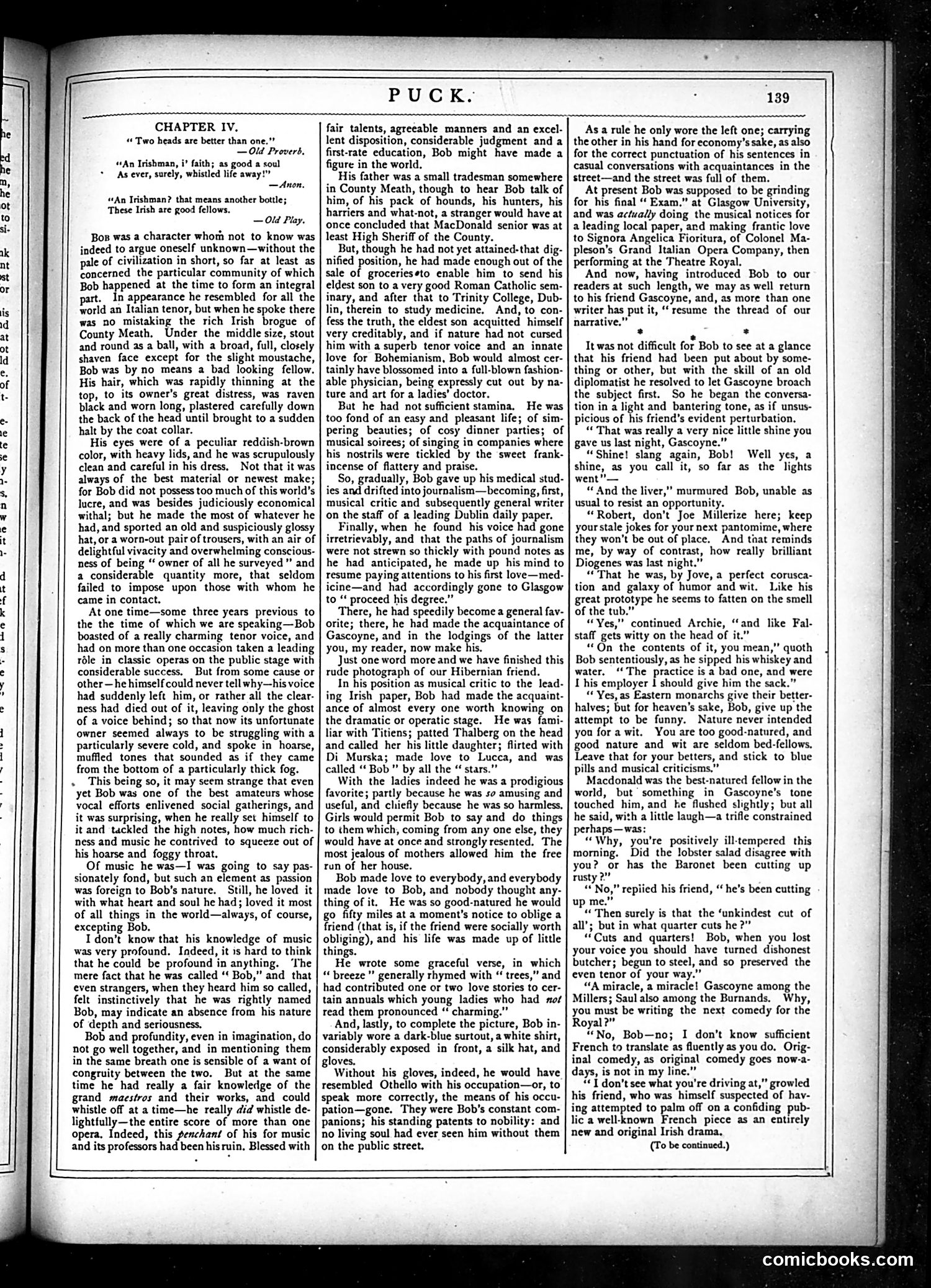
This page is primarily text—a chapter from a serialized story called "Puck" rather than a political cartoon. The narrative focuses on a character named Bob, described as a charming but somewhat aimless Irishman of modest means who has pursued various occupations including journalism and music. The text discusses Bob's talents, his romantic appeal, and his eventual success in theater and journalism in Dublin and Glasgow. The passage emphasizes Bob's good nature, social charm, and musical abilities while gently satirizing his lack of direction and tendency toward opportunism. Without visible cartoons on this page, the satire operates through character portrayal rather than visual caricature.
📄 Transcribed text from this page (OCR, searchable)
Machine-transcribed from the original scan — historical spelling and the odd misread are preserved.
PUCK. CHAPTER IV. «« Two heads are better than one.” —Old Proverb, “An Irishman, i faith; as good a soul As ever, surely, whistled life away!” —Anon. “An Irishman? that means another bottle; These Irish are good fellows. —Old Play. Bop was a character whom not to know was indeed to argue oneself unknown—without the pale of civilization in short, so far at least as concerned the particular community of which Bob happened at the time to form an integral In appearance he resembled for all the world an Italian tenor, but when he spoke there was no mistaking the rich Irish brogue of County Meath. Under the middle size, stout and round as a ball, with a broad, full, closely shaven face except for the slight moustache, Bob was by no means a bad looking fellow. His hair, which was rapidly thinning at the top, to its owner's great distress, was raven black and worn long, plastered carefully down the back of the head until brought to a sudden halt by the coat collar. His eyes were of a peculiar reddish-brown color, with heavy lids, and he was scrupulously clean and careful in his dress, Not that it was always of the best material or newest make; for Bob did not possess too much of this world’s lucre, and was besides judiciously economical withal; but he made the most of whatever he had, and sported an old and suspiciously glossy hat, or a worn-out pair of trousers, with an air of delightful vivacity and overwhelming conscious- ness of being “ owner of all he surveyed” and a considerable quantity more, that seldom failed to impose upon those with whom he came in contact. At one time—some three years previous to the the time of which we are speaking—Bob boasted of a really charming tenor voice, and had on more than one occasion taken a leading role in classic operas on the public stage with considerable success. But from some cause or other —he himself could never tell why—his voice had suddenly left him, or rather all the clear- ness had died out of it, leaving only the ghost of a voice behind; so that now its unfortunate owner seemed always to be struggling with a particularly severe cold, and spoke in hoarse, muffled tones that sounded as if they came from the bottom of a particularly thick fog. » This being so, it may seem strange that even yet Bob was one of the best amateurs whose vocal efforts enlivened social gatherings, and it was surprising, when he really set himself to it and tackled the high notes, how much rich- ness and music he contrived to squeeze out of his hoarse and foggy throat. Of music he was—I was going to say pas- sionately fond, but such an element as passion was foreign to Bob’s nature. Still, he loved it with what heart and soul he had; loved it most of all things in the world—always, of course, excepting Bob. I don’t know that his knowledge of music was very profound. Indeed, it is hard to think that he could be profound in anything. ‘The mere fact that he was called ‘‘ Bob,” and that even strangers, when they heard him so called, felt instinctively that he was rightly named Bob, may indicate an absence from his nature of depth and seriousness. Bob and profundity, even in imagination, do not go well together, and in mentioning them in the same breath one is sensible of a want of congruity between the two. But at the same time he had really a fair knowledge of the grand maestros and their works, and could whistle off at a time—he really did whistle de- lightfully—the entire score of more than one opera, Indeed, this penchant of his for music and its professors had been his ruin, Blessed with fair talents, agreeable manners and an excel- lent disposition, considerable judgment and a first-rate education, Bob might have made a figure in the world, His father was a small tradesman somewhere in County Meath, though to hear Bob talk of him, of his pack of hounds, his hunters, his harriers and what-not, a stranger would have at once concluded that MacDonald senior was at least High Sheriff of the County. But, though he had not yet attained-that dig- nified position, he had made enough out of the sale of grocerieseto enable him to send his eldest son to a very good Roman Catholic sem- inary, and after that to Trinity College, Dub- lin, therein to study medicine. And, to con- fess the truth, the eldest son acquitted himself very creditably, and if nature had not cursed him with a superb tenor voice and an innate love for Bohemianism, Bob would almost cer- tainly have blossomed into a full-blown fashion- able physician, being expressly cut out by na- ture and art for a ladies’ doctor. Bat he had not sufficient stamina. He was too fond of an easy and pleasant life; of sim- pering beauties; of cosy dinner parties; of musical soirees; of singing in companies where his nostrils were tickled by the sweet frank- incense of flattery and praise. So, gradually, Bob gave up his medical stud- ies and drifted into journalism—becoming, first, musical critic and subsequently general writer on the staff of a leading Dublin daily paper. Finally, when he found his voice had gone irretrievably, and that the paths of journalism were not strewn so thickly with pound notes as he had anticipated, he made up his mind to resume paying attentions to his first love—med- icine—and had accordingly gone to Glasgow to “‘ proceed his degree.” There, he had speedily become a general fav- orite; there, he had made the acquaintance of Gascoyne, and in the lodgings of the latter you, my reader, now make Fis. Just one word more and we have finished this rude photograph of our Hibernian friend. In his position as musical critic to the lead- ing Irish paper, Bob had made the acquaint- ance of almost every one worth knowing on the dramatic or operatic stage. He was fami- liar with Titiens; patted Thalberg on the head and called her his little daughter; flirted with Di Murska; made love to Lucca, and was called ‘‘ Bob" by all the “ stars.” With the ladies indeed he was a prodigious favorite; partly because he was so amusing and useful, and chiefly because he was so harmless. Girls would permit Bob to say and do things to them which, coming from any one else, they would have at once and strongly resented. The most jealous of mothers allowed him the free run of her house. Bob made love to everybody, and everybody made love to Bob, and nobody thought any- thing of it. He was so good-natured he would go fifty miles at a moment's notice to oblige a friend (that is, if the friend were socially worth obliging), and his life was made up of little things. He wrote some graceful verse, in which “ breeze” generally rhymed with “ trees,” and had contributed one or two love stories to cer- tain annuals which young ladies who had not read them pronounced “charming.” And, lastly, to complete the picture, Bob i variably wore a dark-blue surtout, a white shirt, considerably exposed in front, a silk hat, and gloves. Without his gloves, indeed, he would have resembled Othello with his occupation—or, to speak more correctly, the means of his occu- pation—gone. They were Bob’s constant com- panions; his standing patents to nobility: and no living soul had ever seen him without them on the public street. Asa rule he only wore the left one; carrying the other in his hand for economy's sake, as also for the correct punctuation of his sentences in casual conversations with acquaintances in the street—and the street was full of them. At present Bob was supposed to be grinding for his final ‘‘ Exam.” at Glasgow University, and was actually doing the musical notices for a leading local paper, and making frantic love to Signora Angelica Fioritura, of Colonel Ma- pleson’s Grand Italian Opera Company, then performing at the Theatre Royal. And now, having introduced Bob to our readers at such length, we may as well return to his friend Gascoyne, and, as more than one writer has put it, “resume the thread of our narrative.” Ps * It was not difficult for Bob to see at a glance that his friend had been put about by some- thing or other, but with the skill of an old diplomatist he resolved to let Gascoyne broach the subject first. So he began the conversa- tion in a light and bantering tone, as if unsus- picious of his friend's evident perturbation, “That was really a very nice little shine you gave us last night, Gascoyne.” “Shine! slang again, Bob! Well yes, a shine, as you call it, so far as the lights went"— “ And the liver,” murmured Bob, unable as usual to resist an opportunity. “Robert, don’t Joe Millerize here; keep yourstale jokes for your next pantomime, where they won't be out of place. And that reminds me, by way of contrast, how really brilliant Diogenes was last night.” “That he was, by Jove, a perfect corusca- tion and galaxy of humor and wit. Like his great prototype he seems to fatten on the smell of the tub.” “Yes,” continued Archie, ‘and like Fal- staff gets witty on the head of it.” “‘On the contents of it, you mean,” quoth Bob sententiously, as he sipped his whiskey and water. “The practice is a bad one, and were Lhis employer | should give him the sack.” “Yes, as Eastern monarchs give their better- halves; but for heaven's sake, Bob, give up the attempt to be funny. Nature never intended you for a wit. You are too good-natured, and good nature and wit are seldom bed-fellows. Leave that for your betters, and stick to blue pills and musical criticisms.” Macdonald was the best-natured fellow in the world, but something in Gascoyne’s tone touched him, and he flushed slightly; but all he said, with a little laugh—a trifle constrained perhaps —was: “Why, you're positively ill-tempered this morning. Did the lobster salad disagree with you? or has the Baronet been cutting up rusty 2” “No,” repiied his friend, “he's been cutting up me.” “Then surely is that the ‘unkindest cut of all’; but in what quarter cuts he ?” “Cuts and quarters! Bob, when you lost your voice you should have turned dishonest butcher; begun to steel, and so preserved the even tenor of your way.” “A miracle, a miracle! Gascoyne among the Millers; Saul also among the Burnands. Why, you must be writing the next comedy for the Royal?” “No, Bob—no; I don’t know sufficient French to translate as fluently as you do, Orig- inal comedy, as original comedy goes now-a- days, is not in my line.” “I don’t see what you're driving at,” growled his friend, who was himself suspected of hav- ing attempted to palm off on a confiding pub- lic a well-known French piece as an entirely new and original Irish drama, (To be continued.) comicbooks.com