
Puck, 1879-05-07 · page 7 of 16
Puck — May 7, 1879 — page 7: what you’re looking at
What you’re looking at
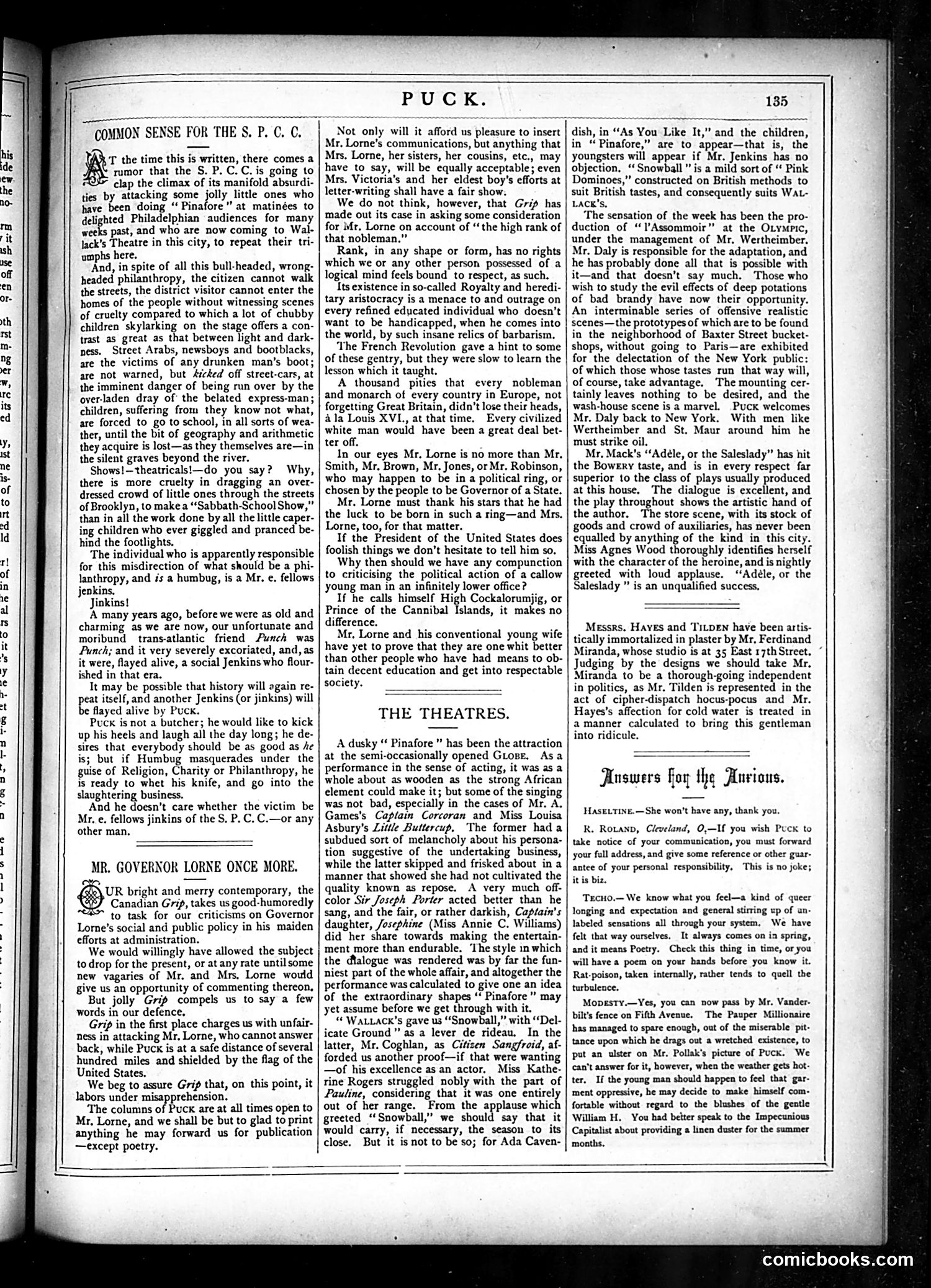
This page contains primarily **text articles and theater reviews** rather than political cartoons. The main content includes: 1. **"Common Sense for the S.P.C.C."** - A defense of Governor Lorne against criticism regarding *Pinafore* performances and the Society for the Prevention of Cruelty to Children's involvement in theater censorship. 2. **"Mr. Governor Lorne Once More"** - Further commentary on Lorne's social policies and public administration, defending him against charges of unfairness in attacking critics. 3. **"The Theatres"** - Reviews of current theatrical productions, including *Pinafore* and other performances. The satirical tone targets theater censorship practices and political figures involved in arts regulation during this period. Without visible illustrations, the humor relies on written argument rather than visual caricature.
📄 Transcribed text from this page (OCR, searchable)
Machine-transcribed from the original scan — historical spelling and the odd misread are preserved.
COMMON SENSE FOR THE S. P. C. C. T the time this is written, there comes a rumor that the S. P. C.C. is going to ¢ clap the climax of its manifold absurdi- ties by attacking some jolly, little ones who have been doing ‘‘ Pinafore" at matinées to delighted Philadelphian audiences for many weeks past, and who are now coming to Wal- lack’s Theatre in this city, to repeat their tri- umphs here. ‘And, in spite of all this bull-headed, wrong- headed philanthropy, the citizen cannot walk the streets, the district visitor cannot enter the homes of the people without witnessing scenes of cruelty compared to which a lot of chubby children skylarking on the stage offers a con- trast as great as that between light and dark- ness. Street Arabs, newsboys and bootblacks, are the victims of any drunken man’s boot; are not warned, but 4iched off street-cars, at the imminent danger of being run over by the overladen dray of the belated express-man; children, suffering from they know not what, are forced to go to school, in all sorts of wea- ther, until the bit of geography and arithmetic they acquire is lost—as they themselves are—in the silent graves beyond the river. Shows!—theatricals!—do you say? Why, there is more cruelty in dragging an over- dressed crowd of little ones through the streets of Brooklyn, to make a “‘Sabbath-School Show,” than in all the work done by all the little caper- ing children who ever giggled and pranced be- hind the footlights. The individual who is apparently responsible for this misdirection of what should be a phi- lanthropy, and és a humbug, is a Mr. e, fellows jenkins. Jinkins! ‘A many years ago, before we were as old and charming as we are now, our unfortunate and moribund trans-atlantic friend Punch was Punch; and it very severely excoriated, and, as it were, flayed alive, a social Jenkins who flour- ished in that era. It may be possible that history will again re- peat itself, and another Jenkins (or jinkins) will be flayed alive by Puck. Puck is not a butcher; he would like to kick up his heels and laugh all the day long; he de- sires that everybody should be as good as he is; but if Humbug masquerades under the guise of Religion, Charity or Philanthropy, he is ready to whet his knife, and go into the slaughtering business. And he doesn’t care whether the victim be Mr. e. fellows jinkins of the S. P. C.C.—or any other man, MR. GOVERNOR LORNE ONCE MORE. UR bright and merry contemporary, the Canadian Grip, takes us good-humoredly to task for our criticisms on Governor Lorme’s social and public policy in his maiden efforts at administration. We would willingly have allowed the subject to drop for the present, or at any rate untilsome new vagaries of Mr. and Mrs, Lorne would give us an opportunity of commenting thereon, But jolly Grip compels us to say a few words in our defence, Grip in the first place charges us with unfair- ness in attacking Mr, Lorne, who cannot answer back, while Puck is at a safe distance of several hundred miles and shielded by the flag of the United States. ‘ We beg to assure Grip that, on this point, it labors under misapprehension. The columns oft Puck are at all times open to Mr. Lorne, and we shall be but to glad to print anything he may forward us for publication —except poetry. PUCK. Not only will it afford us pleasure to insert Mr, Lorne’s communications, but anything that Mrs. Lorne, her sisters, her cousins, etc., may have to say, will be equally acceptable; even Mrs. Victoria’s and her eldest boy's efforts at letter-writing shall have a fair show. We do not think, however, that Grif has made out its case in asking some consideration for Mr. Lorne on account of “the high rank of that nobleman.” Rank, in any shape or form, has no rights which we or any other person possessed of a logical mind feels bound to respect, as such. Its existence in so-called Royalty and heredi- tary aristocracy is a menace to and outrage on every refined educated individual who doesn’t want to be handicapped, when he comes into the world, by such insane relics of barbarism, ‘The French Revolution gave a hint to some of these gentry, but they were slow to learn the lesson which it taught. A thousand pities that every nobleman and monarch of every country in Europe, not forgetting Great Britain, didn’t lose their heads, ala Louis XVL., at that time. Every civilized white man would have been a great deal bet- ter off. In our eyes Mr, Lorne is no more than Mr, Smith, Mr. Brown, Mr. Jones, or Mr. Robinson, who may happen to be ina political ring, or chosen by the people to be Governor of a State. Mr. Lorne must thank his stars that he had the luck to be born in such a ring—and Mrs. Lorne, too, for that matter. If the President of the United States does foolish things we don’t hesitate to tell him so, Why then should we have any compunction to criticising the political action of a callow young man in an infinitely lower office? Tf he calls himself High Cockalorumjig, or Prince of the Cannibal Islands, it makes no difference. Mr. Lorne and his conventional young wife have yet to prove that they are one whit better than other people who have had means to ob- tain decent education and get into respectable society. THE THEATRES. A dusky “ Pinafore” has been the attraction at the semi-occasionally opened Grose. Asa performance in the sense of acting, it was as a whole about as wooden as the strong African element could make it; but some of the singing was not bad, especially in the cases of Mr. A. Games's Caplain Corcoran and Miss Louisa Asbury's Litéle Buttercup, The former had a subdued sort of melancholy about his persona- tion suggestive of the undertaking business, while the latter skipped and frisked about in a manner that showed she had not cultivated the quality known as repose. A very much off- color Sir Joseph Porter acted better than he sang, and the fair, or rather darkish, Captain's daughter, Josephine (Miss Annie C. Williams) did her share towards making the entertain- ment more than endurable. ‘The style in which the dfalogue was rendered was by far the fun- niest part of the whole affair, and altogether the performance was calculated to give one an idea of the extraordinary shapes “* Pinafore ” may yet assume before we get through with it. “ WaLLack’s gave us “Snowball,” with ‘‘Del- icate Ground” as a lever de rideau. In the latter, Mr. Coghlan, as Citizen Sangfroid, af- forded us another proof—if that were wanting —of his excellence as an actor. Miss Kathe- rine Rogers struggled nobly with the part of Pauline, considering that it was one entirely out of her range. From the applause which greeted “Snowball,” we should say that it would carry, if necessary, the season to its close. But it is not to be so; for Ada Caven- dish, in “As You Like It,” and the children, in “Pinafore,” are to appear—that is, the youngsters will appear if Mr. Jenkins has no objection. ‘Snowball ” is a mild sort of “ Pink Dominoes,” constructed on British methods to suit British tastes, and consequently suits WAL- LACK's, ‘The sensation of the week has been the pro- duction of “’Assommoir” at the OLyMpic, under the management of Mr. Wertheimber. Mr. Daly is responsible for the adaptation, and he has probably done all that is possible with it—and that doesn’t say much. Those who wish to study the evil effects of deep potations of bad brandy have now their opportunity. An interminable series of offensive realistic scenes—the prototypes of which are to be found in the neighborhood of Baxter Street bucket- shops, without going to Paris—are exhibited for the delectation of the New York public: of which those whose tastes run that way will, of course, take advantage. The mounting cer- tainly leaves nothing to be desired, and the wash-house scene is a marvel. Puck welcomes Mr. Daly back to New York. With men like Wertheimber and St, Maur around him he must strike oil. Mr, Mack's ‘‘Adéle, or the Saleslady”’ has hit the Bowery taste, and is in every respect far superior to the class of plays usually produced at this house. The dialogue is excellent, and the play throughout shows the artistic hand of the author. The store scene, with its stock of goods and crowd of auxiliaries, has never been equalled by anything of the kind in this city. Miss Agnes Wood thoroughly identifies herself with the character of the heroine, and is nightly greeted with loud applause. “Adéle, or the Saleslady ” is an unqualified success, Messrs. Hayes and TiLDEN have been artis- tically immortalized in plaster by Mr, Ferdinand Miranda, whose studio is at 35 East 17thStreet. “ Judging ‘by the designs we should take Mr. Miranda to be a thorough-going independent in politics, as Mr. Tilden is represented in the act of cipher-dispatch hocus-pocus and Mr. Hayes’s affection for cold water is treated in amanner calculated to bring this gentleman into ridicule. Answers Foy the Aurions. HasELtiNe.—She won't have any, thank you. R. Rotann, Cleveland, O,—If you wish Puck to take notice of your communication, you must forward your full address, and give some reference or other guar- antee of your personal responsibility, This is no joke; itis biz. Tecno.—We know what you feel—a kind of queer longing and expectation and general stirring up of un- labeled sensations all through your system. We have felt that way ourselves. It always comes on in spring, and it means Poetry. Check this thing in time, or you will have a poem on your hands before you know it. Rat-poison, taken internally, rather tends to quell the turbulence. Mopesty.—Yes, you can now pass by Mr. Vander- bilt’s fence on Fifth Avenue. The Pauper Millionaire has managed to spare enough, out of the miserable pit- tance upon which he drags out a wretched existence, to put an ulster on Mr. Pollak’s picture of Puck. We can't answer for it, however, when the weather gets hot- ter, If the young man should happen to feel that gar- ment oppressive, he may decide to make himself com- fortable without regard to the blushes of the gentle William H. You had beiter speak to the Impecunious Capitalist about providing a linen duster for the summer months. comicbooks.com