
Puck, 1879-05-07 · page 4 of 16
Puck — May 7, 1879 — page 4: what you’re looking at
What you’re looking at
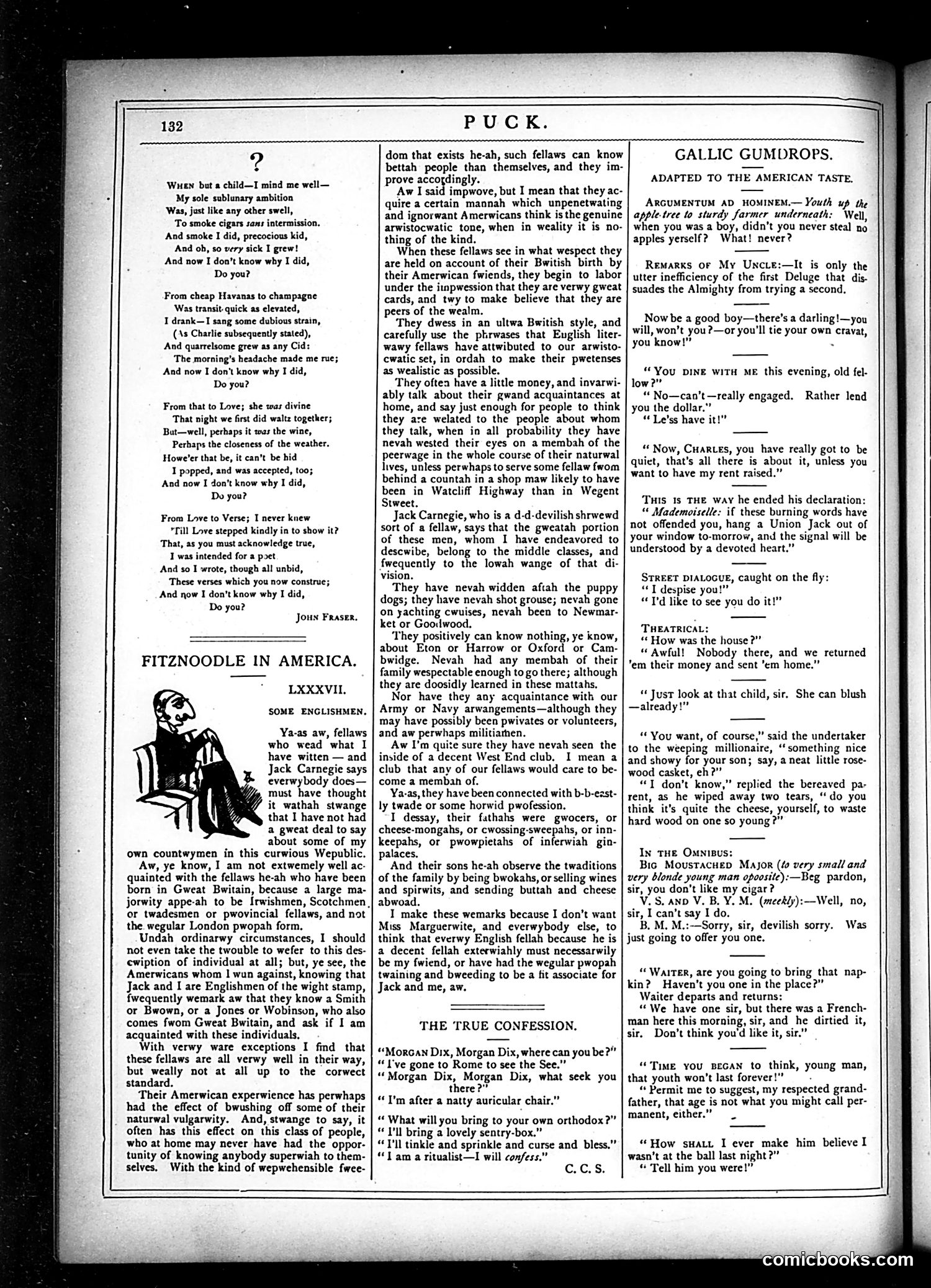
This page contains three distinct sections: **"Fitznoodle in America"** (main cartoon): A satirical piece mocking English visitors' attitudes toward America. The text critiques English travelers who arrive in America claiming superior knowledge and connections, name-dropping prestigious British institutions (Eton, Oxford, Cambridge) while actually knowing nothing. The cartoon illustrates this type of pretentious Englishman. The satire targets both the English visitors' snobbery and Americans' tendency to be impressed by such false claims of sophistication. **"Gallic Gumdrops"** and **"The True Confession"**: Shorter humorous pieces with dialogue, appearing to be social comedy sketches rather than political satire. The overall theme mocks cross-cultural pretension and class affectation among English travelers in America during the Gilded Age.
📄 Transcribed text from this page (OCR, searchable)
Machine-transcribed from the original scan — historical spelling and the odd misread are preserved.
PUCK. 9 Wuen but a child—I mind me well— My sole sublunary ambition ‘Was, jast like any other swell, To smoke cigars sans intermission. And smoke I did, precocious kid, ‘And ob, so very sick I grew! And now I don’t know why I did, Do you? From cheap Havanas to champagne Was transit. quick as elevated, I drank—TI sang some dubious strain, (As Charlie subsequently stated), ‘And quarrelsome grew as any Cid: ‘The morning's headache made me rue; And now I don't know why I did, Do you? From that to Love; she was divine That night we first did waltz together; But—well, perhaps it was the wine, Perhaps the closeness of the weather. Howe'er that be, it can’t be hid I popped, and was accepted, too; And now I don't know why I did, Do you? From Love to Verse; I never knew "Till Love stepped kindly in to show it? That, as you must acknowledge true, I was intended for a poet And so I wrote, though all unbid, ‘These verses which you now construe; And now I don’t know why I did, Do you? Jous Fraser. FITZNOODLE IN AMERICA. LXXXVII. SOME ENGLISHMEN, Ya-as aw, fellaws who wead what I have witten — and Jack Carnegie says everwybody does— y must have thought it wathah stwange that I have not had a gweat deal to say about some of my own countwymen in this curwious Wepublic. Aw, ye know, I am not extwemely well ac- quainted with the fellaws he-ah who have been born in Gweat Bwitain, because a large ma- jorwity appe-ah to be Irwishmen, Scotchmen, or twadesmen or pwovincial fellaws, and not the. wegular London pwopah form. Undah ordinarwy circumstances, I should not even take the twouble to wefer to this des- ewiption of individual at all; but, ye see, the Amerwicans whom I wun against, knowing that Jack and I are Englishmen of the wight stamp, fwequently wemark aw that they know a Smith or Bwown, or a Jones or Wobinson, who also comes fwom Gweat Bwitain, and ask if I am acquainted with these individuals, With verwy ware exceptions I find that these fellaws are all verwy well in their way, but weally not at all up to the corwect standard. Their Amerwican experwience has perwhaps had the effect of bwushing off some of their naturwal vulgarwity. And, stwange to say, it often has this effect on this class of people, who at home may never have had the oppor- tunity of knowing anybody superwiah to them- selves, With the kind of wepwehensible fwee- dom that exists he-ah, such fellaws can know bettah people than themselves, and they im- prove accordingly. Aw I said impwove, but I mean that they ac- quire a certain mannah which unpenetwating and ignorwant Amerwicans think is the genuine arwistocwatic tone, when in weality it is no- thing of the kind. When these fellaws see in what wespect they are held on account of their Bwitish birth by their Amerwican fwiends, they begin to labor under the itnpwession that they are verwy gweat cards, and twy to make believe that they are peers of the wealm. They dwess in an ultwa Bwitish style, and carefully use the phrwases that Euglish liter- wawy fellaws have attwibuted to our arwisto- cwatic set, in ordah to make their pwetenses as wealistic as possible. They oftea have a little money, and invarwi- ably talk about their gwand acquaintances at home, and say just enough for people to think they are welated to the people about whom they talk, when in all probability they have nevah wested their eyes on a membah of the peerwage in the whole course of their naturwal lives, unless perwhaps to serve some fellaw fwom behind a countah in a shop maw likely to have been in Watcliff Highway than in Wegent Stweet. Jack Carnegie, who is a d-d-devilish shrwewd sort of a fellaw, says that the gweatah portion of these men, whom I have endeavored to descwibe, belong to the middle classes, and fwequently to the lowah wange of that di- vision. They have nevah widden aftah the puppy dogs; they have nevah shot grouse; nevah gone on yachting cwuises, nevah been to Newmar- ket or Goodwood. ‘They positively can know nothing, ye know, about Eton or Harrow or Oxford or Cam- bwidge. Nevah had any membah of their family wespectable enough to go there; although they are doosidly learned in these mattahs, Nor have they any acquaintance with our Army or Navy arwangements—although they may have possibly been pwivates or volunteers, and aw perwhaps militiarhen. ‘Aw I’m quite sure they have nevah seen the inside of a decent West End club, I mean a club that any of our fellaws would care to be- come a membanh of. Ya-as, they have been connected with b-b-east- ly twade or some horwid pwofession. I dessay, their fathahs were gwocers, or cheese-mongahs, or cwossing-sweepahs, or inn- keepahs, or pwowpietahs of inferwiah gin- palaces, And their sons he-ah observe the twaditions of the family by being bwokahs, or selling wines and spirwits, and sending buttah and cheese abwoad. I make these wemarks because I don’t want Miss Marguerwite, and everwybody else, to think that everwy English fellah because he is a decent fellah exterwiahly must necessarwily be my fwiend, or have had the wegular pwopah twaining and bweeding to be a fit associate for Jack and me, aw. THE TRUE CONFESSION. “Moroan Dix, Morgan Dix, where can you be?” “I've gone to Rome to see the See.” “Morgan Dix, Morgan Dix, what seek you there?” “I'm after a natty auricular chair.” “What will you bring to your own orthodox?” “V'll bring a lovely sentry-box.”” “T'll tinkle and sprinkle and curse and bless.” “1am a ritualist—I will confess.” C.C.S. GALLIC GUMDROPS. ADAPTED TO THE AMERICAN TASTE, ARGUMENTUM AD HOMINEM.— Youth up the apple-tree to sturdy farmer underneath: Well, when you was a boy, didn’t you never steal no apples yerself? What! never? Remarks of My Uncve:—It is only the utter inefficiency of the first Deluge that dis- suades the Almighty from trying a second, Now be a good boy—there’s a darling!—you will, won't you?—or you'll tie your own cravat, you know!” . “You DINE wiTH ME this evening, old fel- low?” “ No—can’t—really engaged. Rather lend you the dollar.” “ Le’ss have it!” “ Now, Cares, you have really got to be quiet, that's all there is about it, unless you want to have my rent raised.” Tuts 1s THE way he ended his declaration: “ Mademoiselle: if these burning words have not offended you, hang a Union Jack out of your window to-morrow, and the signal will be understood by a devoted heart.” STREET DIALOGUE, caught on the fly: “T despise you!” “I'd like to see you do it!” ‘THEATRICAL: *«« How was the house?” “ Awful! Nobody there, and we returned "em their money and sent ‘em home.” * Just look at that child, sir. She can blush —already!" “You want, of course,” said the undertaker to the weeping millionaire, “something nice and showy for your son; say, a neat little rose- wood casket, eh?” “JT don’t know,” replied the bereaved pa- rent, as he wiped away two tears, “do you think it’s quite the cheese, yourself, to waste hard wood on one so young?” In THE Omnisus: Bic Moustacuep Major (fo very small and very blonde young man opoosite):—Beg pardon, sir, you don't like my cigar? V.S. ano V. B. Y. M. (meeky):—Well, no, sir, I can’t say I do. B, M. M.:—Sorry, sir, devilish sorry. just going to offer you one, Was “ WalITER, are you going to bring that nap- kin? Haven't you one in the place?” Waiter departs and returns: “We have one sir, but there was a French- man here this morning, sir, and he dirtied it, sir, Don’t think you'd like it, sir.” “Time you BEGAN to think, young man, that youth won’t last forever!" “ Permit me to suggest, my respected grand- father, that age is not what you might call per- manent, either.” “How suatt I ever make him believe I wasn’t at the ball last night?” “ Tell him you were!”