
Puck, 1879-05-07 · page 10 of 16
Puck — May 7, 1879 — page 10: what you’re looking at
What you’re looking at
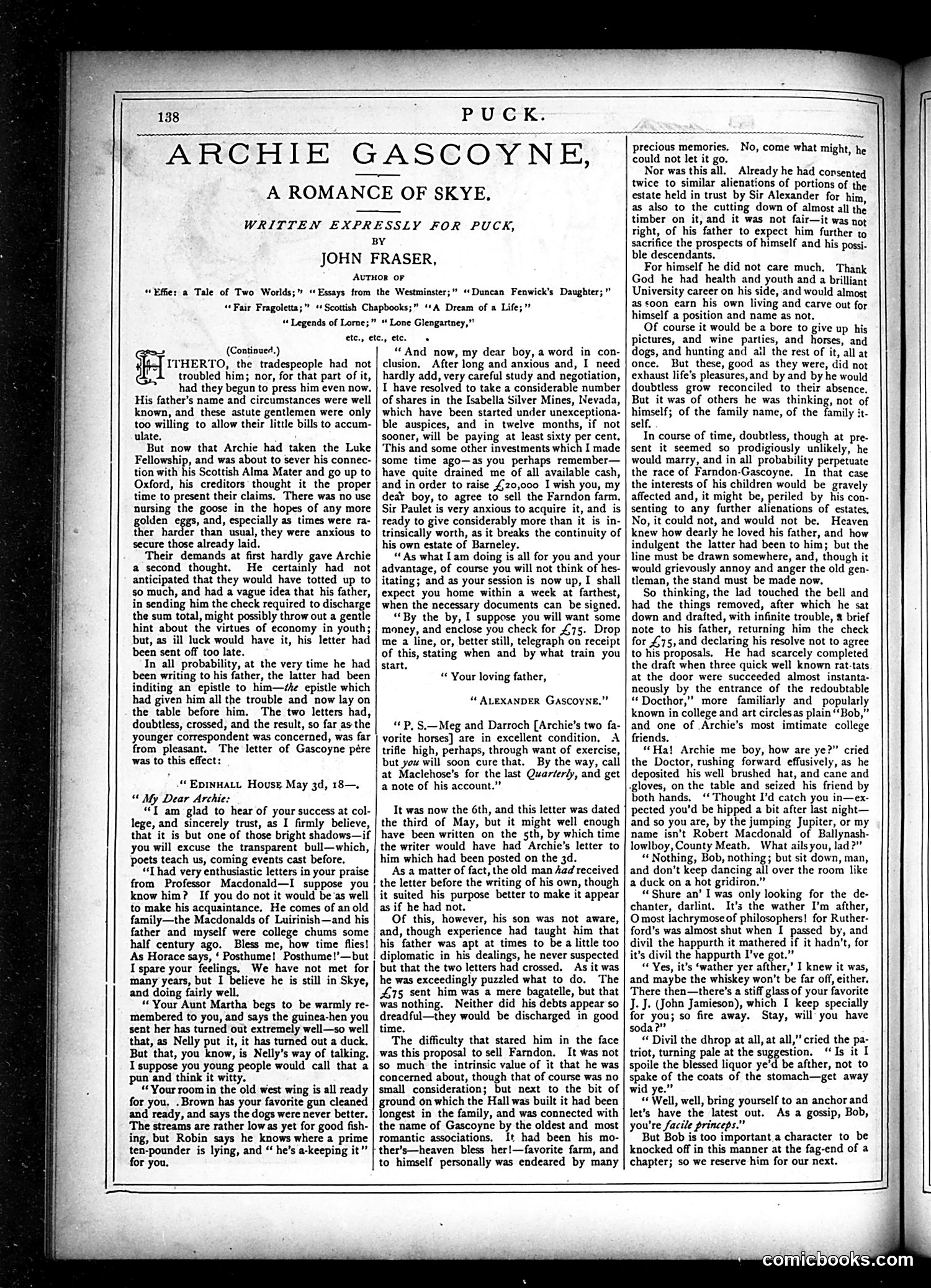
This page is **not a political cartoon** but rather the continuation of a serialized fiction story titled "Archie Gascoyne: A Romance of Skye," written by John Fraser expressly for Puck magazine. The page reproduces a letter from "Alexander Gascoyne" to his son, discussing financial matters related to selling the Fardon farm and Isabella Silver Mines shares in Nevada. The narrative involves family inheritance disputes, estate management, and personal correspondence between father and son. This represents Puck's literary content—serialized romantic fiction rather than satirical commentary. The magazine mixed humor, cartoons, and serialized stories for entertainment purposes.
📄 Transcribed text from this page (OCR, searchable)
Machine-transcribed from the original scan — historical spelling and the odd misread are preserved.
PUCK. ARCHIE A ROMANCE OF SKYE, WRITTEN EXPRESSLY FOR PUCK, BY JOHN FRASER, AUTHOR OF “Effie: a Tale of Two Worlds;” «Essays from the Westminster;” “Duncan Fenwick’s Daughter; ” “« Fair Fragoletta;” «Scottish Chapbooks; « Legends of Lorne;” * Lone Glengartney,” ete., ete, ete. + (Continued,) ITHERTO, the tradespeople had not troubled him; nor, for that part of it, had they begun to press him even now. His father’s name and circumstances were well known, and these astute gentlemen were only too willing to allow their little bills to accum- ulate. But now that Archie had taken the Luke Fellowship, and was about to sever his connec- tion with his Scottish Alma Mater and go up to Oxford, his creditors thought it the proper time to present their claims. There was no use nursing the goose in the hopes of any more golden eggs, and, especially as times were ra- ther harder than usual, they were anxious to secure those already laid. Their demands at first hardly gave Archie a second thought. He certainly had not anticipated that they would have totted up to so much, and had a vague idea that his father, in sending him the check required to discharge the sum total, might possibly throw out a gentle hint about the virtues of economy in youth; but, as ill luck would have it, his letter had been sent off too late. In all probability, at the very time he had been writing to his father, the latter had been inditing an epistle to him—she epistle which had given him all the trouble and now lay on the table before him. The two letters had, doubtless, crossed, and the result, so far as the younger correspondent was concerned, was far from pleasant, The letter of Gascoyne pére was to this effect: “ EpINHALL House May 3d, 18—. “ My Dear Archie: “I am glad to hear of your success at col- lege, and sincerely trust, as I firmly believe, that it is but one of those bright shadows—if you will excuse the transparent bull—which, poets teach us, coming events cast before. “Thad very enthusiastic letters in your praise from Professor Macdonald—I suppose you know him? If you do not it would be’as well to make his acquaintance. He comes of anold family—the Macdonalds of Luirinish—and his father and myself were college chums some half century ago. Bless me, how time flies! As Horace says, ‘ Posthume! Posthume!’—but I spare your feelings, We have not met for many years, but I believe he is still in Skye, and doing fairly well. “Your Aunt Martha begs to be warmly re- membered to you, and says the guinea-hen you sent her has turned out extremely well—so well that, as Nelly put it, it has turned out a duck. But that, you know, is Nelly’s way of talking. I suppose you young people would call that a pun and think it witty. “Your room in the old west wing is all ready for you, . Brown has your favorite gun cleaned and ready, and says the dogs were never better. The streams are rather low as yet for good fish- ing, but Robin says he knows where a prime ten-pounder is lying, and “‘ he’s a-keeping it” for you. ASCOYNE, “(A Dream of a Life;"” “And now, my dear boy, a word in con- clusion, After long and anxious and, I need hardly add, very careful study and negotiation, I have resolved to take a considerable number of shares in the Isabella Silver Mines, Nevada, which have been started under unexceptiona- ble auspices, and in twelve months, if not sooner, will be paying at least sixty per cent. This and some other investments which I made some time ago—as you perhaps remember— have quite drained me of all available cash, and in order to raise £20,000 I wish you, my deat boy, to agree to sell the Farndon farm. Sir Paulet is very anxious to acquire it, and is ready to give considerably more than it is in- trinsically worth, as it breaks the continuity of his own estate of Barneley. “As what Lam doing is all for you and your advantage, of course you will not think of hes- itating; and as your session is now up, I shall expect you home within a week at farthest, when the necessary documents can be signed. “By the by, I suppose you will want some money, and enclose you check for £75. Drop me a line, or, better still, telegraph on receipt of this, stating when and by what train you start. “ Your loving father, “ ALEXANDER GASCOYNE.” “ P, S—Meg and Darroch [Archie's two fa- vorite horses] are in excellent condition, A trifle high, perhaps, through want of exercise, but you will soon cure that. By the way, call at Maclehose’s for the last Quarterly, and get a note of his account.” It was now the 6th, and this letter was dated the third of May, but it might well enough have been written on the 5th, by which time the writer would have had Archie’s letter to him which had been posted on the 3d. As a matter of fact, the old man Aad received the letter before the writing of his own, though it suited his purpose better to make it appear as if he had not. Of this, however, his son was not aware, and, though experience had taught him that his father was apt at times to bea little too diplomatic in his dealings, he never suspected but that the two letters had crossed. As it was he was exceedingly puzzled what to do. The 475 sent him was a mere bagatelle, but that was nothing. Neither did his debts appear so dreadful—they would be discharged in good time. The difficulty that stared him in the face was this proposal to sell Farndon. It was not so much the intrinsic value of it that he was concerned about, though that of course was no small consideration; but next to the bit of ground on which the Hall was built it had been longest in the family, and was connected with the name of Gascoyne by the oldest and most romantic associations. It had been his mo- ther’s—heaven bless her!—favorite farm, and to himself personally was endeared by many - $a precious memories. No, come what might, he could not let it go. Nor was this all. Already he had consented twice to similar alienations of portions of the estate held in trust by Sir Alexander for him, as also to the cutting down of almost all the timber on it, and it was not fair—it was not right, of his father to expect him further to sacrifice the prospects of himself and his possi- ble descendants. For himself he did not care much. Thank God he had health and youth and a brilliant University career on his side, and would almost as soon earn his own living and carve out for himself a position and name as not. Of course it would be a bore to give up his pictures, and wine parties, and horses, and dogs, and hunting and ail the rest of it, all at once. But these, good as they were, did not exhaust life’s pleasures,and by and by he would doubtless grow reconciled to their absence, But it was of others he was thinking, not of himself; of the family name, of the family it- self. In course of time, doubtless, though at pre- sent it seemed so prodigiously unlikely, he would marry, and in all probability perpetuate the race of Farndon-Gascoyne. In that case the interests of his children would be gravely affected and, it might be, periled by his con- senting to any further alienations of estates, No, it could not, and would not be. Heaven knew how dearly he loved his father, and how indulgent the latter had been to him; but the line must be drawn somewhere, and, though it would grievously annoy and anger the old gen- tleman, the stand must be made now, So thinking, the lad touched the bell and had the things removed, after which he sat down and drafted, with infinite trouble, & brief note to his father, returning him the check for £75, and declaring his resolve not to agree to his proposals. He had scarcely completed the draft when three quick well known rat-tats at the door were succeeded almost instanta- neously by the entrance of the redoubtable *Docthor,” more familiarly and popularly known in college and art circlesas plain ‘‘Bob,” and one of .Archie’s most imtimate college friends. “Hal Archie me boy, how are ye?” cried the Doctor, rushing forward effusively, as he deposited his well brushed hat, and cane and gloves, on the table and seized his friend by both hands, “ Thought I’d catch you in—ex- pected you'd be hipped a bit after last night— and so you are, by the jumping Jupiter, or my name isn’t Robert Macdonald of Ballynash- lowlboy,County Meath. What ails you, lad?” “Nothing, Bob, nothing ; but sit down, man, and don’t keep dancing all over the room like a duck on a hot gridiron.” “Shure an’ I was only looking for the de- chanter, darlint. It's the wather I’m afther, Omost lachrymoseof philosophers! for Ruther- ford’s was almost shut when I passed by, and divil the happurth it mathered if it hadn’t, for it’s divil the happurth I’ve got.”” “Yes, it’s ‘wather yer afther,’ I knew it was, and maybe the whiskey won't be far off, either, There then—there’s a stiff glass of your favorite J. J. (John Jamieson), which I keep specially for you; so fire away. Stay, will you have soda?” “ Divil the dhrop at all, at all,""cried the pa- triot, turning pale at the suggestion. “Is it I spoile the blessed liquor ye’d be afther, not to spake of the coats of the stomach—get away wid ye.” “ Well, well, bring yourself to an anchor and let's have the latest out. As a gossip, Bob, you're facile princeps.” But Bob is too important.a character to be knocked off in this manner at the fag-end of a chapter; so we reserve him for our next.