
Puck, 1879-05-07 · page 3 of 16
Puck — May 7, 1879 — page 3: what you’re looking at
What you’re looking at
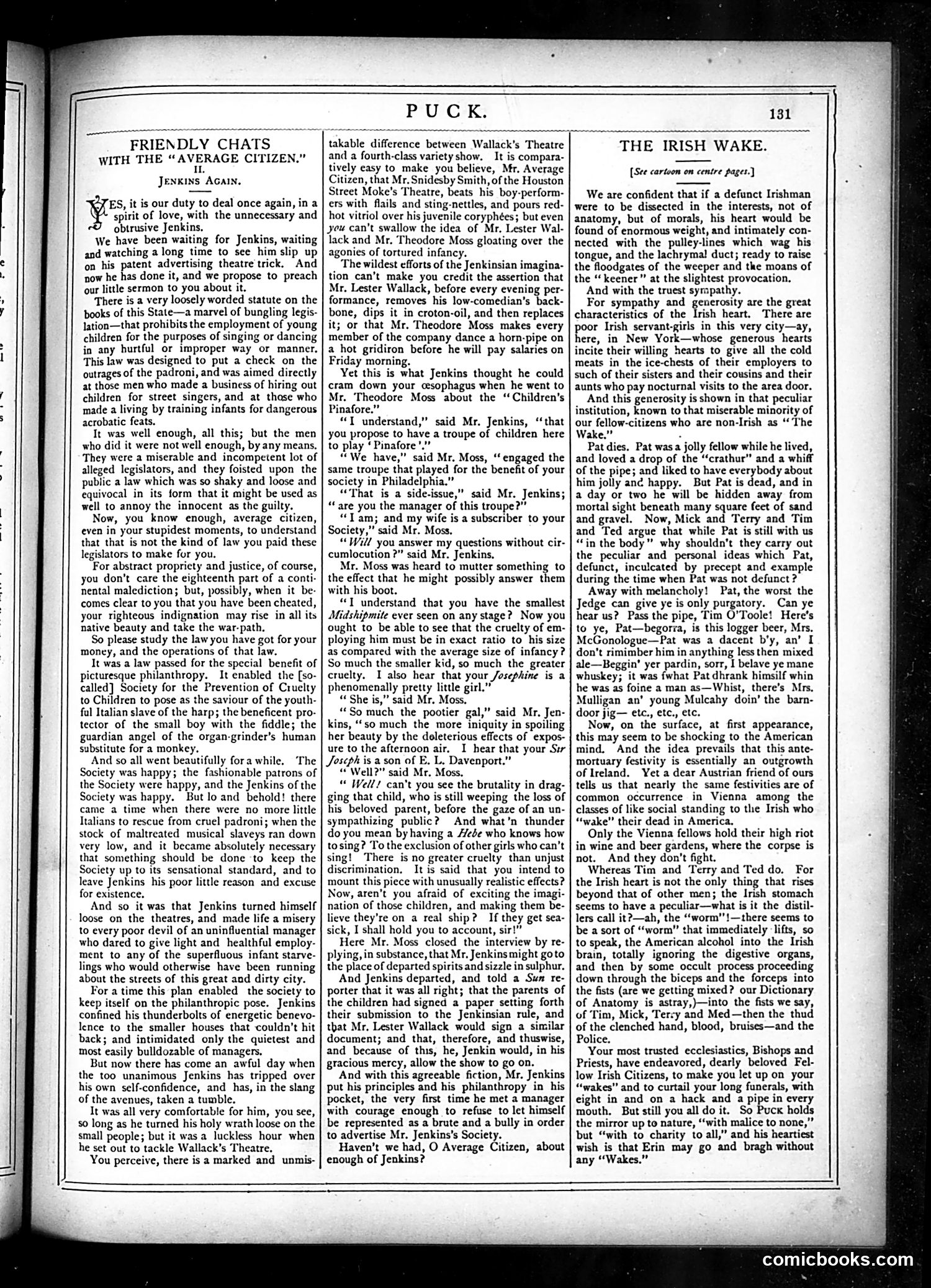
This page contains two distinct articles. The left column features "Friendly Chats with the Average Citizen," a satirical interview with Jenkins criticizing theatrical manager Lester Wallack's production choices. The satire mocks Wallack's decision to stage children performing acrobatic acts rather than traditional drama, calling it exploitation of youth for profit. The right column, "The Irish Wake," is a humorous piece celebrating Irish-American generosity and distinctive cultural characteristics. It uses gentle ethnic humor to praise Irish immigrants' charitable nature and their convivial social traditions, positioning Irish-Americans as valued contributors to American society despite occasional stereotyping about drinking and rowdiness. Both pieces reflect Puck's characteristic blend of social criticism and ethnic humor typical of late 19th-century American satire.
📄 Transcribed text from this page (OCR, searchable)
Machine-transcribed from the original scan — historical spelling and the odd misread are preserved.
FRIENDLY CHATS WITH THE “AVERAGE CITIZEN.” Jenkins AGAIN. ES, it is our duty to deal once again, in a spirit of love, with the unnecessary and obtrusive Jenkins, We have been waiting for Jenkins, waiting and watching a long time to see him slip up on his patent advertising theatre trick. And now he has done it, and we propose to preach our little sermon to you about it. There is a very loosely worded statute on the books of this State—a marvel of bungling legis- lation—that prohibits the employment of young children for the purposes of singing or dancing in any hurtful or improper way or manner. This law was designed to put a check on the outrages of the padroni, and was aimed directly at those men who made a business of hiring out children for street singers, and at thase who made a living by training infants for dangerous acrobatic feats. It was well enough, all this; but the men who did it were not well enough, by any means, They were a miserable and incompetent lot of alleged legislators, and they foisted upon the public a law which was so shaky and loose and equivocal in its form that it might be used as well to annoy the innocent as the guilty. Now, you know enough, average citizen, even in your stupidest moments, to understand that that is not the kind of law you paid these legislators to make for you. For abstract propricty and justice, of course, you don’t care the eighteenth part of a conti- nental malediction; but, possibly, when it be- comes clear to you that you have been cheated, your righteous indignation may rise in all its native beauty and take the war-path, So please study the law you have got for your money, and the operations of that law. It was a law passed for the special benefit of picturesque philanthropy. It enabled the [so- called] Society for the Prevention of Cruelty to Children to pose as the saviour of the youth- ful Italian slave of the harp; the beneficent pro- tector of the small boy with the fiddle; the guardian angel of the organ-grinder’s human substitute for a monkey, And so all went beautifully fora while. The Society was happy; the fashionable patrons of the Society were happy, and the Jenkins of the Society was happy. But lo and behold! there came a time when there were no more little Italians to rescue from cruel padroni; when the stock of maltreated musical slaveys ran down very low, and it became absolutely necessary that something should be done ‘to keep the Society up to its sensational standard, and to leave Jenkins his poor little reason and excuse for existence, And so it was that Jenkins turned himself loose on the theatres, and made life a misery to every poor devil of an uninfluential manager who dared to give light and healthful employ- ment to any of the superfluous infant starve- lings who would otherwise have been running about the streets of this great and dirty city. For a time this plan enabled the society to keep itself on the philanthropic pose. Jenkins confined his thunderbolts of energetic benevo- lence to the smaller houses that couldn't hit back; and intimidated only the quietest and most easily bulldozable of managers. But now there has come an awful day when the too unanimous Jenkins has tripped over his own self-confidence, and _ has, in the slang of the avenues, taken a tumble. It was all very comfortable for him, you see, so long as he turned his holy wrath loose on the small people; but it was a luckless hour when he set out to tackle Wallack’s Theatre. You perceive, there is a marked and unmis- PUCK. takable difference between Wallack’s Theatre and a fourth-class variety show. It is compara- tively easy to make you believe, Mr. Average Citizen, that Mr. Snidesby Smith, of the Houston Street Moke’s Theatre, beats his boy-perform- ers with flails and sting-nettles, and pours red- hot vitriol over his juvenile coryphées; but even you can’t swallow the idea of Mr. Lester Wal- lack and Mr. Theodore Moss gloating over the agonies of tortured infancy. The wildest efforts of the Jenkinsian imagina- tion can’t make you credit the assertion that Mr. Lester Wallack, before every evening per- formance, removes his low-comedian’s back- bone, dips it in croton-oil, and then replaces it; or that Mr. Theodore Moss makes every member of the company dance a horn-pipe on a hot gridiron before he will pay salaries on Friday morning. Yet this is what Jenkins thought he could cram down your cesophagus when he went to Mr. ‘Theodore Moss about the “Children’s Pinafore.” “T understand,” said Mr. Jenkins, ‘that you propose to have a troupe of children here to play ‘Pinafore '.” “We have,” said Mr. Moss, “ engaged the same troupe that played for the benefit of your society in Philadelphia.” “That is a side-issue,” said Mr. Jenkins; “are you the manager of this troupe?” “Tam; and my wife is a subscriber to your Society,” said Mr. Moss. “Will you answer my questions without cir- cumlocution ?” said Mr. Jenkins, Mr. Moss was heard to mutter something to the effect that he might possibly answer them with his boot. “I understand that you have the smallest Midshipmite ever seen on any stage? Now you ought to be able to see that the cruelty of em- ploying him must be in exact ratio to his size as compared with the average size of infancy? So much the smaller kid, so much the greater cruelty. I also hear that your Josephine is a phenomenally pretty little girl.”* “She is,” said Mr. Moss, “So much the pootier gal,” said Mr. Jen- kins, ‘so much the more iniquity in spoiling her beauty by the doleterious effects of expos- ure to the afternoon air, I hear that your Sir Jostph is a. son of E. L, Davenport.” “Well?” said Mr. Moss. “ Well? can’t you see the brutality in drag- ging that child, who is still weeping the loss of his beloved parent, before the gaze of an un- sympathizing public? And what'n thunder do you mean by having a Hebe who knows how tosing? To the exclusion of other girls who can’t sing! There is no greater cruelty than unjust discrimination. It is said that you intend to mount this piece with unusually realistic effects? Now, aren’t you afraid of exciting the imagi- nation of those children, and making them be- lieve they're on a real ship? If they get sea- sick, I shall hold you to account, sir!” Here Mr. Moss closed the interview by re- plying, in substance, that Mr, Jenkins might goto the place of departed spirits and sizzle in sulphur. And Jenkins departed, and told a Sun re- porter that it was all right; that the parents of the children had signed a paper setting forth their submission to the Jenkinsian rule, and that Mr. Lester Wallack would sign a similar document; and that, therefore, and thuswise, and because of this, he, Jenkin would, in hi: gracious mercy, allow the show to go on. And with this agreeable fiction, Mr. Jenkins put his principles and his philanthropy in his pocket, the very first time he met a manager with courage enough to refuse to let himself be represented as a brute and a bully in order to advertise Mr. Jenkins’s Society. Haven't we had, O Average Citizen, about enough of Jenkins? 131 THE IRISH WAKE. [See cartoon on centre pages.] We are confident that if a defunct Irishman were to be dissected in the interests, not of anatomy, but of morals, his heart would be found of enormous weight, and intimately con- nected with the pulley-lines which wag his tongue, and the lachrymal duct; ready to raise the floodgates of the weeper and the moans of the “keener” at the slightest provocation. And with the truest sympathy. For sympathy and pencroely are the great characteristics of the Irish heart. There are oor Irish servant-girls in this very city—ay, Bes, in New York—whose generous hearts incite their willing hearts to give all the cold meats in the ice-chests of their employers to such of their sisters and their cousins and their aunts who pay nocturnal visits to the area door. And this generosity is shown in that peculiar institution, known to that miserable minority of our fellow-citizens who are non-Irish as ‘The Wake.” . Pat dies. Pat wasa jolly fellow while he lived, and loved a drop of the “crathur” and a whiff of the pipe; and liked to have everybody about him jolly ané happy. But Pat is dead, and in a day or two he will be hidden away from mortal sight beneath many square feet of sand and gravel. Now, Mick and Terry and Tim and Ted argue that while Pat is still with us “in the body” why shouldn't they carry out the peculiar and personal ideas which Pat, defunct, inculcated by precept and example during the time when Pat was not defunct ? Away with melancholy! Pat, the worst the Jedge can give ye is only purgatory. Can ye hear us? Pass the pipe, Tim O'Toole! Here's to ye, Pat—begorra, is this logger beer, Mrs. McGonologue—Pat was a dacent b'y, an’ I don’t rimimber him in anything less then mixed ale—Beggin’ yer pardin, sorr, I belave ye mane whuskey; it was fwhat Pat dhrank himsilf whin he was as foine a man as—Whist, there's Mrs, Mulligan an’ young Mulcahy doin’ the barn- door jig— etc., etc., etc. Now, on the surface, at first appearance, this may seem to be shocking to the American mind. And the idea prevails that this ante- mortuary festivity is essentially an outgrowth of Ireland. Yet a dear Austrian friend of ours tells us that nearly the same festivities are of common occurrence in Vienna among the classes of like social standing to the Irish who “wake” their dead in America, Only the Vienna fellows hold their high riot in wine and beer gardens, where the corpse is not. And they don’t fight. Whereas Tim and Terry and Ted do. For the Irish heart is not the only thing that rises beyond that of other men; the Irish stomach seems to have a peculiar—what is it the distil- lers call it?—ah, the ‘“‘worm’’!—there seems to be a sort of “worm” that immediately ‘lifts, so to speak, the American alcohol into the Irish brain, totally ignoring the digestive organs, and then by some occult process proceeding down through the biceps and the forceps into the fists (are we getting mixed? our Dictionary of Anatomy is astray,}—into the fists we say, of Tim, Mick, Tercy and Med—then the thud of the clenched hand, blood, bruises—and the Police. Your most trusted ecclesiastics, Bishops and Priests, have endeavored, dearly beloved Fel- low Irish Citizens, to make you let up on your “wakes” and to curtail your long funerals, with eight in and on a hack and a pipe in every mouth, But still you all do it. So Puck holds the mirror up to nature, ‘with malice to none,” but “with to charity to all,” and his heartiest wish is that Erin may go and bragh without any “Wakes.” comicbooks.com