
A complete issue · 16 pages · 1879
Puck — April 2, 1879
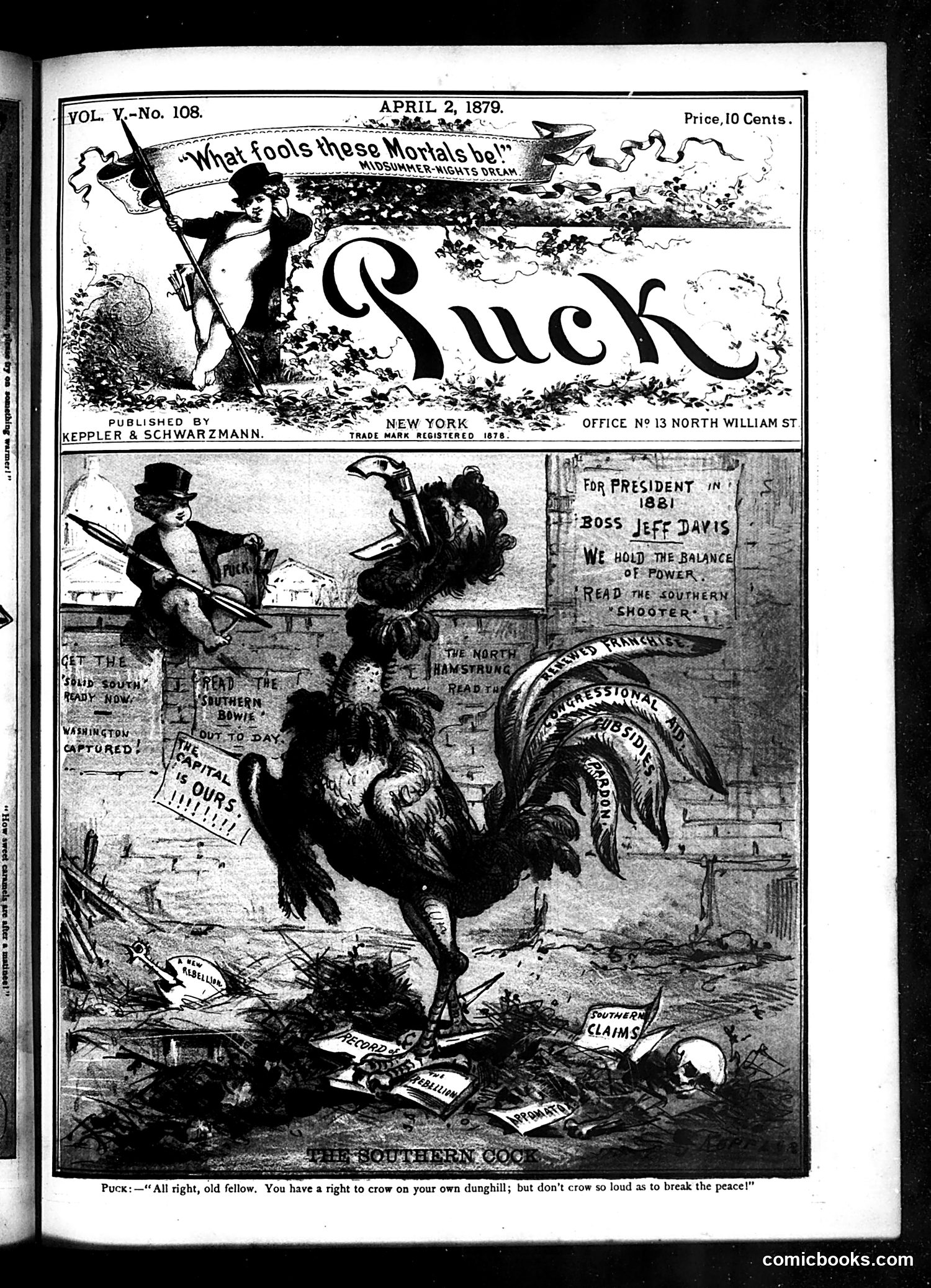
**The Main Cartoon: "The Southern Cock"** This depicts a rooster (symbolizing the American South) crowing loudly while standing atop debris labeled with post-Civil War issues: "Reconstruction," "Southern Claims," and references to Northern "hamstrung" power. A small figure (likely representing the North or Republican leadership) warns the rooster to crow on its own dunghill but not so loudly as to break the peace. **Political Context:** The cartoon satirizes Southern Democrats' aggressive reassertion of power during Reconstruction's end (1877-1879). The rooster's crowing represents Southern political reclamation. A sign references "Boss Jeff Davis" and the 1881 presidential election, suggesting Southern Democratic resurgence threatened national stability. The satire mocks both Southern aggression and Northern weakness in enforcing post-war reforms.
This page is primarily **text-based editorial content** with minimal illustration. The main article critiques **Bishop Purcell and Catholic Church financial mismanagement** in Cincinnati. The piece sarcastically attacks bishops who demand money from congregants while their churches accumulate massive debts, comparing them to "sacred birds" that drain parishioners' resources. A secondary piece titled "The Geese to Save 'Rome' Again" uses geese as a metaphor for Episcopal clergy supposedly working to "save Rome"—likely referencing 19th-century anti-Catholic Protestant anxieties about papal influence in America. The tone is **sharply satirical**, attacking Catholic leadership's financial hypocrisy. Without visible illustrations, the satire relies entirely on acerbic written commentary typical of Puck's irreverent editorial voice.
**"When Lovely Woman"** satirizes arguments against women's political participation. An "outrageous old curmudgeon" defends female exclusion from voting by claiming women lack competence in governance. The piece ridicules this position, noting women successfully manage households, businesses, and finances—yet supposedly cannot vote. The satire highlights the hypocrisy: if women can handle complex domestic economies, they're clearly capable of political judgment. **"Business Troubles"** discusses the Purcell Bros. banking failure in Cincinnati. It defends the senior Purcell against blame, attributing the collapse to broader economic forces rather than personal mismanagement. A letter from "J.B. + Purcell" provides his perspective on creditors' concerns. Both pieces advance progressive arguments: women's competence and sympathetic treatment of businessmen facing systemic difficulties.
This page contains three literary pieces rather than visual cartoons. "Paris-Green: A Poem of Places" is a poem about visiting Nancy, France. "We Won't" is the main satirical content—a lengthy response to William Ebenezor of the Kafoozedum, who apparently criticized Puck in previous issues. Puck's editors defend their editorial independence and refute accusations of bias, explaining they won't censor content or favor particular groups. They mock Ebenezor's complaints as petty and assert journalism's right to honest expression without self-censorship. The piece emphasizes that Puck won't be bullied into silence or forced to credit competitors. "A Traveler's Lament" (right column) humorously describes tedious train travel to Bangor, Maine, cataloging minor annoyances of 19th-century rail journeys.
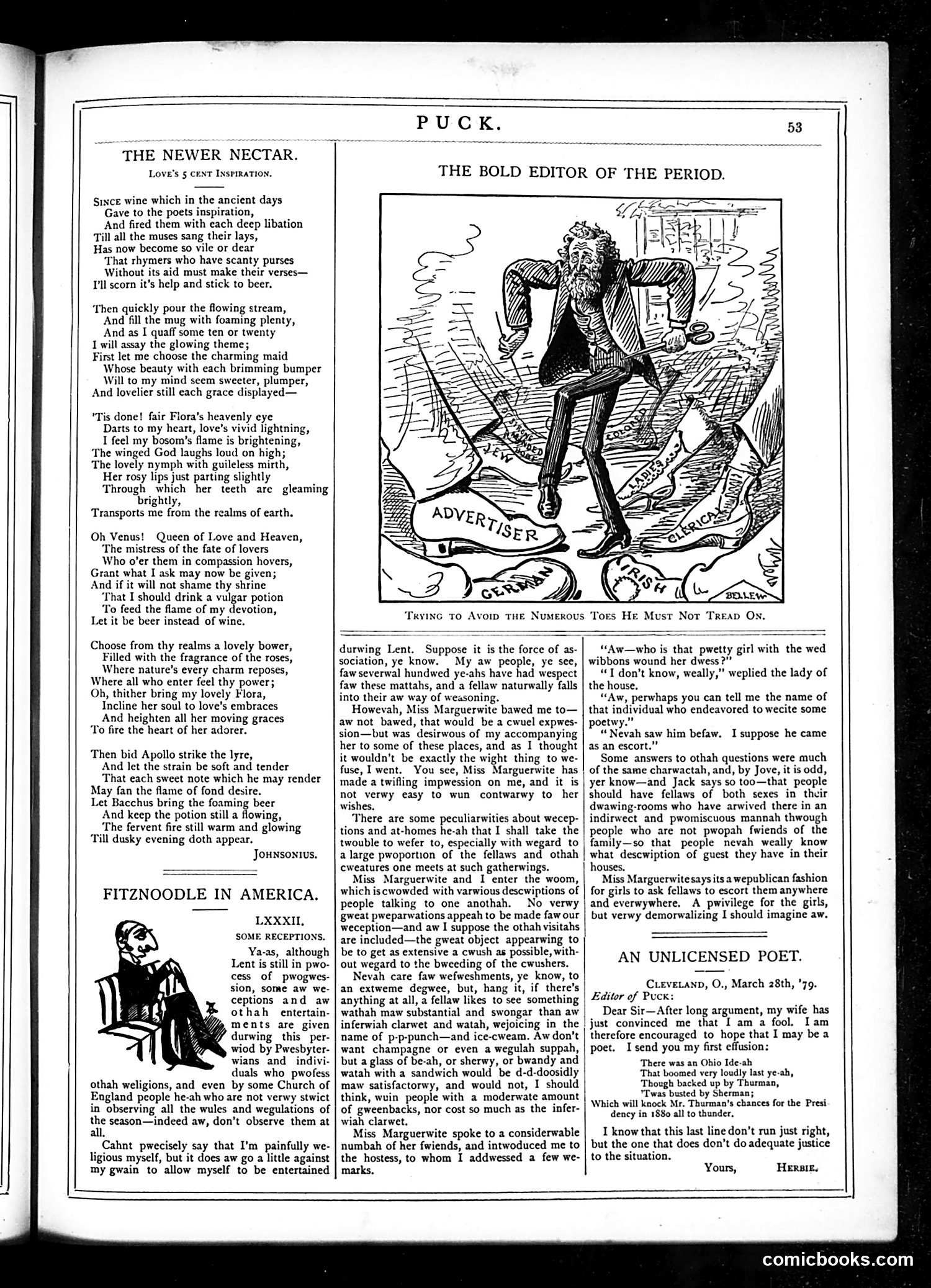
This cartoon satirizes a newspaper editor navigating the treacherous landscape of late-19th-century journalism. The figure, depicted as skeletal and precarious, balances on "ADVERTISER," "PRESS," "CIRCULATION," and other labeled platforms while avoiding pitfalls labeled "PACK" and other dangers. The satire targets the editor's impossible position: he must simultaneously serve advertisers, maintain readership, manage the printing press, and avoid libel suits or public outrage—each a potential catastrophe. The caption "Trying to Avoid the Numerous Toes He Must Not Tread On" makes explicit the editorial challenge of offending no constituency while producing engaging content. This reflects Puck's critique of how commercial pressures compromise journalistic independence during the Gilded Age.
This page contains three distinct pieces of political satire from what appears to be the Reconstruction era: **"The Southern Cock"** uses a rooster metaphor to mock Southern Democratic politicians. The satirist argues that while Northern Republicans felt courageous defeating the South militarily, Southern Democrats regained political power through intimidation and violence—essentially winning the peace after losing the war. The "cock crow" represents Southern resurgence and braggadocio. **"Talmage on Hasty Trials"** criticizes judicial procedures, likely referencing a specific controversial trial or sermon by Rev. Talmage. **"Hairidity"** appears to be a humorous lecture satirizing pseudoscientific claims about heredity and hair characteristics. The overall theme reflects post-Civil War anxieties about Southern political rehabilitation and Reconstruction policies.
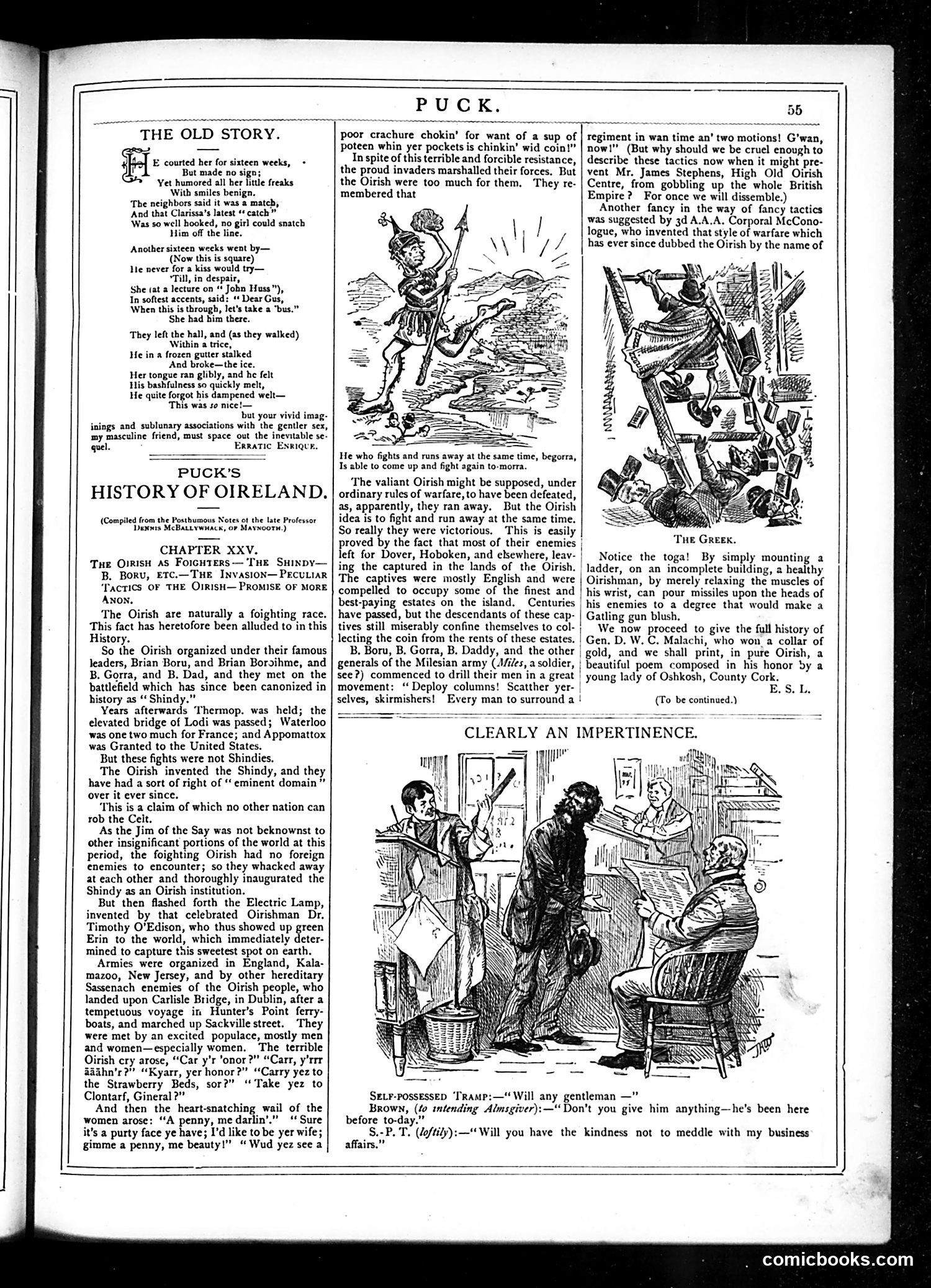
This page contains three distinct sections: **"The Old Story"** (left): A poem about a woman who "counted her for sixteen weeks" but "made no signs"—appears to be satirizing romantic indifference or courtship customs of the era. **"Puck's History of Ireland, Chapter XXV"** (center): Discusses the Oirish as fighters, referencing historical figures like B. Gorra and B. Daddy. The text critiques both Irish military tactics and British oppression, with illustrations of conflict. This represents Puck's typical Anglo-American perspective on Irish affairs. **"Clearly an Impertinence"** (bottom right): A cartoon showing working-class figures in what appears to be a domestic dispute or business disagreement, with dialogue about not meddling in affairs. The caption suggests commentary on class relations or workplace hierarchy. The page reflects late 19th-century American attitudes toward immigration, Irish identity, and social class.
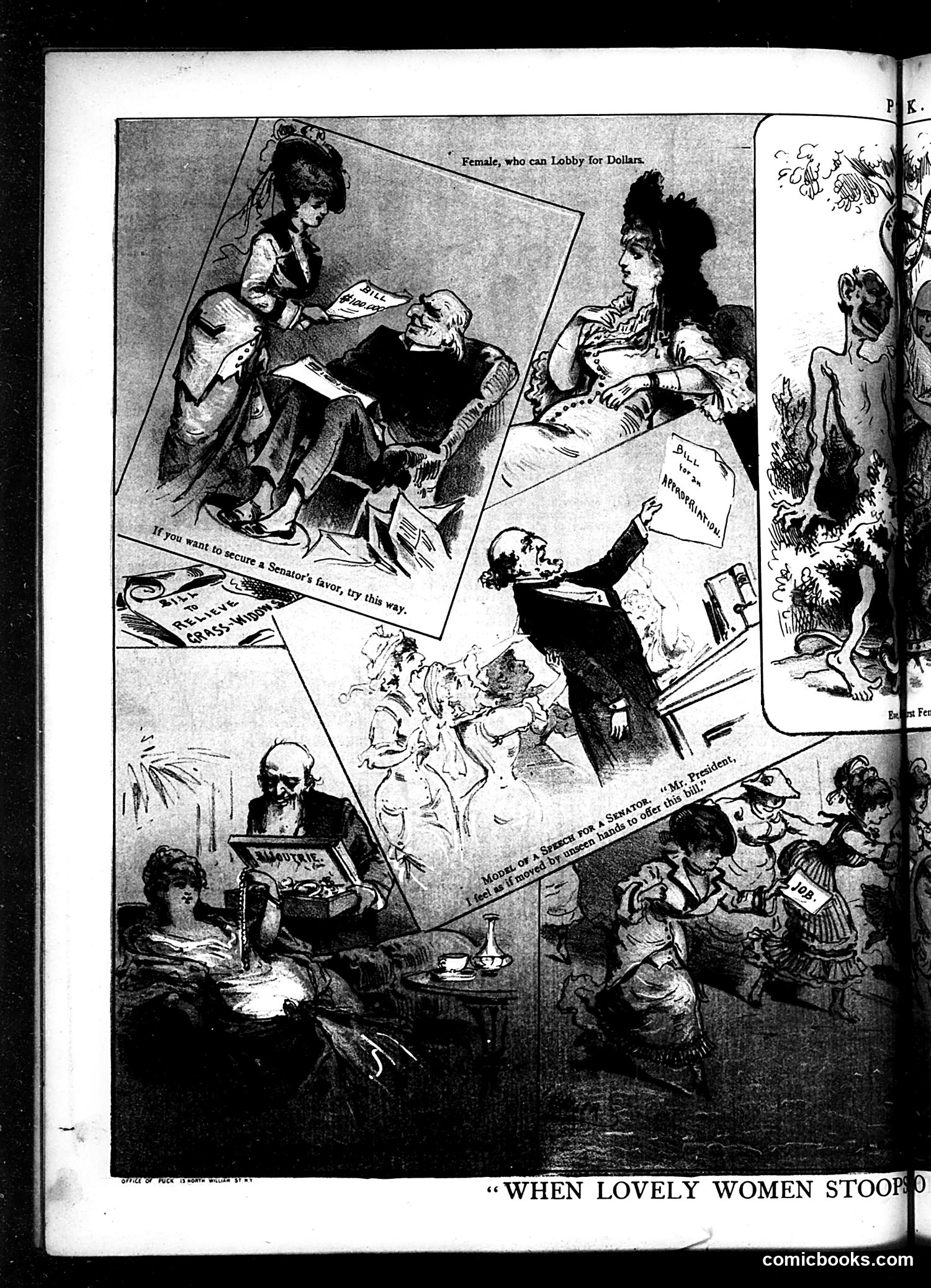
This Puck magazine page satirizes **lobbying and political corruption**, specifically women's use of influence to secure legislative favors. The caption "Female, who can Lobby for Dollars" and the title "When Lovely Women Stoop" suggest the cartoon mocks women deploying charm and sexuality to manipulate politicians. The scenes depict women presenting petitions or bills to male legislators and officials in various settings—including what appears to be a senator's office. The visual language implies transactional relationships: women trading appearance/charm for political influence. The bottom panel shows what appears to be a legislative or political gathering, reinforcing themes of backroom deal-making. The satire criticizes both the women for this behavior and the male politicians susceptible to such influence, presenting lobbying as morally compromised and dependent on gender-based manipulation rather than merit or principle.
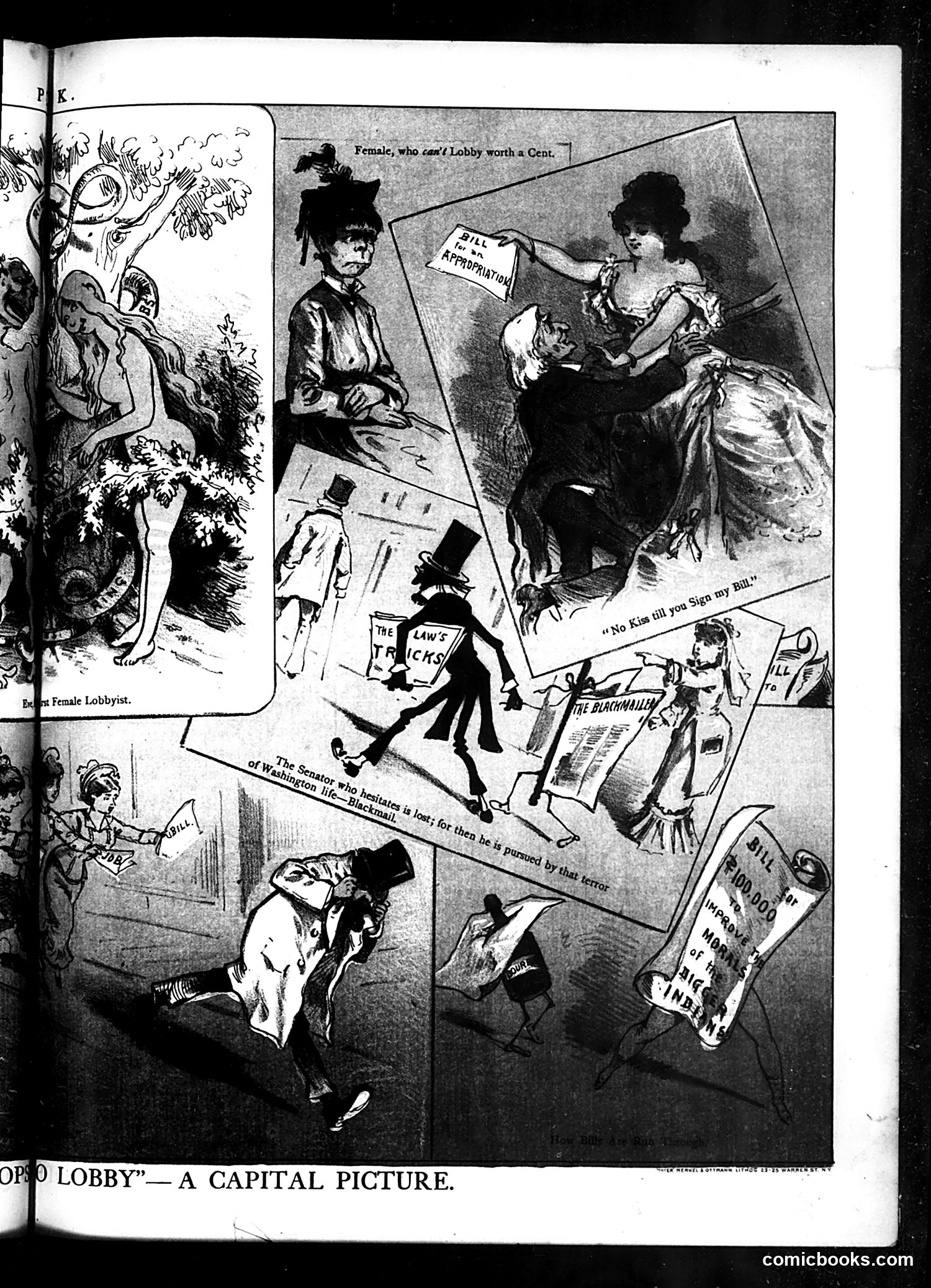
This Puck cartoon satirizes the practice of legislative lobbying in Washington, D.C. The central figure labeled "Female Lobbyist" appears to be a well-dressed woman using charm and manipulation to influence politicians and legislation. The comic depicts her employing various tactics—seduction, flattery, and underhanded deals—to sway lawmakers shown in top hats carrying documents labeled "Bill" and "Appropriation." The senator character mentioned in the caption appears to be "terrorized" by lobbying pressure. The satire critiques how wealthy interests used attractive intermediaries and personal influence to manipulate the legislative process, bypassing proper democratic procedures. The cartoon mocks both the corrupting power of lobbying and suggests women exploited as instruments of political corruption in the Gilded Age.
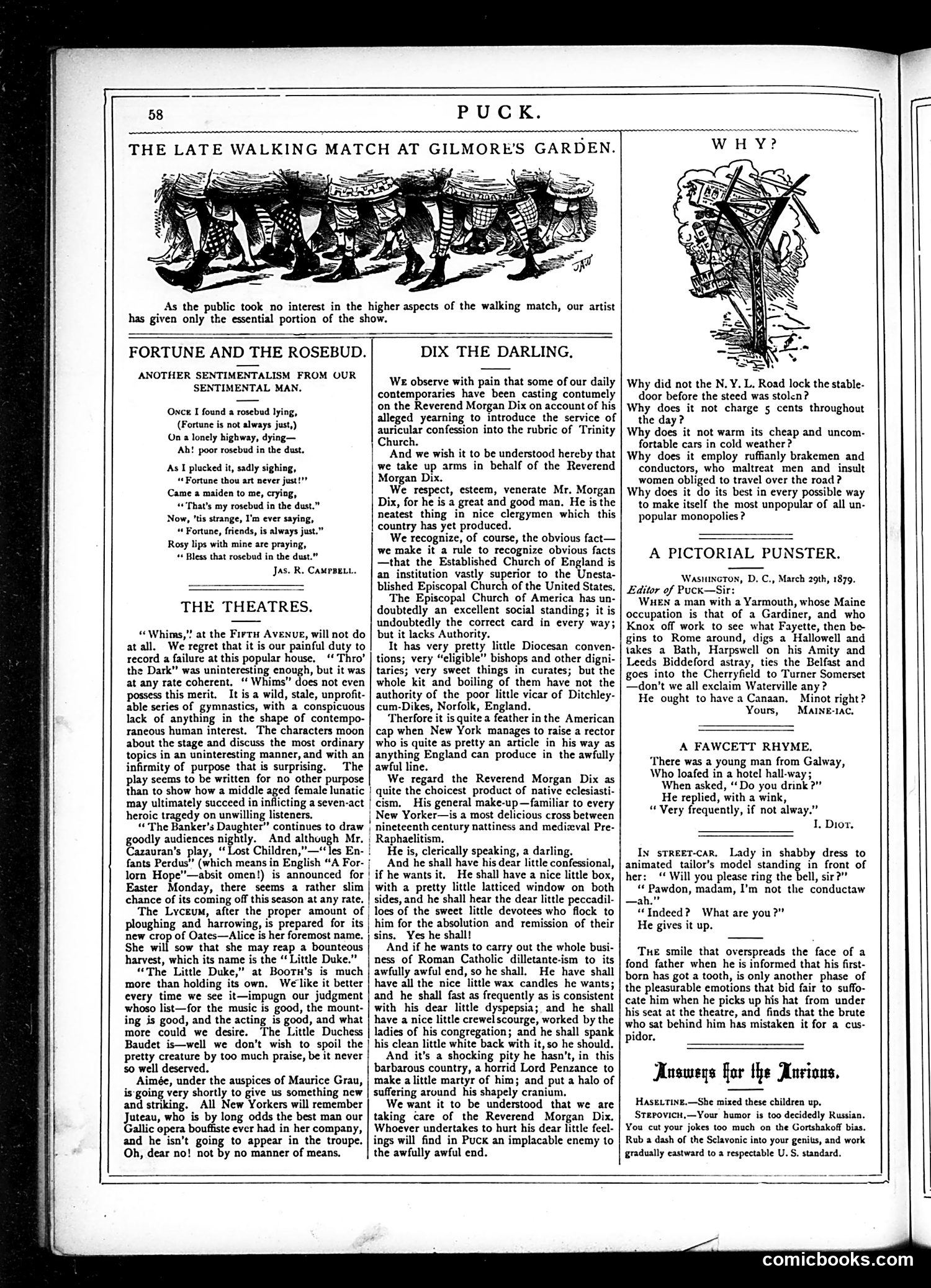
This page contains several satirical pieces rather than a single unified cartoon: **"The Late Walking Match at Gilmore's Garden"** (top): A silhouetted illustration of contestants in what appears to be a competitive walking event—likely a popular Victorian-era endurance spectacle that attracted public crowds. **"Fortune and the Rosebud"** and **"Dix the Darling"**: These are sentimental poetry pieces mocking overwrought sentimentalism, a common Puck target. "Dix the Darling" defends Reverend Morgan Dix against criticism for introducing auricular confession to his Trinity Church congregation—a High Church practice controversial in 1870s Protestant America. **Remaining sections** include theater reviews, a fawcett rhyme, and an "Answers for the Curious" advice column. The page reflects Puck's characteristic mix of visual and textual satire targeting Victorian society's excesses.
This page contains a serialized story titled "Blood and Thunder" by Richard Dowling, labeled as appearing in *Puck* magazine (page 59). The narrative depicts a domestic drama involving Michael and a woman at his bedside. The story concerns itself with labor disputes and capital conflict—the text references "great efforts of labor against capital" and mentions "employers" and "workingmen." The narrative appears to critique both labor activism and capitalist exploitation, presenting a melodramatic tale where personal domestic crisis intersects with broader class tensions. The story emphasizes emotional suffering and suggests labor disputes have caused widespread societal damage. This reflects late-19th-century *Puck* content that often satirized or dramatized contemporary labor conflicts for entertainment and political commentary.
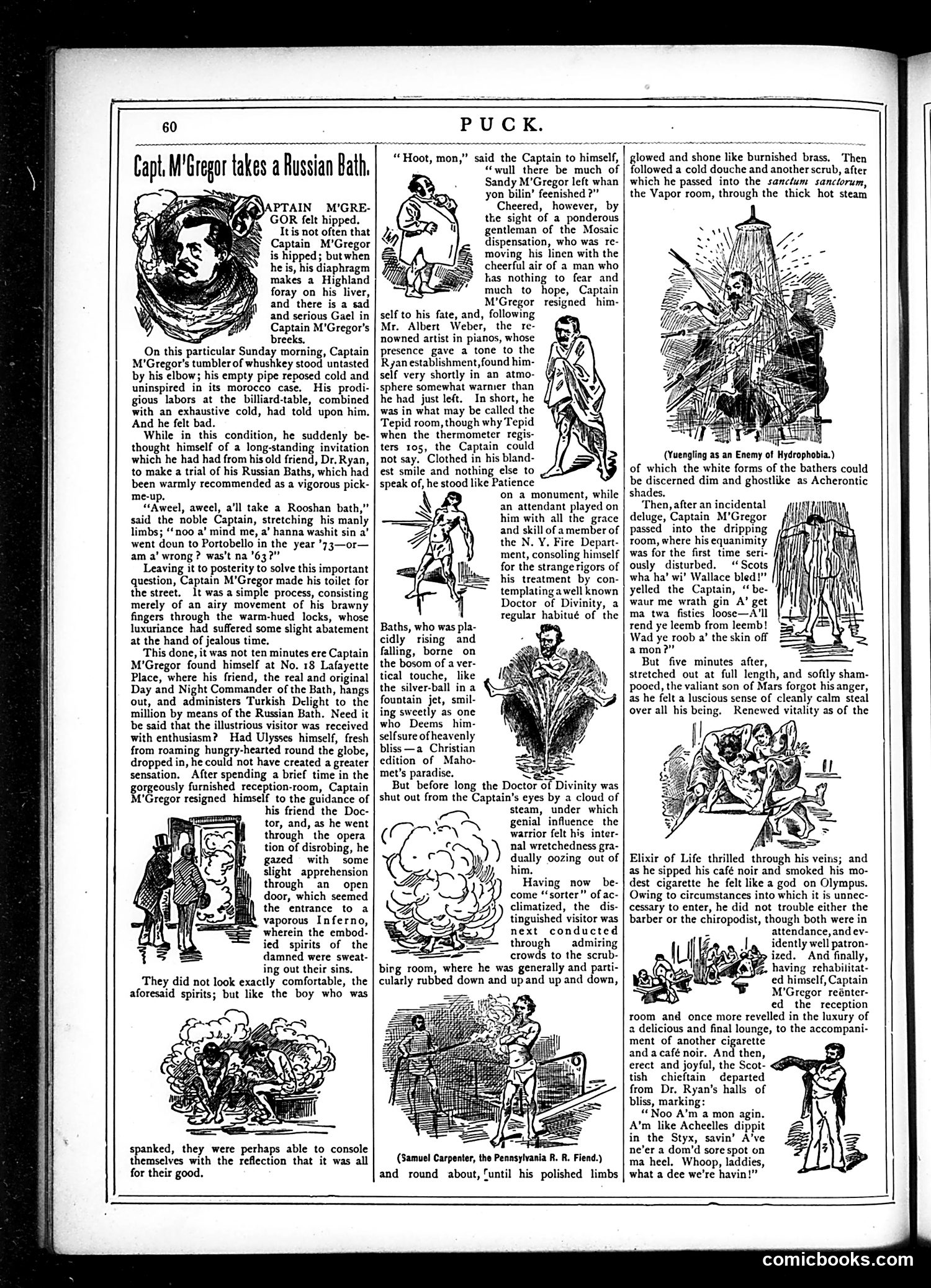
This humorous article describes Captain M'Gregor's experience at a Russian bathhouse. The narrative satirizes the uncomfortable contrast between M'Gregor's expectations and reality: he arrives seeking the therapeutic benefits of a Russian bath, only to endure an extremely hot steam room followed by an icy cold plunge—a traditional Russian bathing practice. The satire targets genteel Victorian sensibilities about health treatments and masculinity. M'Gregor, seeking vigor and vitality, instead experiences physical misery. The accompanying illustrations show him progressively uncomfortable during the scalding heat and shocking cold-water stages. The piece mocks both pseudoscientific health fads of the era and the supposed toughness required to properly endure "foreign" wellness treatments.
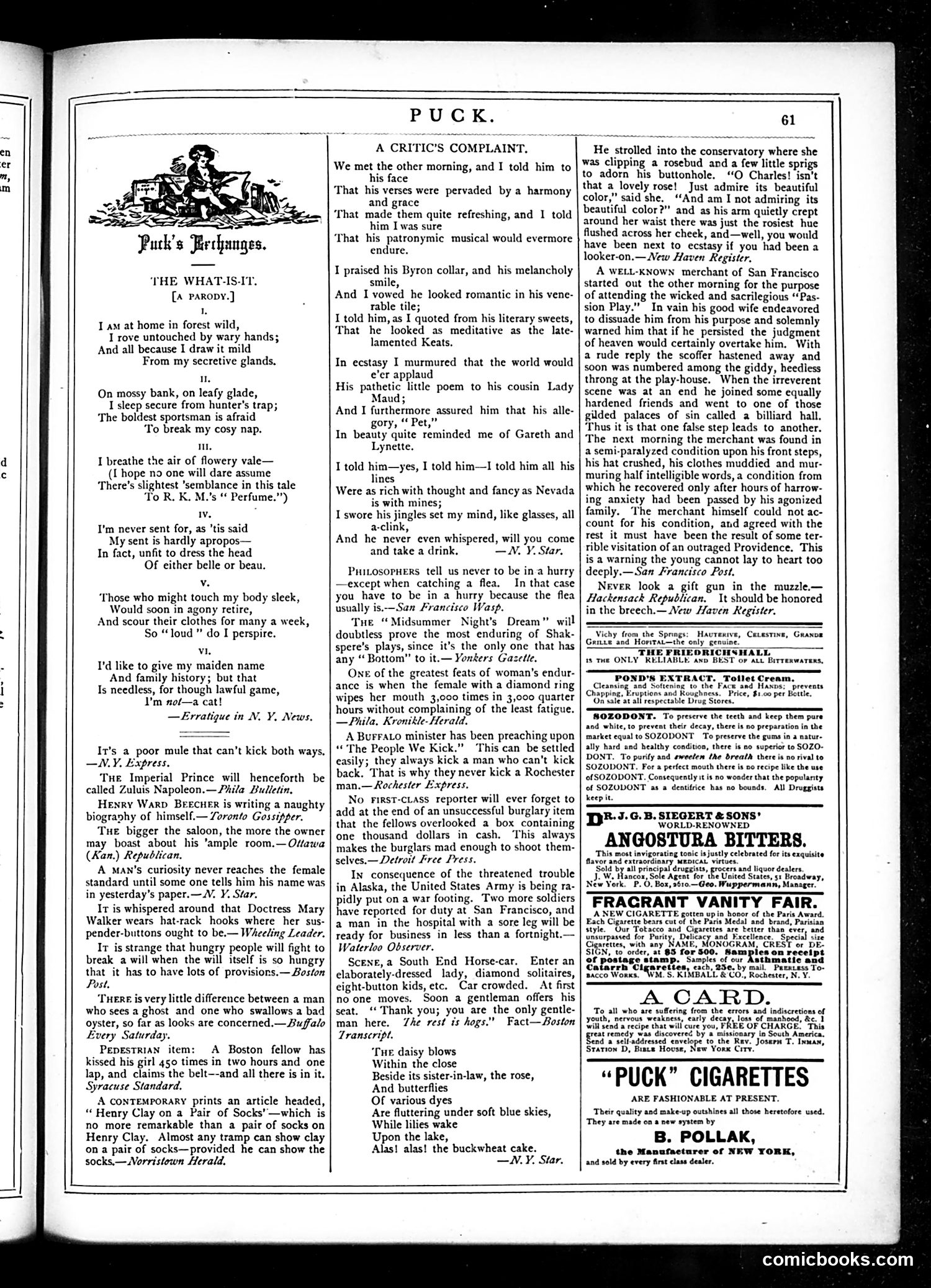
This page is primarily a **humorous column** featuring short satirical pieces and jokes rather than a political cartoon. The content includes: **"The What-Is-It"** — A poem mocking romantic idealism, suggesting the speaker prefers practical reality over flowery sentiment. **Multiple brief satirical commentaries** targeting contemporary figures and social absurdities: - A critic praising a mediocre author's "Byron collar" appearance over actual talent - A merchant's moral collapse through incremental compromises - Jokes about Prince Napoleon's nickname and various social observations **The humor relies on** Victorian-era references (Keats, Shakespeare) and commentary on 19th-century social pretension, snobbery, and hypocrisy. Most requires period context to fully appreciate—the targets and references are now obscure to modern readers. The page concludes with **advertisements** for patent medicines and cigarettes typical of the era.
This is primarily an **advertising page** from Puck magazine (page 62), containing no political cartoons or satirical content. The page features various Victorian-era advertisements including: - **Puck Smoking Tobacco** (with a devil mascot) - **Spring Cloths** and gentlemen's furnishings by Arnold, Constable & Co. - **Photography services** by Zeck - **Bent wood furniture** by Thonet Brothers - **Candy and dental services** - **Lottery advertisements** - A memorial notice for "Brigham Young" The only notable non-commercial element is a brief mention referencing demand for a Puck cartoon illustration, suggesting readers could obtain reprints. The page primarily reflects 1879 consumer goods and services rather than political satire.
This is primarily an **advertising page** from Puck magazine (page 63), not a political cartoon or satirical content page. The advertisements include: - **Denham Co.** (gentlemen's hats) - **E.D. Bassford** (drinking glasses) - **Piper-Heidsick Champagne** - **Louisiana State Lottery Co.** (promoting a $30,000 capital prize drawing) - **Royal Havana Lottery** (competing lottery advertisement) - **Nicoll, the Tailor** (clothing) - Various other merchants and services The page reflects late-19th-century consumer culture and notably features **multiple lottery advertisements**—a legal practice at this time that would later be prohibited. These represent significant gambling opportunities being openly marketed to readers. There are no identifiable political cartoons or satirical commentary on this particular page.
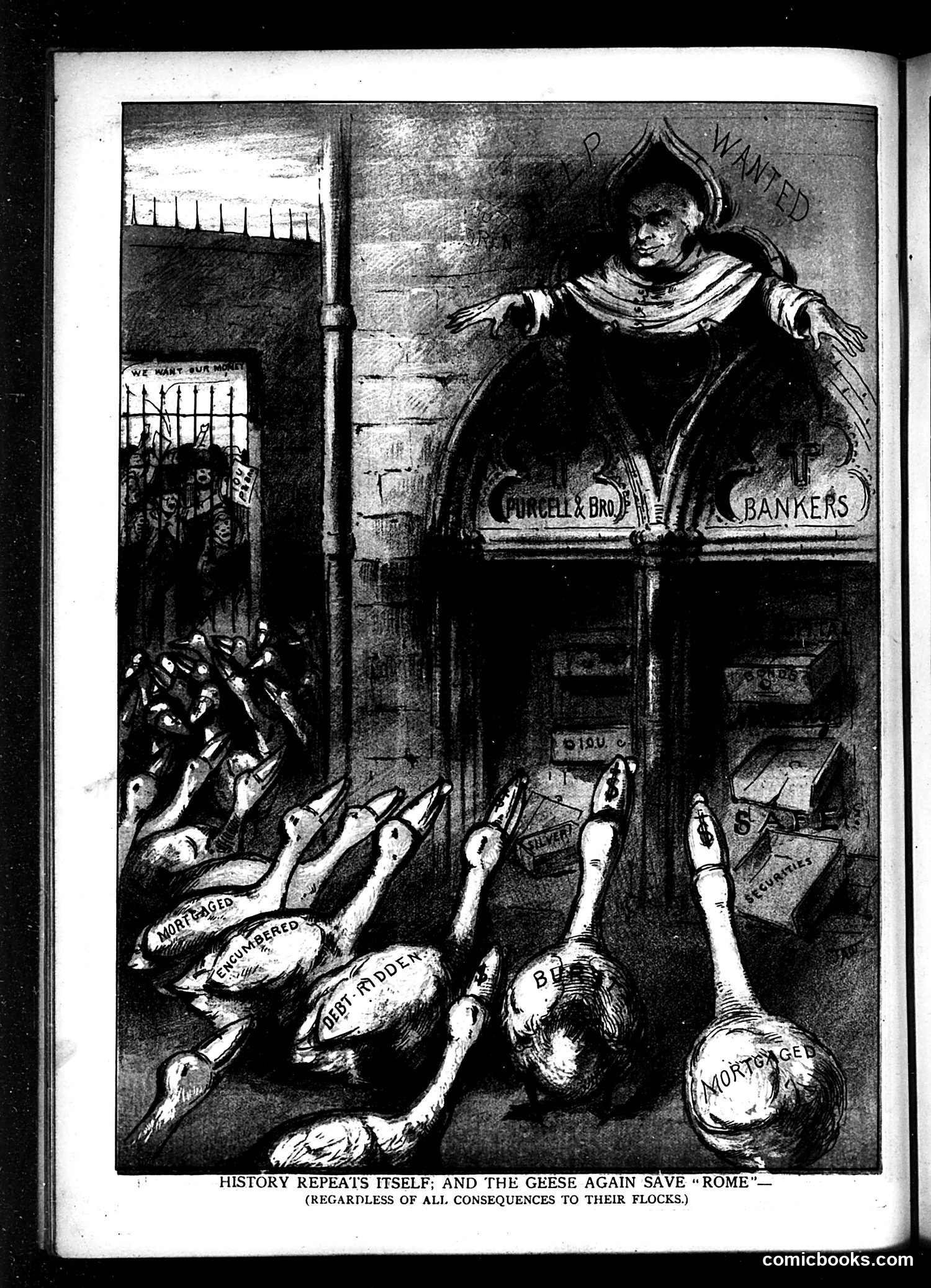
This Puck cartoon satirizes financial corruption, using the classical allusion of Rome's legendary geese (which saved Rome by alerting guards to invasion). Here, the geese are labeled with financial terms: "MORT-AGED," "SICK REFERRED," "DEBT RIDDEN," "BED," and "MORTGAGED"—representing debts and financial troubles. A robed figure labeled "WANTED" looms over the scene, appearing to be a personification of a financier or banker. The storefront shows "PURGELL & BRO. BANKERS." The caption's dark humor suggests that just as geese once saved Rome, these debt-laden figures (the "geese") will again "save Rome"—implying their financial sacrifice will benefit the banking establishment. The left panel shows imprisoned or trapped figures, emphasizing themes of financial ruin and captivity. The satire critiques exploitative banking practices and their consequences for ordinary people.