
Puck, 1879-04-02 · page 6 of 16
Puck — April 2, 1879 — page 6: what you’re looking at
What you’re looking at
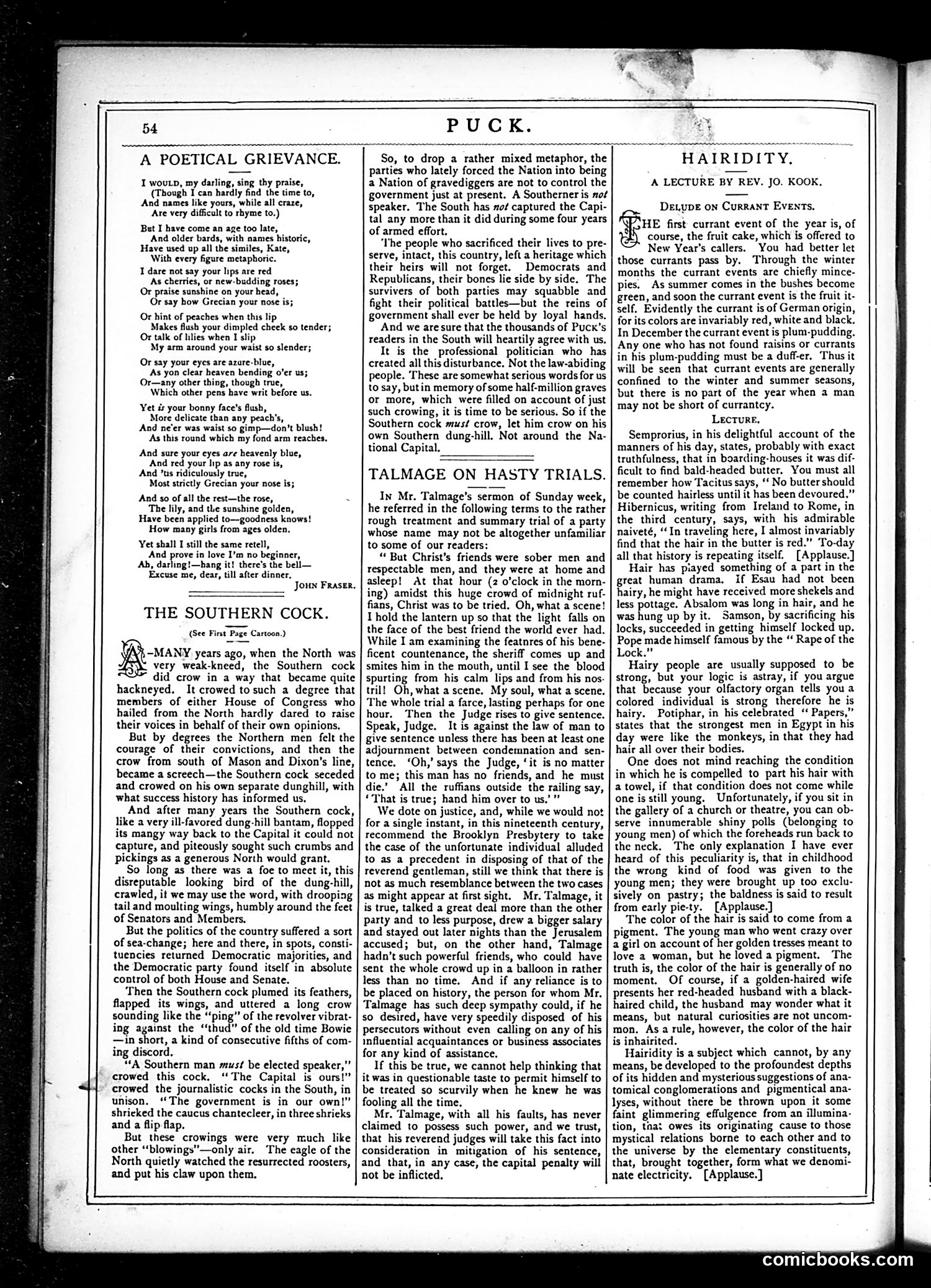
This page contains three distinct pieces of political satire from what appears to be the Reconstruction era: **"The Southern Cock"** uses a rooster metaphor to mock Southern Democratic politicians. The satirist argues that while Northern Republicans felt courageous defeating the South militarily, Southern Democrats regained political power through intimidation and violence—essentially winning the peace after losing the war. The "cock crow" represents Southern resurgence and braggadocio. **"Talmage on Hasty Trials"** criticizes judicial procedures, likely referencing a specific controversial trial or sermon by Rev. Talmage. **"Hairidity"** appears to be a humorous lecture satirizing pseudoscientific claims about heredity and hair characteristics. The overall theme reflects post-Civil War anxieties about Southern political rehabilitation and Reconstruction policies.
📄 Transcribed text from this page (OCR, searchable)
Machine-transcribed from the original scan — historical spelling and the odd misread are preserved.
54 A POETICAL GRIEVANCE. I woutp, my darling, sing thy praise, (Though I can hardly find the time to, ‘And names like yours, while all craze, ‘Are very difficult to rhyme to.) But I have come an age too late, ‘And older bards, with names historic, Have used up all the similes, Kate, With every figure metaphoric. I dare not say your hips are red As cherries, or new-budding roses; Or praise sunshine on your head, Or say how Grecian your nose is; Or hint of peaches when this lip ‘Makes flush your dimpled cheek so tender; Or talk of hilies when I slip My arm around your waist so slender; Or say your eyes are azare-blue, ‘As yon clear heaven bending o'er us; Or—any other thing, though true, Which other pens have writ before us. Yet is your bonny face’s flush, More delicate than any peach’s, And ne'er was waist so gimp—don"t blush! ‘As this round which my fond arm reaches. And sure your eyes are heavenly blue, And red your hip as any rose is, And ‘us ridiculously true, Most strictly Grecian your nose is; And so of all the rest—the rose, The lily, and the sunshine golden, Have been applied to—goodness knows! How many girls from ages olden. Yet shall I still the same retell, ‘And prove in love I'm no beginner, ‘Ab, darling!—hang it! there's the bell— Excuse me, dear, till after dinner, Joun Fraser. THE SOUTHERN COCK. (See First Page Cartoon.) -MANY years ago, when the North was very weak-kneed, the Southern cock did crow in a way that became quite hackneyed. It crowed to such a degree that members of either House of Congress who hailed from the North hardly dared to raise their voices in behalf of their own opinions, But by degrees the Northern men felt the courage of their convictions, and then the crow from south of Mason and Dixon’s line, became a screech—the Southern cock seceded and crowed on his own separate dunghill, with what success history has informed us, And after many years the Southern cock, like a very ill-favored dung-hill bantam, flopped its mangy way back to the Capital it could not capture, and piteously sought such crumbs and pickings as a generous North would grant. So long as there was a foe to meet it, this disreputable looking bird of the dung-hill, crawled, it we may use the word, with drooping tail and moulting wings, humbly around the feet of Senators and Members. But the politics of the country suffered a sort of sea-change; here and there, in spots, consti- tuencies returned Democratic majorities, and the Democratic party found itself in absolute control of both House and Senate. Then the Southern cock plumed its feathers, flapped its wings, and uttered a long crow sounding like the “ping” of the revolver vibrat- ing against the ‘thud” of the old time Bowie —in short, a kind of consecutive fifths of com- ing discord. “A Southern man must be elected speaker,” crowed this cock. ‘The Capital is ours!’ crowed the journalistic cocks in the South, in unison, “The government is in our own!” shrieked the caucus chantecleer, in three shrieks and a flip flap, But these crowings were very much like other “‘blowings”—only air. ‘The eagle of the North quietly watched the resurrected roosters, and put his claw upon them, PUCK. So, to drop a rather mixed metaphor, the parties who lately forced the Nation into being a Nation of gravediggers are not to control the government just at present. A Southerner is not speaker. The South has nof captured the Capi- tal any more than it did during some four years of armed effort. ‘The people who sacrificed their lives to pre- serve, intact, this country, left a heritage which their heirs will not forget. Democrats and Republicans, their bones lie side by side. The survivers of both parties may squabble and fight their political battles—but the reins of government shall ever be held by loyal hands. And we are sure that the thousands of Puck's readers in the South will heartily agree with us, It is the professional politician who has created all this disturbance. Not the law-abiding people. These are somewhat serious words for us to say, but in memory of some half-million graves or more, which were filled on account of just such crowing, it is time to be serious. So if the Southern cock must crow, let him crow on his own Southern dung-hill. Not around the Na- tional Capital. TALMAGE ON HASTY TRIALS. In Mr. Talmage’s sermon of Sunday week, he referred in the following terms to the rather rough treatment and summary trial of a party whose name may not be altogether unfamiliar to some of our readers: “ But Christ’s friends were sober men and respectable men, and they were at home and asleep! At that hour (2 o’clock in the morn- ing) amidst this huge crowd of midnight ruf- fians, Christ was to be tried. Oh, what a scene! T hold the lantern up so that the light falls on the face of the best friend the world ever had. While I am examining the featnres of his bene- ficent countenance, the sheriff comes up and smites him in the mouth, until I see the blood spurting from his calm lips and from his nos- tril! Oh, what a scene. My soul, what a scene, ‘The whole trial a farce, lasting perhaps for one hour, Then the Judge rises to give sentence. Speak, Judge. It is against the law of man to give sentence unless there has been at least one adjournment between condemnation and sen- tence. ‘Oh,’ says the Judge, ‘it is no matter to me; this man has no friends, and he must die.’ All the ruffians outside the railing say, ‘That is true; hand him over to us.’ We dote on justice, and, while we would not for a single instant, in this nineteenth century, recommend the Brooklyn Presbytery to take the case of the unfortunate individual alluded to as a precedent in disposing of that of the reverend gentleman, still we think that there is not as much resemblance between the two cases as might appear at first sight. Mr. Talmage, it is true, talked a great deal more than the other party and to less purpose, drew a bigger salary and stayed out later nights than the Jerusalem accused; but, on the other hand, Talmage hadn’t such powerful friends, who could have sent the whole crowd up in a balloon in rather less than no time. And if any reliance is to be placed on history, the person for whom Mr, Talmage has such deep sympathy could, if he so desired, have very speedily disposed of his persecutors without even calling on any of his influential acquaintances or business associates for any kind of assistance. If this be true, we cannot help thinking that it was in questionable taste to permit himself to be treated so scurvily when he knew he was fooling all the time, Mr. Talmage, with all his faults, has never claimed to possess such power, and we trust, that his reverend judges will take this fact into consideration in mitigation of his sentence, and that, in any case, the capital penalty will not be inflicted, 5 HAIRIDITY. A LECTURE BY REV. JO. KOOK. DeELUDE ON Currant Events. HE first currant event of the year is, of course, the fruit cake, which is offered to New Year's callers. You had better let those currants pass by. Through the winter months the currant events are chiefly mince- pies. As summer comes in the bushes become green, and soon the currant event is the fruit ii self. Evidently the currant is of German origin, for its colors are invariably red, white and black. In December the currant event is plum-pudding. Any one who has not found raisins or currants in his plum-pudding must be a duff-er. Thus it will be seen that currant events are generally confined to the winter and summer seasons, but there is no part of the year when a man may not be short of currantcy. Lecture. Semprorius, in his delightful account of the manners of his day, states, probably with exact truthfulness, that in boarding-houses it was dif- ficult to find bald-headed butter. You must all remember how Tacitus says, ‘‘ No butter should be counted hairless until it has been devoured,” Hibernicus, writing from Ireland to Rome, in the third century, says, with his admirable naiveté, “In traveling here, I almost invariably find that the hair in the butter is red.” To-day all that history is repeating itself, [Applause.] Hair has piayed something of a part in the great human drama. if Esau had not been hairy, he might have received more shekels and less pottage. Absalom was long in hair, and he was hung up by it. Samson, by sacrificing his locks, succeeded in getting himself locked up. Pope made himself famous by the ‘ Rape of the Lock.” Hairy people are usually supposed to be strong, but your logic is astray, if you argue that Tecate your olfactory organ tells you a colored individual is strong therefore he is hairy. Potiphar, in his celebrated “ Papers,” states that the strongest men in Egypt in his day were like the monkeys, in that they had hair all over their bodies. One does not mind reaching the condition in which he is compelled to part his hair with a towel, if that condition does not come while one is still young. Unfortunately, if you sit in the gallery of a church or theatre, you can ob- serve innumerable shiny polls (belonging to young men) of which the foreheads run back to the neck, The only explanation I have ever heard of this peculiarity is, that in childhood the wrong kind of food was given to the young men; they were brought up too exclu- sively on pastry; the baldness is said to result from early pie-ty. [Applause.] The color of the hair is said to come from a pigment. The young man who went crazy over a girl on account of her golden tresses meant to love a woman, but he loved a pigment. The truth is, the color of the hair is generally of no moment. Of course, if a golden-haired wife presents her red-headed husband with a black- haired child, the husband may wonder what it means, but natural curiosities are not uncom- mon. As a rule, however, the color of the hair is inhairited. Hairidity is a subject which cannot, by any means, be developed to the profoundest depths of its hidden and mysterious suggestions of ana- tomical conglomerations and pigmentical ana- lyses, without there be thrown upon it some faint glimmering effulgence from an illumina- tion, that owes its originating cause to those mystical relations borne to each other and to the universe by the elementary constituents, that, brought together, form what we denomi- nate electricity. [Applause.] comicbooks.com