
Puck, 1879-04-02 · page 10 of 16
Puck — April 2, 1879 — page 10: what you’re looking at
What you’re looking at
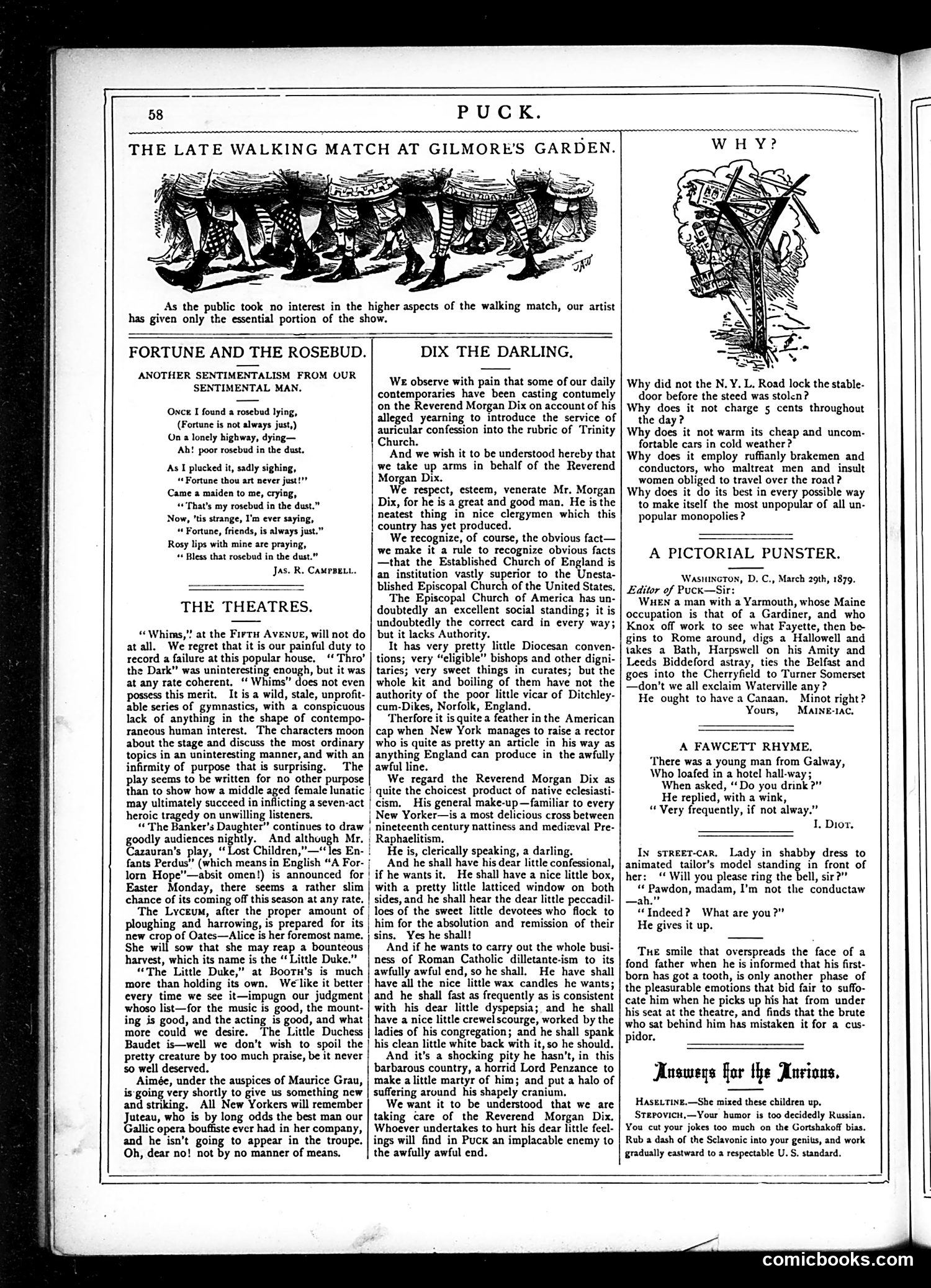
This page contains several satirical pieces rather than a single unified cartoon: **"The Late Walking Match at Gilmore's Garden"** (top): A silhouetted illustration of contestants in what appears to be a competitive walking event—likely a popular Victorian-era endurance spectacle that attracted public crowds. **"Fortune and the Rosebud"** and **"Dix the Darling"**: These are sentimental poetry pieces mocking overwrought sentimentalism, a common Puck target. "Dix the Darling" defends Reverend Morgan Dix against criticism for introducing auricular confession to his Trinity Church congregation—a High Church practice controversial in 1870s Protestant America. **Remaining sections** include theater reviews, a fawcett rhyme, and an "Answers for the Curious" advice column. The page reflects Puck's characteristic mix of visual and textual satire targeting Victorian society's excesses.
📄 Transcribed text from this page (OCR, searchable)
Machine-transcribed from the original scan — historical spelling and the odd misread are preserved.
58 PUCK. THE LATE WALKING MATCH AT GILMORE'S GARDEN. ) meas As the public took no interest in the higher aspects of the walking match, our artist has given only the essential portion of the show. FORTUNE AND THE ROSEBUD. ANOTHER SENTIMENTALISM FROM OUR SENTIMENTAL MAN. Once I found a rosebud lying, (Fortune is not always just,) On a lonely highway, dying— Ab! poor rosebud in the dust. As I plucked it, sadly sighing, «Fortune thou art never just!’? Came a maiden to me, crying, “That's my rosebud in the dust.” Now, 'tis strange, I'm ever saying, “ Fortune, friends, is always just.” Rosy lips with mine are praying, “Bless that rosebud in the dust.” Jas. R. CampBet. THE THEATRES. “ Whims,”’ at the Firt AvENvE, will not do at all. We regret that it is our painful duty to record a failure at this popular house. ‘‘ Thro’ the Dark" was uninteresting enough, but it was at any rate coherent. ‘ Whims” does not even possess this merit, It is a wild, stale, unprofit- able series of gymnastics, with a conspicuous lack of anything in the shape of contempo- raneous human interest. The characters moon about the stage and discuss the most ordinary topics in an uninteresting manner, and with an infirmity of purpose that is surprising. The play seems to be written for no other purpose than to show how a middle aged female lunatic may ultimately succeed in inflicting a seven-act heroic tragedy on unwilling listeners. | “ The Banker’s Daughter” continues to draw | goodly audiences nightly. And although Mr. | Cazauran’s play, ‘Lost Children,”—‘ les En- fants Perdus” (which means in English “A For- j lorn Hope”—absit omen!) is announced for | Easter Monday, there seems a rather slim chance of its coming off this season at any rate. The Lyceum, after the proper amount of ploughing and harrowing, is prepared for its new crop of Oates—Alice is her foremost name. She will sow that she may reap a bountcous harvest, which its name is the “Little Duke.” “The Little Duke,” at BootH’s is much more than holding its own. We'like it better every time we see it—impugn our judgment whoso list—for the music is good, the mount- ing is good, and the acting is good, and what more could we desire. The Little Duchess Baudet is—well we don’t wish to spoil the pretty creature by too much praise, be it never so well deserved. Aimée, under the auspices of Maurice Grau, is going very shortly to give us something new and striking. All New Yorkers will remember Juteau, who is by long odds the best man our Gallic opera bouffiste ever had in her company, and he isn’t going to appear in the troupe. Oh, dear no! not by no manner of means. DIX THE DARLING, WE observe with pain that some of our daily contemporaries have been casting contumely on the Reverend Morgan Dix on account of his alleged yearning to introduce the service of auricular confession into the rubric of Trinity Church. And we wish it to be understood hereby that we take up arms in behalf of the Reverend Morgan Dix. We respect, esteem, venerate Mr. Morgan Dix, for he is a great and good man. He is the neatest thing in nice clergymen which this country has yet produced. Why did not the N. Y. L. Road lock the stable- door before the steed was stolen? Why does it not charge 5 cents throughout the day? Why does it not warm its cheap and uncom- fortable cars in cold weather? Why does it employ ruffianly brakemen and conductors, who maltreat men and insult women obliged to travel over the road? Why does it do its best in every possible way to make itself the most unpopular of all un- popular monopolies ? We recognize, of course, the obvious fact we make it a rule to recognize obvious facts —that the Established Church of England is an institution vastly superior to the Unesta- blished Episcopal Church of the United States. The Episcopal Church of America has un- doubtedly an excellent social standing; it is undoubtedly the correct card in every way; but it lacks Authority. It has very pretty little Diocesan conven- tions; very “eligible” bishops and other digni- taries; very sweet things in curates; but the whole kit and boiling of them have not the authority of the poor little vicar of Ditchley- cum-Dikes, Norfolk, England. Therfore it is quite a feather inthe American cap when New York manages to raise a rector who is quite as pretty an article in his way as anything England can produce in the awfully awful line. We regard the Reverend Morgan Dix as | quite the choicest product of native eclesiasti- cism. His general make-up—familiar to every New Yorker—is a most delicious cross between nineteenth century nattiness and medizval Pre- Raphaelitism, He is, clerically speaking, a darling. And he shall have his dear little confessional, if he wants it. He shall have a nice little box, with a pretty little latticed window on both sides, and he shall hear the dear little peccadil- loes of the sweet little devotees who flock to him for the absolution and remission of their sins, Yes he shall! And if he wants to carry out the whole busi- ness of Roman Catholic dilletante-ism to its awfully awful end, so he shall. He have shall have all the nice little wax candles he wants; and he shall fast as frequently as is consistent with his dear little dyspepsia; and he shall have a nice little crewel scourge, worked by the ladies of his congregation; and he shall spank his clean little white back with it, so he should. And it’s a shocking pity he hasn't, in this barbarous country, a horrid Lord Penzance to make a little martyr of him; and put a halo of suffering around his shapely cranium. We want it to be understood that we are taking care of the Reverend Morgan Dix. Whoever undertakes to hurt his dear little feel- ings will find in Puck an implacable enemy to the awfully awful end. A PICTORIAL PUNSTER. Wasutncton, D. C., March 29th, 1879. Editor of Puck—Sir: WHEN a man with a Yarmouth, whose Maine occupation is that of a Gardiner, and who Knox off work to see what Fayette, then be- gins to Rome around, digs a Hallowell and takes a Bath, Harpswell on his Amity and Leeds Biddeford astray, ties the Belfast and goes into the Cherryfield to Turner Somerset —don't we all exclaim Waterville any? He ought to have a Canaan, Minot right? Yours, MAatNe-1Ac. A FAWCETT RHYME. ‘There was a young man from Galway, Who loafed in a hotel hall-way; When asked, “Do you drink ?” He replied, with a wink, “ Very frequently, if not alway.” I. Dior. In srReet-car. Lady in shabby dress to animated tailor’s model standing in front of her: “ Will you please ring the bell, sir?” “ Pawdon, madam, I’m not the conductaw —ah.” “Indeed? What are you?” He gives it up. Tue smile that overspreads the face of a fond father when he is informed that his first- born has got a tooth, is only another phase of the pleasurable emotions that bid fair to suffo- cate him when he picks up his hat from under his seat at the theatre, and finds that the brute who sat behind him has mistaken it for a cus- pidor. Answeys for the Anrions, HaseLting.—She mixed these children up. Stepovict.—Your humor is too decidedly Russian. You cut your jokes too much on the Gortshakoff bias, Rub a dash of the Sclavonic into your genitss, and work gradually eastward to a respectable U. S. standard, comicbooks.com