
Puck, 1879-04-02 · page 11 of 16
Puck — April 2, 1879 — page 11: what you’re looking at
What you’re looking at
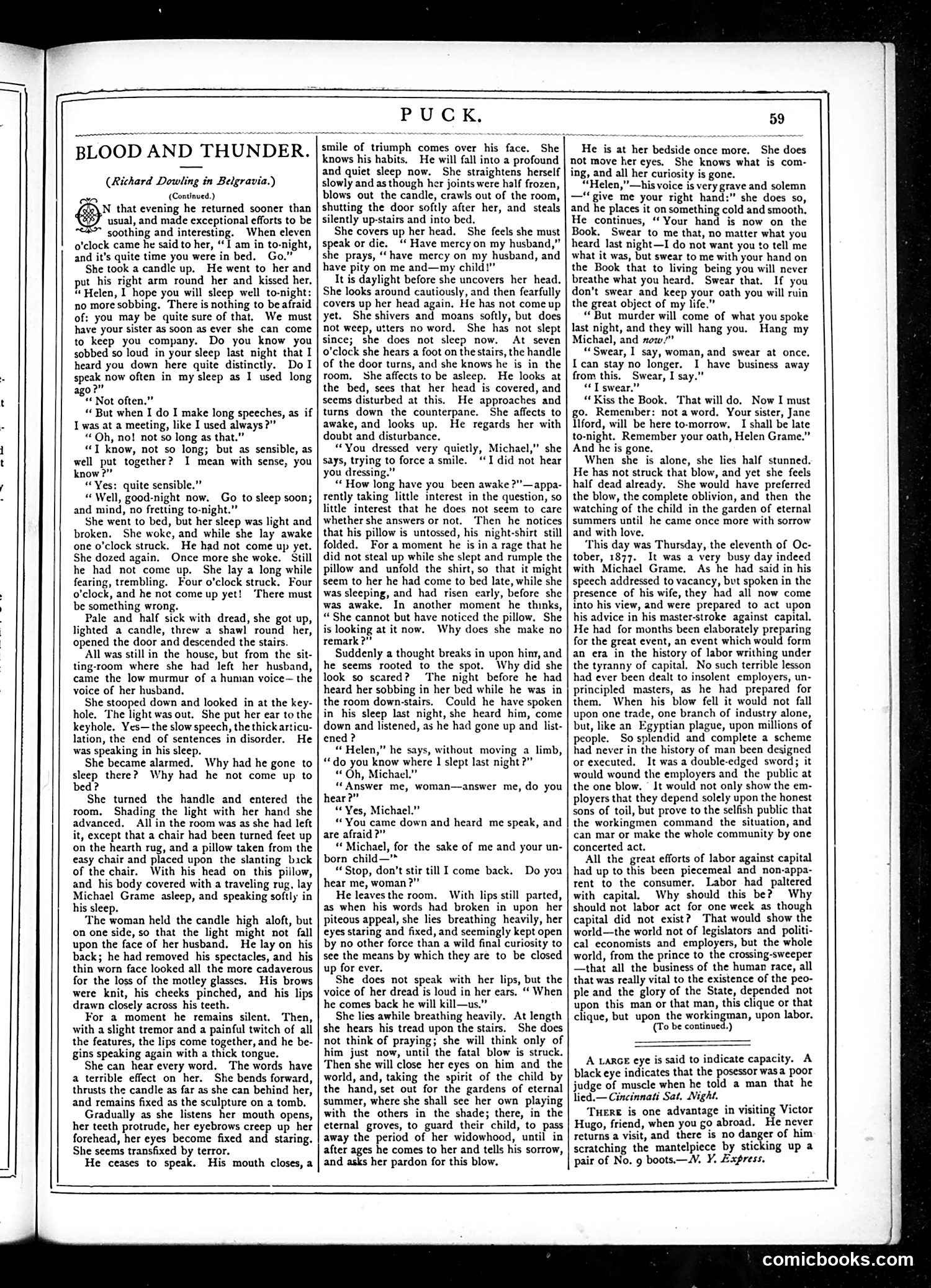
This page contains a serialized story titled "Blood and Thunder" by Richard Dowling, labeled as appearing in *Puck* magazine (page 59). The narrative depicts a domestic drama involving Michael and a woman at his bedside. The story concerns itself with labor disputes and capital conflict—the text references "great efforts of labor against capital" and mentions "employers" and "workingmen." The narrative appears to critique both labor activism and capitalist exploitation, presenting a melodramatic tale where personal domestic crisis intersects with broader class tensions. The story emphasizes emotional suffering and suggests labor disputes have caused widespread societal damage. This reflects late-19th-century *Puck* content that often satirized or dramatized contemporary labor conflicts for entertainment and political commentary.
📄 Transcribed text from this page (OCR, searchable)
Machine-transcribed from the original scan — historical spelling and the odd misread are preserved.
— BLOOD AND THUNDER. (Richard Dowling in Belgravia.) we (Continued. N that evening he returned sooner than usual, and made exceptional efforts to be soothing and interesting. When eleven o'clock came he said to her, “1 am in to-night, and it’s quite time you were in bed. Go.” She took a candle up. He went to her and put his right arm round her and kissed her. ‘Helen, I hope you will sleep well to-night: no more sobbing, There is nothing to be afraid of: you may be quite sure of that, We must have your sister as soon as ever she can come to keep you company. Do you know you sobbed so loud in your sleep last night that I heard you down here quite distinctly. DoI speak now often in my sleep as 1 used long 0?” * Not often,” “ But when I do I make long speeches, as if, I was at a meeting, like I used always?” “Oh, no! not so long as that.” “T know, not so long; but as sensible, as well put together? I mean with sense, you know ?”” “Yes: quite sensible.” “Well, good-night now. Go to sleep soon; and mind, no fretting to-night.” She went to bed, but her sleep was light and broken. She woke, and while she lay awake one o'clock struck. He had not come up yet. She dozed again. Once more she woke. Still he had not come up. She lay a long while fearing, trembling. Four o'clock struck. Four o'clock, and he not come up yet! ‘There must be something wrong. Pale and half sick with dread, she got up, lighted a candle, threw a shawl round her, opened the door and descended the stairs. All was still in the house, but from the sit- ting-room where she had left her husband, came the low murmur of a human voice— the voice of her husband. She stooped down and looked in at the key- hole. The light was out, She put her ear to the keyhole, Yes—the slow speech, the thick articu- lation, the end of sentences in disorder. He was speaking in his sleep. She became alarmed. Why had he gone to sleep there? Why had he not come up to bed? She turned the handle and entered the room, Shading the light with her hand she advanced. All in the room was as she had left it, except that a chair had been turned feet up on the hearth rug, and a pillow taken from the easy chair and placed upon the slanting back of the chair. With his head on this pillow, and his body covered with a traveling rug, lay Michael Grame asleep, and speaking softly in his sleep. ‘The woman held the candle high aloft, but on one side, so that the light might not fall upon the face of her husband. He lay on his back; he had removed his spectacles, and his thin worn face looked all the more cadaverous for the loss of the motley glasses. His brows were knit, his cheeks pinched, and his lips drawn closely across his teeth. For a moment he remains silent. Then, with a slight tremor and a painful twitch of all the features, the lips come together, and he be- gins speaking again with a thick tongue. She can hear every word. The words have a terrible effect on her. She bends forward, thrusts the candle as far as she can behind her, and remains fixed as the sculpture on a tomb. Gradually as she listens her mouth opens, her teeth protrude, her eyebrows creep up her forehead, her eyes become fixed and staring. She seems transfixed by terror. He ceases to speak. His mouth closes, a PUCK, smile of triumph comes over his face. She knows his habits. He will fall into a profound and quiet sleep now. She straightens herself slowly and as though her joints were half frozen, blows out the candle, crawls out of the room, shutting the door softly after her, and steals silently up-stairs and into bed. She covers up her head. She feels she must speak or die,“ Have mercy on my husband,” she prays, “have mercy on my husband, and have pity on me and—my child!” It is daylight before she uncovers her head. She looks around cautiously, and then fearfully covers up her head again, He has not come up yet. She shivers and moans softly, but does not weep, utters no word, She has not slept since; she does not sleep now. At seven o'clock she hears a foot on the stairs, the handle of the door turns, and she knows he is in the room. She affects to be asleep. He looks at the bed, sees that her head is covered, and seems disturbed at this. He approaches and turns down the counterpane. She affects to awake, and looks up. He regards her with doubt and disturbance. “You dressed very quietly, Michael,” she says, trying to force a smile. “I did not hear you dressing.” “ How long have you been awake ?”—appa- rently taking little interest in the question, so little interest that he does not seem to care whether she answers or not. Then he notices that his pillow is untossed, his night-shirt still folded. For a moment he is in a rage that he did not steal up while she slept and rumple the pillow and unfold the shirt, so that it might seem to her he had come to bed late, while she was sleeping, and had risen early, before she was awake. In another moment he thinks, “She cannot but have noticed the pillow. She is looking at it now. Why does she make no remark?” Suddenly a thought breaks in upon hint, and he seems rooted to the spot. Why did she look so scared? The night before he had heard her sobbing in her bed while he was in the room down-stairs. Could he have spoken in his sleep last night, she heard him, come down and listened, as he had gone up and list- ened ? “Helen,” he says, without moving a limb, “do you know where I slept last night ?” “Oh, Michael.” “Answer me, woman—answer me, do you hear?” “Yes, Michael.” “You came down and heard me speak, and are afraid?” “ Michael, for the sake of me and your un- born child—* “Stop, don’t stir till I come back. Do you hear me, woman ?” He leavesthe room. With lips still parted, as when his words had broken in upon her piteous appeal, she lies breathing heavily, her eyes staring and fixed, and seemingly kept open by no other force than a wild final curiosity to see the means by which they are to be closed up for ever. She does not speak with her lips, but the voice of her dread is loud in her ears. “ When he comes back he will kill—us.”” She lies awhile breathing heavily. At length she hears his tread upon the stairs. She does not think of praying; she will think only of him just now, until the fatal blow is struck. Then she will close her eyes on him and the world, and, taking the spirit of the child by the hand, set out for the gardens of eternal summer, where she shall see her own playing with the others in the shade; there, in the eternal groves, to guard their child, to pass away the period of her widowhood, until in after ages he comes to her and tells his sorrow, and asks her pardon for this blow. =| 59 He is at her bedside once more. She does not move her eyes. She knows what is com- ing, and all her curiosity is gone. “Helen,” —his voice is very grave and solemn —‘‘give me your right hand:” she does so, and he places it on something cold and smooth, He continues, “Your hand is now on the Book. Swear to me that, no matter what you heard last night—I do not want you to tell me what it was, but swear to me with your hand on the Book that to living being you will never breathe what you heard. Swear that. If you don't swear and keep your oath you will ruin the great object of my life." «But murder will come of what you spoke last night, and they will hang you. Hang my Michael, and now!” “Swear, I say, woman, and swear at once. Ican stay no longer. I have business away from this. Swear, I say.” “T swear.” “ Kiss the Book. That will do, Now I must go. Remeniber: not a word, Your sister, Jane Ilford, will be here to-morrow, _I shall be late to-night. Remember your oath, Helen Grame.” And he is gone. When she is alone, she lies half stunned. He has not struck that blow, and yet she feels half dead already. She would have preferred the blow, the complete oblivion, and then the watching of the child in the garden of eternal summers until he came once more with sorrow and with love. ‘This day was Thursday, the eleventh of Oc- tober, 1877. It was a very busy day indeed with Michael Grame, As he had said in his speech addressed to vacancy, but spoken in the presence of his wife, they had all now come into his view, and were prepared to act upon his advice in his master-stroke against capital. He had for months been elaborately preparing for the great event, an event which would form an era in the history of labor writhing under the tyranny of capital. No such terrible lesson had ever been dealt to insolent employers, un- principled masters, as he had prepared for them. When his blow fell it would not fall upon one trade, one branch of industry alone, but, like an Egyptian plague, upon millions of people. So splendid and complete a scheme had never in the history of man been designed or executed, It was a double-edged sword; it would wound the employers and the public at the one blow. © Jt would not only show the em- ployers that they depend solely upon the honest sons of toil, but prove to the selfish public that the workingmen command the situation, and can mar or make the whole community by one concerted act. All the great efforts of labor against capital had up to this been piecemeal and non-appa- rent to the consumer. Labor had paltered with capital. Why should this be? Why should not labor act for one week as though capital did not exist? That would show the world—the world not of legislators and politi- cal economists and employers, but the whole world, from the prince to the crossing-sweeper —that all the business of the human race, all that was really vital to the existence of the peo- ple and the glory of the State, depended not upon this man or that man, this clique or that clique, but upon the workingman, upon labor. (To be continued.) A LARGE eye is said to indicate capacity. A black eye indicates that the posessor wasa poor judge of muscle when he told a man that he lied.— Cincinnati Sat. Night. Tuere is one advantage in visiting Victor Hugo, friend, when you go abroad. He never returns a visit, and there is no danger of him scratching the mantelpiece by sticking up a pair of No. 9 boots.—W. ¥. Express. comicbooks.com