
Puck, 1879-04-02 · page 7 of 16
Puck — April 2, 1879 — page 7: what you’re looking at
What you’re looking at
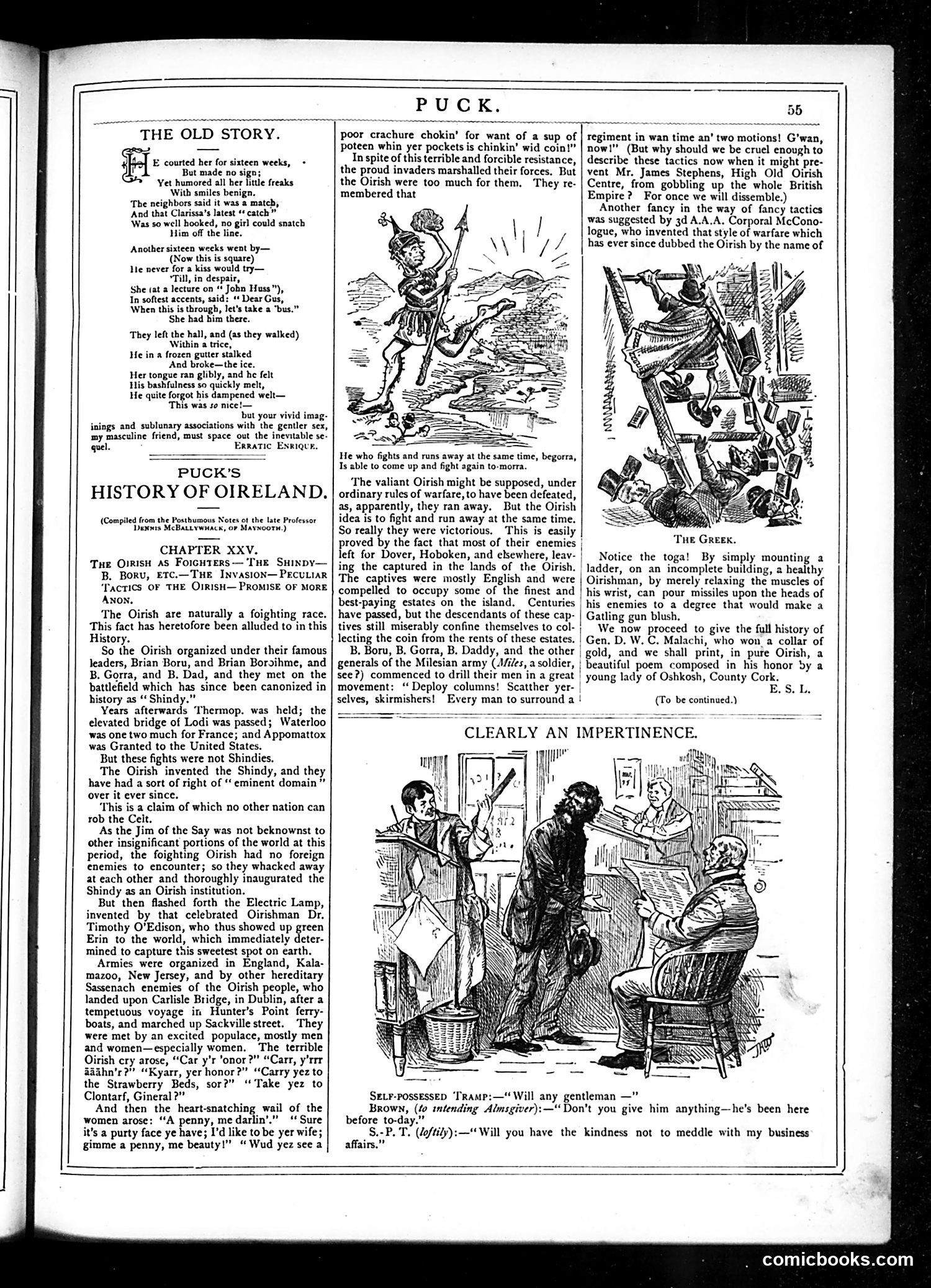
This page contains three distinct sections: **"The Old Story"** (left): A poem about a woman who "counted her for sixteen weeks" but "made no signs"—appears to be satirizing romantic indifference or courtship customs of the era. **"Puck's History of Ireland, Chapter XXV"** (center): Discusses the Oirish as fighters, referencing historical figures like B. Gorra and B. Daddy. The text critiques both Irish military tactics and British oppression, with illustrations of conflict. This represents Puck's typical Anglo-American perspective on Irish affairs. **"Clearly an Impertinence"** (bottom right): A cartoon showing working-class figures in what appears to be a domestic dispute or business disagreement, with dialogue about not meddling in affairs. The caption suggests commentary on class relations or workplace hierarchy. The page reflects late 19th-century American attitudes toward immigration, Irish identity, and social class.
📄 Transcribed text from this page (OCR, searchable)
Machine-transcribed from the original scan — historical spelling and the odd misread are preserved.
THE OLD STORY. et E courted her for sixteen weeks, + But made no sign; Yet humored all her little freaks With smiles benign, ‘The neighbors said it was a match, ‘And that Clarissa’s latest « catch” Was so well hooked, no girl could snatch Him off the line. ‘Another sixteen weeks went by— (Now this is square) He never for a kiss would try— “Till, in despair, She (at a lecture on ** John Huss”), In softest accents, said: ** Dear Gus, When this is through, Jet's take a “bus.” She had him there. ‘They left the hall, and (as they walked) Within a trice, He in a frozen gutter stalked And broke—the ice. Her tongue ran glibly, and he felt His bashfulness so quickly melt, He quite forgot his dampened welt— This was s0 nice!— bbut your vivid imag- inings and sublunary associations with the gentler sez, my masculine friend, must space out the inevitable se- ERRATIC ENRIQUE. PUCK’S HISTORY OF OIRELAND. (Compited from the Posthumous Notes of the late Professor Dannis McBALLYWHACK, O” MAYNOOTH.) CHAPTER XXV. Tne O1risH AS FoicHTers— ‘THE SHinpy— B. Boru, ETC.—THE Invasion— PECULIAR ‘TacTICs OF THE O1RISH— PROMISE OF MORE ANON, ‘The Oirish are naturally a foighting race. This fact has heretofore been alluded to in this History. So the Oirish organized under their famous leaders, Brian Boru, and Brian Boroihme, and B. Gorra, and B. Dad, and they met on the battlefield which has since been canonized in history as “ Shindy.” Years afterwards Thermop. was held; the elevated bridge of Lodi was passed; Waterloo was one two much for France; and Appomattox was Granted to the United States. But these fights were not Shindies. The Oirish invented the Shindy, and they have had a sort of right of ‘‘ eminent domain” over it ever since. This is a claim of which no other nation can rob the Ceit. As the Jim of the Say was not beknownst to other insignificant portions of the world at this period, the foighting Oirish had no foreign enemies to encounter; so they whacked away at each other and thoroughly inaugurated the Shindy as an Oirish institution. But then flashed forth the Electric Lamp, invented by that celebrated Oirishman Dr. Timothy O’Edison, who thus showed up green Erin to the world, which immediately deter- mined to capture this sweetest spot on earth. Armies were organized in England, Kala- mazoo, New Jersey, and by other hereditary Sassenach enemies of the Oirish people, who landed upon Carlisle Bridge, in Dublin, after a tempetuous voyage in Hunter’s Point ferry- boats, and marched up Sackville street. They were met by an excited populace, mostly men and women—especially women. The terrible Oirish cry arose, “Car y’r 'onor ?” “Carr, y’rrr aaahn’r?” “Kyarr, yer honor?” “Carry yez to the Strawberry Beds, sor?” ‘Take yez to Clontarf, Gineral ?” And then the heart-snatching wail of the women arose: “A penny, me darlin’.” “Sure it's a purty face ye have; I'd like to be yer wife; gimme a penny, me beauty!” “Wud yez see a PUCK. poor crachure chokin’ for want of a sup of poteen whin yer pockets is chinkin’ wid coin!” In spite of this terrible and forcible resistance, the proud invaders marshalled their forces. But the Oirish were too much for them. They re- membered that He who fights and runs away at the same time, begorra, Is able to come up and fight again to-morra. ‘The valiant Oirish might be supposed, under ordinary rules of warfare, to have been defeated, as, apparently, they ran away. But the Oirish idea is to fight and run away at the same time. So really they were victorious. This is easily proved by the fact that most of their enemies | left for Dover, Hoboken, and elsewhere, leay- ing the captured in the lands of the Oirish. The captives were mostly English and were compelled to occupy some of the finest and best-paying estates on the island. Centuries have passed, but the descendants of these cap- tives still miserably confine themselves to col- lecting the coin from the rents of these estates. B. Boru, B, Gorra, B. Daddy, and the other | generals of the Milesian army (Afi/es, a soldier, see?) commenced to drill their men in a great movement: ‘“ Deploy columns! Scatther yer- | selves, skirmishers! Every man to surround a regiment in wan time an’ two motions! G’wan, now!” (But why should we be cruel enough to describe these tactics now when it might pre- vent Mr. James Stephens, High Old’ Oirish Centre, from gobbling up the whole British Empire? For once we will dissemble.) Another fancy in the way of fancy tactics was suggested by 3d A.A.A. Corporal McCono- logue, who invented that style of warfare which has ever since dubbed the Oirish by the name of. Tue Greek. Notice the toga! By simply mounting a ladder, on an incomplete building, a healthy Oirishman, by merely relaxing the muscles of his wrist, can pour missiles upon the heads of his enemies to a degree that would make a Gatling gun blush. We now proceed to give the full history of Gen, D. W. C. Malachi, who won a collar of gold, and we shall print, in pure Oirish, a | beautiful poem composed in his honor by a young lady of Oshkosh, County Cork. E.S. L. 1 (To be continued.) CLEARLY AN IMPERTINENCE. me" SELr-PossesseD ‘TRamp:—‘ Will any gentleman —” Brown, (to intending Almsgiver):—" Don't you give him anything—he’s been here before to-day.” S.-P. T. (Joftily):—“ Will you have the kindness not to meddle with my business affairs.” comicbooks.com