
Puck, 1879-04-02 · page 4 of 16
Puck — April 2, 1879 — page 4: what you’re looking at
What you’re looking at
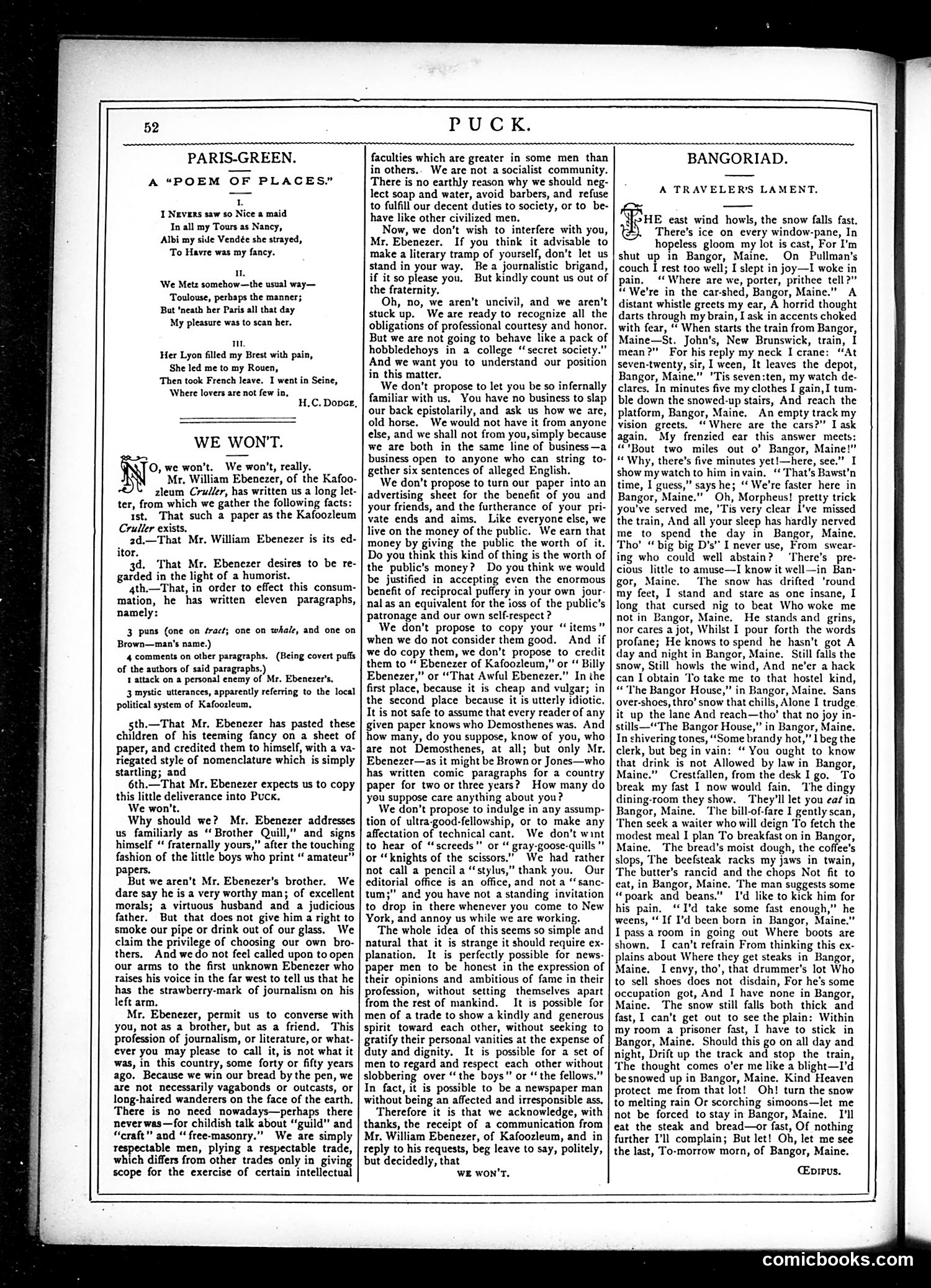
This page contains three literary pieces rather than visual cartoons. "Paris-Green: A Poem of Places" is a poem about visiting Nancy, France. "We Won't" is the main satirical content—a lengthy response to William Ebenezor of the Kafoozedum, who apparently criticized Puck in previous issues. Puck's editors defend their editorial independence and refute accusations of bias, explaining they won't censor content or favor particular groups. They mock Ebenezor's complaints as petty and assert journalism's right to honest expression without self-censorship. The piece emphasizes that Puck won't be bullied into silence or forced to credit competitors. "A Traveler's Lament" (right column) humorously describes tedious train travel to Bangor, Maine, cataloging minor annoyances of 19th-century rail journeys.
📄 Transcribed text from this page (OCR, searchable)
Machine-transcribed from the original scan — historical spelling and the odd misread are preserved.
PUCK. 52 PARIS-GREEN. A “POEM OF PLACES.” L I Nevers saw so Nice a maid In all my Tours as Nancy, Albi my side Vendée she strayed, To Havre was my fancy. i ‘We Metz somehow—the usual way— Toulouse, perhaps the manner; But neath her Paris all that day My pleasure was to scan her. m. Her Lyon filled my Brest with pain, She led me to my Rouen, Then took French leave. I went in Seine, ‘Where lovers are not few in, H.C. Donce, WE WON'T. O, we won’t. We won't, really. SN Mr. William Ebenezer, of the Kafoo- zleum Cruller, has written us a long let- ter, from which we gather the following facts: ist, That such a paper as the Kafoozleum Cruller exists. 2d.—That Mr. William Ebenezer is its ed- itor. 3d. ‘That Mr. Ebenezer desires to be re- garded in the light of a humorist. 4th.—That, in order to effect this consum- mation, he has written eleven paragraphs, namely: 3 puns (one on éract; one on whale, and one on Brown—man's name.) 4.comments on other paragraphs. (Being covert puffs of the authors of said paragraphs.) 1 attack on a personal enemy of Mr. Ebenezer's, 3 mystic utterances, apparently referring to the local political system of Kafoozleum, gth.—That Mr. Ebenezer has pasted these children of his teeming fancy on a sheet of paper, and credited them to himself, with a va- riegated style of nomenclature which is simply startling; and 6th.—That Mr. Ebenezer expects us to copy this little deliverance into Puck, We won't. Why should we? Mr. Ebenezer addresses us familiarly as ‘Brother Quill,” and signs himself “ fraternally yours,” after the touching fashion of the little boys who print “ amateur” Papers. But we aren’t Mr. Ebenezer’s brother. We dare say he is a very worthy man; of excellent morals; a virtuous husband and a judicious father. But that does not give him a right to smoke our pipe or drink out of our glass. We claim the privilege of choosing our own bro- thers. And wedo not feel called upon to open our arms to the first unknown Ebenezer who raises his voice in the far west to tell us that he has the strawberry-mark of journalism on his left arm, Mr. Ebenezer, permit us to converse with you, not as a brother, but as a friend. This profession of journalism, or literature, or what- ever you may please to call it, is not what it was, in this country, some forty or fifty years ago. Because we win our bread by the pen, we are not necessarily vagabonds or outcasts, or long-haired wanderers on the face of the earth. There is no need nowadays—perhaps there never was—for childish talk about ‘‘guild” and “craft” and “‘free-masonry.” We are simply respectable men, plying a respectable trade, which differs from other trades only in giving scope for the exercise of certain intellectual faculties which are greater in some men than in others.. We are not a socialist community. There is no earthly reason why we should neg- lect soap and water, avoid barbers, and refuse to fulfill our decent duties to society, or to be- have like other civilized men. Now, we don’t wish to interfere with you, Mr. Ebenezer. If you think it advisable to make a literary tramp of yourself, don’t let us stand in your way. Bea journalistic brigand, if it so please you, But kindly count us out of the fraternity. Oh, no, we aren’t uncivil, and we aren’t stuck up. | We are ready to recognize all the obligations of professional courtesy and honor. But we are not going to behave like a pack of hobbledehoys in a college “secret society.” And we want you to understand our position in this matter. We don't propose to let you be so infernally familiar with us. You have no business to slap our back epistolarily, and ask us how we are, old horse. We would not have it from anyone else, and we shall not from you, simply because we are both in the same line of business—a business open to anyone who can string to- gether six sentences of alleged English. We don’t propose to turn our paper into an advertising sheet for the benefit of you and your friends, and the furtherance of your pri- vate ends and aims. Like everyone else, we live on the money of the public. We earn that money by giving the public the worth of it. Do you think this kind of thing is the worth of the public’s money? Do you think we would be justified in accepting even the enormous benefit of reciprocal puffery in your own jour- nal as an equivalent for the ioss of the public’s patronage and our own self-respect ? We don't propose to copy your “ items” when we do not consider them good. And if we do copy them, we don’t propose to credit them to “ Ebenezer of Kafoozleum,” or “ Billy Ebenezer,” or ‘That Awful Ebenezer.” In the first place, because it is cheap and vulgar; in the second place because it is utterly idiotic, It is not safe to assume that every reader of any given paper knows who Demosthenes was. And how many, do you suppose, know of you, who are not Demosthenes, at all; but only Mr. Ebenezer—as it might be Brown or Jones—who has written comic paragraphs for a country paper for two or three years? How many do you suppose care anything about you? We don’t propose to indulge in any assump- tion of ultra-good-fellowship, or to make any affectation of technical cant. We don’t wint to hear of “screeds” or “ gray-goose-quills ” or “knights of the scissors.” We had rather not call a pencil a “stylus,” thank you. Our editorial office is an office, and not a “sanc- tum;” and you have not a standing invitation to drop in there whenever you come to New York, and annoy us while we are working. The whole idea of this seems so simple and natural that it is strange it should require ex- planation. It is perfectly possible for news- paper men to be honest in the expression of their opinions and ambitious of fame in their profession, without setting themselves apart from the rest of mankind. It is possible for men of a trade to show a kindly and generous spirit toward each other, without seeking to gratify their personal vanities at the expense of duty and dignity. It is possible for a set of men to regard and respect each other without slobbering over “the boys” or “the fellows.” In fact, it is possible to be a newspaper man without being an affected and irresponsible ass, Therefore it is that we acknowledge, with thanks, the receipt of a communication from Mr. William Ebenezer, of Kafoozleum, and in reply to his requests, beg leave to say, politely, but decidedly, that WE WON'T. BANGORIAD. A TRAVELER'S LAMENT. Bue east wind howls, the snow falls fast. There’s ice on every window-pane, In hopeless gloom my lot is cast, For I'm shut up in Bangor, Maine. On Pullman's couch I rest too well; I slept in joy—I woke in pain, “Where are we, porter, prithce tell?” ‘We're in the car-shed, Bangor, Maine.” A distant whistle greets my ear, A horrid thought darts through my brain, I ask in accents choked with fear, “ When starts the train from Bangor, Maine—St. John’s, New Brunswick, train, I mean?” For his reply my neck I crane: “At seven-twenty, sir, 1 ween, It leaves the depot, Bangor, Maine.” 'Tis seven:ten, my watch de- clares. In minutes five my clothes I gain, I tum- ble down the snowed-up stairs, And reach the platform, Bangor, Maine. An empty track my vision greets. ‘Where are the cars?” I ask again, My frenzied ear this answer meets: "Bout two miles out o’ Bangor, Maine!” “Why, there’s five minutes yet!—here, see.” I show my watch to him invain. ‘ That’s Bawst’n time, I guess,” says he; ‘ We're faster here in Bangor, Maine.” Oh, Morpheus! pretty trick you've served me, ’Tis very clear I've missed the train, And all your sleep has hardly nerved me to spend the day in Bangor, Maine. Tho’ “ big big D's’ I never use, From swear- ing who could well abstain? ‘There’s _pre- cious little to amuse—I know it well—in Ban- gor, Maine. The snow has drifted ‘round my feet, I stand and stare as one insane, I long that cursed nig to beat Who woke me not in Bangor, Maine. He stands and grins, nor cares a jot, Whilst I pour forth the words profane; He knows to spend he hasn’t got A day and night in Bangor, Maine. Still falls the snow, Still howls the wind, And ne’er a hack can I obtain To take me to that hostel kind, “The Bangor House,” in Bangor, Maine. Sans over-shoes, thro’ snow that chills, Alone I trudge it up the lane And reach—tho’ that no joy in- stills—The Bangor House,” in Bangor, Maine. In shivering tones, ‘Some brandy hot,” 1 beg the clerk, but beg in vain: “ You ought to know that drink is not Allowed by law in Bangor, Maine.” Crestfallen, from the desk I go. To break my fast I now would fain, ‘The dingy dining-room they show. ‘They'll let you eaf in Bangor, Maine. ‘The bill-of-fare I gently scan, Then seek a waiter who will deign To fetch the modest meal I plan To breakfast on in Bangor, Maine. The bread's moist dough, the coffee’s slops, The beefsteak racks my jaws in twain, The butter’s rancid and the chops Not fit to cat, in Bangor, Maine. ‘The man suggests some “poark and beans.” I'd like to kick him for his pain. ‘I'd take some fast enough,” he weens, ‘If I’d been born in Bangor, Maine.” I pass a room in going out Where boots are shown, I can’t refrain From thinking this ex- plains about Where they get steaks in Bangor, Maine. I envy, tho’, that drummer’s lot Who to sell shoes does not disdain, For he's some occupation got, And I have none in Bangor, Maine. The snow still falls both thick and fast, 1 can’t get out to see the plain: Within my room a prisoner fast, I have to stick in Bangor, Maine. Should this go on all day and night, Drift up the track and stop the train, ‘The thought comes o’er me like a blight—I'd besnowed up in Bangor, Maine. Kind Heaven protect me from that lot! Oh! turn the snow to melting rain Or scorching simoons—let me not be forced to stay in Bangor, Maine. I'll eat the steak and bread—or fast, Of nothing further I’ll complain; But let! Oh, let me see the last, To-morrow morn, of Bangor, Maine. rrus. comicbooks.com