
A complete issue · 16 pages · 1879
Puck — March 19, 1879
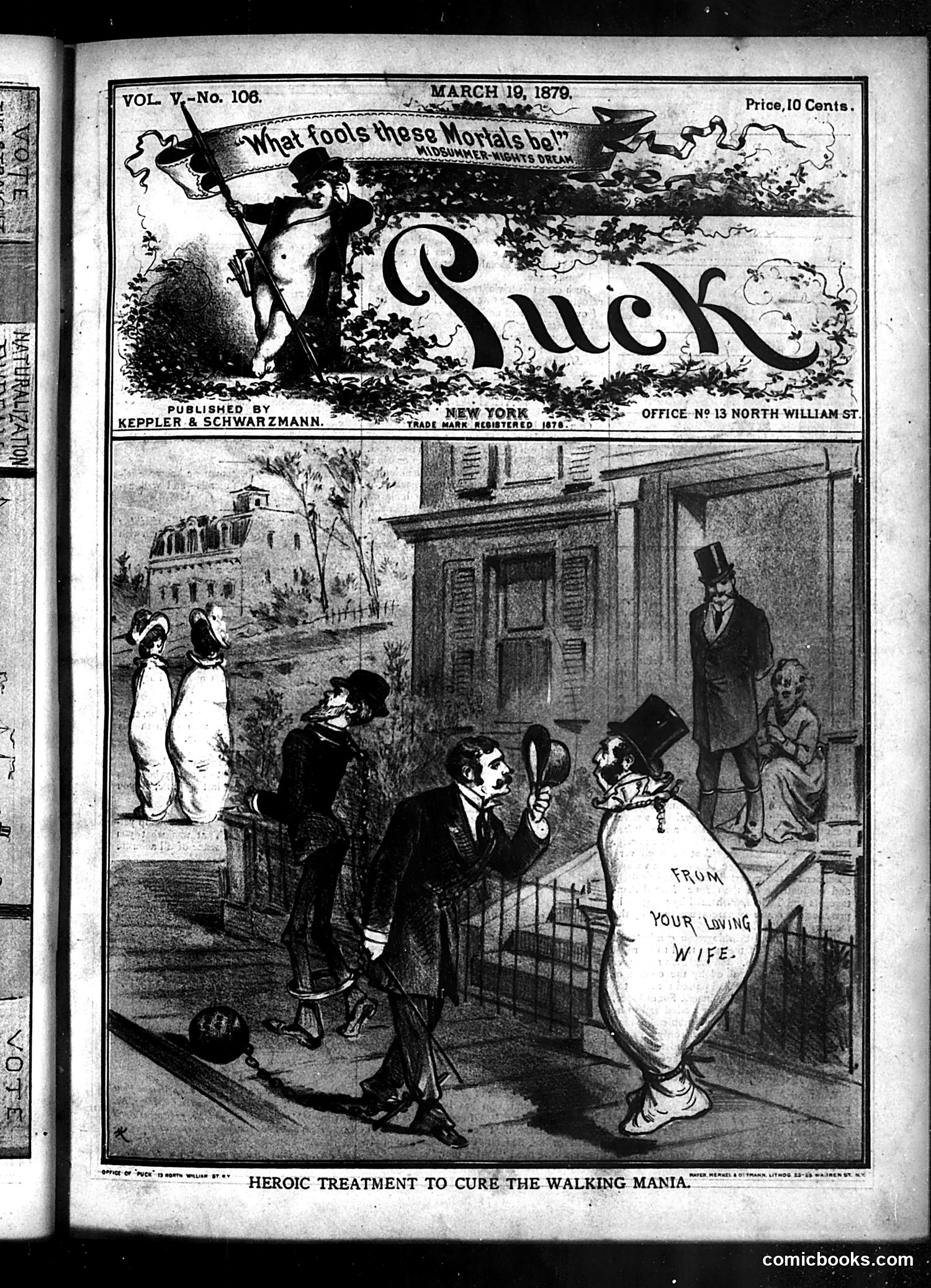
**Main Cartoon: "Heroic Treatment to Cure the Walking Mania"** This satirical cartoon mocks a social phenomenon called "walking mania"—apparently a concern about excessive walking or pedestrianism among the wealthy. The image shows a fashionable man in a top hat being physically restrained by his wife, who wraps him in bedding labeled "FROM YOUR LOVING WIFE." The satire suggests that concerned spouses are resorting to extreme measures—essentially imprisoning their husbands—to cure this compulsive walking habit. Onlookers and servants observe the scene, emphasizing society's awareness of this peculiar "disease." The cartoon ridicules both the walking fad itself and the drastic domestic interventions it supposedly provoked among Victorian families.
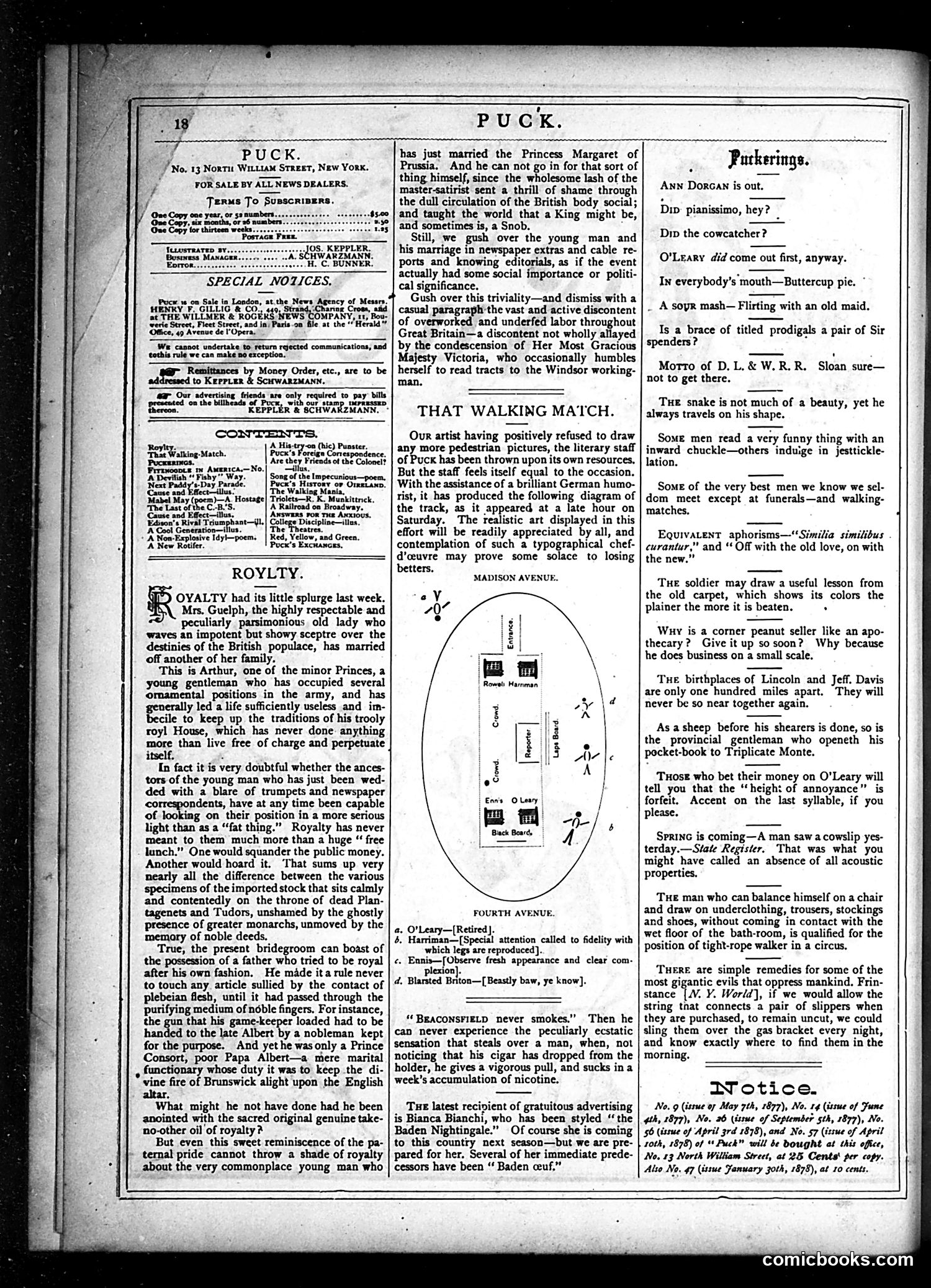
This diagram illustrates a satirical "walking match"—a popular Victorian-era competitive sport where contestants walked long distances for prizes and public entertainment. The cartoon mocks the absurdity of these events by mapping out a walking route on "Madison Avenue" and "Fourth Avenue" in New York, with labeled stations (O'Leary's, Hamilton's, Blasted Briton's, and Black Hand's) marking checkpoints. The accompanying text reveals the satire's target: Puck's artists had refused to draw more pedestrian pictures, so the literary staff created this diagram instead. The joke plays on the era's obsession with walking competitions while simultaneously poking fun at the magazine's own editorial process and the triviality of such sporting events.
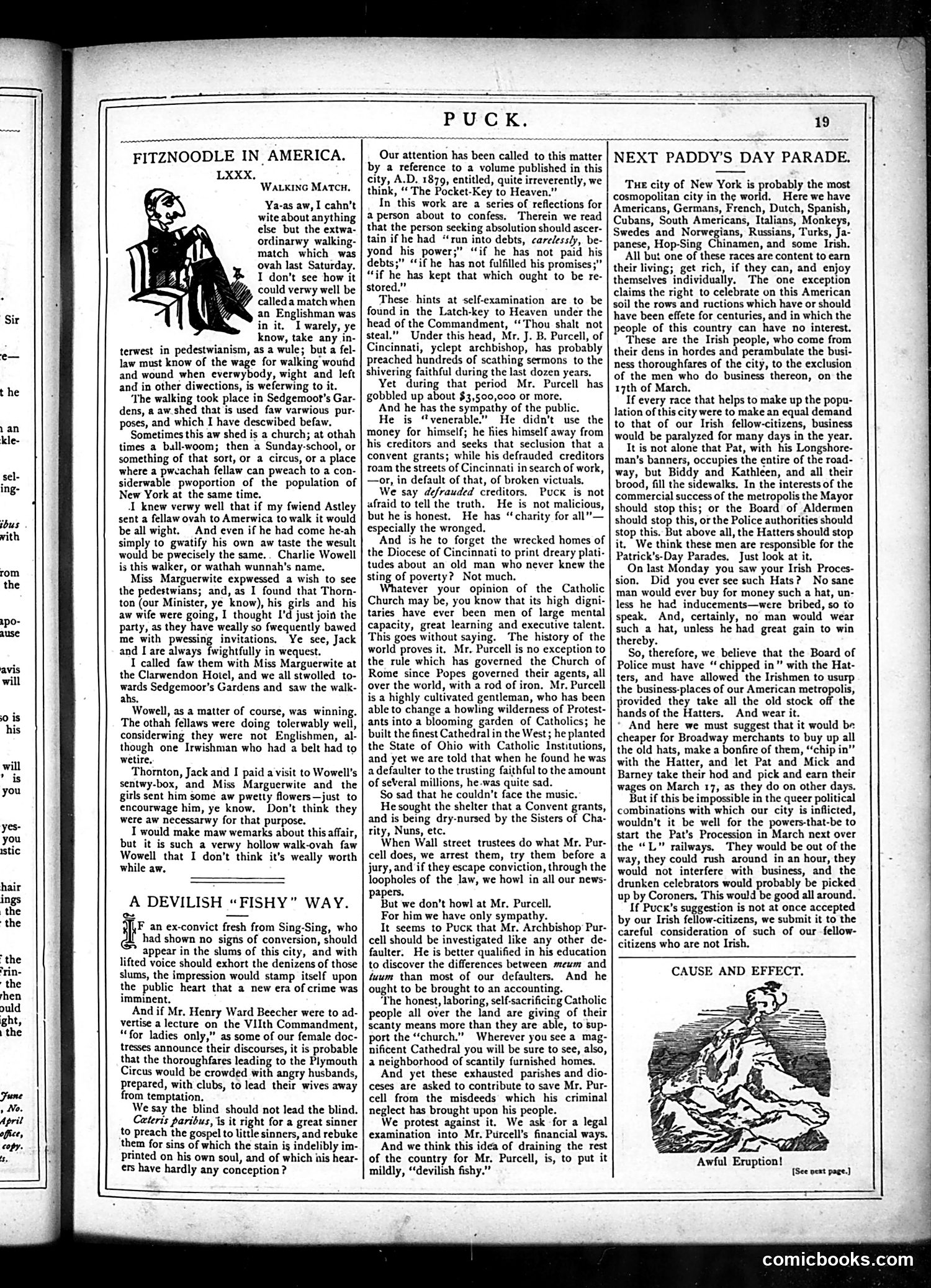
This page contains three distinct pieces of political satire: 1. **"Fitznoodle in America"** critiques pedestrian behavior and urban walking etiquette, using a character's observations about American street conduct as social commentary. 2. **"Next Paddy's Day Parade"** satirizes New York's Irish-American community and Catholic Church influence. It criticizes Archbishop Purcell's financial mismanagement and suggests Irish Catholics should redirect their civic participation away from religious processions toward secular civic duties. The piece argues their energy would better serve the city's commercial interests. 3. **"A Devilish 'Fishy' Way"** attacks what appears to be ecclesiastical corruption or hypocrisy, using religious imagery to mock clerical dishonesty. The overall tone reflects late-19th-century anti-Catholic prejudice common in American Protestant publications.
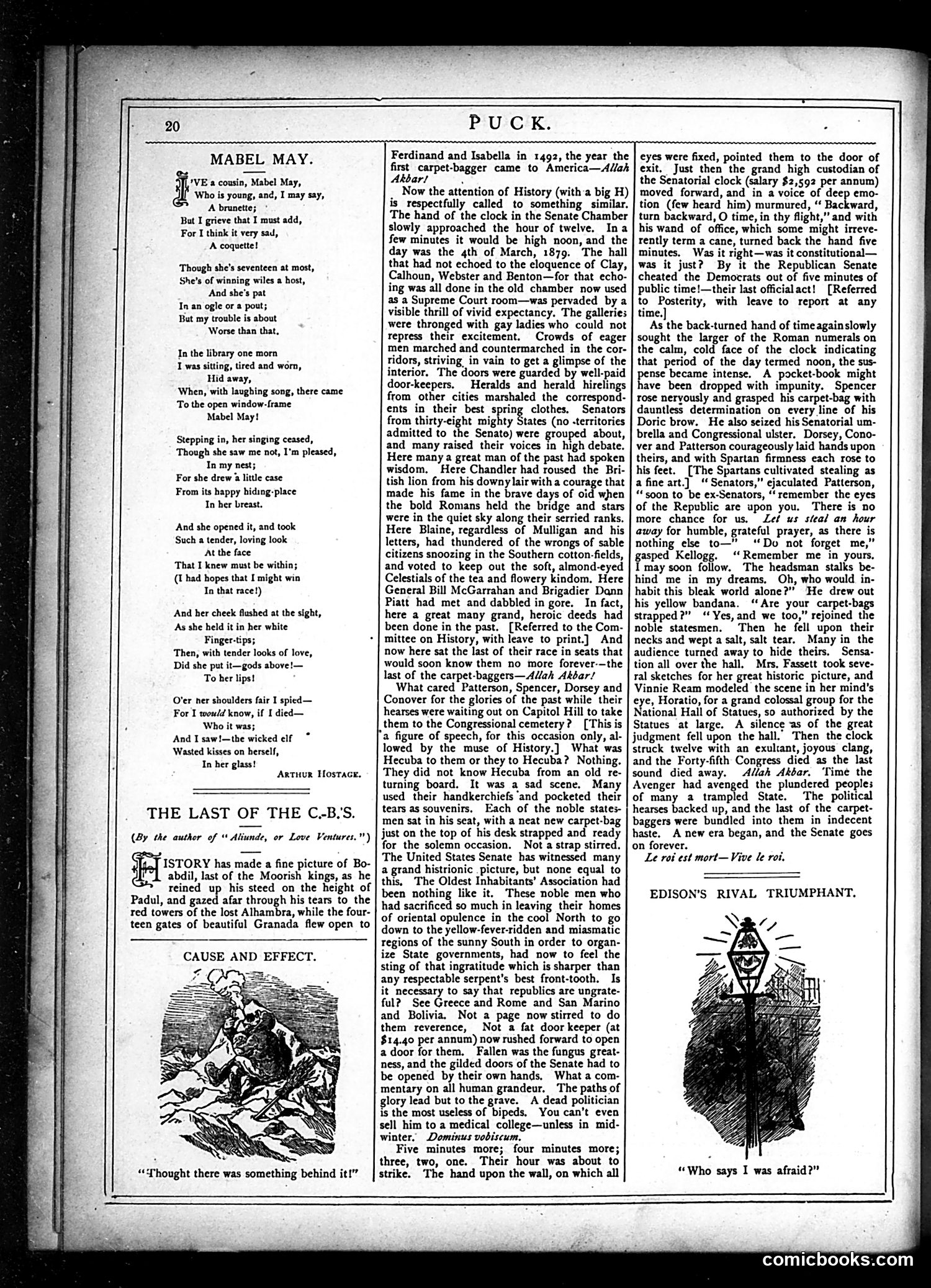
This page contains three distinct pieces: 1. **"Mabel May"** (poem by Arthur Hostage): A sentimental love poem with no political content. 2. **"The Last of the C.B.S."** (by the author of *Atlantis*): A prose piece about Hernán Cortés gazing at Granada. The accompanying illustration labeled "Thought there was something behind it" shows a reclining figure—likely satirizing historical nostalgia or Spanish imperial decline. 3. **"Edison's Rival Triumphant"**: A cartoon captioned "Who says I was afraid?" showing a figure with a lightbulb-head, apparently mocking competition in electrical innovation during the late 19th-century "War of Currents" between Edison and Tesla/Westinghouse. The page blends literary content with political and technological satire typical of Puck's miscellaneous format.
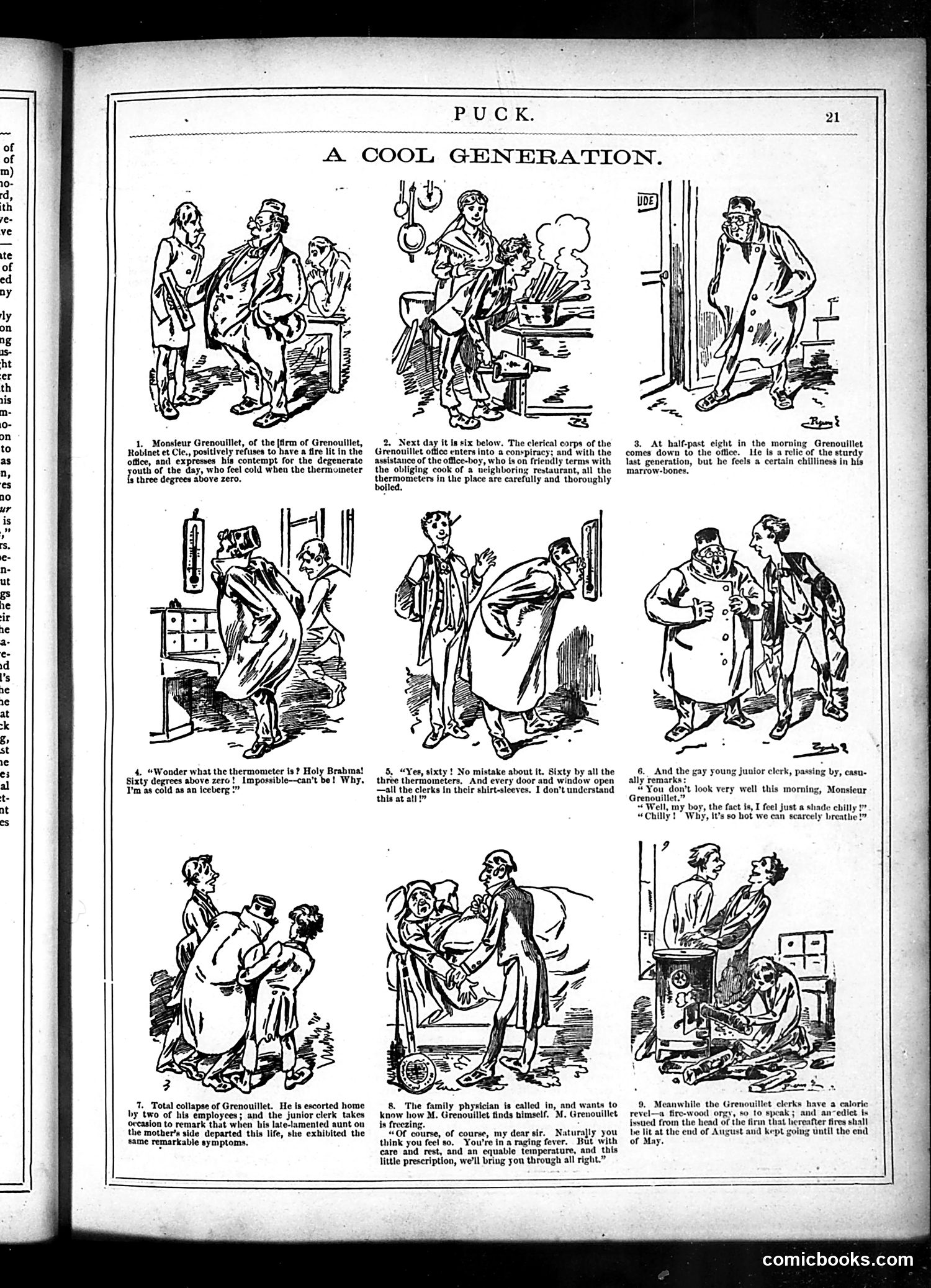
This satirical comic strip mocks Parisian office workers enduring extreme cold during winter. The narrative follows Monsieur Grenouillet, a company manager who refuses to light the office fireplace despite freezing temperatures, claiming economy. The humor centers on the absurd consequences: employees work in coats and hats, thermometers freeze solid, and staff collapse from cold exposure. A doctor is eventually called to treat the hypothermic workers. The final panel shows Grenouillet's household staff suffering similarly, suggesting his stinginess extends everywhere. The satire critiques miserly employers who prioritize cost-cutting over worker welfare and basic comfort—a commentary on industrial-era labor conditions. The exaggerated visual comedy emphasizes how ridiculous and inhumane such penny-pinching truly is.
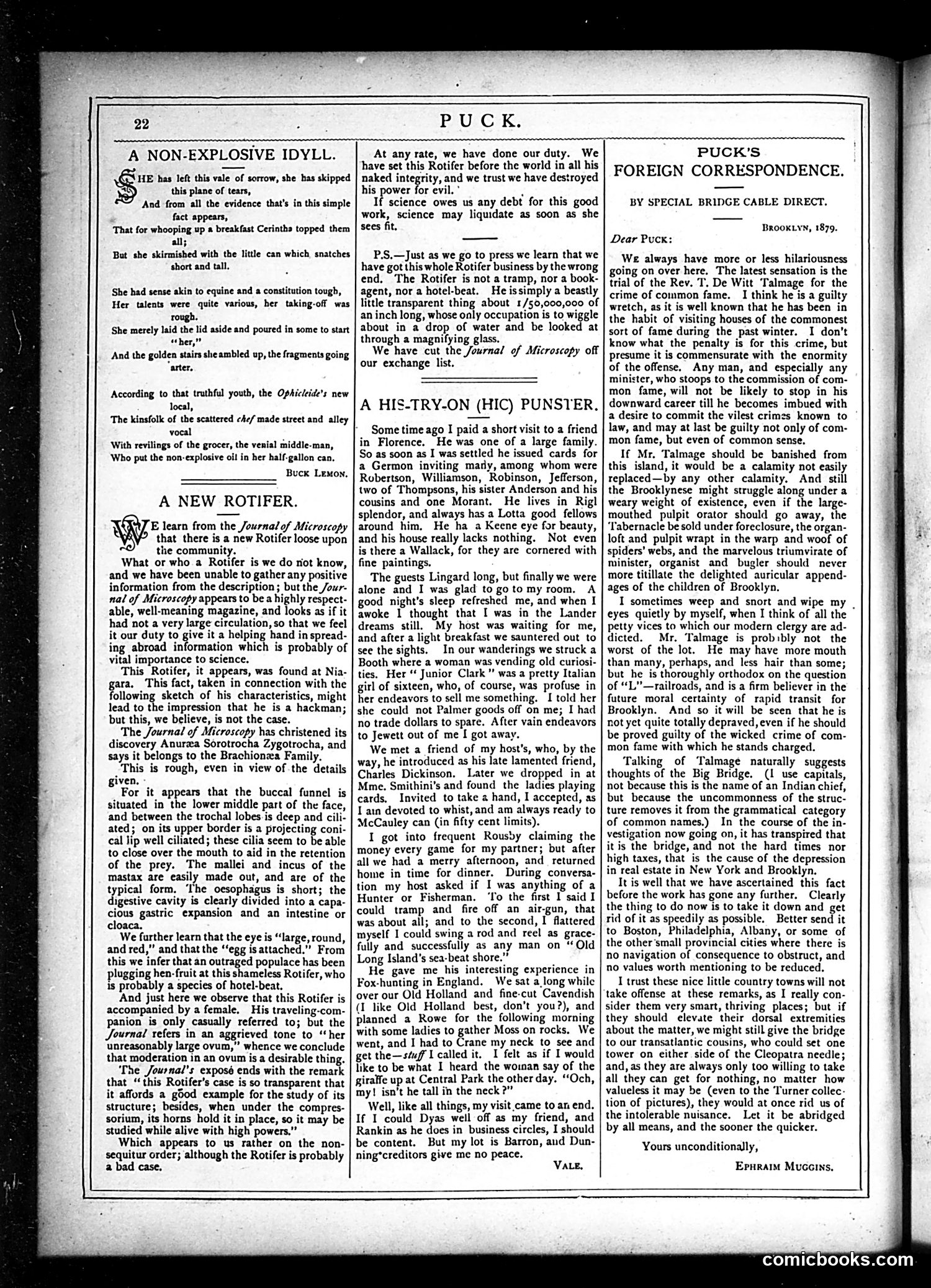
This page contains three satirical sections rather than a single cartoon: 1. **"A Non-Explosive Idyll"** - A poem mocking a woman who abandoned her domestic role, leaving "whooping up a breakfast Caribee" and general household chaos. The satire targets women neglecting traditional domestic duties. 2. **"A His-Try-On (HIC) Punster"** - A humorous travel narrative about visiting Florence, filled with puns and wordplay (typical of Puck's style). It's social commentary disguised as entertainment. 3. **"Puck's Foreign Correspondence"** - A letter from Brooklyn criticizing Reverend Talmage for visiting poor neighborhoods and worsening conditions through publicity. The writer (Ephraim Muggins) argues his interventions actually harm the communities he claims to help. The page exemplifies Puck's mix of domestic satire, humor, and social critique of contemporary figures and reform efforts.
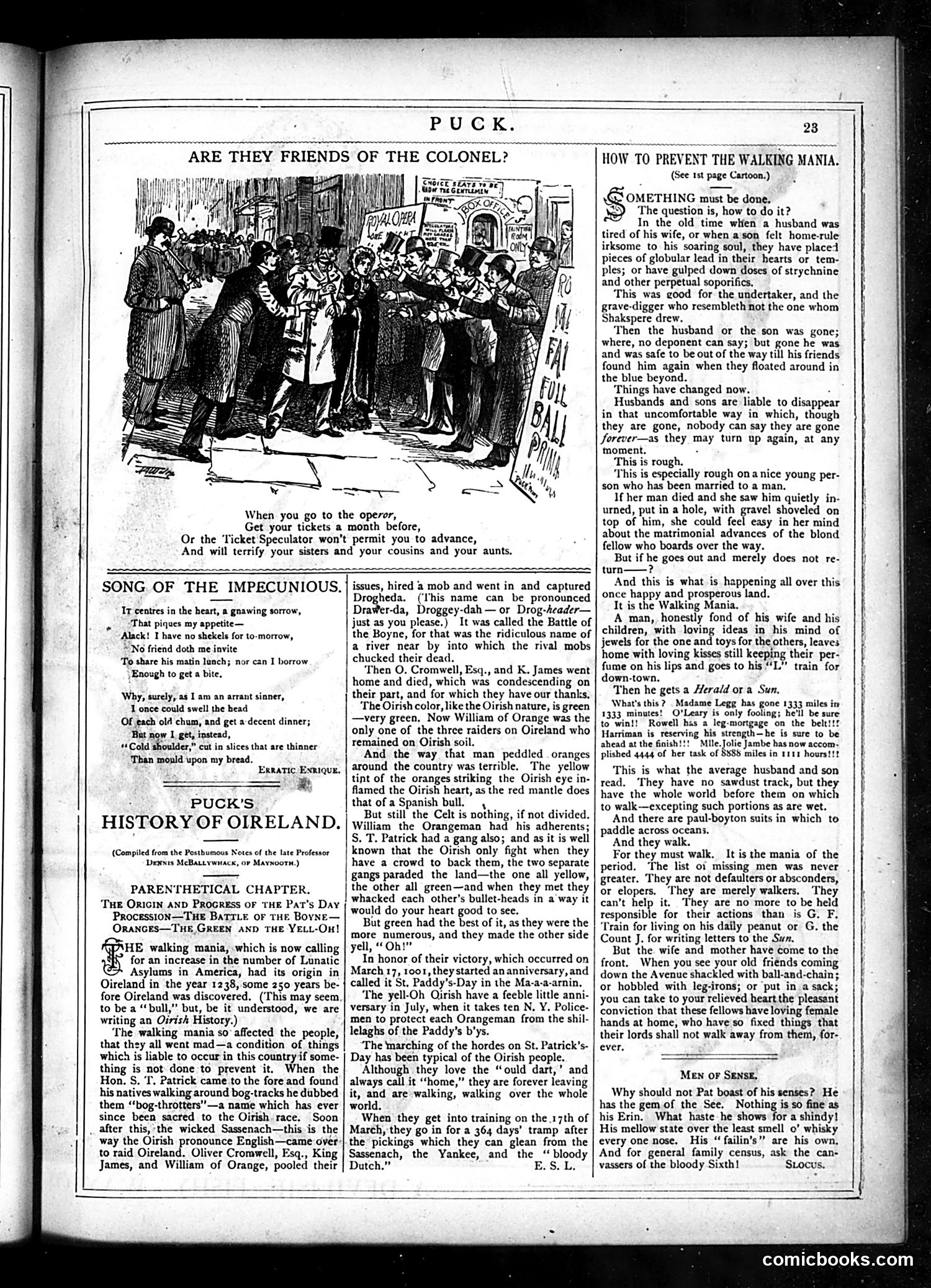
The main cartoon "Are They Friends of the Colonel?" depicts a crowded street scene with what appears to be political or military figures being questioned about their allegiance to "the Colonel"—likely a reference to Colonel Sellers or a similar public figure of the era. The page also contains "Song of the Impecunious" (a humorous poem about financial hardship) and "Puck's History of Oireland," which satirizes Irish immigration and the Irish-American community through exaggerated dialect and stereotypes common to 19th-century American humor. The right column includes "How to Prevent the Walking Mania," addressing a period concern about men abandoning their families. Without clearer identification of the specific Colonel referenced, the precise political target remains unclear, though the satire targets military/political authority and social behavior.
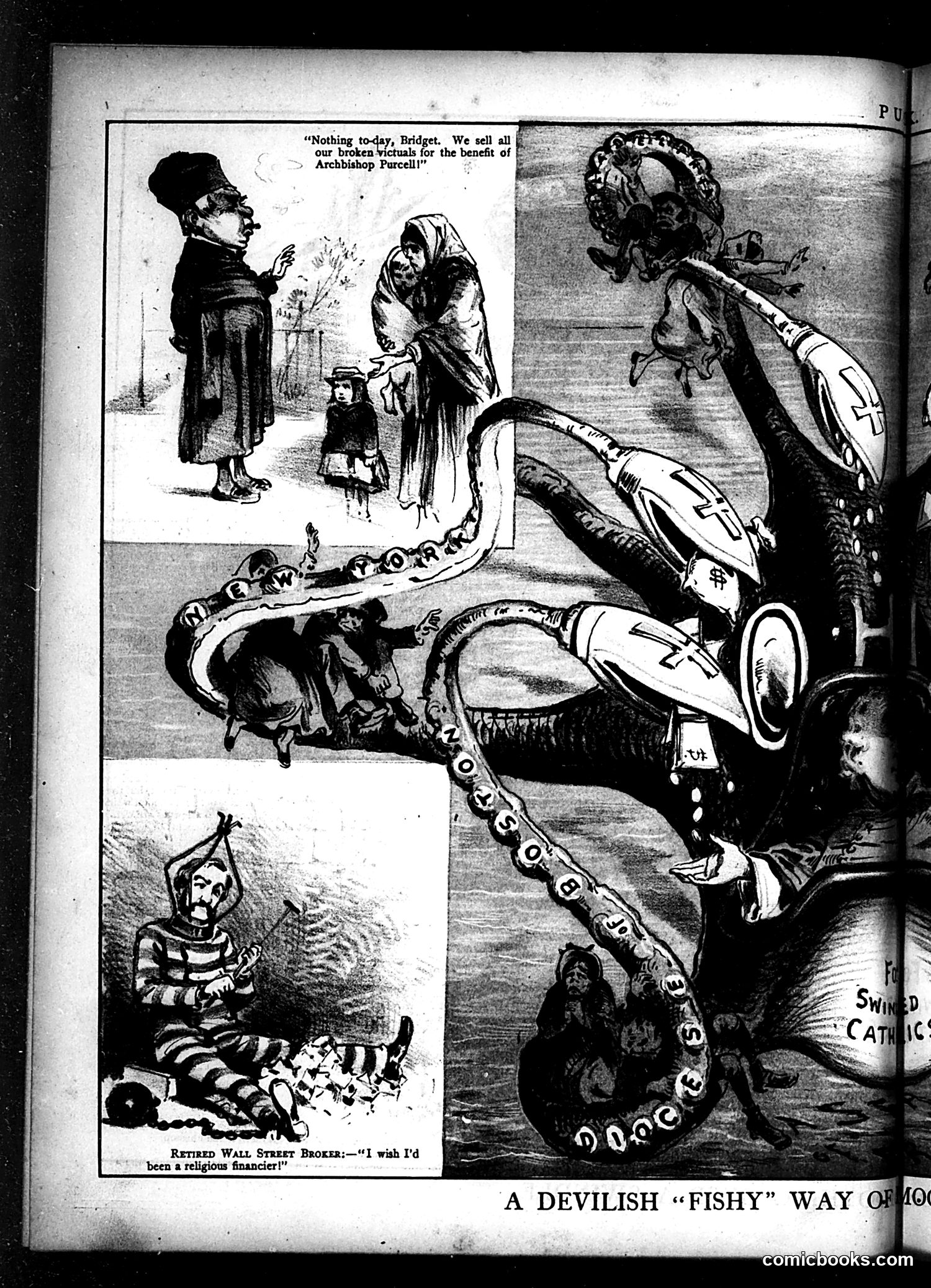
This page contains political satire attacking Catholic institutions and leadership during a period of anti-Catholic sentiment in American media. The **top cartoon** depicts a woman and child, with dialogue about selling "broken virtuals" for Archbishop Purcell's benefit—likely referencing financial scandal involving Archbishop John Purcell of Cincinnati, whose mismanagement caused major losses in the 1870s. The **bottom cartoon**, titled "A Devilish 'Fishy' Way of Loot," shows a grotesque figure manipulating chains of victims labeled with dollar signs, suggesting predatory financial exploitation by Catholic institutions. The **left panel** captioned "Retired Wall Street Broker" mocks converting to Catholicism for financial gain. The satire conflates religious authority with financial corruption and fraud, reflecting widespread 19th-century American Protestant suspicion of Catholic wealth and institutional power.
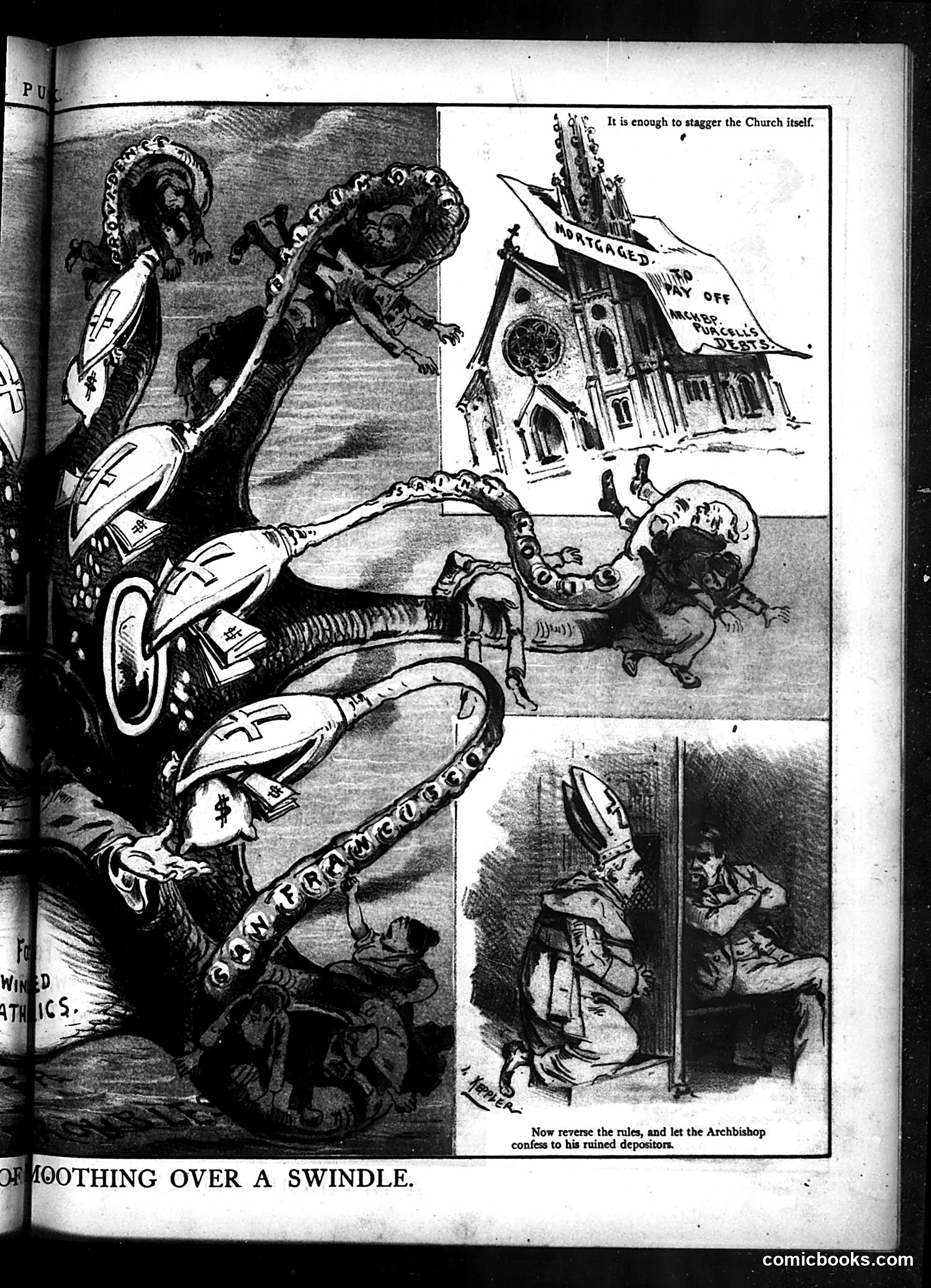
This political cartoon satirizes what appears to be financial or property fraud involving the Church. The left panel shows religious figures (identifiable by crosses on their vestments) entangled with chains labeled "Mortgaged," suggesting the Church's financial troubles or debt. The upper right panel depicts a damaged church building with similar labels, captioned "It is enough to stagger the Church itself." The bottom right panels show what appears to be an Archbishop or high church official in compromising positions, with text reading "Now reverse the rules, and let the Archbishop confess to his ruined depositors." The overall message criticizes church leadership for mishandling funds or engaging in financial misconduct while maintaining their authority. The title suggests covering up or minimizing ("soothing") what is essentially a "swindle"—fraud involving church finances and depositors' trust.
This page contains a satirical illustration titled "COLLEGE DISCIPLINE" showing what appears to be a college president or authority figure scolding a student. The accompanying text criticizes student conduct and institutional discipline. The main content addresses practical urban issues: proposals for Broadway horse-car railways, Aldermen rejecting the Puck transit proposal in favor of competing plans, and various theatrical and entertainment notices. The satirical thrust criticizes both student misbehavior and competing transit proposals in New York City. The illustration mocks formal institutional authority, while the text lampoons multiple proposals for improving urban transportation—each backed by different business interests and politicians claiming superiority. The page reflects late-19th-century urban governance debates about infrastructure development and institutional control.
This is a satirical story (not a cartoon) about wine connoisseurship and social pretension. The narrative involves a character named Charles, apparently a waiter or sommelier, and M. Peyrade, who debates the merits of different wines—specifically red, yellow, and green seal wines. The satire mocks wealthy gentlemen who claim expertise in wine while actually knowing little about it. Characters use elaborate language to discuss wines they cannot genuinely distinguish, with the story suggesting that much of their sophisticated judgment is mere pretense and social posturing. The humor derives from exposing the gap between claimed connoisseurship and actual knowledge among the upper classes, a common Puck theme targeting pomposity and affected taste.
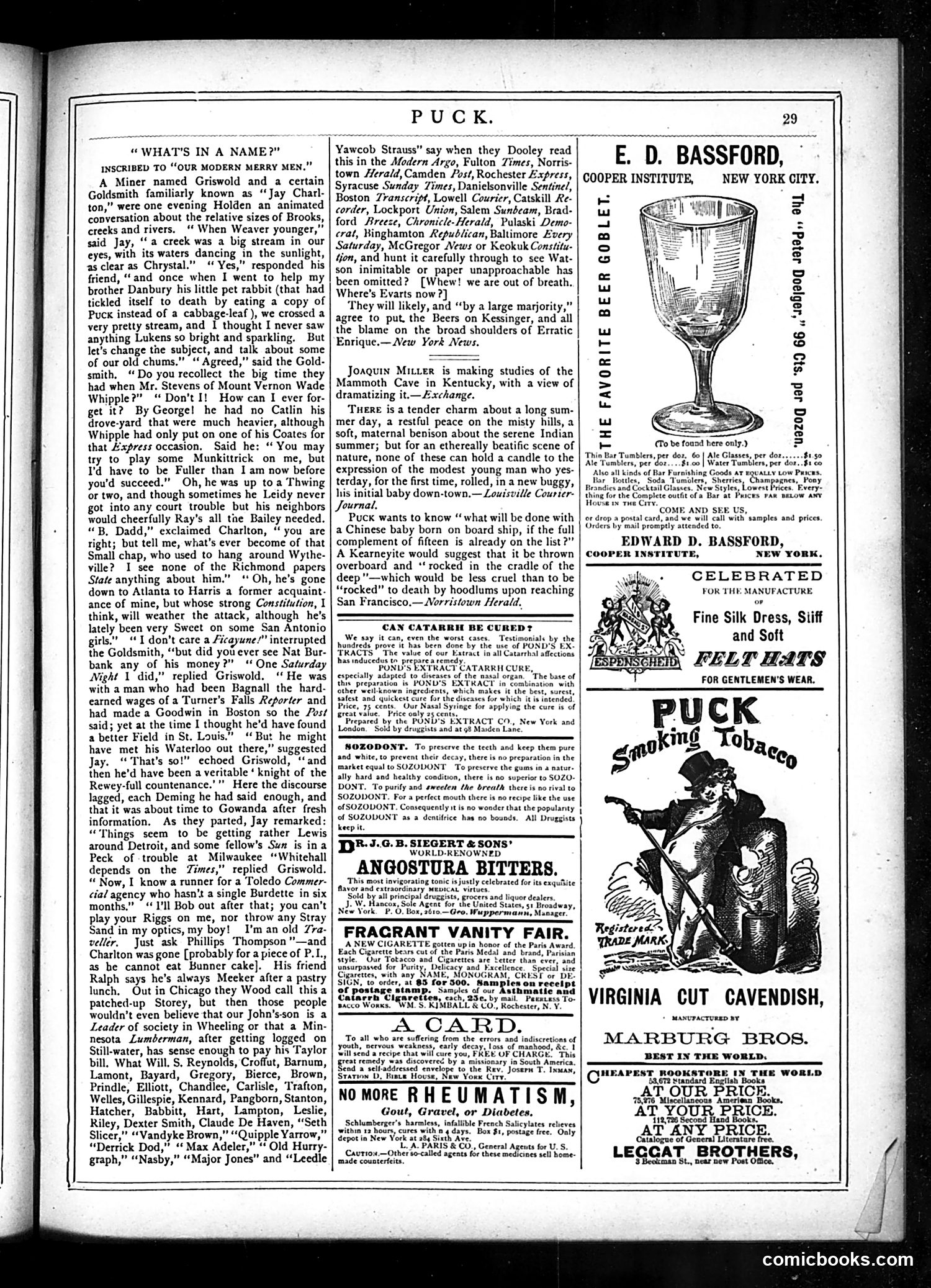
This page is primarily **advertisements and notices** rather than political satire or editorial cartoons. The main content includes ads for: - E.D. Bassford's glassware and drinkware (Cooper Institute, NYC) - Felt hats for gentlemen's wear - Puck Smoking Tobacco - Angostura Bitters - Fragrant Vanity Fair cigarettes - Virginia Cut Cavendish tobacco by Marburg Bros. - Patent medicines (Sozodont toothpaste, rheumatism cure) - Leggate Brothers bookstore The left column contains "What's in a Name?" — anecdotal humor pieces about notable people and local incidents, typical of Puck's miscellaneous content. There's no significant political cartoon or satire visible on this page; it represents the magazine's standard advertising-heavy layout.
This page is **primarily advertising**, not editorial content. It contains commercial advertisements for late 19th-century goods and services: Atwood's Jaundice Bitters (patent medicine), photographer services, furniture, clothing, parasols, umbrellas, billiard tables, dental work, and cigarettes. The only non-advertising content is a brief "In Memoriam Brigham Young" notice referencing the Mormon leader's death, asking readers to purchase a Puck cartoon about him from the office. The page demonstrates how Puck magazine was funded—the advertisements subsidized satirical content. There are no political cartoons visible on this particular page; it's essentially a classified ads section with one obituary notice.
This page is primarily **advertising** rather than editorial content or political cartoons. The advertisements occupy most of the space and include: - Patent covers for filing "Puck" magazines - Hungarian wines (D.A. Mayer) - Champagne brands (Ayala-Château d'Ay, L. de Venoge) - Paris clocks and watches (Hamann & Koch) - A restaurant (C. Pfaff's) - Two lottery advertisements (Louisiana State Lottery and Royal Havana Lottery) The only substantive content appears to be a small illustration showing what appears to be a street scene or storefront in the upper right, but the image quality and size make specific identification difficult. This is a back-of-magazine advertisement section typical of 19th-century periodicals, not satirical editorial content.
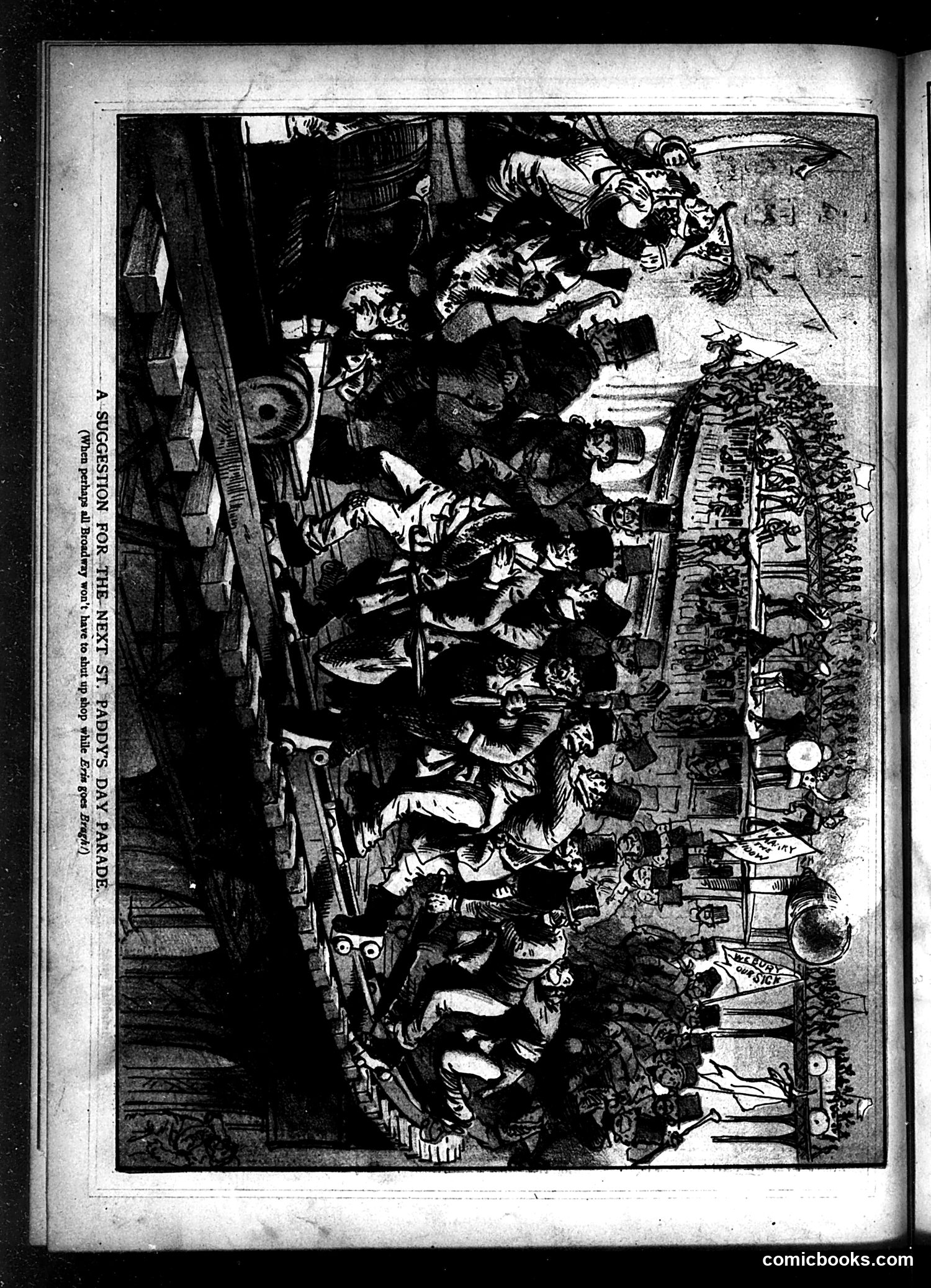
This appears to be a satirical illustration from Puck magazine depicting "A Suggestion for the Next St. Paddy's Day Parade" (based on the visible text on the left margin). The cartoon shows a crowded, chaotic street scene rendered in detailed cross-hatching. It depicts what seems to be a satirical commentary on Irish-American St. Patrick's Day celebrations, likely critiquing the parade's disorder, drunkenness, or rowdiness—common themes in late 19th/early 20th-century American satire about Irish immigrants and their cultural observances. The intricate linework captures numerous figures in a densely packed urban setting with buildings visible on the right side. Without clearer text visibility, the specific satirical target remains somewhat unclear, but the scene appears to mock aspects of how St. Patrick's Day was celebrated in American cities during this period.