
Puck, 1879-03-19 · page 4 of 16
Puck — March 19, 1879 — page 4: what you’re looking at
What you’re looking at
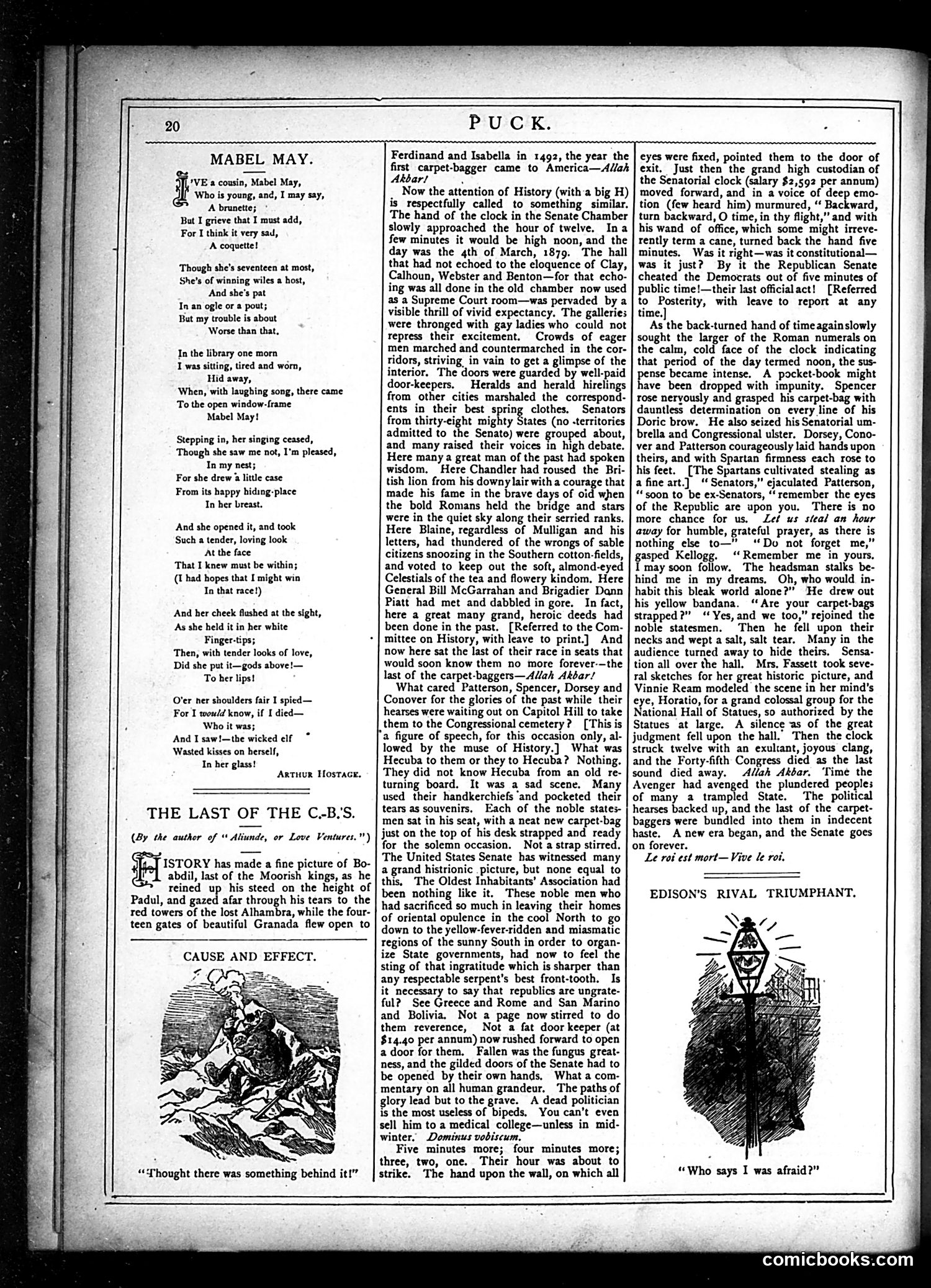
This page contains three distinct pieces: 1. **"Mabel May"** (poem by Arthur Hostage): A sentimental love poem with no political content. 2. **"The Last of the C.B.S."** (by the author of *Atlantis*): A prose piece about Hernán Cortés gazing at Granada. The accompanying illustration labeled "Thought there was something behind it" shows a reclining figure—likely satirizing historical nostalgia or Spanish imperial decline. 3. **"Edison's Rival Triumphant"**: A cartoon captioned "Who says I was afraid?" showing a figure with a lightbulb-head, apparently mocking competition in electrical innovation during the late 19th-century "War of Currents" between Edison and Tesla/Westinghouse. The page blends literary content with political and technological satire typical of Puck's miscellaneous format.
📄 Transcribed text from this page (OCR, searchable)
Machine-transcribed from the original scan — historical spelling and the odd misread are preserved.
PUCK. MABEL MAY. ‘VE a cousin, Mabel May, Who is young, and, I may say, A brunette; * But I grieve that I must add, For I think it very sad, A coquette! Though she’s seventeen at most, She's of winning wiles a host, ‘And she's pat In an ogle or a pout; But my trouble is about Worse than that, In the library one morn I was sitting, tired and worn, Hid away, When, with laughing song, there came To the open window-frame Mabel May! Stepping in, her singing ceased, Though she saw me not, I'm pleased, In my nests For she drew 4 little case From its happy hiding-place In her breast. ‘And she opened it, and took Such a tender, loving look At the face That I knew must be within; (Thad hopes that I might win In that race!) And her cheek flushed at the sight, ‘As she held it in her white Finger-tips; Then, with tender looks of love, Did she put it—gods above!— To her lips! er ner shoulders fair I spied— For I would know, if I died— Who it was; And I saw!—the wicked elf Wasted kisses on herself, In her glass! ArTuur Hostack. THE LAST OF THE C.-B,'S. (By the author of “ Aliunde, or Love Ventures.”) ISTORY has made a fine picture of Bo- abdil, last of the Moorish kings, as he reined up his steed on the height of Padul, and gazed afar through his tears to the red towers of the lost Alhambra, while the four- teen gates of beautiful Granada flew open to CAUSE AND EFFECT. x) “Thought there was something behind it!” Ferdinand and Isabella in 1492, the year the first. carpet-bagger came to America—A//ah Akbar! 5 _ Now the attention of History (witha big H) is respectfully called to something similar. The hand of the clock in the Senate Chamber slowly approached the hour of twelve. Ina few minutes it would be high noon, and the day was the 4th of March, 1879. ‘The hall that had not echoed to the eloquence of Clay, Calhoun, Webster and Benton—for that echo- ing was all done in the old chamber now used as a Supreme Court room—was pervaded by a visible thrill of vivid expectancy, The galleries were thronged with gay ladies who could not repress their excitement. Crowds of eager men marched and countermarched in the cor- tidors, striving in vain to get a glimpse of the interior. The doors were guarded by well-paid door-keepers. Heralds and herald hirelings from other cities marshaled the correspond- ents in their best spring clothes. Senators from thirty-eight mighty Srates (no -territories admitted to the Senate) were grouped about, and many raised their voices in high debate. Here many a great man of the past had spoken wisdom, Here Chandler had roused the Bri- tish lion from his downy lair with a courage that made his fame in the brave days of oid when the bold Romans held the bridge and stars were in the quiet sky along their serried ranks. Here Blaine, regardless of Mulligan and his letters, had thundered of the wrongs of sable citizens snoozing in the Southern cotton-fields, and voted to keep out the soft, almond-eyed Celestials of the tea and flowery kindom. Here General Bill McGarrahan and Brigadier Dann Piatt had met and dabbled in gore. In fact, here a great many grand, heroic deeds had been done in the past. [Referred to the Com- mittee on History, with leave to print.) And now here sat the last of their race in seats that would soon know them no more forever-—the last of the carpet-baggers—Ad/ah Akbar! What cared Patterson, Spencer, Dorsey and Conover for the glories of the past while their hearses were waiting out on Capitol Hill to take them to the Congressional cemetery? [This is a figure of speech, for this occasion only, al- lowed by the muse of History.) What was Hecuba to them or they to Hecuba? Nothing. They did not know Hecuba from an old re- turning board. It was a sad scene. Many used their handkerchiefs ‘and pocketed their tears as souvenirs. Each of the noble states- men sat in his seat, with a neat new carpet-bag just on the top of his desk strapped and ready for the solemn occasion. Not a strap stirred. The United States Senate has witnessed many a grand histrionic picture, but none equal to this, The Oldest Inhabitants’ Association had been nothing like it. These noble men who had sacrificed so much in leaving their homes of oriental opulence in the cool North to go down to the yellow-fever-ridden and miasmatic regions of the sunny South in order to organ- ize State governments, had now to feel the sting of that ingratitude which is sharper than any respectable serpent’s best front-tooth. Is it necessary to say that republics are ungrate- ful? See Greece and Rome and San Marino and Bolivia. Not a page now stirred to do them reverence, Not a fat door keeper (at $14.40 per annum) now rushed forward to open adoor for them. Fallen was the fungus great- ness, and the gilded doors of the Senate had to be opened by their own hands, What a com- mentary on all human grandeur. The paths of glory lead but to the grave. A dead politician is the most useless of bipeds, You can’t even sell him to a medical college—unless in mid- winter. Dominus vobiscum, Five minutes more; four minutes more; three, two, one. Their hour was about to strike. The hand upon the wall, on which all eyes were fixed, pointed them to the door of exit, Just then the grand high custodian of the Senatorial clock (salary $2,592 per annum) moved forward, and in a voice of deep emo- tion (few heard him) murmured, “ Backward, turn backward, O time, in thy flight,” and with his wand of office, which some might irreve- rently term a cane, turned back the hand five minutes. Was it right—was it constitutional— was it just? By it the Republican Senate cheated the Democrats out of five minutes of public time!—their last officialact! [Referred to Posterity, with leave to report at any time.] As the back-turned hand of time againslowly sought the larger of the Roman numerals on the calm, cold face of the clock indicating that period of the day termed noon, the sus- pense became intense. A pocket-book might have been dropped with impunity. Spencer rose neryously and grasped his carpet-bag with dauntless determination on every line of his Doric brow. He also seized his Senatorial um- brella and Congressional ulster. Dorsey, Cono- ver and Patterson courageously laid hands upon theirs, and with Spartan firmness each rose to his feet. [The Spartans cultivated stealing as a fine art.] “Senators,” ejaculated Patterson, “soon to be ex-Senators, “remember the eyes of the Republic are upon you. There is no more chance for us. Let us steal an hour away for humble, grateful prayer, as there is nothing else to—"” ‘Do not forget me,” gasped Kellogg. ‘Remember me in yours. I may soon follow. The headsman stalks be- hind me in my dreams. Oh, who would in- habit this bleak world alone?” ‘He drew out his yellow bandana. ‘Are your carpet-bags strapped?” “Yes, and we too,” rejoined the noble statesmen. Then he fell upon their necks and wept a salt, salt tear. Many in the audience turned away to hide theirs. Sensa- tion all over the hall, Mrs, Fassett took seve- ral sketches for her great historic picture, and Vinnie Ream modeled the scene in her mind's eye, Horatio, for a grand colossal group for the National Hall of Statues, so authorized by the Statues at large. A silence as of the great judgment fell upon the hall.” Then the clock struck twelve with an exultant, joyous clang, and the Forty-fifth Congress died as the last sound died away. Allah Akbar. ‘Time the Avenger had avenged the plundered peoples of many a trampled State. The political hearses backed up, and the last of the carpet- baggers were bundled into them in indecent haste. A new era began, and the Senate goes on forever. Le roi est mort—Vive le roi. EDISON’S RIVAL TRIUMPHANT. “Who says I was afraid?” comicbooks.com