
Puck, 1879-03-19 · page 6 of 16
Puck — March 19, 1879 — page 6: what you’re looking at
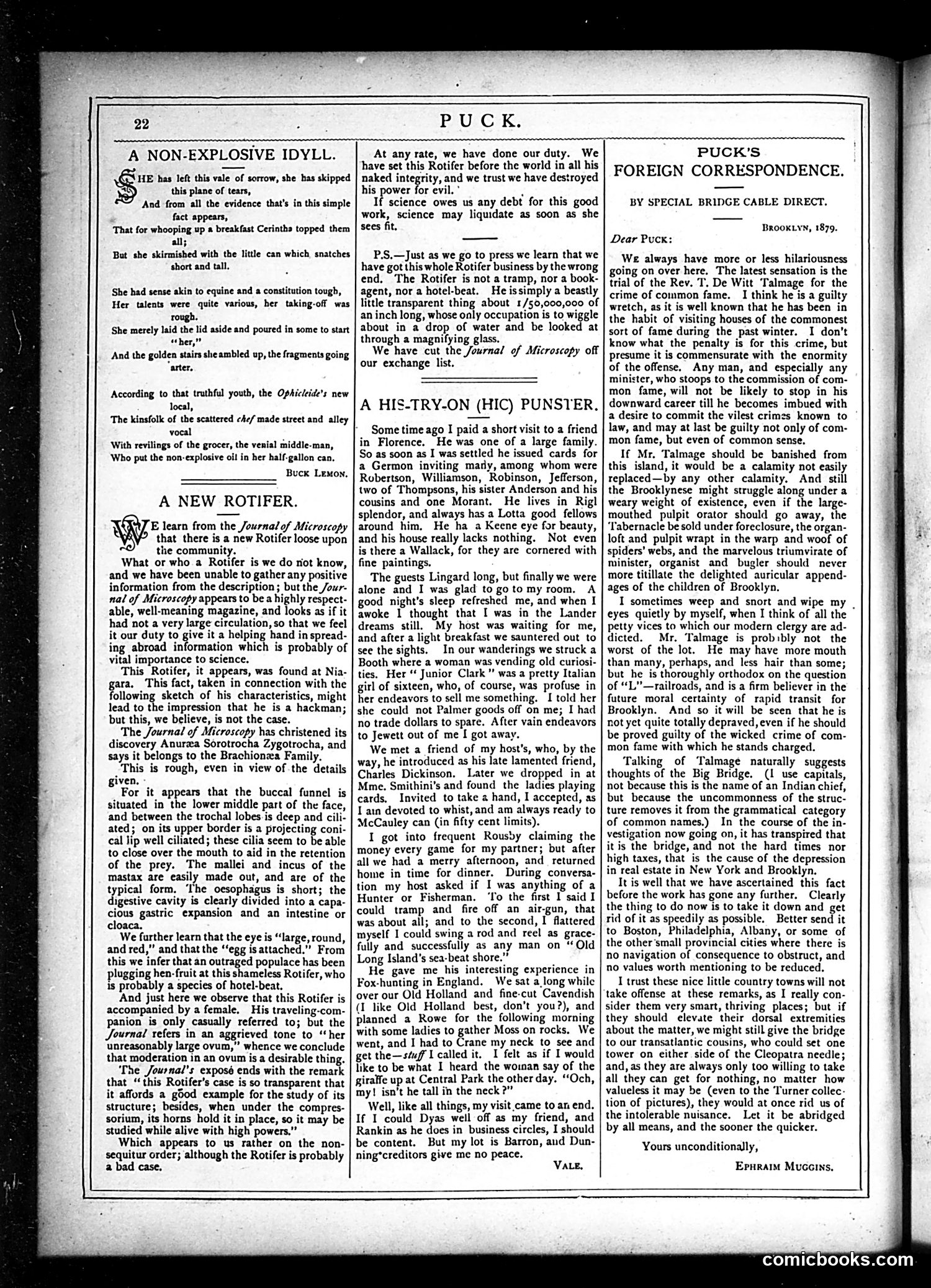
What you’re looking at
This page contains three satirical sections rather than a single cartoon: 1. **"A Non-Explosive Idyll"** - A poem mocking a woman who abandoned her domestic role, leaving "whooping up a breakfast Caribee" and general household chaos. The satire targets women neglecting traditional domestic duties. 2. **"A His-Try-On (HIC) Punster"** - A humorous travel narrative about visiting Florence, filled with puns and wordplay (typical of Puck's style). It's social commentary disguised as entertainment. 3. **"Puck's Foreign Correspondence"** - A letter from Brooklyn criticizing Reverend Talmage for visiting poor neighborhoods and worsening conditions through publicity. The writer (Ephraim Muggins) argues his interventions actually harm the communities he claims to help. The page exemplifies Puck's mix of domestic satire, humor, and social critique of contemporary figures and reform efforts.
📄 Transcribed text from this page (OCR, searchable)
Machine-transcribed from the original scan — historical spelling and the odd misread are preserved.
A NON-EXPLOSIVE IDYLL. HE has left this vale of sorrow, she has skipped . this plane of tears, ‘And from all the evidence that’s in this simple fact appears, ‘That for whooping up a breakfast Cerintha topped them all; But she skirmished with the little can which, snatches short and tall. She had sense akin to equine and a constitution tough, Her talents were quite various, her taking-off was rough. ‘She merely laid the lid aside and poured in some to start ther,” And the golden stairs sheambled up, the fragments going arter, According to that truthful youth, the Ophicieide's new local, ‘The kinsfolk of the scattered chef made street and alley vocal ‘With revilings of the grocer, the venial middle-man, ‘Who put the non-explosive oil in her half-gallon can, Buck Lemon, A NEW ROTIFER. E learn from the Journal of Microscopy that there is a new Rotifer loose upon the community. What or who a Rotifer is we do not know, and we have been unable to gather any positive information from the description; but the Jour- nal of Microscopy appears to be a highly respect- able, well-meaning magazine, and looks as if it had not a very large circulation, so that we feel it our duty to give it a helping hand in spread- ing abroad information which is probably of vital importance to science. This Rotifer, it appears, was found at Nia- gara. This fact, taken in connection with the following sketch of his characteristics, might lead to the impression that he is a hackman; but this, we believe, is not the case. The Journal of Microscopy has christened its discovery Anurza Sorotrocha Zygotrocha, and says it belongs to the Brachionza Family, This is rough, even in view of the details given. For it appears that the buccal funnel is situated in the lower middle part of the face, and between the trochal lobes:is deep and cili- ated; on its upper border is a projecting coni- cal lip well ciliated; these cilia seem to be able to close over the mouth to aid in the retention of the prey. The mallei and incus of the mastax are easily made out, and are of the typical form. ‘he oesophagus is short; the digestive cavity is clearly divided into a capa- cious gastric expansion and an intestine or cloaca. We further learn that the eye is “large, round, and red,” and that the ‘‘egg is attached.” From this we infer that an outraged populace has been plugging hen-fruit at this shancless Rotifer, who is probably a species of hotel-beat. And just here we observe that this Rotifer is accompanied by a female. His traveling-com- panion is only casually referred to; but the Journal refers in an aggrieved tone to “her unreasonably large ovum,” whence we conclude that moderation in an ovum is a desirable thing. ‘The Journal's exposé ends with the remark that “this Rotifer’s case is so transparent that it affords a good example for the study of its structure; besides, when under the compres- sorium, its horns hold it in place, so it may be studied while alive with high powers.”” Which appears to us rather on the non- sequitur order; although the Rotifer is probably a bad case, At any rate, we have done our duty. We have set this Rotifer before the world in all his naked integrity, and we trust we have destroyed his power for evil. ° ‘i If science owes us any debt for this good work, science may liquidate as soon as she sees fit, P.S.—Just as we go to press we learn that we have got ihis whole Rotifer business by the wrong end. The Rotifer is not a tramp, nor a book- agent, nor a hotel-beat. He issimply a beastly little transparent thing about 1/50,000,000 of an inch long, whose only occupation is to wiggle about in a drop of water and be looked at through a magnifying glass. We have cut the Journal of Microscopy off our exchange list. A HIS-TRY-ON (HIC) PUNSTER. Some time ago I paid a short visit to a friend in Florence. He was one of a large family. So as soon as I was settled he issued cards for a Germon inviting many, among whom were Robertson, Williamson, Robinson, Jefferson, two of Thompsons, his sister Anderson and his cousins and one Morant. He lives in Rigl splendor, and always has a Lotta good fellows around him. He ha a Keene eye for beauty, and his house really lacks nothing. Not even is there a Wallack, for they are cornered with fine paintings. The guests Lingard long, but finally we were alone and I was glad to goto my room. A good night's sleep refreshed me, and when I awoke 1 thought that I was in the Lander dreams still, My host was waiting for me, and after a light breakfast we sauntered out to see the sights. In our wanderings we struck a Booth where a woman was vending old curiosi- ties. Her “ Junior Clark” was a pretty Italian girl of sixteen, who, of course, was profuse in her endeavors to sell me something. I told her she could not Palmer goods off on me; I had no trade dollars to spare. After vain endeavors to Jewett out of me I got away. We met a friend of my host's, who, by the way, he introduced as his late lamented friend, Chatles Dickinson. Later we dropped in at Mme. Smithini’s and found the ladies playing cards, Invited to take a hand, I accepted, as I ain devoted to whist, and am always ready to McCauley can (in fifty cent limits). I got into frequent Rousdy claiming the money every game for my partner; but after all we had a merry afternoon, and returned home in time for dinner. During conversa- tion my host asked if I was anything of a Hunter or Fisherman. ‘lo the first I said I could tramp and fire off an air-gun, that was about all; and to the second, I flattered myself I could swing a rod and reel as grace- fully and successfully as any man on “Old Long Island’s sea-beat shore.” He gave me his interesting experience in Fox-hunting in England. We sat along while over our Old Holland and fine-cut Cavendish (I like Old Holland best, don’t you?), and planned a Rowe for the following morning with some ladies to gather Moss on rocks. We went, and I had to Crane my neck to see and get the—s/uff I called it. I felt as if 1 would like to be what I heard the wonan say of the giraffe up at Central Park the other day. “Och, my! isn’t he tall in the neck ?” Well, like all things, my visit came to an end. If I could Dyas well off as my friend, and Rankin as he does in business circles, I should be content. But my lot is Barron, aud Dun- ning*creditors give me no peace. VaLe. PUCK’S FOREIGN CORRESPONDENCE. BY SPECIAL BRIDGE CABLE DIRECT. BROOKLYN, 1879. Dear Puck: We always have more or less hilariousness going on over here. The latest sensation is the trial of the Rev. T, De Witt Talmage for the crime of common fame. I think he is a guilty wretch, as it is well known that he has been in the habit of visiting houses of the commonest sort of fame during the past winter. I don’t know what the penalty is for this crime, but presume it is commensurate with the enormity of the offense. Any man, and especially any minister, who stoops to the commission of com- mon fame, will not be likely to stop in his downward career till he becomes imbued with a desire to commit the vilest crimes known to law, and may at last be guilty not only of com- mon fame, but even of common sense. If Mr. Talmage should be banished from this island, it would be a calamity not easily replaced—by any other calamity. And still the Brooklynese might struggle along under a weary weight of existence, even if the large- mouthed pulpit orator should go away, the ‘Tabernacle be sold under foreclosure, the organ- loft and pulpit wrapt in the warp and woof of spiders’ webs, and the marvelous triumvirate of minister, organist and bugler should never more titillate the delighted auricular append- ages of the children of Brooklyn. I sometimes weep and snort and wipe my . eyes quietly by myself, when I think of all the petty vices to which our modern clergy are ad- dicted. Mr. ‘Talmage is probibly not the worst of the lot. He may have more mouth than many, perhaps, and less hair than some; but he is thoroughly orthodox on the question of “L"—railroads, and is a firm believer in the future moral certainty of rapid transit for Brooklyn. And so it will be seen that he is not yet quite totally depraved, even if he should be proved guilty of the wicked crime of com- mon fame with which he stands charged. Talking of ‘Talmage naturally suggests thoughts of the Big Bridge. (1 use capitals, not because this is the name of an Indian chief, but because the uncommonness of the struc- ture removes it from the grammatical category of common names.) In the course of the in- vestigation now going on, it has transpired that it is the bridge, and not the hard times nor high taxes, that is the cause of the depression in real estate in New York and Brooklyn. It is well that we have ascertained this fact before the work has gone any further. Clearly the thing to do now is to take it down and get rid of it as speedily as possible. Better send it to Boston, Philadelphia, Albany, or some of the other’small provincial cities where there is no navigation of consequence to obstruct, and no values worth mentioning to be reduced, I trust these nice little country towns will not take offense at these remarks, as I really con- sider them very smart, thriving places; but if they should elevate their dorsal extrem’ about the matter, we might still give the bridge to our transatlantic cousins, who could set one tower on either side of the Cleopatra needle; and, as they are always only too willing to take all they can get for nothing, no matter how valueless it may be (even to the Turner collec- tion of pictures), they would at once rid us of the intolerable nuisance. Let it be abridged by all means, and the sooner the quicker. Yours unconditionally, Epuraim Mucoins, comicbooks.com