
Puck, 1879-03-19 · page 11 of 16
Puck — March 19, 1879 — page 11: what you’re looking at
What you’re looking at
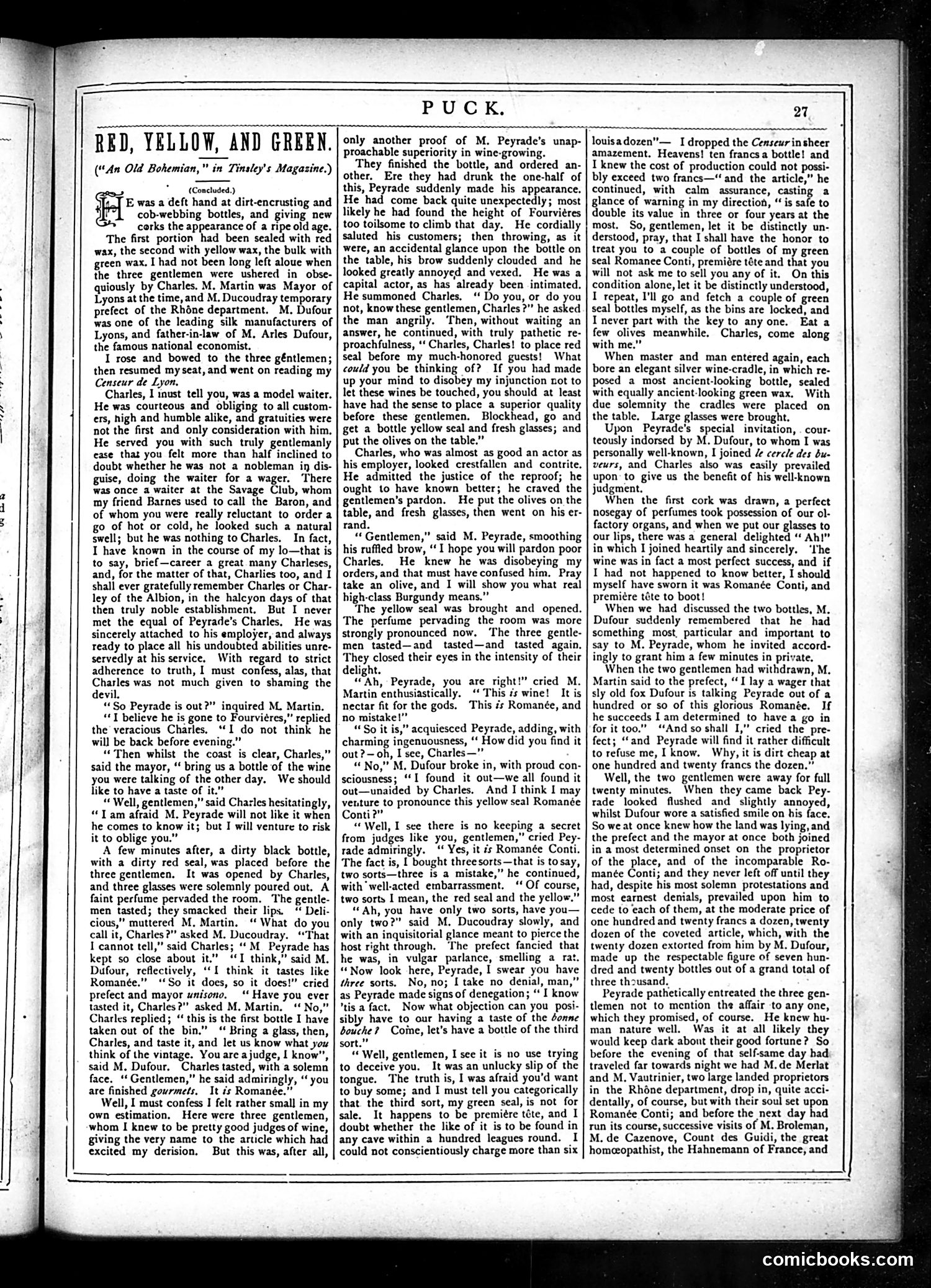
This is a satirical story (not a cartoon) about wine connoisseurship and social pretension. The narrative involves a character named Charles, apparently a waiter or sommelier, and M. Peyrade, who debates the merits of different wines—specifically red, yellow, and green seal wines. The satire mocks wealthy gentlemen who claim expertise in wine while actually knowing little about it. Characters use elaborate language to discuss wines they cannot genuinely distinguish, with the story suggesting that much of their sophisticated judgment is mere pretense and social posturing. The humor derives from exposing the gap between claimed connoisseurship and actual knowledge among the upper classes, a common Puck theme targeting pomposity and affected taste.
📄 Transcribed text from this page (OCR, searchable)
Machine-transcribed from the original scan — historical spelling and the odd misread are preserved.
PUCK. 27 RED, YELLOW, AND GREEN. (“An Old Bohemian, in Tinsley's Magazine.) * (Concluded.) 4] E was a deft hand at dirt-encrusting and | cob-webbing bottles, and giving new corks the appearance of a ripe old age. The first portion had been sealed with red wax, the second with yellow wax, the bulk with green wax. I had not been long left aloue when the three gentlemen were ushered in obse- quiously by Charles. M. Martin was Mayor of Lyons at the time, and M. Ducoudray temporary prefect of the Rhéne department. M. Dufour was one of the leading silk manufacturers of Lyons, and father-in-law of M. Arles Dufour, the famous national economist. I rose and bowed to the three géntlemen; then resumed my seat, and went on reading my Censeur de Lyon, Charles, I inust tell you, was a model waiter. He was courteous and obliging to all custom- ers, high and humble alike, and gratuities were not the first and only consideration with him, He served you with such truly gentlemanly ease that you felt more than half inclined to doubt whether he was not a nobleman in dis- guise, doing the waiter for a wager. There was once a waiter at the Savage Club, whom my friend Barnes used to call the Baron, and of whom you were really reluctant to order a go of hot or cold, he looked such a natural swell; but he was nothing to Charles. In fact, I have known in the course of my lo—that is to say, brief—career a great many Charleses, and, for the matter of that, Charlies too, and I shall ever gratefully remember Charles or Char- ley of the Albion, in the halcyon days of that then truly noble establishment, But I never met the equal of Peyrade’s Charles. He was sincerely attached to his employer, and always ready to place all his undoubted abilities unre- servedly at his service. With regard to strict adherence to truth, I must confess, alas, that Charles was not much given to shaming the devil. “So Peyrade is out?” inquired M. Martin. “«T believe he is gone to Fourvi¢res,” replied the veracious Charles, “1 do not think he will be back before evening.” “Then whilst the coast is clear, Charles,” said the mayor, “ bring us a bottle of the wine you were talking of the other day. We should like to have a taste of it.” “ Well, gentlemen,” said Chazles hesitatingly, “Tam afraid M. Peyrade will not like it when he comes to know it; but I will venture to risk it to oblige you.” A few minutes after, a dirty black bottle, with a dirty red seal, was placed before the three gentlemen. It was opened by Charles, and three glasses were solemnly poured out. A faint perfume pervaded the room. The gentle- men tasted; they smacked their lips. “ Deli- cious,” muttered M, Martin. “ What do you call it, Charles?” asked M. Ducoudray. ‘That I cannot tell,” said Charles; ‘‘ M_ Peyrade has kept so close about it.” ‘I think,” said M. Dufour, reflectively, ‘(1 think it tastes like Romanée,.” ‘So it does, so it does!” cried prefect and mayor unisono. ‘‘ Have you ever tasted it, Charles?” asked M. Martin. ‘ No,” Charles replied; “ this is the first bottle I have taken out of the bin.” “ Bring a glass, then, Charles, and taste it, and let us know what you think of the vintage. You are ajudge, | know”, said M. Dufour. Charles tasted, with a solemn face. “Gentlemen,” he said admiringly, “ you are finished gourmets. It is Romanée.” Well, I must confess I felt rather smal] in my own estimation. Here were three gentlemen, whom I knew to be pretty good judges of wine, giving the very name to the article which had excited my derision. But this was, after all, only another proof of M. Peyrade’s unap- proachable superiority in wine-growing. They finished the bottle, and ordered an- other. Ere they had drunk the one-half of this, Peyrade suddenly made his appearance. He had come back quite unexpectedly; most likely he had found the height of Fourviéres too toilsome to climb that day. He cordially saluted his customers; then throwing, as it were, an accidental glance upon the bottle on the table, his brow suddenly clouded and he looked greatly annoyed and vexed. He was a capital actor, as has already been intimated. He summoned Charles. “Do you, or do you not, know these gentlemen, Charles?” he asked the man angrily. ‘Then, without waiting an answer, he continued, with truly pathetic re- proachfulness, *‘ Charles, Charles! to place red seal before my much-honored guests! What could you be thinking of? If you had made up your mind to disobey my injunction not to let these wines be touched, you should at least have had the sense to place a superior quality before these gentlemen. Blockhead, go and get a bottle yellow seal and fresh glasses; and put the olives on the table.” Charles, who was almost as good an actor as his employer, looked crestfallen and contrite. He admitted the justice of the reproof; he ought to have known better; he craved the gentlemen's pardon. He put the olives on the table, and fresh glasses, then went on his er- rand. “Gentlemen,” said M. Peyrade, smoothing his ruffled brow, “1 hope you will pardon poor Charles, He knew he was disobeying my orders, and that must have confused him. Pray take an olive, and I will show you what real high-class Burgundy means.” The yellow seal was brought and opened. The perfume pervading the room was more strongly pronounced now. ‘he three gentle- men tasted—and tasted—and tasted again. They closed their eyes in the intensity of their delight. “Ah, Peyrade, you are right!” cried M. Martin enthusiastically. ‘‘ This és wine! It is nectar fit for the gods. This #s Romanée, and no mistake!” “So it is,” acquiesced Peyrade, adding, with charming ingenuousness, ‘‘ How did you find it out ?—oh, I see, Charles—”” “No,” M. Dufour broke in, with proud con- sciousness; “I found it out—we all found it out—unaided by Charles. And I think I may venture to pronounce this yellow seal Romanée Conti?” “Well, I see there is no keeping a secret from judges like you, gentlemen,” cried Pey- rade admiringly. ‘‘ Yes, it s Romanée Conti. The fact is, 1 bought threesorts—that is tosay, two sorts—three is a mistake,” he continued, with well-acted embarrassment. ‘ Of course, two sorts I mean, the red seal and the yellow.” “Ah, you have only two sorts, have you— only two?” said M, Ducoudray slowly, and with an inquisitorial glance meant to pierce the host right through. he prefect fancied that he was, in vulgar parlance, smelling a rat. “Now look here, Peyrade, I swear you have three sorts, No, no; I take no denial, man,” as Peyrade made signs of denegation; “I know ‘tis a fact. Now what objection can you posi- sibly have to our having a taste of the donne bouche? Coine, let’s have a bottle of the third sort.”” “Well, gentlemen, I see it is no use trying to deceive you. It was an unlucky slip of the tongue. The truth is, I was afraid you'd want to buy some; and I must tell you categorically that. the third sort, my green seal, is not for sale. It happens to be premiere téte, and I doubt whether the like of it is to be found in any cave within a hundred leagues round. I could not conscientiously charge more than six louisadozen"— I dropped the Censeur in sheer amazement. Heavens! ten francs a bottle! and I knew the cost of production could not possi- bly exceed two francs—“ and the article,” he continued, with calm assurance, casting a glance of warning in my direction, “ is safe to double its value in three or four years at the most. So, gentlemen, let it be distinctly un- derstood, pray, that I shall have the honor to treat you to a couple of bottles of my green seal Romanee Conti, premiére téte and that you will not ask me to sell you any of it. On this condition alone, let it be distinctly understood, I repeat, I'll go and fetch a couple of green seal bottles myself, as the bins are locked, and I never part with the key to any one. Eat a few olives meanwhile, Charles, come along with me.” When master and man entered again, each bore an elegant silver wine-cradle, in which re- posed a most ancient-looking bottle, sealed with equally ancient-looking green wax. With due solemnity the cradles were placed on the table. Large glasses were brought, Upon Peyrade's special invitation, . cour- teously indorsed by M. Dufour, to whom I was personally well-known, I joined /e cerele des bus veurs, and Charles also was easily prevailed upon’ to give us the benefit of his well-known judgment, When the first cork was drawn, a perfect nosegay of perfumes took possession of our ol- factory organs, and when we put our glasses to our lips, there was a general delighted “ Ahi" in which I joined heartily and sincerely. ‘I'he wine was in fact a most perfect success, and if I had not happened to know better, I should myself have sworn it was Romanée Conti, and premiére téte to boot! When we had discussed the two bottles, M. Dufour suddenly remembered that he had something most, particular and important to say to M. Peyrade, whom he invited accord- ingly to grant him a few minutes in private. When the two gentlemen had withdrawn, M. Martin said to the prefect, “I lay a wager that sly old fox Dufour is talking Peyrade out of a hundred or so of this glorious Romanée. If he succeeds I am determined to havea go in for it too.” “And so shall I,” cried the pre- fect; “and Peyrade will find it rather difficult to refuse me, I know. Why, it is dirt cheap at one hundred and twenty francs the dozen,” Well, the two gentlemen were away for full twenty minutes. When they came back Pey- rade looked flushed and slightly annoyed, whilst Dufour wore a satisfied smile on his face. So we at once knew how the land was lying, and the prefect and the mayor at once both joined in a most determined onset on the proprietor of the place, and of the incomparable Ro- manée Conti; and they never left off until they had, despite his most solemn protestations and most earnest denials, prevailed upon him to cede to each of them, at the moderate price of one hundred and twenty francs a dozen, twenty dozen of the coveted article, which, with the twenty dozen extorted from him by M. Dufour, made up the respectable figure of seven hun- dred and twenty bottles out of a grand total of three thousand, Peyrade pathetically entreated the three gen- tlemen not to mention the affair to any one, which they promised, of course. He knew hu- man nature well. Was it at all likely they would keep dark abont their good fortune? So before the evening of that self-same day had. traveled far towards night we had M.de Merlat and M. Vautrinier, two large landed proprietors in the Rhéne department, drop in, quite acci- dentally, of course, but with their soul set upon Romanée Conti; and before the next day had run its course, successive visits of M. Broleman, M. de Cazenove, Count des Guidi, the great homeeopathist, the Hahnemann of France, and comicbooks:com