
Puck, 1879-03-19 · page 10 of 16
Puck — March 19, 1879 — page 10: what you’re looking at
What you’re looking at
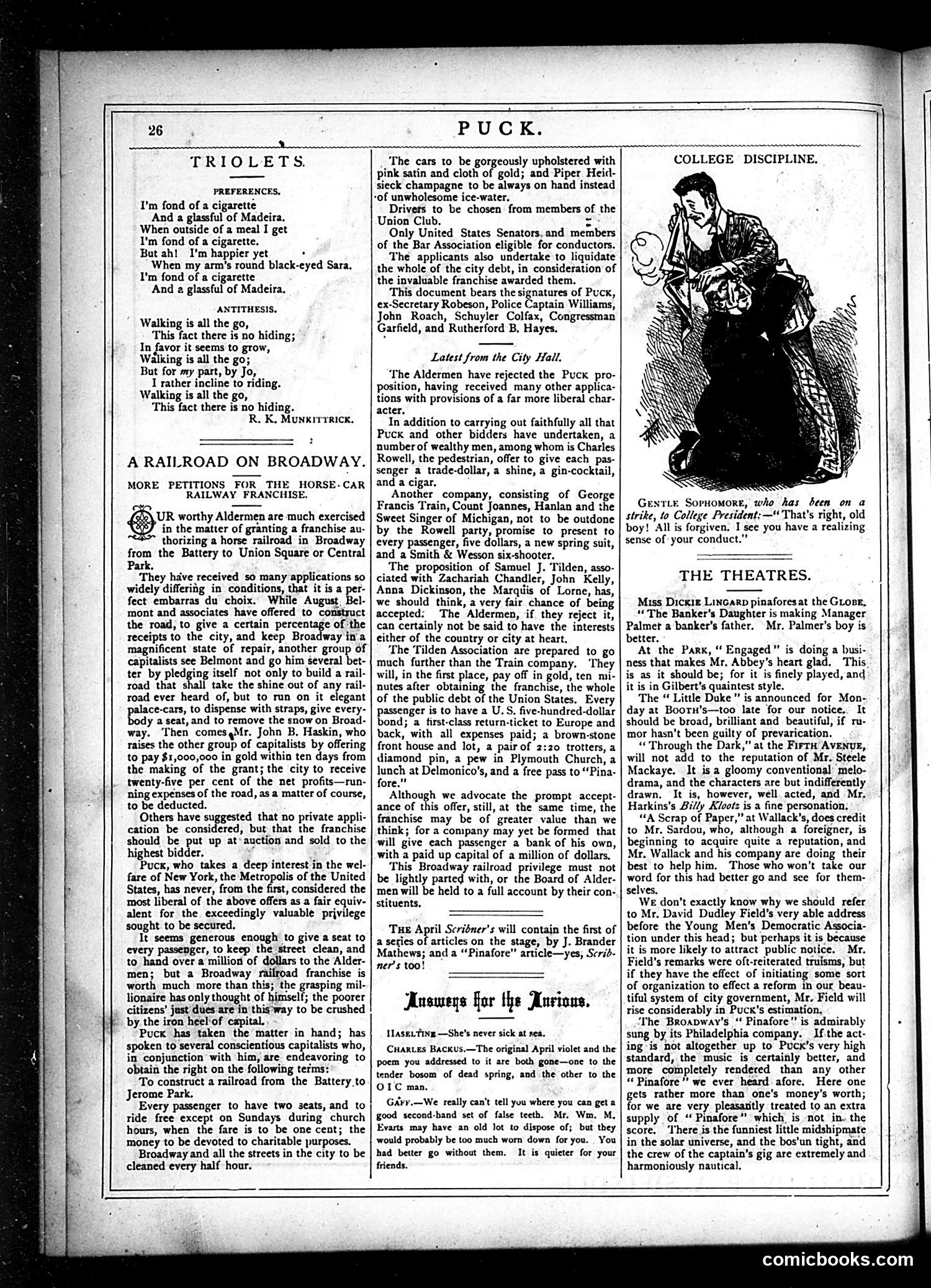
This page contains a satirical illustration titled "COLLEGE DISCIPLINE" showing what appears to be a college president or authority figure scolding a student. The accompanying text criticizes student conduct and institutional discipline. The main content addresses practical urban issues: proposals for Broadway horse-car railways, Aldermen rejecting the Puck transit proposal in favor of competing plans, and various theatrical and entertainment notices. The satirical thrust criticizes both student misbehavior and competing transit proposals in New York City. The illustration mocks formal institutional authority, while the text lampoons multiple proposals for improving urban transportation—each backed by different business interests and politicians claiming superiority. The page reflects late-19th-century urban governance debates about infrastructure development and institutional control.
📄 Transcribed text from this page (OCR, searchable)
Machine-transcribed from the original scan — historical spelling and the odd misread are preserved.
PUCK. ». TRIOLETS. The cars to be gorgeously upholstered with pink satin and cloth of gold; and Piper. Heid- sieck champagne to be always on hand instead I'm fond of a anes -of unwholesome ice-water. ‘And a glassful of Madeira. Gat. be chosen from members of the When outside of a meal I get I'm fond of a cigarette, But ah! I’m happier yet When my arm's round black-eyed Sara. I'm fond of a cigarette And a glassful of Madeira. ANTITHESIS. Walking is all the go, This fact there is no hiding; In favor it seems to grow, Walking is all the go; But for my part, by Jo, I rather incline to riding. Walking is all the go, This fact there is no hiding. R. K. Munxirrrick, A RAILROAD ON BROADWAY. MORE PETITIONS FOR THE HORSE-CAR RAILWAY FRANCHISE. UR worthy Aldermen are much exercised in the matter of granting a franchise au- thorizing a horse railroad in Broadway from the Battery to Union Square or Central ‘They have received so many applications so widely differing in conditions, that it is a per- fect embarras du choix. While August. Bel- mont and associates have offered to construct the road, to give a certain percentage of the receipts to the city, and keep Broadway ina magnificent state of repair, another group of capitalists see Belmont and go him several bet- ter by pledging itself not only to build a rail- road that shall take the shine out of any rail- road ever heard of, but to run on it elegant pence, to dispense with straps, give every- ly a seat, and to remove the snow on Broad- way. Then comesqMr. John B, Haskin, who raises the other group of capitalists by offering to pay $1,000,000 in gold within ten days from the making of the grant; the city to receive twenty-five per cent of the net profits—run- ning expenses of the road, as a matter of course, to be deducted. Others have suggested that no private appli- cation be considered, but that the franchise should be put up at*auction and sold to the highest bidder. Puck, who takes a deep interest in the wel- fare of New York, the Metropolis of the United States, has never, from the first, considered the most liberal of the above offers as a fair equiv- alent for the exceedingly valuable privilege sought to be secured. It seems generous enough to give a seat to every passenger, to keep the street clean, and to hand over a million of dollars to the Alder- men; but a Broadway railroad franchise is worth much more than this; the grasping mil- lionaire has only thought of himself; the poorer citizens’ just dues are in this;way to be crushed by the iron heel'of capital. Puck has taken the matter in hand; has spoken to several conscientious capitalists who, in conjunction with him, are endeavoring to obtain the right on the following terms: To construct a railroad from the Battery to Jerome Park. Every passenger to have two seats, and to tide free except on Sundays during church hours, when the fare is to be one cent; the money to be devoted to charitable purposes. Broadway and all the streets in the city to be cleaned every half hour. Only United States Senators, and members of the Bar Association eligible for conductors. The applicants also undertake to liquidate the whole of the city debt, in consideration of the invaluable franchise awarded them. This document bears the signatures of Puck, ex-Secretary Robeson, Police Captain Williams, John Roach, Schuyler Colfax, Congressman Garfield, and Rutherford B, Hayes. Latest from the City Hall, ‘The Aldermen have rejected the Puck pro- position, having received many other applica- tions with provisions of a far more liberal char- acter. In addition to carrying out faithfully all that Puck and other bidders have undertaken, a number of wealthy men, among whom is Charles Rowell, the pedestrian, offer to give each pas- senger a trade-dollar, a shine, a gin-cocktail, and a cigar, Another company, consisting of George Francis Train, Count Joannes, Hanlan and the Sweet Singer of Michigan, not to be outdone by the Rowell party, promise to present to every passenger, five dollars, a new spring suit, and a Smith & Wesson six-shooter. The proposition of Samuel J. Tilden, asso- ciated with Zachariah Chandler, John Kelly, Anna Dickinson, the Marquis of Lorne, has, we should think, a very fair chance of being accepted: The Aldermen, if they reject it, can certainly not be said to have the interests either of the country or city at heart. ‘The Tilden Association are prepared to go much further than the Train company. ‘They will, in the first place, pay off in gold, ten mi- nutes after obtaining the franchise, the whole of the public debt of the Union States. Every passenger is to have a U.S. five-hundred-dollar bond; a first-class return-ticket to Europe and back, with all expenses paid; a brown-stone front house and lot, a pair of 2:20 trotters, a diamond pin, a pew in Plymouth Church, a lunch at Delmonico's, and a free pass to “Pina- fore.” Although we advocate the prompt accept- ance of this offer, still, at the same time, the franchise may be of greater value than we think; for a company may yet be formed that will give each passenger a bank of his own, with a paid up capital of a million of dollars. This Broadway railroad privilege must not be lightly parted with, or the Board of Alder: men will be held to a full account by their con- stituents, THE April Scribner's will contain the first of a series of articles on the stage, by J. Brander Mathews; and a “Pinafore” article—yes, Scrid- ner’s too! Answers for the Anvions. IaseLting —She's never sick at sea. Cuartes BACKUS.—The original April violet and the poem you addressed to it are both gone—one to the tender bosom of dead spring, and the other to the OTC man. Gavy.—We really can't tell you where you can get a good second-hand set of false teeth. Mr. Wm. M. Evarts may have an old lot to dispose of; but they would probably be too much worn down for you. had better go without them. friends. You It is quieter for your AN \\ NX SS GentLe SorHomore, who has been on a strike, to College President: —" That's right, old boy! ‘All is forgiven, I see you have a realizing sense of your conduct.” THE THEATRES. Miss Dickie Lincarp pinafores at the GLone. “The Banker's Daughter is making Manager Palmet a banker's father. Mr. Palmer's boy is better. At the Park, “ Engaged” is doing a busi- ness that makes Mr, Abbey's heart glad. This is as it should be; for it is finely played, and it is in Gilbert's quaintest style. The “ Little Duke" is announced for Mon- day at Boorn’s—too late for our notice,. It should be broad, brilliant and beautiful, if ru- mor hasn’t been guilty of prevarication. “ Through the Dark,” at the FirTH AVENUE, will not add to the reputation of Mr. Steele Mackaye. It is a gloomy conventional’ melo- drama, and the characters are but indifferently drawn. It is, however, well acted, and Mr. Harkins’s Billy Kioots is a fine personation, “A Scrap of Paper,” at Wallack’s, does credit to Mr. Sardou, who, although a foreigner, is beginning to acquire quite a reputation, and Mr, Wallack and his company are doing their best to help him. Those who won't take our word for this had better go and sce for them- selves, We don't exactly know why we should refer to Mr. David Dudley Field's very able address before the Young Men’s Democratic Associa- tion under this head; but perhaps it is because it is more likely to attract public notice. Mr. Field's remarks were oft-reiterated truisms, but if they have the effect of initiating some sort of organization to effect a reform in our beau- tiful system of city government, Mr. Field will rise considerably in Puck's estimation. ‘The Broapway's “ Pinafore” is admirably sung by its Philadelphia company. If the act- ing-is not altogether up to Puck’s very high standard, the music is certainly better, and more completely rendered than any other “Pinafore” we ever heard afore. Here one ets rather more than one’s money’s worth; for we are very pleasatitly treated to an extra supply of “ Pinafore” which, is not in. the score. ‘There is the funniest little midshipmate in the solar universe, and the bos’un tight, and the crew of the captain’s gig are extremely and harmoniously nautical. comicbooks.com