
Puck, 1879-03-19 · page 7 of 16
Puck — March 19, 1879 — page 7: what you’re looking at
What you’re looking at
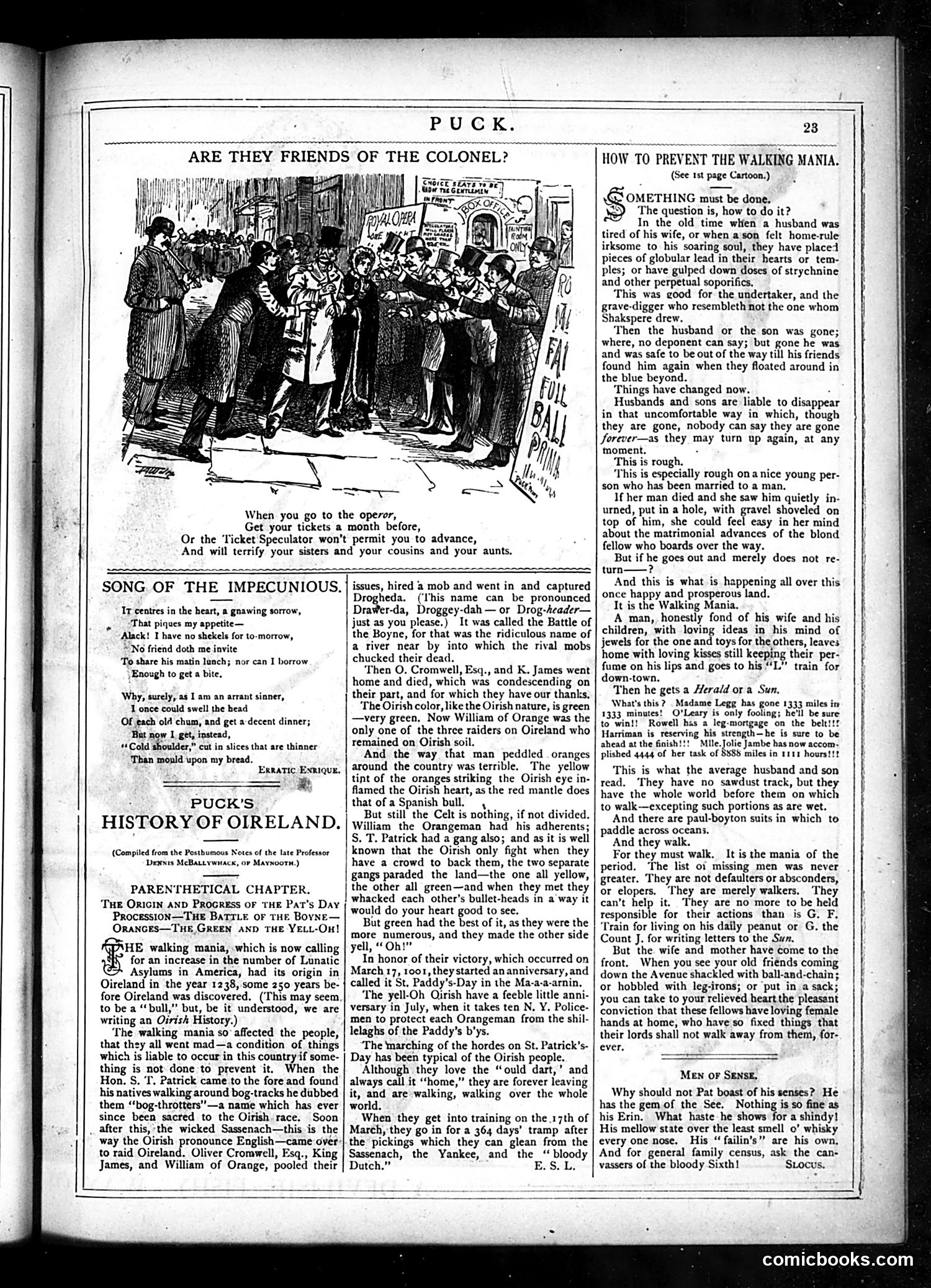
The main cartoon "Are They Friends of the Colonel?" depicts a crowded street scene with what appears to be political or military figures being questioned about their allegiance to "the Colonel"—likely a reference to Colonel Sellers or a similar public figure of the era. The page also contains "Song of the Impecunious" (a humorous poem about financial hardship) and "Puck's History of Oireland," which satirizes Irish immigration and the Irish-American community through exaggerated dialect and stereotypes common to 19th-century American humor. The right column includes "How to Prevent the Walking Mania," addressing a period concern about men abandoning their families. Without clearer identification of the specific Colonel referenced, the precise political target remains unclear, though the satire targets military/political authority and social behavior.
📄 Transcribed text from this page (OCR, searchable)
Machine-transcribed from the original scan — historical spelling and the odd misread are preserved.
23 When you go to the opevor, Get your tickets a month before, Or the ‘Ticket'Speculator won’t permit you to advance, And will terrify your sisters and your cousins and your aunts. HOW TO PREVENT THE WALKING MANIA. (See 1st page Cartoon.) Sx OMETHING must be done, s) ‘The question is, how to do it? In the old time when a husband was tired of his wife, or when a son felt home-rule irksome to his soaring soul, they have placed pieces of globular lead in their hearts or tem- ples; or have gulped down doses of strychnine and other perpetual soporifics, This was good for the undertaker, and the grave-digger who resembleth not the one whom Shakspere drew. Then the husband or the son was gone; where, no deponent can say; but gone he was and was safe to be out of the way till his friends found him again when they floated around in the blue beyond. ‘Things have changed now. 3 Husbands and sons are liable to disappear in that uncomfortable way in which, though they are gone, nobody can say they are gone Sorever—as they may turn up again, at any ‘moment, : This is rough. ‘This is especially rough onanice young per- son who has been married to a man. If her man died and she saw him quietly in- urned, put in a hole, with gravel shoveled on top of him, she could feel easy in her mind about the matrimonial advances of the blond fellow who boards over the way. But if he goes out and merely does not re- turn ? SONG. OF THE IMPECUNIOUS. Tr centres in the heart, a gnawing sorrow, That piques my appetite— Alack! I have no shekels for to-morrow, “ING friend doth me invite To share his matin lunch; nor can I borrow Enough to get a bite. Why, surely, ag I am an arrant sinner, L once could swell the bead Of each olf chum, and get a-decent dinner; Bat now I get, instead, “Cold shoulder,” cut in slices that are thinner ‘Than mould upon my bread. Exraric Exrique. ‘ PUCK’S HISTORY OF OIRELAND. (Compiled from the Posthumous Notes of the late Professor Dennis MeBaLtywnack, o” MAYNOOTH.) PARENTHETICAL CHAPTER. THe ORIGIN AND PRroGREss OF THE Pat’s Day ProcessiON—THE BaTILe oF THE BoyNE— OranGes—THE GREEN AND THE YELL-OH! HE walking mania, which is now calling for an increase in the number of Lunatic Asylums in America, had its origin in Oireland in the year 1238, some 250 years be- fore Oireland was discovered. (This may seem, to be a “bull,” but, be it understood, we are writing an Oirish History.) ‘The walking mania so’ affected the people, that they all went mad—a condition of things which is liable to occur in this country if some- thing is not done to prevent ‘it. When the Hon. S. T. Patrick came.to the fore and found his natives walking around bog-tracks he dubbed. them ‘‘bog-throtters”—a name which has ever since been sacred to the Oirish race. Soon . after this, the wicked Sassenach—this is the way the Oirish pronounce English—came over: to raid Oireland, Oliver Cromwell, Esq., King James, and William of Orange, pooled their issues, hired a mob and went in and captured Drogheda. (‘This name can be pronounced Drawer-da, Droggey-dah — or Drog-header— just as you please.) It was called the Battle of the Boyne, for that was the ridiculous name of a river near by into which the rival mobs chucked their dead. Then O. Cromwell, Esq., and K. James went home and died, which was condescending on their part, and for which they have our thanks, ‘The Oirish color, like the Oirish nature, is green —very green. Now William of Orange was the only one of the three raiders on Oireland who remained on Oirish soil. And the way that man peddled oranges around the country was terrible. The yellow tint of the oranges striking the Oirish eye in- flamed the Oirish heart, as the red mantle does that of a Spanish bull. But still the Celt is nothing, if not divided. William the Orangeman had his adherents; S. T. Patrick had a gang also; and as it is well known that the Oirish only fight when they have a crowd to back them, the two separate gangs paraded the land—the one all yellow, the other all green—and when they met they whacked cach other’s bullet-heads in a’way it would do your heart good to see. But green had the best of it, as they were the more numerous, and they made the other side yell, “Oh!” In honor of their victory, which occurred on March 17, 1001, they started an anniversary, and called it St. Paddy’s-Day in the Ma-a-a-arnin, ‘The yell-Oh Qirish have a feeble little anni- versary in July, when it takes ten N. Y. Police- men to protect each Orangeman from the shil- lelaghs of the Paddy's b'ys. ‘The ‘marching of the hordes on St. Patrick’s- Day has been typical of the Oirish people. Although they love the “ould dart,’ and always call it “home,” they are forever leaving it, and are walking, walking over the whole world. When they get into training on the 17th of March, they go in for a 364 days’ tramp after the pickings which they can glean from the Sassenach, the Yankee, and the “ bloody Dutch.” E.S. L. And this is what is happening all over this once happy and prosperous land. It is the Walking Mania, A man, honestly fond of his wife and his children, with loving ideas in his mind of jewels for the one and toys for the others, leaves home with loving kisses still keeping their per- fume on his lips and goes to his “L” train for down-town, Then he gets a Hera/d or a Sun. What's this? Madame Legg has gone 1333 miles in 1333. minutes! O'Leary is only fooling; he'll be sure to win! Rowell has a leg-mortgage on the belt!!£ Harriman is reserving his strength—he is sure to be ahead at the finish!!! Mile. Jolie Jambe has now accom- plished 4444 of her task of 8885 miles in 1111 hours!!! This is what the average husband and son read, They have no sawdust track, but they have the whole world before them on which to walk—excepting such portions as are wet. And there are paul-boyton suits in which to paddle across oceans. And they walk. For they must walk. It is the mania of the period. The list o1 missing men was never greater. They are not defaulters or absconders, or elopers. ‘They are merely walkers. They can’t help it. They are no more to be held responsible for their actions than is G. F, ‘Train for living on his daily peanut or G. the Count J. for writing letters to the Sun, But the. wife and mother have come to the front. When you see your old friénds coming down the Avenue shackled with ball-and-chain ; or hobbled with leg-irons; or ‘put ina sack; you can take to your relieved heart the pleasant conviction that these fellows have loving female hands at home, who have so fixed things that their lords shall not walk away from them, for- ever. MEN OF SENSE, Why should not Pat boast of his senses? He has the gem of the See, Nothing is so fine as his Erin, What haste he shows for a shindy! His mellow state over the least smell o’ whisky every one nose. His “ failin’s” are his own, And for general family census, ask the can- vassers of the bloody Sixth! Stocus. comicbooks.com