
Puck, 1879-03-19 · page 3 of 16
Puck — March 19, 1879 — page 3: what you’re looking at
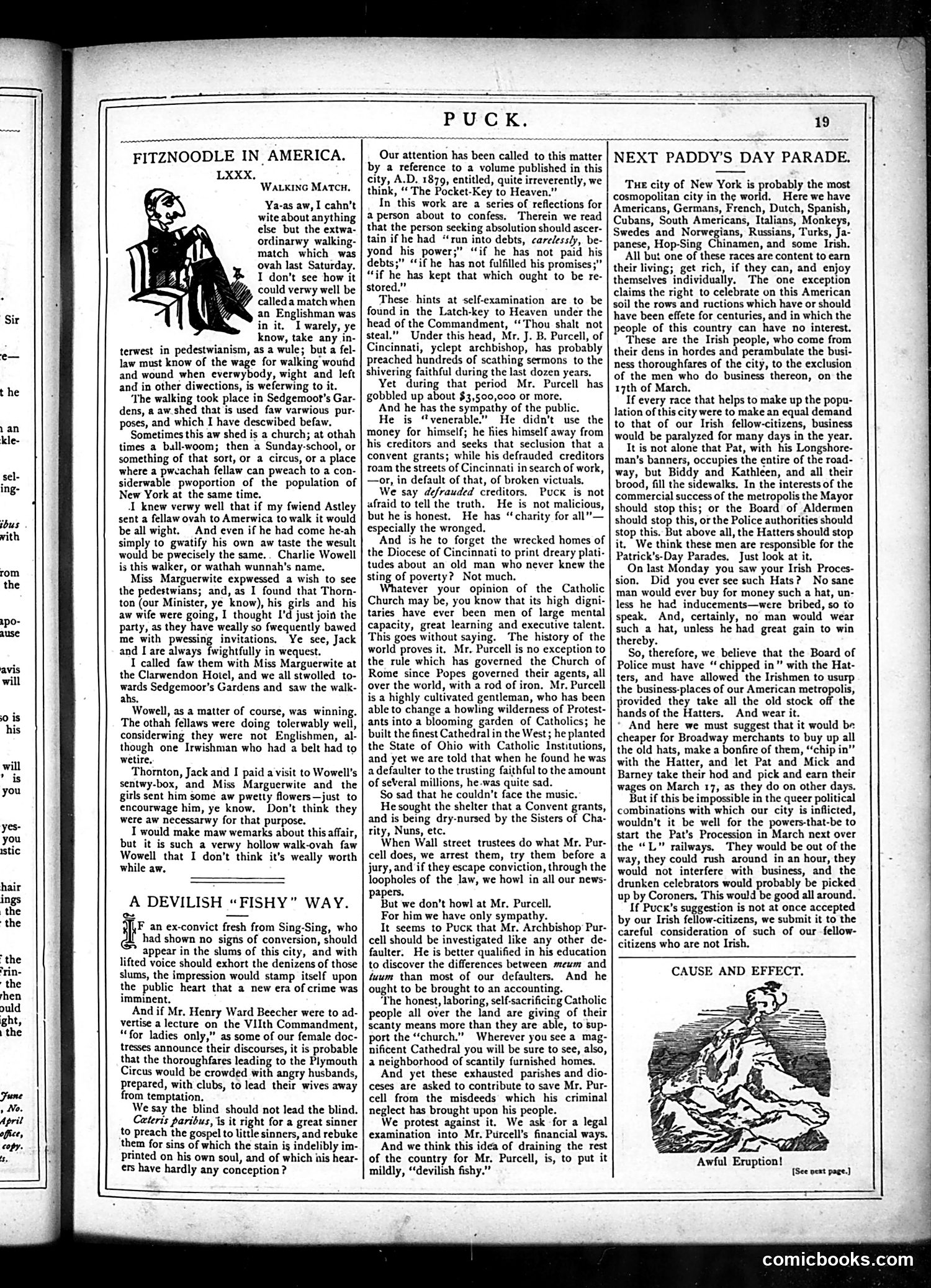
What you’re looking at
This page contains three distinct pieces of political satire: 1. **"Fitznoodle in America"** critiques pedestrian behavior and urban walking etiquette, using a character's observations about American street conduct as social commentary. 2. **"Next Paddy's Day Parade"** satirizes New York's Irish-American community and Catholic Church influence. It criticizes Archbishop Purcell's financial mismanagement and suggests Irish Catholics should redirect their civic participation away from religious processions toward secular civic duties. The piece argues their energy would better serve the city's commercial interests. 3. **"A Devilish 'Fishy' Way"** attacks what appears to be ecclesiastical corruption or hypocrisy, using religious imagery to mock clerical dishonesty. The overall tone reflects late-19th-century anti-Catholic prejudice common in American Protestant publications.
📄 Transcribed text from this page (OCR, searchable)
Machine-transcribed from the original scan — historical spelling and the odd misread are preserved.
an kle- sel- ing- bus vith rom the xpo- use avis will 0 is his will is you ye you istic hair ings the the the rin- ‘the hen ould ght, \ the , No. Aprit office, copy. FITZNOODLE IN AMERICA. WALKING MatTcH, Ya-as aw, I cahn’t wite about anything else but the extwa- ordinarwy walking- match which was ovah last Saturday, I don’t see how it could verwy well be calleda match when an Englishman was in it. I warely, ye know, take any in- terwest in pedestwianism, as a wule; but a fel- law must know of the wage for walking wouhd and wound when everwybody, wight and left and in other diwections, is weferwing to it. ‘The walking took place in Sedgemoot’s Gar- dens, a aw.shed that is used faw varwious pur- poses, and which I have descwibed befaw. Sometimes this aw shed is a church; at othah times a ball-woom; then a Sunday-school, or something of that sort, or a circus, or a place where a pweachah fellaw can pweach to a con- siderwable pwoportion of the population of New York at the same time. I knew verwy well that if my fwiend Astley sent a fellaw ovah to Amerwica to walk it would be all wight. And even if he had come he-ah simply to gwatify his own aw taste the wesult would be pwecisely the same... Charlie Wowell is this walker, or wathah wunnah’s name. Miss Marguerwite expwessed a wish to see the pedest! s; and, as I found that Thorn- ton (our Minister, ye know), his girls and his aw wife were going, I thought I'd just join the party, as they have weally so fwequently bawed me with pwessing invitations, Ye see, Jack and I are always fwightfully in wequest. I called faw them with Miss Marguerwite at the Clarwendon Hotel, and we all stwolled to- wards Sedgemoor’s Gardens and saw the walk- ahs, Wowell, as a matter of course, was winning. The othah fellaws were doing tolerwably well, considerwing they were not Englishmen, al- though one Irwishman who had a belt had to wetire, Thornton, Jack and I paid a visit to Wowell’s sentwy-box, and Miss Marguerwite and the girls sent him some aw pwetty flowers—just to encourwage him, ye know. Don't think they were aw necessarwy for that purpose. I would make maw wemarks about this affair, but it is such a verwy hollow walk-ovah faw Wowell that I don’t think it’s weally worth while aw. A DEVILISH “FISHY” WAY. hE an ex-convict fresh from Sing-Sing, who had shown no signs of conversion, should ~* appear in the slums of this city, and with lifted voice should exhort the denizens of those slums, the impression would stamp itself upon the public heart that a new era of crime was imminent. And if Mr. Henry Ward Beecher were to ad- vertise a lecture on the ViIth Commandment, “for ladies only,” as some of our female doc- tresses announce their discourses, it is probable that the thoroughfares leading to the Plymouth Circus would be crowded with angry husbands, Prepared, with clubs, to lead their wives away from temptation. We say the blind should not lead the blind. Ceteris paribus, is it right for a great sinner to preach the gospel to little sinners, and rebuke them for sins of which the stain is indelibly im- Printed on his own soul, and of which iis hear- ers have hardly any conception? PUCK. Our attention has been called to this matter by a reference to a volume published in this city, A.D. 1879, entitled, quite irreverently, we think, ‘‘ The Pocket-Key to Heaven.” In this work are a series of reflections for a person about to confess. Therein we read that the person seeking absolution should ascer- tain if he had “run into debts, carelessly, be- yond his power;” “if he has not paid his debts;” ‘‘if he has not fulfilled his promises;” “if he has kept that which ought to be re- stored.” These. hints at self-examination are to be found in the Latch-key to Heaven under the head of the Commandment, “Thou shalt not steal.” Under this head, Mr. J. B, Purcell, of Cincinnati, yclept archbishop, has probably preached hundreds of scathing sermons to the shivering faithful during the last dozen years. Yet during that period Mr. Purcell has gobbled up about $3,500,000 or more, And he has the sympathy of the public. He is “venerable.” He didn’t use the money for himself; he hies himself away from his creditors and seeks that seclusion that a convent grants; while his defrauded creditors roam the streets of Cincinnati in search of work, —or, in default of that, of broken victuals. We say defrauded creditors. Puck is not afraid to tell the truth. He is not malicious, but he is honest. He has “charity for all"— especially the wronged. And ishe to forget the wrecked homes of the Diocese of Cincinnati to print dreary plati- tudes about an old man who never knew the sting of poverty? Not much. Whatever your opinion of the Catholic Church may be, you know that its high digni- taries have ever been men of large mental capacity, great learning and executive talent. This goes without saying. ‘The history of the world proves it. Mr. Purcell is no exception to the rule which has governed the Church of Rome since Popes governed their agents, all over the world, with a rod of iron. Mr. Purcell is a highly cultivated gentleman, who has been able to change a howling wilderness of Protest- ants into a blooming garden of Catholics; he built the finest Cathedral in the West; he planted the State of Ohio with Catholic Institutions, and yet we are told that when he found he was adefaulter to the trusting faithful to the amount of seVeral millions, he.was quite sad. So sad that he couldn’t face the music. He sought the shelter that a Convent grants, and is being dry-nursed by the Sisters of Cha- rity, Nuns, etc. When Wall street trustees do what Mr. Pur- cell does, we arrest them, try them before a jury, and if they escape conviction, through the loopholes of the law, we howl in all our news- papers, But we don’t howl at Mr. Purcell. For him we have only sympathy. It seems to Puck that Mr. Archbishop’ Pur- cell should be investigated like any other de- faulter. He is better qualified in his education to discover the differences between meum and fuum than most of our defaulters. And he ought to be brought to an accounting. The honest, laboring, self-sacrificing Catholic people all over the land are giving of their scanty means more than they are able, to sup- port the “church.” Wherever you see a mag- nificent Cathedral you will be sure to see, also, a neighborhood of scantily furnished homes. And yet these exhausted parishes and dio- ceses are asked to contribute to save Mr. Pur- cell from the misdeeds which his criminal neglect has brought upon his people. We protest against it. We ask for a legal examination into Mr. Purcell’s financial ways. And we think this idea of draining the rest of the country for Mr. Purcell, is, to put it mildly, ‘devilish fishy.” 19 NEXT PADDY’S DAY PARADE. Tue city of New York is probably the most cosmopolitan city in the world, Here we have Americans, Germans, French, Dutch, Spanish, Cubans, South Americans, Italians, Monkeys, Swedes and Norwegians, Russians, Turks, Ja- panese, Hop-Sing Chinamen, and some Irish. All but one of these races are content to earn their living; get rich, if they can, and enjoy themselves individually, The one exception claims the right to celebrate on this American soil the rows and ructions which have or should have been effete for centuries, and in which the people of this country can have no interest. These are the Irish people; who come from their dens in hordes and perambulate the busi- ness thoroughfares of the city, to the exclusion of the men who do business thereon, on the 17th of March, If every race that helps to make up the popu- lation of this city were to make an equal demand to that of our Irish fellow-citizens, business would be paralyzed for many days in the year. It is not alone that Pat, with his Longshore- man's banners, occupies the entire of the road- way, but Biddy and Kathleen, and all their brood, fill the sidewalks. In the interests of the commercial success of the metropolis the Mayor should stop this; or the Board of Aldermen should stop this, or the Police authorities should stop this. But above all, the Hatters should stop it, We think these men are responsible for the Patrick’s-Day Parades, Just look at it. On last Monday you saw your Irish Proces- sion. Did you ever see such Hats? No sane man would ever buy for money such a hat, un- less he had inducements—were bribed, so to speak, And, certainly, no man would wear such a hat, unless he had great gain to win thereby. So, therefore, we believe that the Board of Police must have ‘chipped in” with the Hat- ters, and have ‘allowed. the Irishmen to usurp the business-places of our American metropolis, provided they take all the old stock off the hands of the Hatters. And wear it. * And here we must suggest that it would be cheaper for Broadway merchants to buy up all the old hats, make a bonfire of them, “chip in” with the Hatter, and let Pat and Mick and Barney take their hod and pick and earn their wages on March 17, as they do on other days. But if this be impossible in the queer political combinations with which our city is inflicted, wouldn’t it be well for the powers-that-be to start the Pat's Procession in March next over the “L” railways. They would be out of the way, they could rush around in an hour, they would not interfere with business, and the drunken celebrators would probably be picked up by Coroners. This would be good all around. If Puck’s suggestion is not at once accepted by our Irish fellow-citizens, we submit it to the careful consideration of such of our fellow- citizens who are not Irish. CAUSE AND EFFECT. Awful Eruption! [See pent page.) comicbooks.com