
A complete issue · 19 pages · 1879
Puck — March 5, 1879
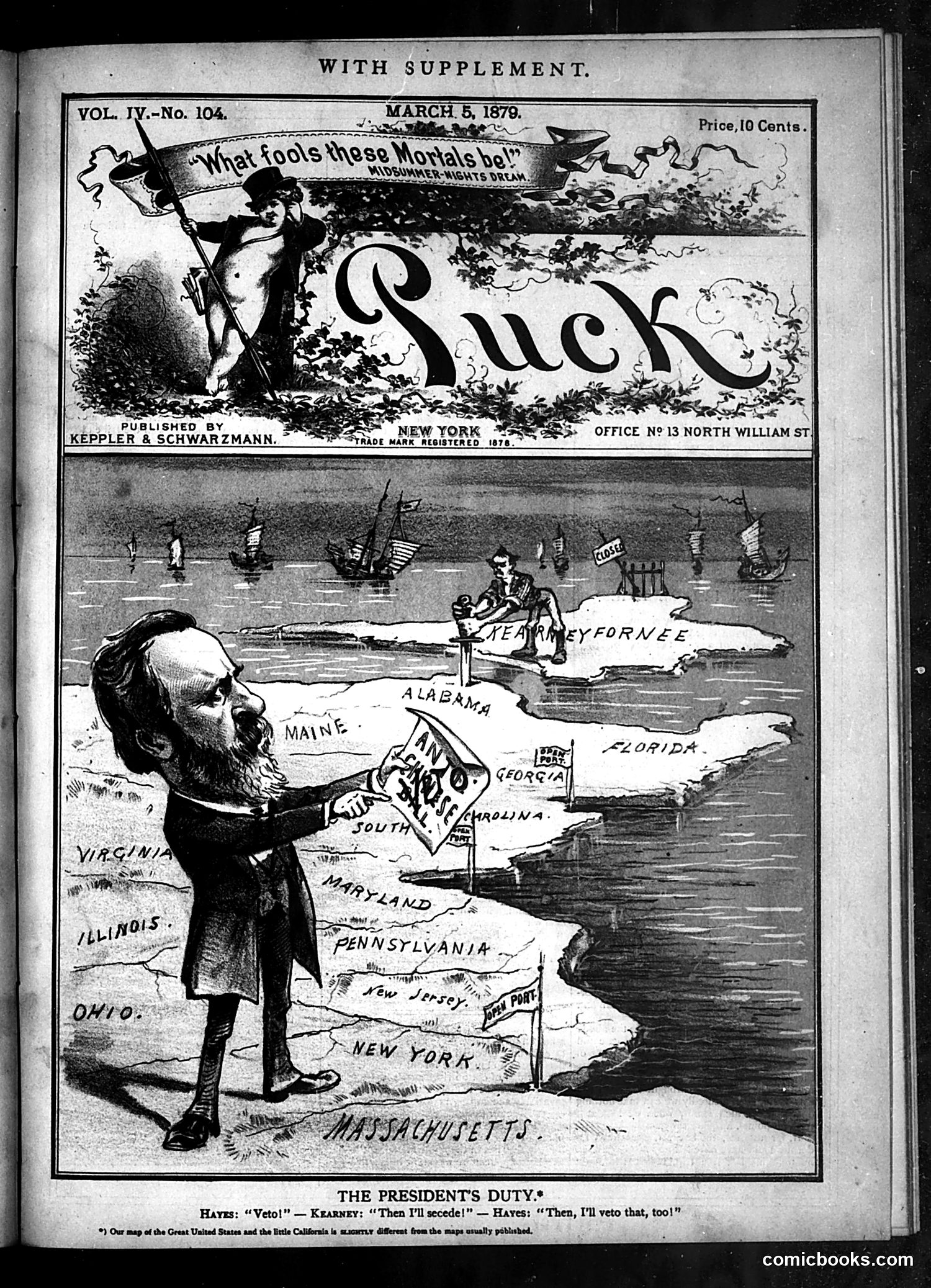
This 1879 *Puck* cartoon satirizes President Rutherford B. Hayes's use of presidential vetoes. The bearded figure (Hayes) holds a sign reading "AN VETO" while standing over a map of Eastern states, with naval ships visible in the background. The caption quotes dialogue: Hayes says "Veto!" while Kearney responds "Then I'll secede!" and Hayes counters "Then, I'll veto that, too!"—mocking Hayes's apparent overreliance on vetoing legislation, including Reconstruction-era bills. The cartoon likely criticizes Hayes's political approach as ineffectual or one-dimensional. The reference to secession suggests tension over post-Civil War policies. The overall message: Hayes's solution to political problems is simply to veto everything, a lazy or inadequate governing strategy.
This page contains primarily **text content rather than political cartoons**—it's a collection of satirical commentary pieces and notices typical of Puck magazine's format. The main section, "MILLIONAIRES' MISERIES," uses satirical humor to mock wealthy individuals' concerns about inheritance and estate planning. It argues ironically that rich men need protection from their own heirs and suggests legal mechanisms to prevent relatives from "indefinite multiplication" and wasteful spending of fortunes. The "Pickerings" column contains brief, witty observations on contemporary urban life—telephone monopolies, pedestrian safety, and social behaviors. The notice section at bottom advertises back issues of the magazine. **No specific political figures are caricatured on this visible page**; the satire targets general social classes and behaviors rather than named individuals.
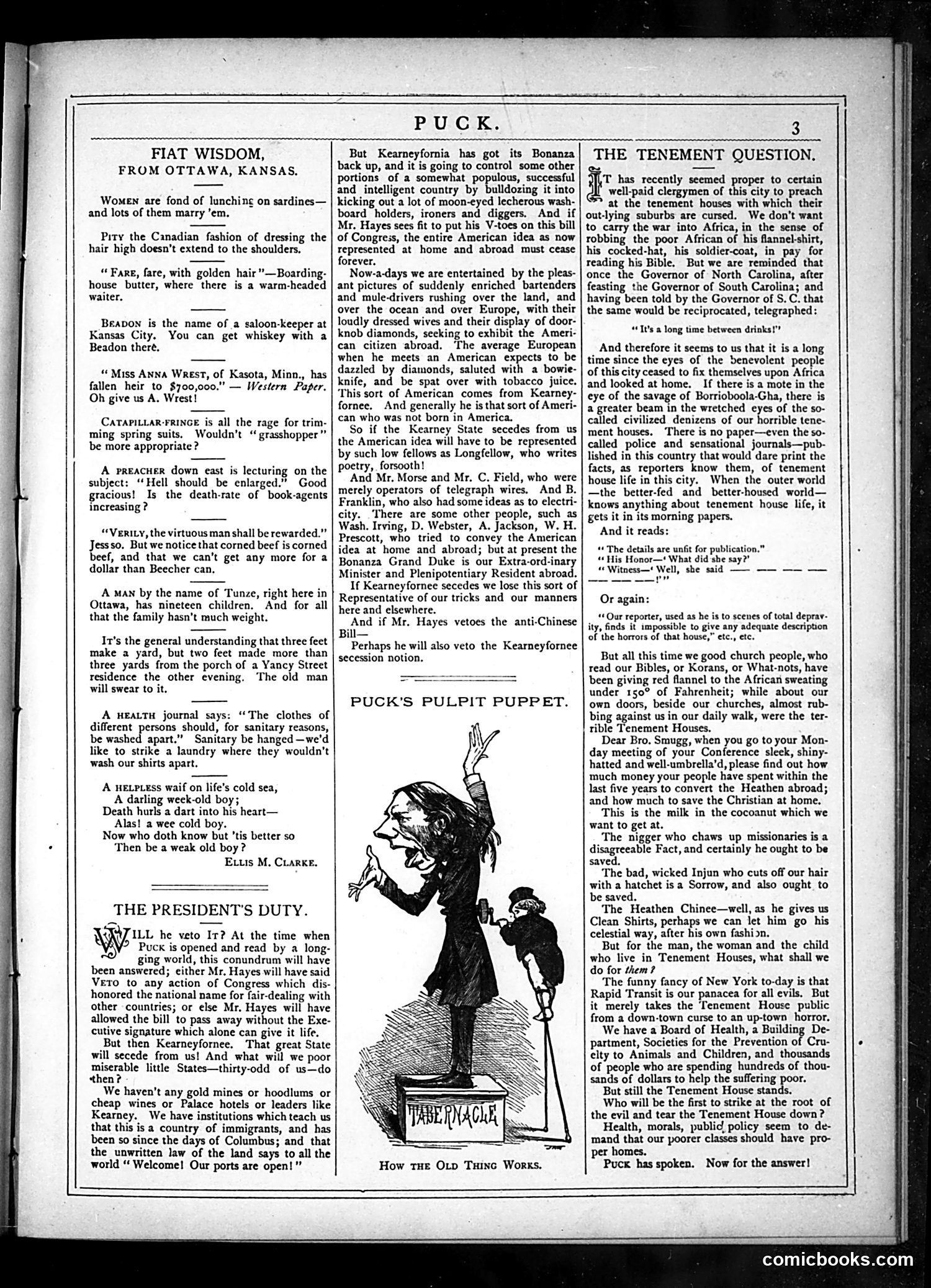
The central cartoon, "How the Old Thing Works," depicts a grotesque figure labeled "TAMMANY" manipulating a smaller figure below like a puppet on strings. This is a direct attack on **Tammany Hall**, the notoriously corrupt Democratic political machine that dominated New York City politics. The accompanying article, "The Tenement Question," criticizes wealthy philanthropists and churches for ineffective responses to urban poverty. It sarcastically notes their efforts to "convert the Heathen abroad" while ignoring suffering in American tenement houses. The satire suggests that Tammany Hall's corruption and mismanagement directly enabled tenement-house conditions, and that the machine controlled politicians like puppets, preventing meaningful reform. The piece demands systemic action rather than charity.
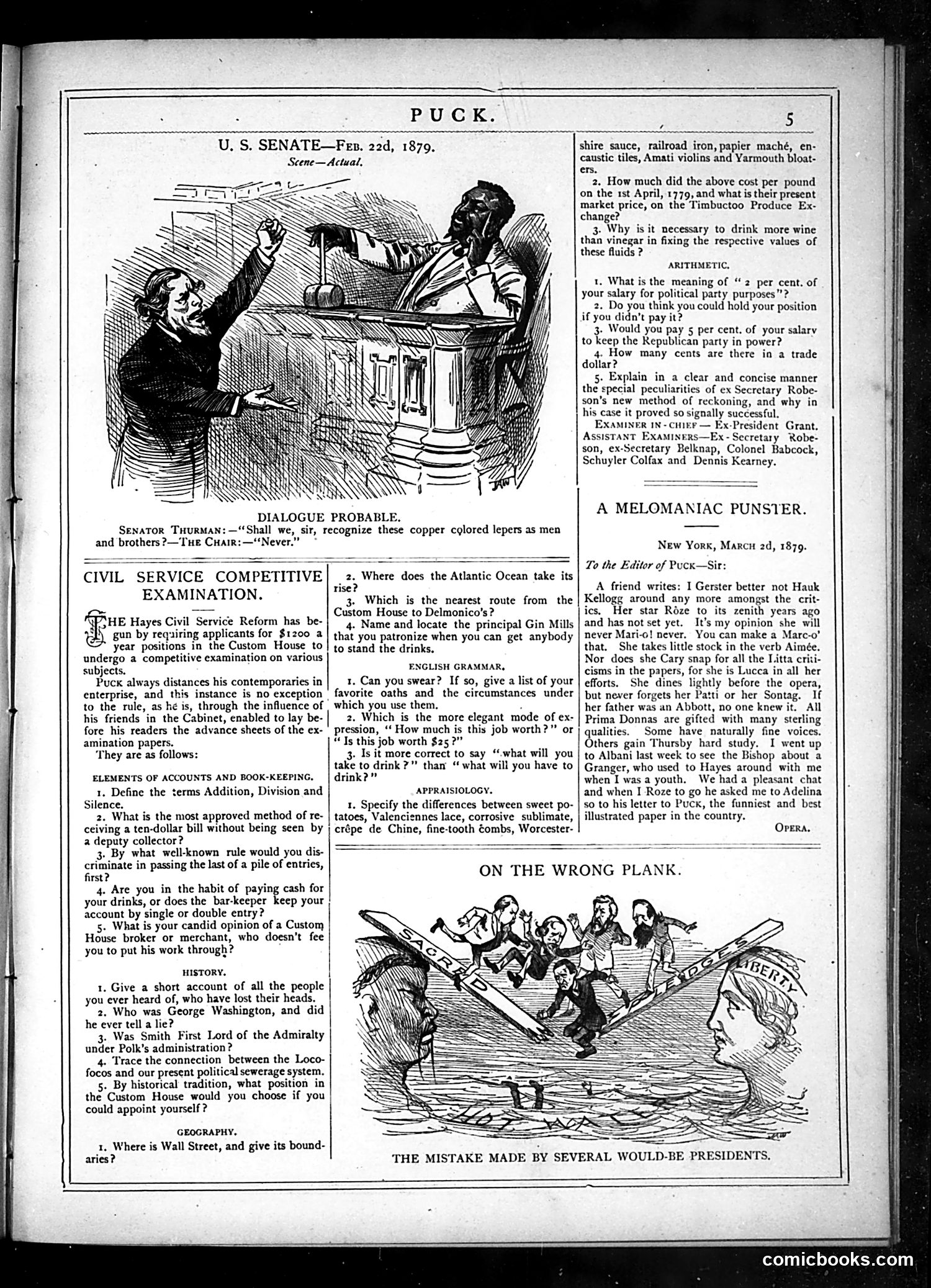
**Top Cartoon - "Dialogue Probable":** Senator Thurman (identifiable by label) addresses the Chair, asking whether copper-colored lepers should be recognized as men and brothers. The Chair responds "Never." This appears to satirize debates over Civil Rights and racial discrimination, possibly referencing Chinese immigrants or African Americans in the context of post-Reconstruction politics. **Bottom Cartoon - "On the Wrong Plank":** Titled "The Mistake Made by Several Would-Be Presidents," this depicts multiple figures in a sinking boat labeled "Liberty." The satire criticizes various potential presidential candidates whose policies or positions are portrayed as fundamentally flawed or destabilizing to the nation—a common Puck theme during election season.
This page contains primarily **text content rather than cartoons**. It includes: 1. **"New Music"** - A lengthy review of Mr. Beethoven's "A Pastoral Symphony in a minor (Op. 25 cents net!)" described as "decidedly the most ambitious work that Mr. Beethoven has yet given us." The review discusses the five-movement composition's structure and musical innovations. 2. **"An Institution"** - A satirical piece about Box Office culture at theaters, criticizing how Box Offices treat customers and noting their dual-role as both "institutions" and profit-driven businesses. It compares Union Square and Wallack's theaters as the strongest "matinee houses." The page appears to be a mixed editorial/review section rather than featuring political cartoons.
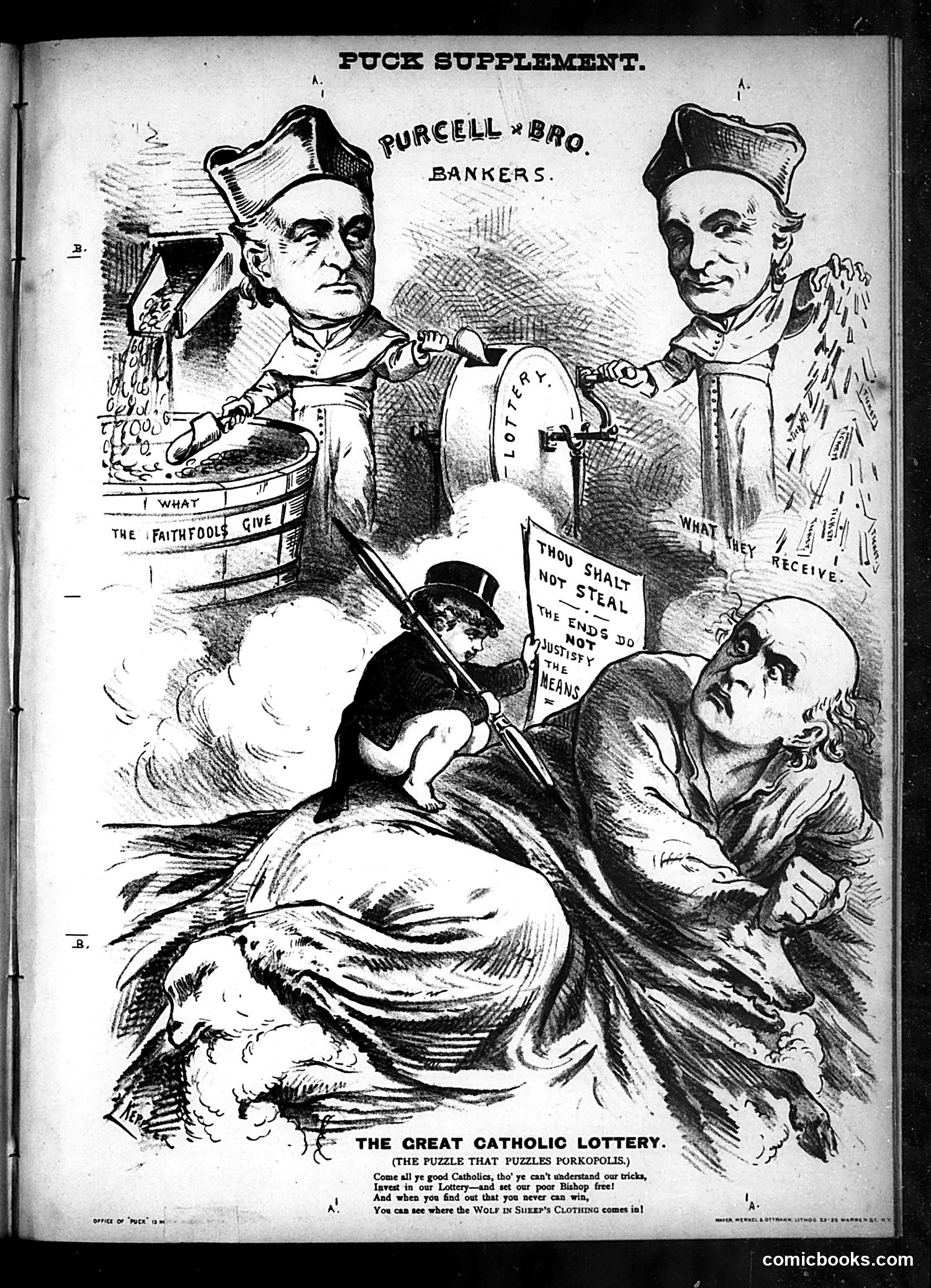
This satirical cartoon criticizes Purcell Brothers, identified as "Bankers," through religious allegory. Two figures wearing bishop's miters (tall pointed hats) sit atop a barrel labeled "LOTTERY," distributing money to supplicants below. The text reads: "Thou shalt not steal / The end doth justify the means." The satire suggests the Purcells are operating a lottery scheme, implying their banking practices amount to organized theft dressed in religious legitimacy. By depicting them as bishops presiding over a lottery "puzzle that puzzles porkopolis" (Cincinnati), the cartoonist mocks both their financial operations and the Catholic Church's perceived complicity or hypocrisy. The caption warns readers that finding where "the Wolf in Sheep's Clothing comes in" is the real puzzle.

I can see this is a page from Puck magazine, but the image shows what appears to be a blank or nearly blank page with only binding/margin marks visible on the left side and some scattered dust spots or printing artifacts. There is no clearly legible text, cartoon imagery, or illustrations that I can confidently identify on this particular page. Without being able to discern actual content—whether it's a cartoon, advertisement, or article text—I cannot accurately explain what political or social commentary it contains or identify any figures, references, or satirical points it might be making. To provide the analysis you're seeking, I would need a page with more clearly visible and legible content.
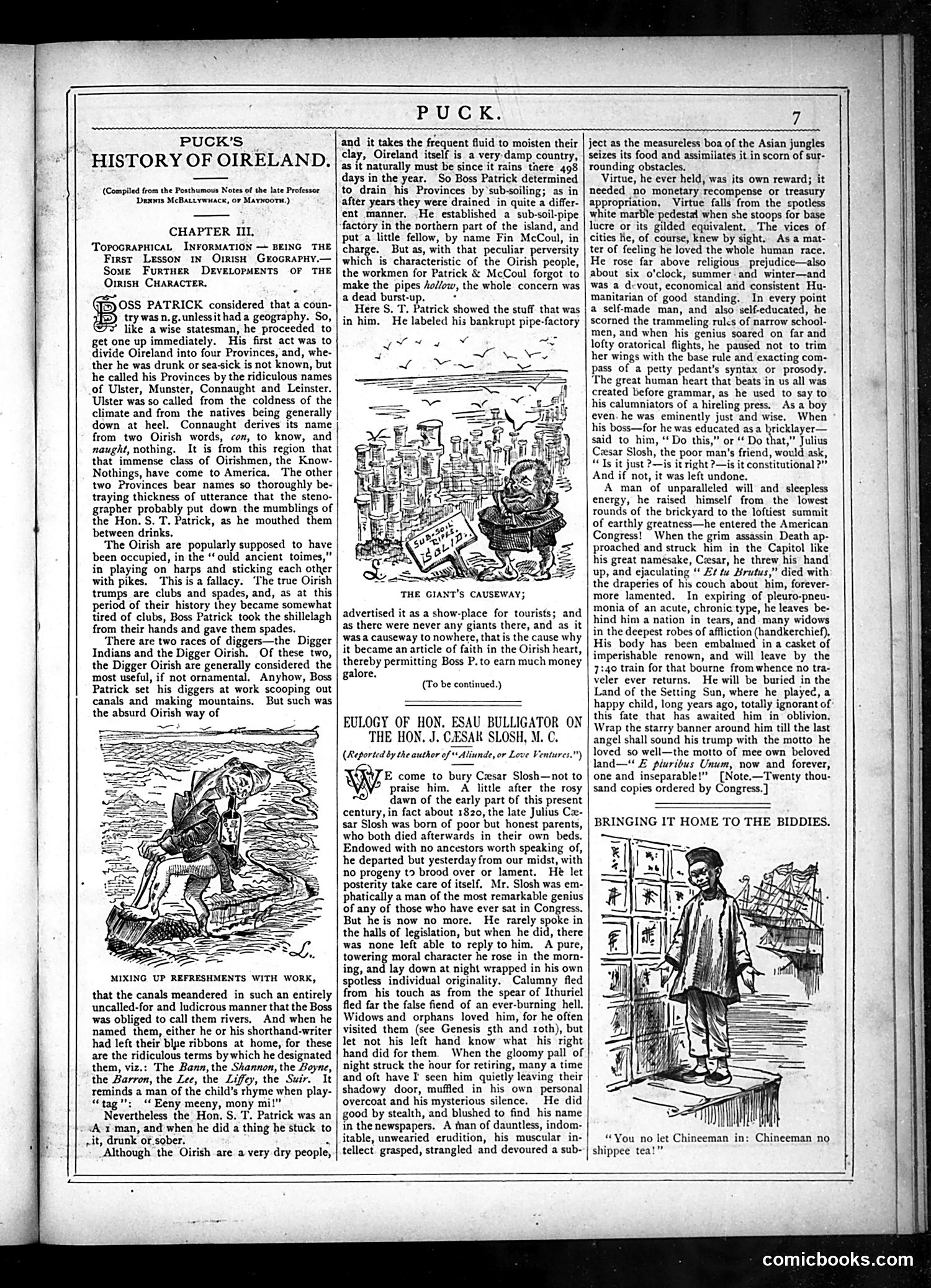
This page contains three distinct sections: 1. **"Puck's History of Ireland"** (top): A serialized article with illustration of "The Giant's Causeway," discussing Irish geography and Patrick's development of sub-soil pipe factories. 2. **"Eulogy of Hon. Esau Bulligator on the Hon. J. Caesar Slosh"** (middle): A satirical obituary piece praising a deceased congressman named Caesar Slosh, portraying him as a man of humble origins who rose through moral character despite lacking formal education or political connections—a commentary on American democratic ideals. 3. **"Bringing It Home to the Hiddies"** (bottom right): A cartoon showing a man displaying Chinese artwork or goods, with the caption "You no let Chinaman in; Chinaman no shippe tea!"—satirizing 1880s-90s anti-Chinese sentiment and trade restrictions, using offensive dialect for comedic effect.
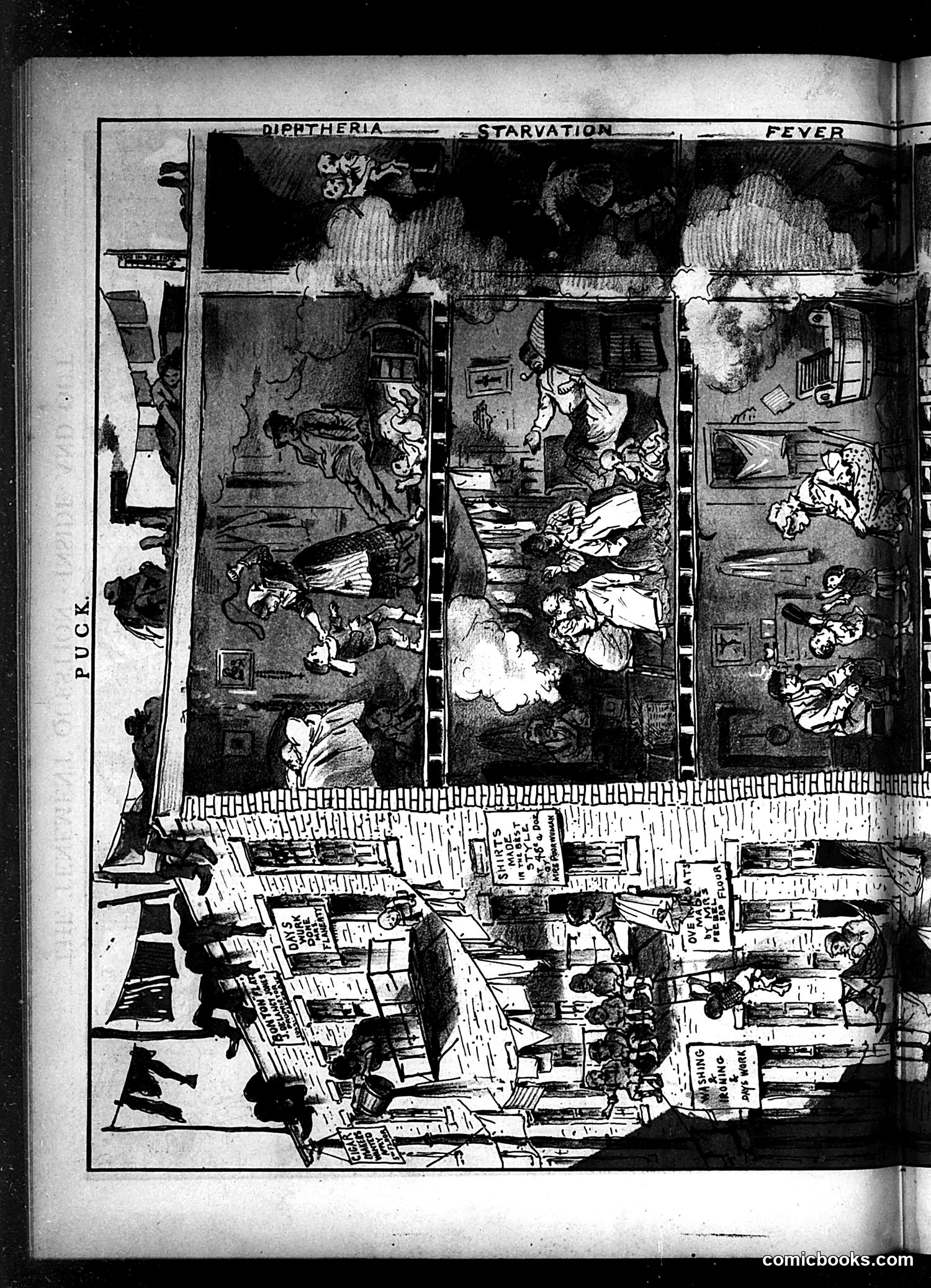
This page displays four illustrated panels labeled "DIPHTHERIA," "STARVATION," and "FEVER," along with "PUCK" on the left margin. The panels appear to depict domestic scenes of poverty and illness—showing suffering families in cramped living conditions with sick children and adults in distress. The satirical intent seems to critique social conditions affecting poor urban populations during the period when Puck was published. The sequential presentation of disease, hunger, and illness suggests commentary on inadequate living standards and healthcare access for working-class families. The lower portion contains what appears to be advertisements or supplementary content, typical of Puck's format. Without clearer text visibility or additional context, the specific political targets or proposed solutions remain unclear, though the overall message condemns the preventable suffering of impoverished Americans.
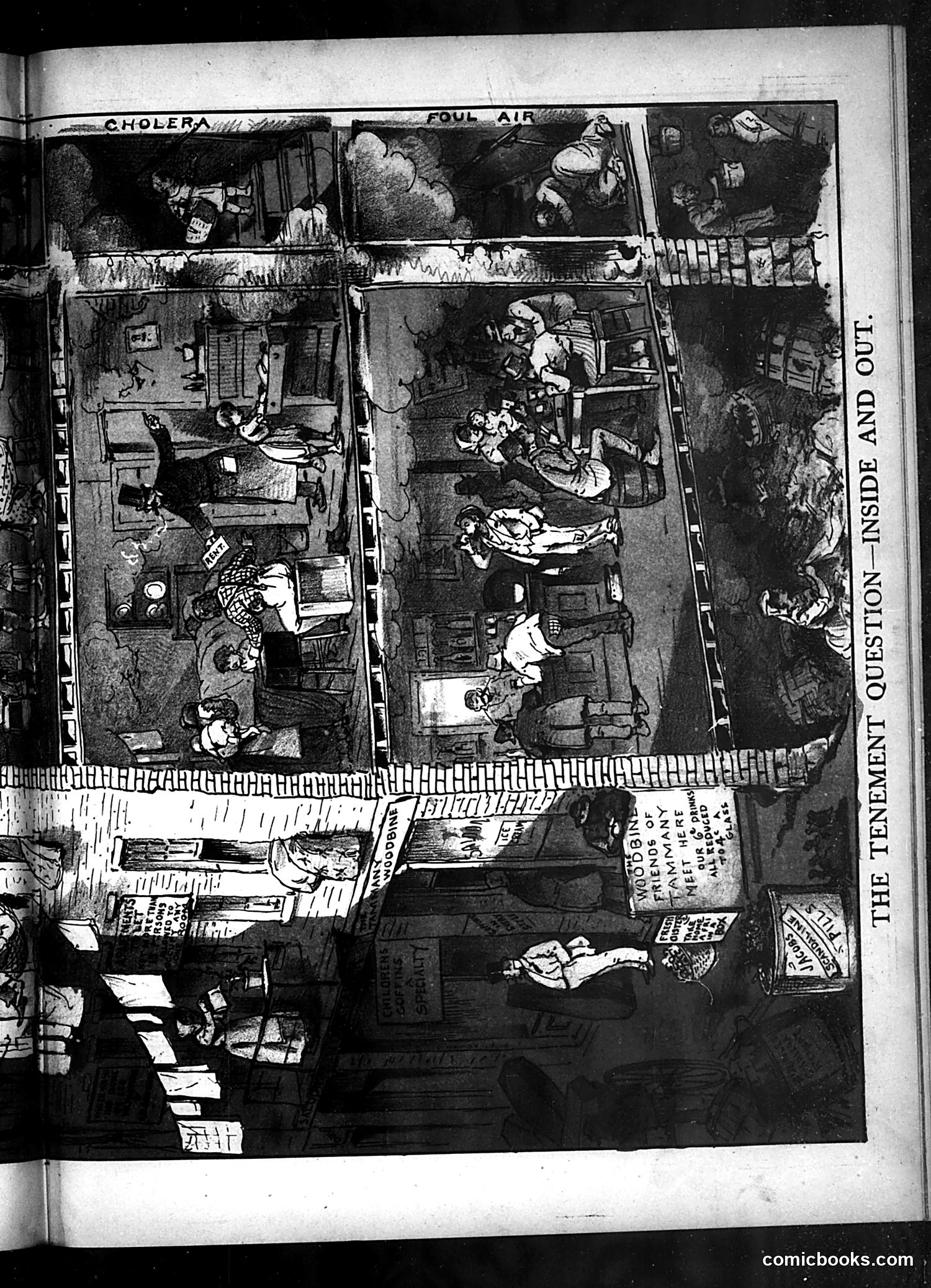
This Puck cartoon satirizes living conditions in late 19th-century urban tenement housing. The image shows a cross-section view of a crowded apartment building, depicting squalid, cramped living spaces where multiple families are crammed together in poor conditions. The top panels labeled "CHOLERA" and "FOUL AIR" highlight the health hazards—disease and poor ventilation—that plagued such buildings. The satire criticizes both the tenement residents' circumstances and likely the indifference of landlords and city authorities. The title's reference to "inside and out" suggests the contrast between the invisible suffering within tenements and the public's external awareness or lack thereof. This reflects Progressive Era concerns about urban poverty, housing reform, and public health in American cities.
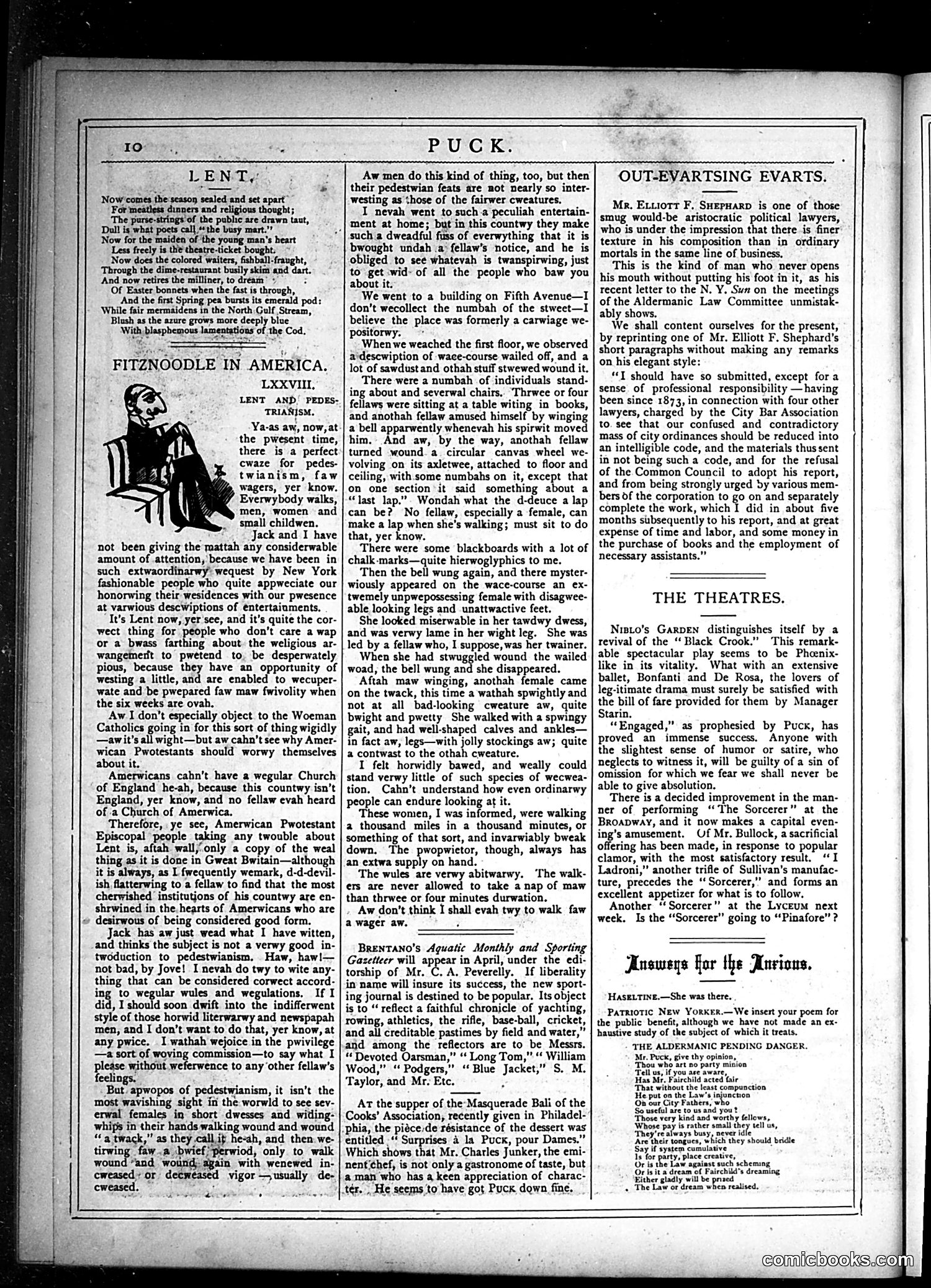
This page contains three distinct sections: a poem titled "Lent," an article about "Fitznoodle in America," and theater reviews. The "Fitznoodle" article appears to be a humorous travel narrative mocking American social customs, particularly contrasting European and American behavior. The illustration shows a caricatured figure, likely representing a European visitor observing American eccentricities. The piece satirizes American women's fashion and comportment, describing absurdly exaggerated physical features and awkward walking styles in a tone of bewildered criticism. This reflects common 19th-century Anglo-American satirical tropes comparing "refined" European manners unfavorably to American vulgarity. The theater section reviews contemporary New York productions, including references to specific performers and venues like Niblo's Garden, indicating this is entertainment criticism for educated readers. The overall tone is genteel mockery typical of Puck's satirical approach.
This page is primarily **text fiction**, not a political cartoon. It's the conclusion of a serialized story from *Belgravia* magazine, featuring dialogue between characters discussing an English country inn called the Maypole and various local matters. The narrative involves a driver, his passengers, and observations about the Maypole's accommodations and proprietors. References include "High Beech," "Barnaby Rudge," and the "Druid's Head" inn. **There are no identifiable political figures or satirical commentary visible on this page.** It is literary content—a Victorian-era short story—rather than the political satire *Puck* magazine typically featured.
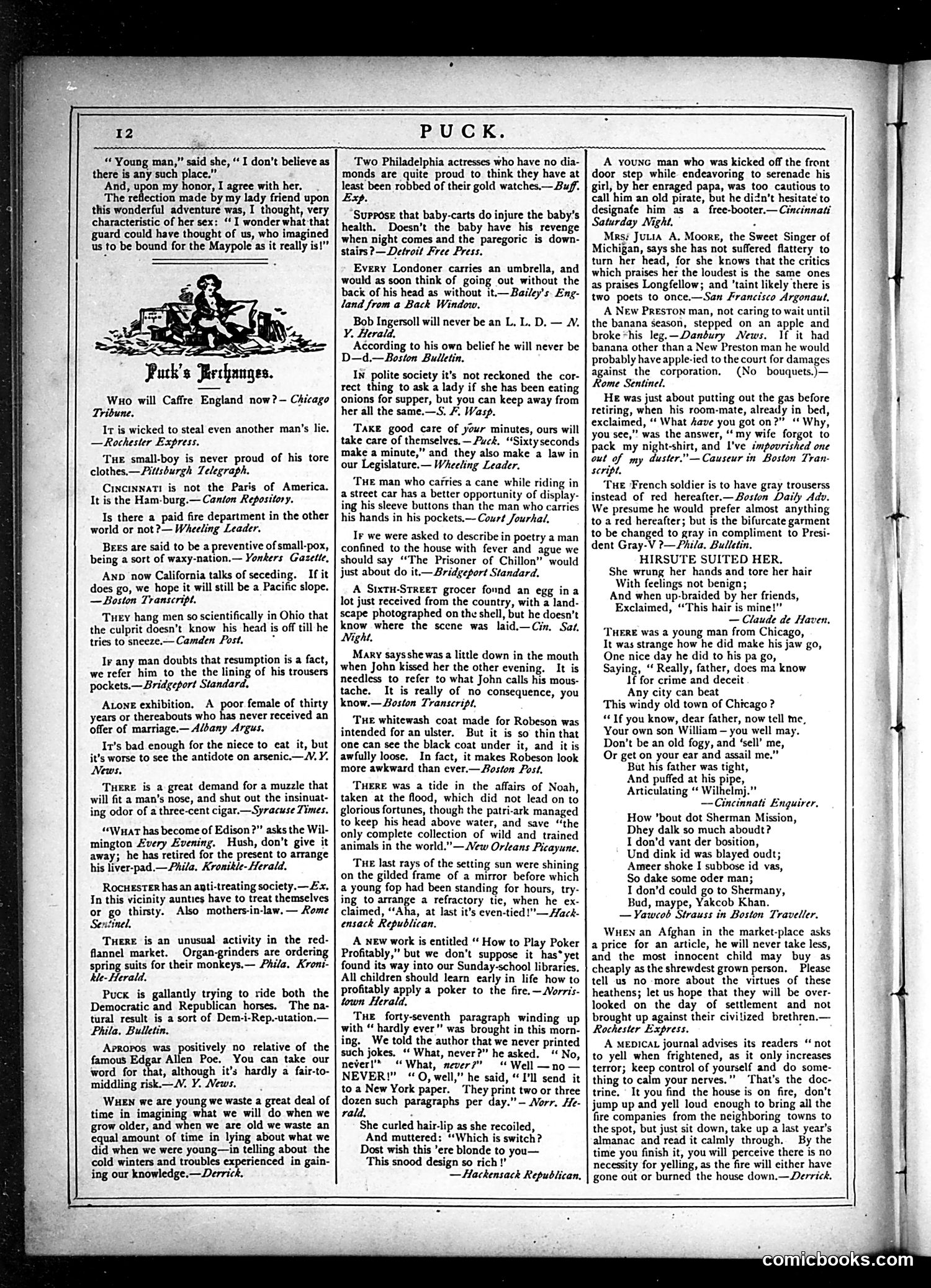
This page contains the humor column "Puck's Briefs" — a collection of short satirical quips rather than a single cartoon. The visible illustration shows a figure at a desk, likely representing editorial commentary. The quips mock various contemporary targets: ineffective small-boy posturing, Cincinnati's pretensions, California's land-boom hype, and fashion absurdities (notably, a commentary on overly-thin coats and baggy trousers). Several items mock social affectations and romantic mishaps. One quip references "Sherman Mission" and another discusses an Afghan market-vendor asking prices — suggesting contemporary international incidents or stereotypes. The overall tone is lighthearted social criticism typical of Puck's satirical format: poking fun at urban pretension, fashion follies, and human vanity rather than serious political commentary.
This page is primarily **text-based content and advertisements** rather than political cartoons. The main articles include: - **"Triolet"** and **"A Startling Phenomenon"** — humorous short pieces with social commentary - Multiple anecdotes about American life, including references to dentists, Lake Shore trains, and alligators in Minnesota The advertisements promote products like **Angostura Bitters**, photography services, and bookstores—typical commercial content of the era. **Key satirical element**: The articles mock contemporary American concerns (medical practices, transportation inconveniences, natural phenomena) through exaggerated anecdotes, characteristic of Puck's satirical style. However, without visible caricatures or illustrations on this particular page, the humor relies on written wit rather than visual satire.
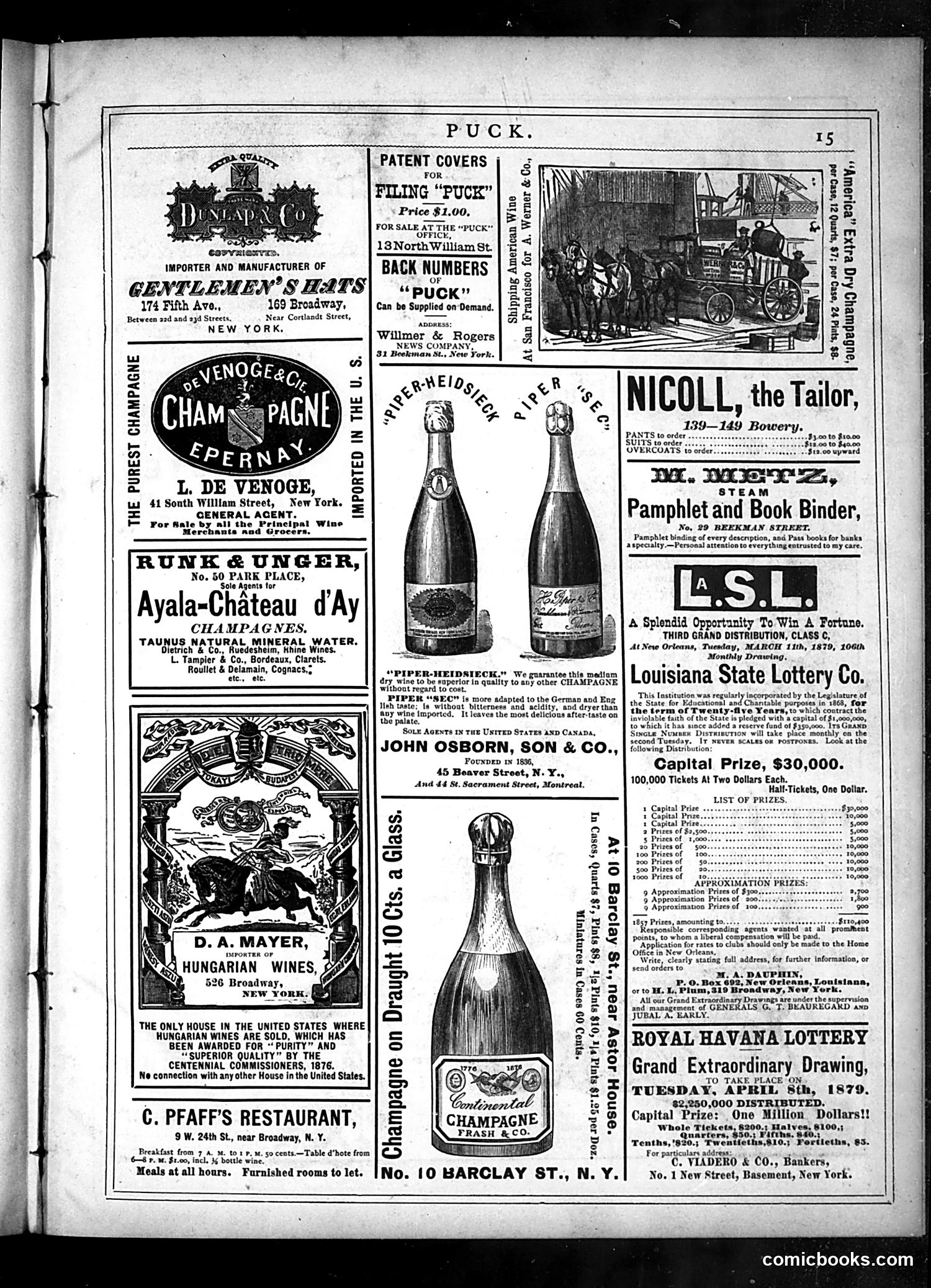
This is primarily an **advertising page** from Puck magazine, not a satirical cartoon. The page contains numerous advertisements for luxury goods and services typical of the 1870s-1880s: - Champagne and wine merchants (Devenoge & Co., Piper-Heidsieck, Ayala-Château d'Ay) - Hungarian wines (D.A. Mayer) - Fine dining (C. Pfaff's Restaurant) - Tailoring services (Nicoll the Tailor) - Bookbinding (M. Metz) - Lottery promotions (Louisiana State Lottery, Royal Havana Lottery) The decorative bottle illustrations and merchant logos dominate the layout. There's a small engraved illustration of an early automobile or carriage at top right, but it appears to be promotional rather than satirical. **This page serves mainly as a revenue-generating advertising section rather than editorial content.**
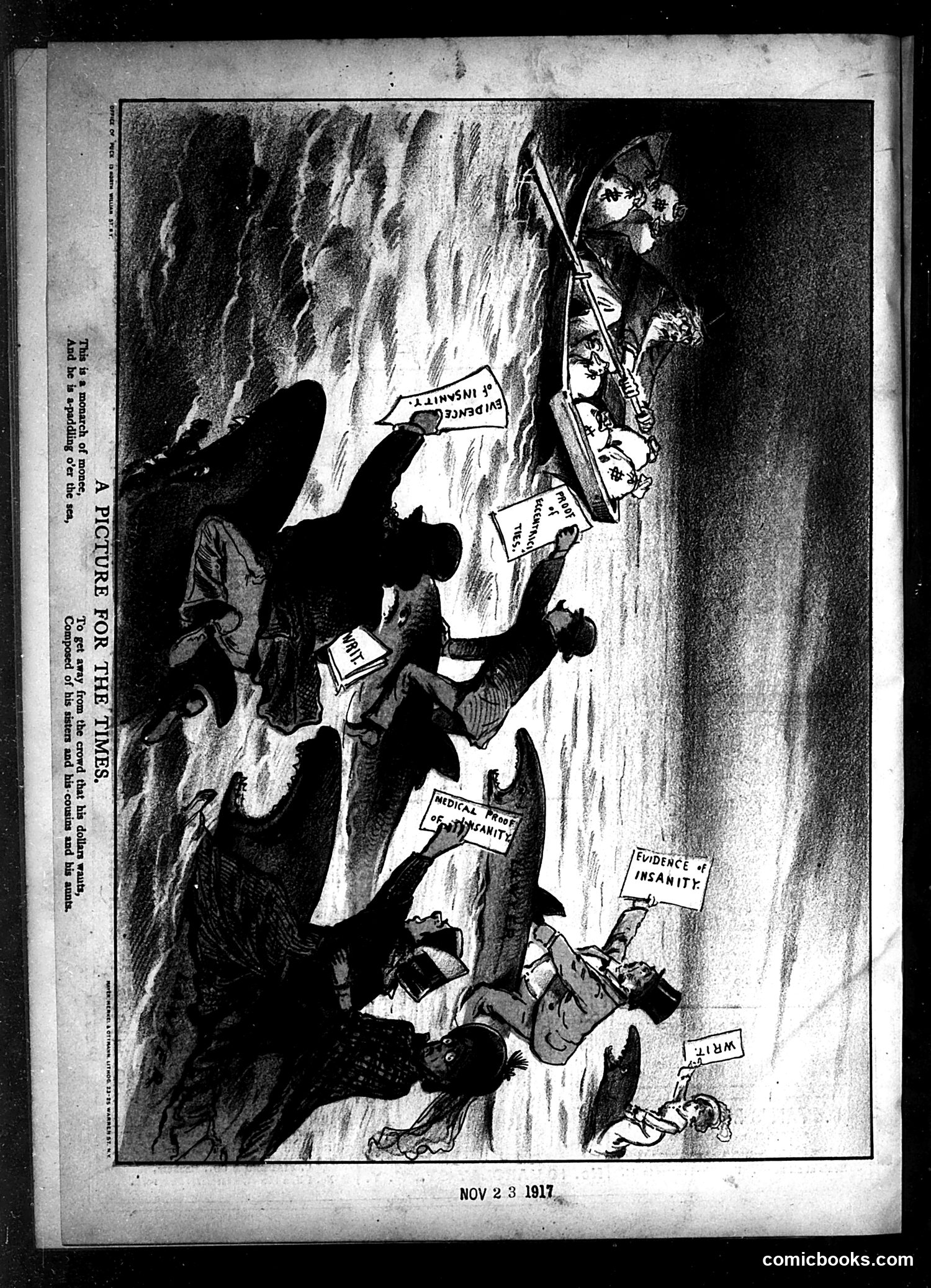
This political cartoon titled "A Picture for the Times" depicts figures climbing a steep, treacherous cliff face during World War I. The climbers carry banners labeled "PATRIOTISM," "MEDICAL NECESSITY," "HUMANITY," and "EVIDENCE OF INSANITY." The satire appears to criticize how various justifications—patriotism, medical claims, humanitarian concerns—are being used to rationalize what the cartoonist suggests is actually evidence of insanity. Published during America's WWI involvement, this likely mocks propaganda or policy arguments used to justify war-related decisions or actions as reasonable when the cartoonist considers them fundamentally irrational. The struggling climbers suggest these justifications are difficult or unstable foundations for decision-making.
I can see this is a page from Puck magazine, but the image is almost entirely black with only a white margin visible on the left side. The OCR text provided is blank, containing no readable content. Without visible cartoon illustrations, captions, or legible text on the page, I cannot identify specific figures, political references, or explain what satire or joke is being made. The page appears to be either a blank page, heavily damaged/deteriorated scan, or improperly digitized. To properly analyze this as a political cartoon historian would, I would need a clearer image showing the actual content of the page.