
Puck, 1879-03-05 · page 13 of 19
Puck — March 5, 1879 — page 13: what you’re looking at
What you’re looking at
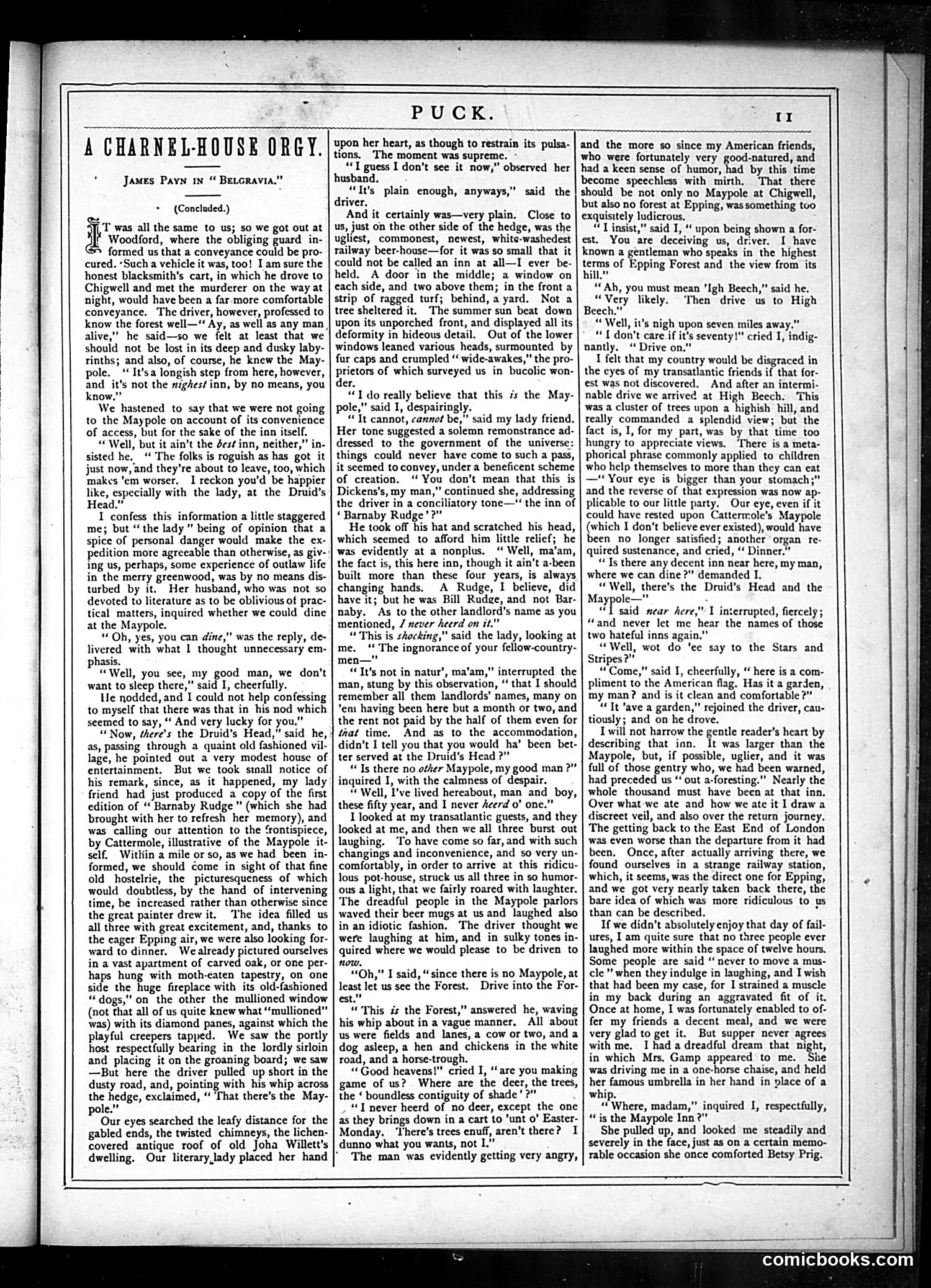
This page is primarily **text fiction**, not a political cartoon. It's the conclusion of a serialized story from *Belgravia* magazine, featuring dialogue between characters discussing an English country inn called the Maypole and various local matters. The narrative involves a driver, his passengers, and observations about the Maypole's accommodations and proprietors. References include "High Beech," "Barnaby Rudge," and the "Druid's Head" inn. **There are no identifiable political figures or satirical commentary visible on this page.** It is literary content—a Victorian-era short story—rather than the political satire *Puck* magazine typically featured.
📄 Transcribed text from this page (OCR, searchable)
Machine-transcribed from the original scan — historical spelling and the odd misread are preserved.
PUCK. 3 19 ¢ A GHARNEL-HOUSE ORGY. James Payn In “ BELGRAVIA.” + (Concluded.) S7{T was all the same to us; so we got out at BN Woodford, where the obliging guard in- formed us that a conveyance could be pro- cured, ‘Such a vehicle it was, too! I am sure the honest blacksmith’s cart, in which he drove to Chigwell and met the murderer on the way at night, would have been a far.more comfortable conveyance. The driver, however, professed to know the forest well—‘ Ay, as well as any man | alive,” he said—so we felt at least that we should not be lost in its deep and dusky laby- rinths; and also, of course, he knew the May- pole. '‘It’sa longish step from here, however, and it’s not the nighest inn, by no means, you know,” We hastened to say that we were not going to the Maypole on account of its convenience of access, but for the sake of the inn itself. “Well, but it ain’t the des¢ inn, neither,” in- sisted he. “ The folks is roguish as has got it just now, and they're about to leave, too, which makes ‘em worser. I reckon you'd be happier like, especially with the lady, at the Druid’s Head.” I confess this information a little staggered me; but “the lady” being of opinion that a spice of personal danger would make the ex- pedition more agreeable than otherwise, as giv- ing us, perhaps, some experience of outlaw life in the merry greenwood, was by no means dis- turbed by it. Her husband, who was not so devoted to literature as to be oblivious of prac- tical matters, inquired whether we could dine at the Maypole. “Oh, yes, you can dine,” was the reply, de- livered with what 1 thought unnecessary em- phasis. “Well, you see, my good man, we don’t want to sleep there,” said I, cheerfully. Ue nodded, and I could not help confessing to myself that there was that in his nod which seemed to say, “ And very lucky for you.” “Now, there's the Druid’s Head,” said he, as, passing through a quaint old fashioned vil- lage, he pointed out a very modest house of entertainment. But we took stnall notice of his remark, since, as it happened, my lady friend had just produced a copy of the first edition of “ Barnaby Rudge” (which she had brought with her to refresh her memory), and was calling our attention to the ‘rontispiece, by Cattermole, illustrative of the Maypole it- self. Witliin a mile or so, as we had been in- formed, we should come in sight of that fine old hostelrie, the picturesqueness of which would doubtless, by the hand of intervening time, be increased rather than otherwise since the great painter drew it. The idea filled us all three with great excitement, and, thanks to the eager Epping air, we were also looking for- ward to dinner, We already pictured ourselves in a vast apartment of carved oak, or one per- haps hung with moth-eaten tapestry, on one side the huge fireplace with its old-fashioned “ dogs,” on the other the mullioned window (not that all of us quite knew what “‘mullioned” was) with its diamond panes, against which the playful creepers tapped. We saw the portly host respectfully bearing in the lordly sirloin and placing it on the groaning board; we saw —But here the driver pulled up short in the dusty road, and, pointing with his whip across the hedge, exclaimed, ‘ ‘That there's the May- pole.” Our eyes searched the leafy distance for the gabled ends, the twisted chimneys, the lichen- covered antique roof of old Joha Willett’s dwelling. Our literarylady placed her hand |" upon her heart, as though to restrain its pulsa- tions, The moment was supreme. - “I guess I don’t see it now,” observed her husband. “It’s plain enough, anyways,” said the driver. And it certainly was—very plain. Close to us, just on the other side of the hedge, was the ugliest, commonest, newest, white-washedest railway beer-house—for it was so small that it could not be called an inn at all—I ever be- held. A door in the middle; a window on each side, and two above them; in the front a strip of ragged turf; behind, a yard. Not a tree sheltered it. The summer sun beat down upon its unporched front, and displayed all its deformity in hideous detail. Out of the lower windows leaned various heads, surmounted by fur caps and crumpled ‘‘ wide-awakes,” the pro- Brletors of which surveyed us in bucolic won- er. “I do really believe that this /s the May- pole,” said I, despairingly. “Tt cannot, cannot be,” said my lady friend. Her tone suggested a solemn remonstrance ad- dressed to the government of the universe: things could never have come to such a pass, it seemed to convey, under a beneficent scheme of creation. ‘“ You don’t mean that this is Dickens's, my man,” continued she, addressing the driver in a conciliatory tone—‘ the inn of * Barnaby Rudge’ ?” He took off his hat and scratched his head, which seemed to afford him little relief; he was evidently at a nonplus. “ Well, ma’am, the fact is, this here inn, though it ain’t a-been built more than these four years, is always changing hands. A Rudge, I believe, did have it; but he was Bill Rudge, and not Bar- naby. As to the other landlord’s name as you mentioned, / never heerd on it.” “This is shocking,” said the lady, looking at me. ‘ The ingnorance of your fellow-country- men—" “It’s not in natur’, ma’am,” interrupted the man, stung by this observation, “that I should remember all them landlords’ names, many on *em having been here but a month or two, and the rent not paid by the half of them even for that time. And as to the accommodation, didn't I tell you that you would ha’ been bet- ter served at the Druid’s Head ?” «Ts there no other Maypole, my good man ?”” inquired I, with the calmness of despair. “Well, I’ve lived hereabout, man and boy, these fifty year, and I never Aeerd 0’ one.” 1 looked at my transatlantic guests, and they looked at me, and then we all three burst out laughing. ‘To have come so far, and with such changings and inconvenience, and so very un- comfortably, in order to arrive at this ridicu- lous pot-house, struck us all three in so humor- ous a light, that we fairly roared with laughter. The dreadful people in the Maypole parlors waved their beer mugs at us and laughed also in an idiotic fashion, The driver thought we were laughing at him, and in sulky tones in- quired where we would please to be driven to now. “Oh,” I said, “since there is no Maypole, at least let us see the Forest. Drive into the For- est.” “This is the Forest,” answered he, waving his whip about in a vague manner, All about us were fields and lanes, a cow or two, and a dog asleep, a hen and chickens in the white road, and a horse-trough. “Good heavens!” cried I, ‘are you making game of us? Where are the deer, the trees, the ‘ boundless contiguity of shade’ ?” “T never heerd of no deer, except the one as they brings down in a cart to ‘unt o’ Easter- Monday. ‘There's trees enuff, aren’t there? I dunno what you wants, not I.” The man was evidently getting very angry, and the more so since my American friends, who were fortunately very good-natured, and had a keen sense of humor, had by this time become speechless with mirth. ‘That there should be not only no Maypole at Chigwell, but also no forest at Epping, was something tuo exquisitely ludicrous, “T insist,” said I, “ upon being shown a for- est. You are deceiving us, driver. I have known a gentleman who speaks in the highest Gata? of Epping Forest and the view from its il” “‘Ah, you must mean 'Igh Beech,” said he. “Very likely, ‘Then drive us to High Beech.” “Well, it’s nigh upon seven miles away.” “I don't care if it's seventy!” cried I, indig- nantly. “ Drive on.” I felt that my country would be disgraced in the eyes of my transatlantic friends if that for- est was not discovered. And after an intermi- nable drive we arrived at High Beech. This was a cluster of trees upon a highish hill, and really commanded a splendid view; but the fact is, I, for my part, was by that time too hungry to appreciate views. ‘There is a meta- phorical phrase commonly applied to children who help themselves to more than they can eat —Your eye is bigger than your stomach;” and the reverse of that expression was now ap- plicable to our little party. Our eye, even if it could have rested upon Cattermole’s Maypole (which I don’t believe ever existed), would have been no longer satisfied; another organ re- quired sustenance, and cried, Dinner.” “Ts there any decent inn near here, my man, where we can dine?” demanded I. “Well, there’s the Druid’s Head and the Maypole—” : “I said near here,” 1 interrupted, fiercely; “and never let me hear the names of those two hateful inns again.” “Well, wot do 'ee say to the Stars and Stripes?” “Come,” said I, cheerfully, “ here is a com- pliment to the American flag. Has it a garden, my man? and is it clean and comfortable ?” “Tt ’ave a garden,” rejoined the driver, cau- tiously; and on he drove. I will not harrow the gentle reader's heart by describing that inn. It was larger than the Maypole, but, if possible, uglier, and it was full of those gentry who, we had been warned, had preceded us “out a-foresting.” Nearly the whole thousand must have been at that inn, Over what-we ate and how we ate it I drawa discreet veil, and also over the return journey. The getting back to the East End of London was even worse than the departure from it had been. Once, after actually arriving there, we found ourselves in a strange railway station, which, it seems, was the direct one for Epping, and we got very nearly taken back there, the bare idea of which was more ridiculous to us than can be described. y If we didn’t absolutely enjoy that day of fail- ures, I am quite sure that no three people ever laughed more within the space of twelve hours. Some people are said “never to move a mus- cle ” when they indulge in laughing, and I wish that had been my case, for I strained a muscle in my back during an aggravated fit of it. Once at home, I was fortunately enabled to of- fer my friends a decent meal, and we were very glad to get it. But supper never agrees with me. I had a dreadful dream that night, in which Mrs, Gamp appeared to me. Sie was driving me in a one-horse chaise, and held her famous umbrella in her hand in place of a whip. “Where, madam,” inquired I, respectfully, “is the Maypole Inn?” She pulled up, and looked me steadily and severely in the face, just as on a certain memo- rable occasion she once comforted Betsy Prig. . a aa ae comicbooks.com