
Puck, 1879-03-05 · page 9 of 19
Puck — March 5, 1879 — page 9: what you’re looking at
What you’re looking at
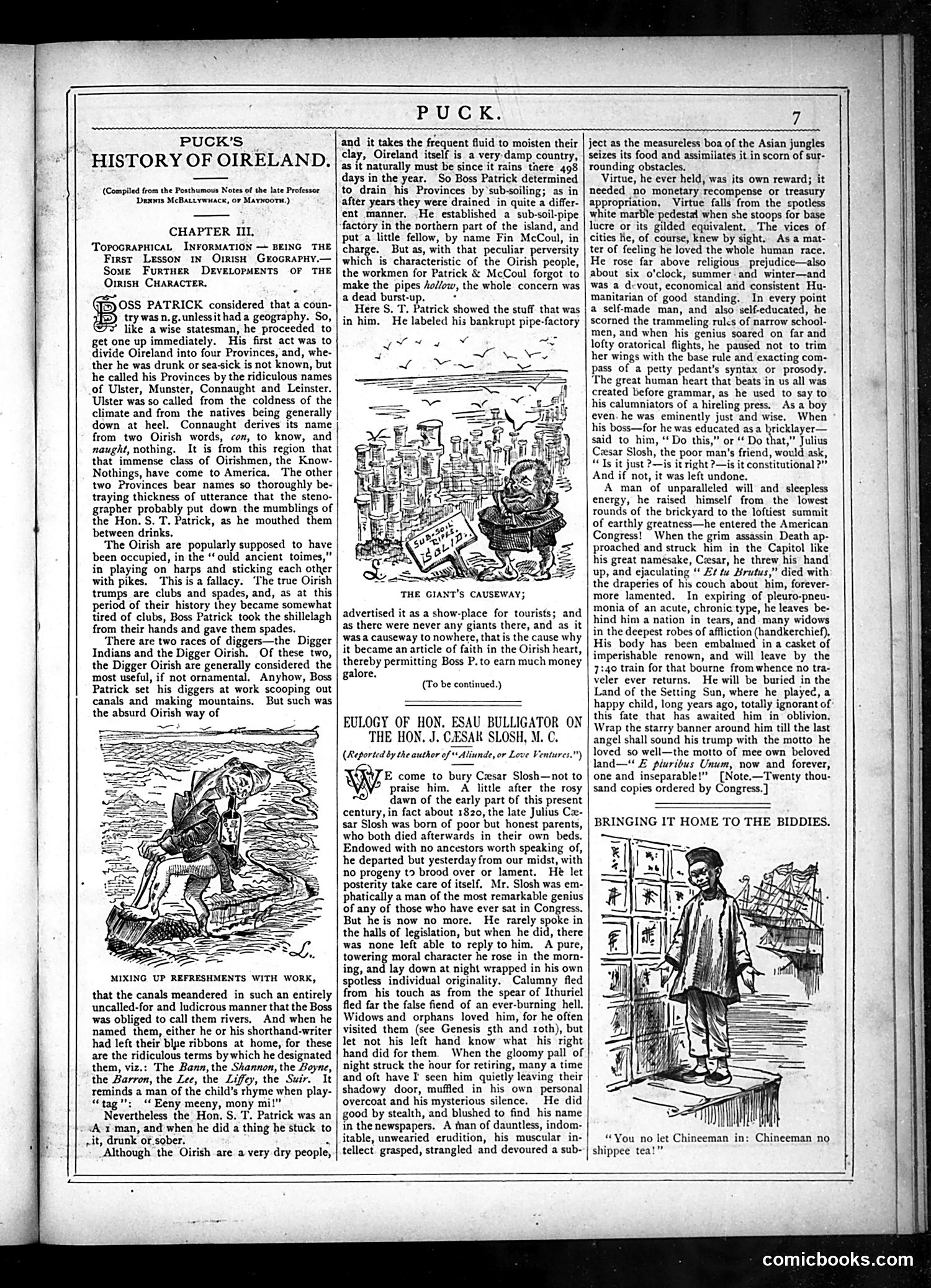
This page contains three distinct sections: 1. **"Puck's History of Ireland"** (top): A serialized article with illustration of "The Giant's Causeway," discussing Irish geography and Patrick's development of sub-soil pipe factories. 2. **"Eulogy of Hon. Esau Bulligator on the Hon. J. Caesar Slosh"** (middle): A satirical obituary piece praising a deceased congressman named Caesar Slosh, portraying him as a man of humble origins who rose through moral character despite lacking formal education or political connections—a commentary on American democratic ideals. 3. **"Bringing It Home to the Hiddies"** (bottom right): A cartoon showing a man displaying Chinese artwork or goods, with the caption "You no let Chinaman in; Chinaman no shippe tea!"—satirizing 1880s-90s anti-Chinese sentiment and trade restrictions, using offensive dialect for comedic effect.
📄 Transcribed text from this page (OCR, searchable)
Machine-transcribed from the original scan — historical spelling and the odd misread are preserved.
PUCK. 7 PUCK’S | HISTORY OF OIRELAND. (Compiled from the Posthumous Notes of the late Professor Daxmis McBattrwnack, or Manors.) CHAPTER III, TOPOGRAPHICAL INFORMATION — BEING THE First Lesson 1N_OirisH GroGRAPHY.— Some FurtHeR DEVELOPMENTS OF THE OrrisH CHARACTER. OSS PATRICK considered that a coun- >) try was n.g.unlessithad a geography. So, like a wise statesman, he proceeded to get one up immediately. His first act was to divide Oireland into four Provinces, and, whe- ther he was drunk or sea-sick is not known, but he called his Provinces by the ridiculous names of Ulster, Munster, Connaught and Leinster. Ulster was so called from the coldness of the climate and from the natives being generally down at heel. Connaught derives its name from two Oirish words, con, to know, and naught, nothing. It is from this region that that immense class of Oirishmen, the Know- Nothings, have come to America, The other two Provinces bear names so thoroughly be- traying thickness of utterance that the steno- grapher probably put down the mumblings of the Hon. S. T. Patrick, as he mouthed them between drinks. The Oirish are popularly supposed to have been occupied, in the ‘ould ancient toimes,” in playing on harps and sticking each other with pikes. This is a fallacy. ‘The true Oirish trumps are clubs and spades, and, as at this period of their history they became somewhat tired of clubs, Boss Patrick took the shillelagh from their hands and gave them spades. ‘There are two races of diggers—the Digger Indians and the Digger Oirish. Of these two, the Digger Oirish are generally considered the most useful, if not ornamental. Anyhow, Boss Patrick set his diggers at work scooping out canals and making mountains. But such was the absurd Oirish way of MIXING UP REFRESHMENTS WITH WORK, that the canals meandered in such an entirely uncalled-for and ludicrous manner that the Boss was obliged to call them rivers, And when he named them, either he or his shorthand-writer had left their blpe ribbons at home, for these are the ridiculous terms by which he designated them, viz.: The Bann, the Shannon, the Boyne, the Barron, the Lee, the Liffey, the Suir. It reminds a man of the child’s rhyme when play- “tag": ‘Eeny meeny, mony mi!” Nevertheless the Hon. S. T, Patrick was an ‘A rman, and when he did a thing he stuck to ,it, drunk or.sober. 3 and it takes the frequent fluid to moisten their clay, Oireland itself is a very-damp country, as it naturally must be since it rains there 498 days in the year. So Boss Patrick determined to drain his Provinces by'sub-soiling; as in after years they were drained in quite a differ- ent manner. .He established a sub-soil-pipe factory in the porthern part of the island, and put a little fellow, by name Fin McCoul, in charge. But as, with that peculiar perversity which is characteristic of the Oirish people, the workmen for Patrick & McCoul forgot to make the pipes io/ow, the whole concern was a dead burst-up. . Here S. T. Patrick showed the stuff that was in him. He labeled his bankrupt pipe-factory THE GIANT'S CAUSEWAY; advertised it as a show-place for tourists; and as there were never any giants there, and as it was a causeway to nowhere, that is the cause why it became an article of faith in the Oirish heart, thereby permitting Boss P. to earn much money galore. (To be continued.) EULOGY OF HON. ESAU BULLIGATOR ON THE HON. J. CESAR SLOSH, M. C. (Reported by the author of “Aliunde, or Love Ventures.") E come to bury Crsar Slosh—not to praise him. A little after the rosy dawn of the early part of this present century, in fact about 1820, the late Julius Cx- sar Slosh was born of poor but honest parents, who both died afterwards in their own beds. Endowed with no ancestors worth speaking of, he departed but yesterday from our midst, with no progeny t> brood over or lament. He let posterity take care of itself. Mr. Slosh was em- phatically a man of the most remarkable genius of any of those who have ever sat in Congress. But he is now no more. He rarely spoke in the halls of legislation, but when he did, there was none left able to reply tohim. A pure, towering moral character he rose in the morn- ing, and lay down at night wrapped in his own spotless individual originality. Calumny fled from his touch as from the spear of Ithuriel fled far the false fiend of an ever-burning hell. Widows and orphans loved him, for he often visited them (see Genesis sth and roth), but let not his left hand know what his right hand did for them. When the gloomy pall of night struck the hour for retiring, many a time and oft have I seen him quietly leaving their shadowy door, muffled in his own personal overcoat and his mysterious silence. He did good by stealth, and blushed to find his name in the newspapers. A than of dauntless, indom- itable, unwearied erudition, his muscular in- Although the Oirish are a very dry people, tellect grasped, strangled and devoured a sub- ject as the measureless boa of the Asian jungles seizes its food and assimilates it in scorn of sur- rounding obstacles. Virtue, he ever held, was its own reward; it needed no monetary recompense or treasury appropriation, Virtue falls from the spotless white marble pedestal when she stoops for base lucre or its gilded equivalent, The vices of cities He, of course, knew by sight. As a mat- ter of feeling he loved the whole human race. He rose far above religious prejudice—also about six o'clock, summer+and winter—and was a devout, economical and consistent Hu- manitarian of good standing. In every point a self-made man, and also self-educated, he scorned the trammeling rulcs of narrow school- men, and when his genius soared on far and lofty oratorical flights, he paused not to trim her wings with the base rule and exacting com- pass of a petty pedant’s syntax or prosody. The great human heart that beats ‘in us all was created before grammar, as he used to say to his calumniators of a hireling press. As a boy even. he was eminently just and wise. When his boss—for he was educated asa Keron Gir said to him, ‘Do this,” or “ Do that,” Julius Cesar Slosh, the poor man's friend, would ask, “Ts it just ?—is it right ?—is it constitutional ?” And if not, it was left undone. A man of unparalleled will and sleepless energy, he raised himself from the lowest rounds of the brickyard to the loftiest summit of earthly greatness—he entered the American Congress! When the grim assassin Death ap- proached and struck him in the Capitol like his great namesake, Ccesar, he threw his hand up, and ejaculating “ £¢ ta Brutus,” died with the draperies of his couch about him, forever- more lamented. In expiring of pleuro-pneu- monia of an acute, chronic type, he leaves be- hind him a nation in tears, and. many widows in the deepest robes of affliction (handkerchief), His body has been embalmed in a casket of imperishable renown, and will leave by the 7:40 train for that bourne from whence no tra- veler ever returns. He will be buried in the Land of the Setting Sun, where he played, a happy child, long years ago, totally ignorant of this fate that has awaited him in oblivion, Wrap the starry banner around him till the last angel shall sound his trump with the motto he loved so well—the motto of mee own beloved land— £ piuribus Unum, now and forever, one and inseparable!” [Note.—Twenty thou- sand copies ordered by Congress.] BRINGING IT HOME TO THE BIDDIES. “You no let Chineeman in: Chineeman no shippee tea!” comicbooks.com