
Puck, 1879-03-05 · page 6 of 19
Puck — March 5, 1879 — page 6: what you’re looking at
What you’re looking at
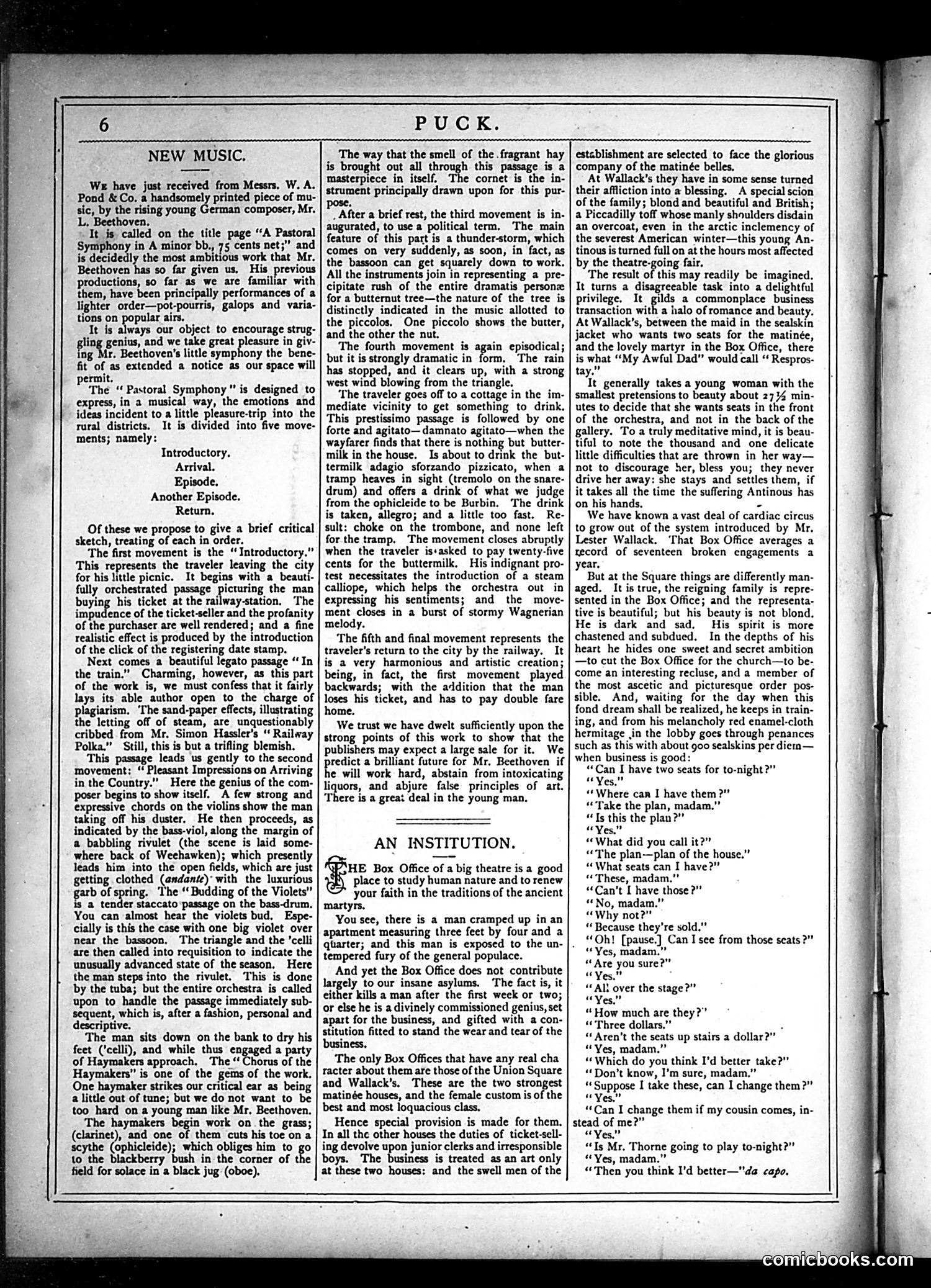
This page contains primarily **text content rather than cartoons**. It includes: 1. **"New Music"** - A lengthy review of Mr. Beethoven's "A Pastoral Symphony in a minor (Op. 25 cents net!)" described as "decidedly the most ambitious work that Mr. Beethoven has yet given us." The review discusses the five-movement composition's structure and musical innovations. 2. **"An Institution"** - A satirical piece about Box Office culture at theaters, criticizing how Box Offices treat customers and noting their dual-role as both "institutions" and profit-driven businesses. It compares Union Square and Wallack's theaters as the strongest "matinee houses." The page appears to be a mixed editorial/review section rather than featuring political cartoons.
📄 Transcribed text from this page (OCR, searchable)
Machine-transcribed from the original scan — historical spelling and the odd misread are preserved.
NEW MUSIC. We have just received from Messrs. W. A. Pond & Co, a handsomely printed piece of mu- sic, by the rising young German composer, Mr. L, Beethoven. It is called on the title page ‘A Pastoral Symphony in A minor bb., 75 cents net;” and is decidedly the most ambitious work that Mr. Beethoven has so far given us. His previous productions, so far as we are familiar with them, have been principally performances of a lighter order—pot-pourris, galops and varia- tions on popular airs. It is always our object to encourage strug- ling genius, and we take great peessite in giv- ing Mr. Beethoven's little symphony the bene- fit of as extended a notice as our space will permit. The ‘Pastoral Symphony" is designed to express, in a musical way, the emotions and ideas incident to a little pleasure-trip into the rural districts. It is divided into five move- ments; namely: Introductory, Arrival. Episode. Another Episode. Return, Of these we propose to give a brief critical sketch, treating of each in order. ‘The first movement is the “Introductory.” This represents the traveler leaving the cit; for his little picnic. It begins with a beauti- fully orchestrated passage picturing the man buying his ticket at the railway-station. The impudence of the ticket-seller and the profanity of the purchaser are well rendered; and a fine realistic effect is produced by the introduction of the click of the registering date stamp. Next comes a beautiful legato passage “In the train.” Charming, however, as this part of the work is, we must confess that it fairly lays its able author open to the charge of lagiarism, ‘The sand-paper effects, illustrating the letting off of steam, are unquestionably cribbed from Mr. Simon Hassler’s “ Railway Polka.” Still, this is but a trifling blemish. This passage leads us gently to the second movement: “Pleasant Impressions on Arriving in the Country.” Here the genius of the com- poser begins to show itself. A few strong and expressive chords on the violins show the man taking off his duster. He then proceeds, as indicated by the bass-viol, along the margin of a babbling rivulet (the scene is laid some- where back of Weehawken); which presently leads him into the open fields, which are just getting clothed (andante)’ with the luxurious garb of spring. The “ Budding of the Violets” is a tender staccato ‘passage on the bass-drum. You can almost hear the violets bud. Espe- cially is this the case with one big violet over near the bassoon. The triangle and the ’celli are then called into requisition to indicate the unusually advanced state of the season. Here the man steps into the rivulet. This is done by the tuba; but the entire orchestra is called upon to handle the passage immediately sub- sequent, which is, after a fashion, personal and descriptive. The man sits down on the bank to dry his feet (‘celli), and while thus engaged a party of Haymakers approach. The ‘“ Chorus of the Haymakers” is one of the gems of the work. One haymaker strikes our critical ear as being a little out of tune; but we do not want to be too hard on a young man like Mr. Beethoven. The haymakers begin work onthe grass; (clarinet), and one of them cuts his toe on a scythe (ophicleide); which obliges him to go to the black bush in the corner of ke field for solace in a black jug (oboe). PUCK. ‘The way that the smell of the.fragrant hay is brought out all through this passage is a masterpiece in itself. The cornet is the in- strument principally drawn upon for this pur- pose, _ After a brief rest, the third movement is in- augurated, to use a political term. The main feature of this part is a thunder-storm, which comes on very suddenly, as soon, in fact, as the bassoon can get squarely down to work. All the instruments join in representing a pre- cipitate rush of the entire dramatis persone for a butternut tree—the nature of the tree is distinctly indicated in the music allotted to the piccolos. One piccolo shows the butter, and the other the nut. The fourth movement is again episodical; but it is strongly dramatic in A The rain has stopped, and it clears up, with a strong west wind blowing from the triangle. ‘The traveler goes off to a cottage in the im- mediate vicinity to get something to drink. This prestissimo passage is followed by one forte and agitato— damnato agitato—when the wayfarer finds that there is nothing but butter- milk in the house. Is about to drink the but- termilk adagio sforzando pizzicato, when a tramp heaves in sight (tremolo on the snare- drum) and offers a drink of what we judge from the ophicleide to be Burbin. ‘The drink is taken, allegro; and a little too fast. Re- sult: choke on the trombone, and none left for the tramp. The movement closes abruptly when the traveler is‘asked to pay twenty-five cents for the buttermilk, His indignant pro- test necessitates the introduction of a steam calliope, which helps the orchestra out in expressing his sentiments; and the move- ment closes in a burst of stormy Wagnerian melody. The fifth and final movement represents the traveler's return to the city by the railway. It is a very harmonious and artistic creation; being, in fact, the first movement played backwards; with the addition that the man loses his ticket, and has to pay double fare home. We trust we have dwelt sufficiently upon the strong points of this work to show that the publishers may expect a large sale for it. We redict a brilliant future for Mr, Beethoven if ¢ will work hard, abstain from intoxicating liquors, and abjure false principles of art. ‘There is a great deal in the young man. AN INSTITUTION. HE Box Office of a big theatre is a good place to study human nature and to renew your faith in the traditions of the ancient martyrs. You see, there is a man cramped up in an apartment measuring three feet by four and a quarter; and this man is exposed to the un- |. tempered fury of the general populace. And yet the Box Office does not contribute largely to our insane asylums. The fact is, it either kills a man after the first week or two; or else he is a divinely commissioned genius, set apart for the business, and gifted with a con- stitution fitted to stand the wear and tear of the business, The only Box Offices that have any real cha racter about them are those of the Union Square and Wallack’s. These are the two strongest matinée houses, and the female custom is of the best and most loquacious class, Hence special provision is made for them. In all the other houses the duties of ticket-scll- ing devolve upon junior clerks and irresponsible boys. The business is treated as an art only at these two houses: and the swell men of the establishment are selected to face the glorious company of the matinée belles. At Wallack’s they have in some sense turned their affliction into a blessing. A special scion of the family; blond and beautiful and British; a Piccadilly toff whose manly shoulders disdain an overcoat, even in the arctic inclemency of the severest American winter—this young An- tinous is turned full on at the hours most affected by the theatre-going fair. The result of this may readily be imagined. It turns a disagreeable task into a delightful privilege. It gilds a commonplace business transaction with a halo of romance and beauty, At Wallack’s, between the maid in the sealskin jacket who wants two seats for the matinée, and the lovely martyr in the Box Office, there is what “My Awful Dad” would call ‘‘ Respros- tay.” It generally takes a young woman with the smallest pretensions to beauty about 2734 min- utes to decide that she wants seats in the front of the orchestra, and not in the back of the gallery. To a truly meditative mind, it is beau- tiful to note the thousand and one delicate little difficulties that are thrown in her way— not to discourage her, bless you; they never drive her away: she stays and settles them, if it takes all the time the suffering Antinous has on his hands. - We have known a vast deal of cardiac circus to grow out of the system introduced by Mr. Lester Wallack. ‘That Box Office averages a record of seventeen broken engagements a year, But at the Square things are differently man- aged. It is true, the reigning family is repre- sented in the Box Office; and the representa- tive is beautiful; but his beauty is not blond. He is dark and sad. His spirit is more chastened and subdued. In the depths of his heart he hides one sweet and secret ambition —to cut the Box Office for the church—to be- come an interesting recluse, and a member of the most ascetic and picturesque order pos- sible. And, waiting for the day when this fond dream shall be realized, he keeps in train- ing, and from his melancholy red enamel-cloth hermitage ,in the lobby goes through penances such as this with about goo sealskins per diem — when business is good: “Can I have two seats for to-night?” Yes.” “Where can I have them?” “Take the plan, madam.” “Ts this the plan?” “Yes,” “What did you call it?” “The plan—plan of the house.” “What seats can I have?” “Can't I have those ?”” “No, madam.” “Why not?” “ Because they're sold.” “Oh! [pause.] Can I see from those seats ?”” “Yes, madam.” “ Are you sure?” “Yes,” “All over the stage?” “Yes,” “ How much are they?” “Three dollars.” : “Aren't the seats up stairs a dollar?” “Yes, madam.” “Which do you think I'd better take?” “Don’t know, I’m sure, madam.” “Suppose I take these, can I change them?” “Yes,” “Can I change them if my cousin comes, in- stead of me?” “Yes,” “Is Mr. Thorne going to play to-night?” “Yes, madam.” “Then you think I'd better—"da capo.