
A complete issue · 16 pages · 1879
Puck — January 29, 1879
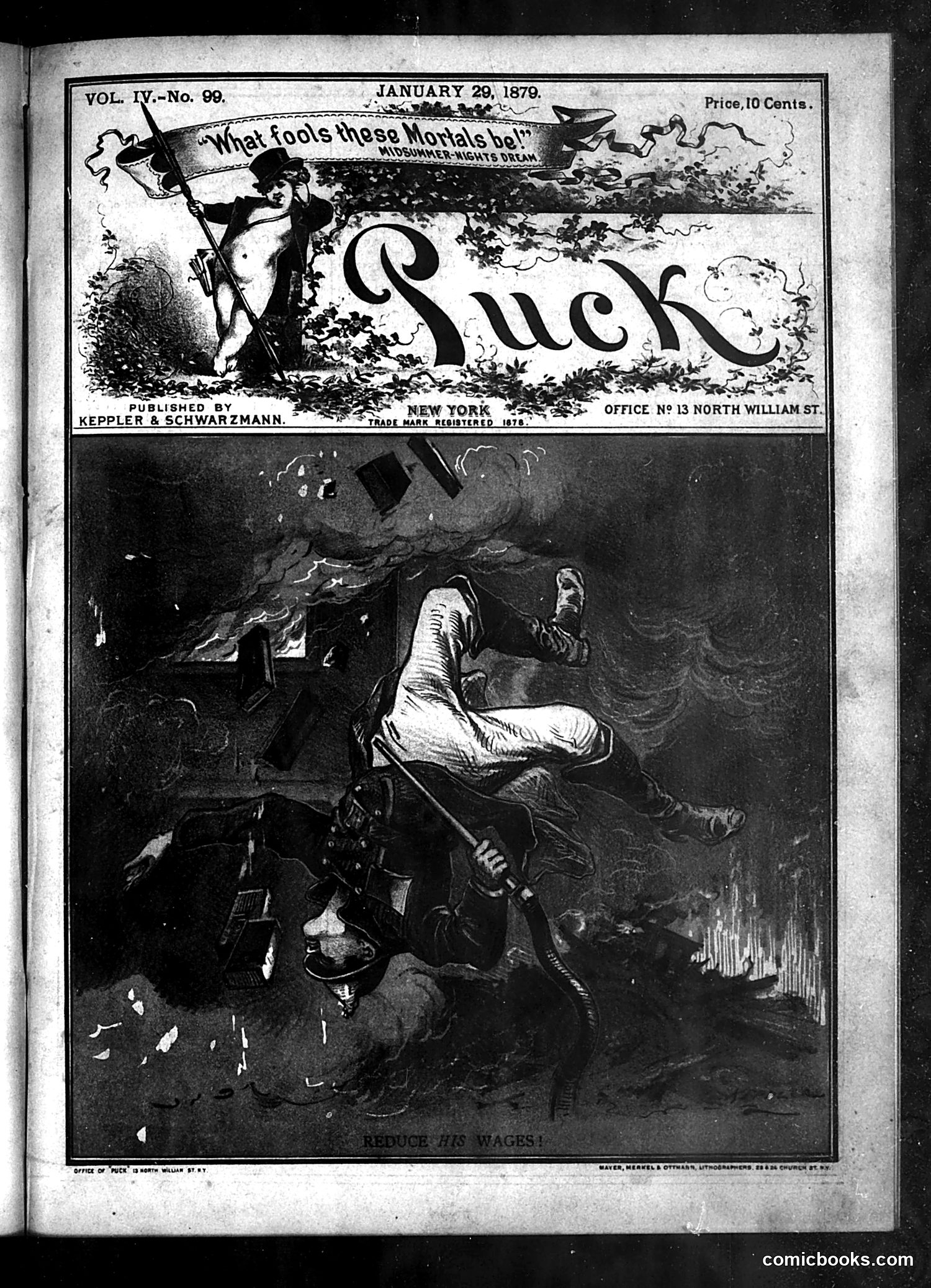
**Main Cartoon: "Reduce His Wages"** This satirical cartoon depicts a laborer being crushed or beaten down by machinery and industrial equipment. The image critiques the brutal treatment of workers during the industrial era—specifically, the practice of wage reduction as employers' response to labor disputes or economic conditions. The caption "Reduce His Wages" sarcastically comments on how factory owners and industrial capitalists would cut workers' pay rather than improve dangerous working conditions or acknowledge labor's hardships. The visual metaphor of the worker trapped beneath heavy machinery emphasizes the powerlessness of laborers against institutional exploitation. This reflects the broader 1870s labor movement tensions in America, when workers faced systematic wage cuts, unsafe conditions, and violent suppression of strikes.
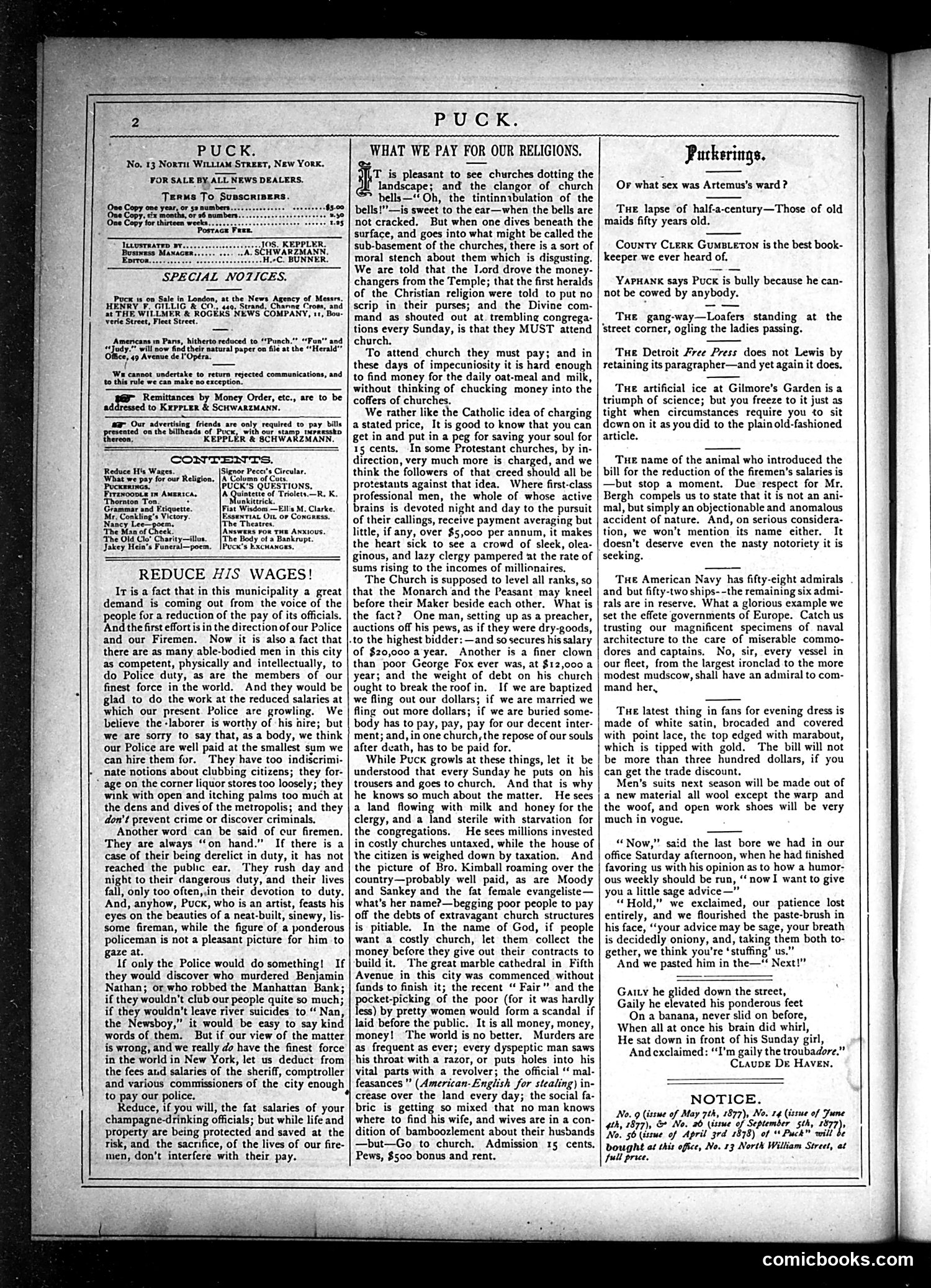
This page is primarily **text-based content** rather than political cartoons. The main articles address: 1. **"What We Pay for Our Religions"** - A lengthy critique of church finances, arguing that organized religion extracts excessive money from congregants while church leaders live lavishly. The piece contrasts wealthy clergy with starving congregations. 2. **"Reduce His Wages!"** - Satire attacking police corruption and arguing officers are overpaid relative to their duties. It suggests reducing police salaries would eliminate misconduct. The satire targets **institutional hypocrisy**: churches preaching charity while hoarding wealth, and corrupt police claiming financial hardship. The rhetoric is sharply class-conscious, championing poor workers against privileged institutions. No specific historical figures are identifiable in this text-heavy layout.
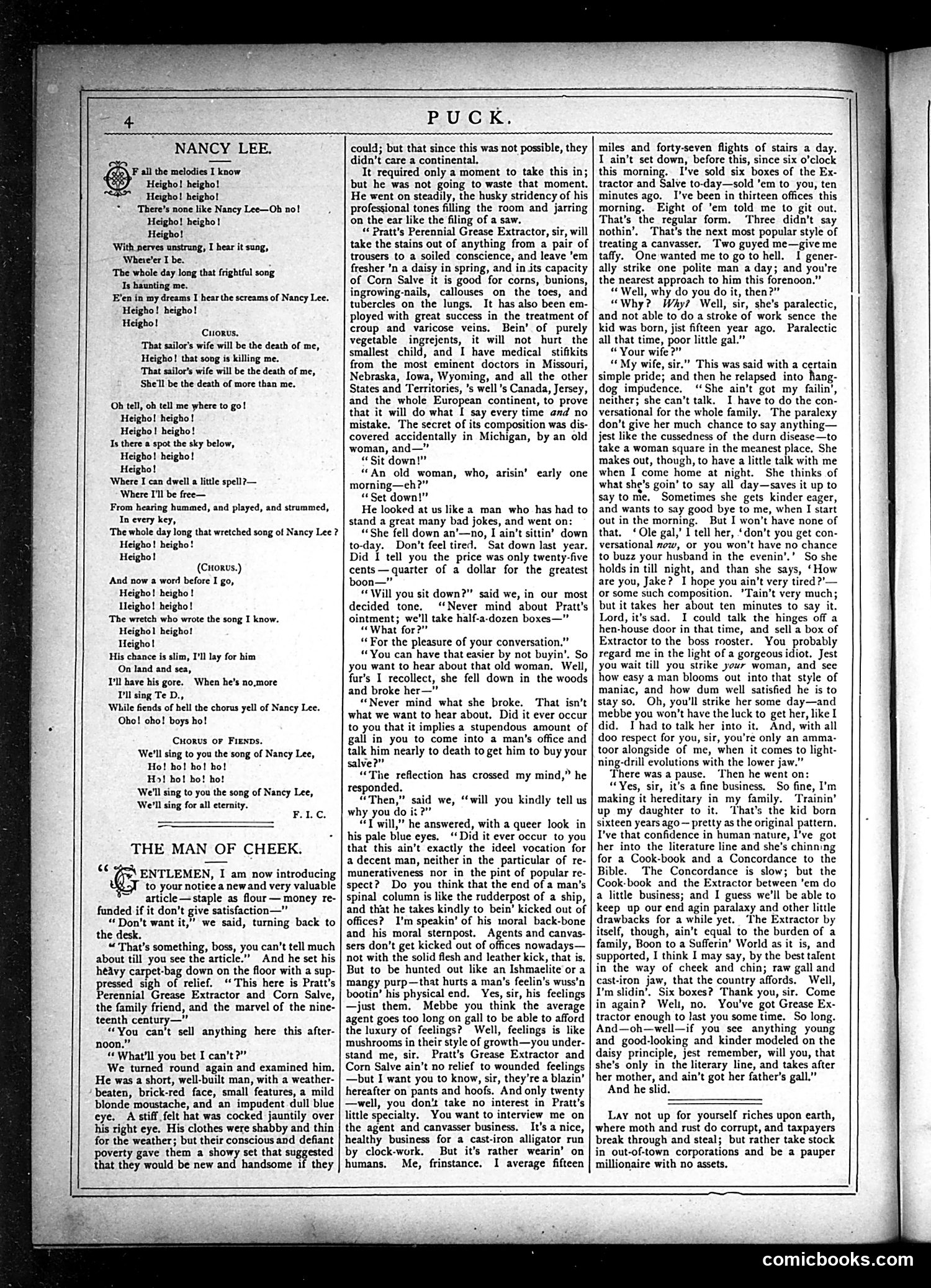
This page contains two distinct pieces: a song titled "Nancy Lee" (with chorus) and a satirical article called "The Man of Cheek." The article appears to be a humorous interview with a patent medicine salesman promoting "Pratt's Perennial Grease Extractor and Corn Salve." The satire targets quack remedies and aggressive sales tactics of the era. The "man of cheek" refers to the shameless confidence and brazen sales pitch of the vendor, who makes exaggerated medical claims while dismissing legitimate concerns about product safety and efficacy. The piece mocks both fraudulent patent medicines—common in Gilded Age America—and the aggressive, unethical advertising practices used to sell them to unsuspecting consumers. The humor relies on the character's outrageous claims and complete disregard for honesty or actual medical benefit.
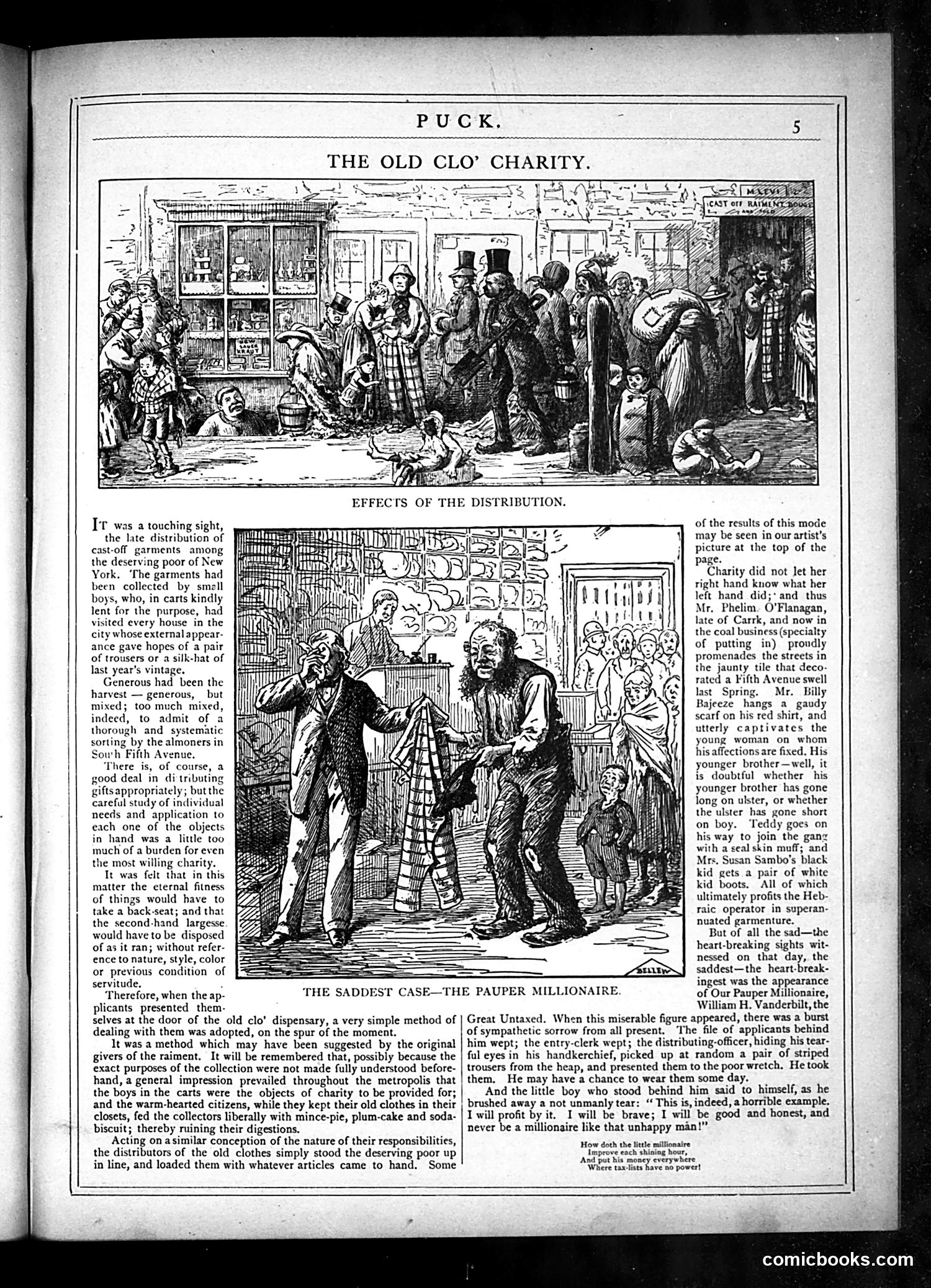
This satirical piece critiques the distribution methods of charitable clothing to New York's poor. The top illustration shows a street scene where deserving poor receive garments from a charity dispensary. The satire centers on the "Pauper Millionaire" cartoon below: a wealthy man in fine dress weeps upon receiving shabby donated clothes, while poor recipients accept them gratefully. The text mocks how the charity's distribution system fails to properly assess individual needs—clothes are given indiscriminately regardless of who deserves them. The joke exposes the inefficiency and absurdity of mechanized, impersonal charity: the system distributes identical items without considering whether recipients actually need them, potentially giving fine clothes to the undeserving while truly poor families receive rags. It's a critique of charity without genuine compassion or thoughtful administration.
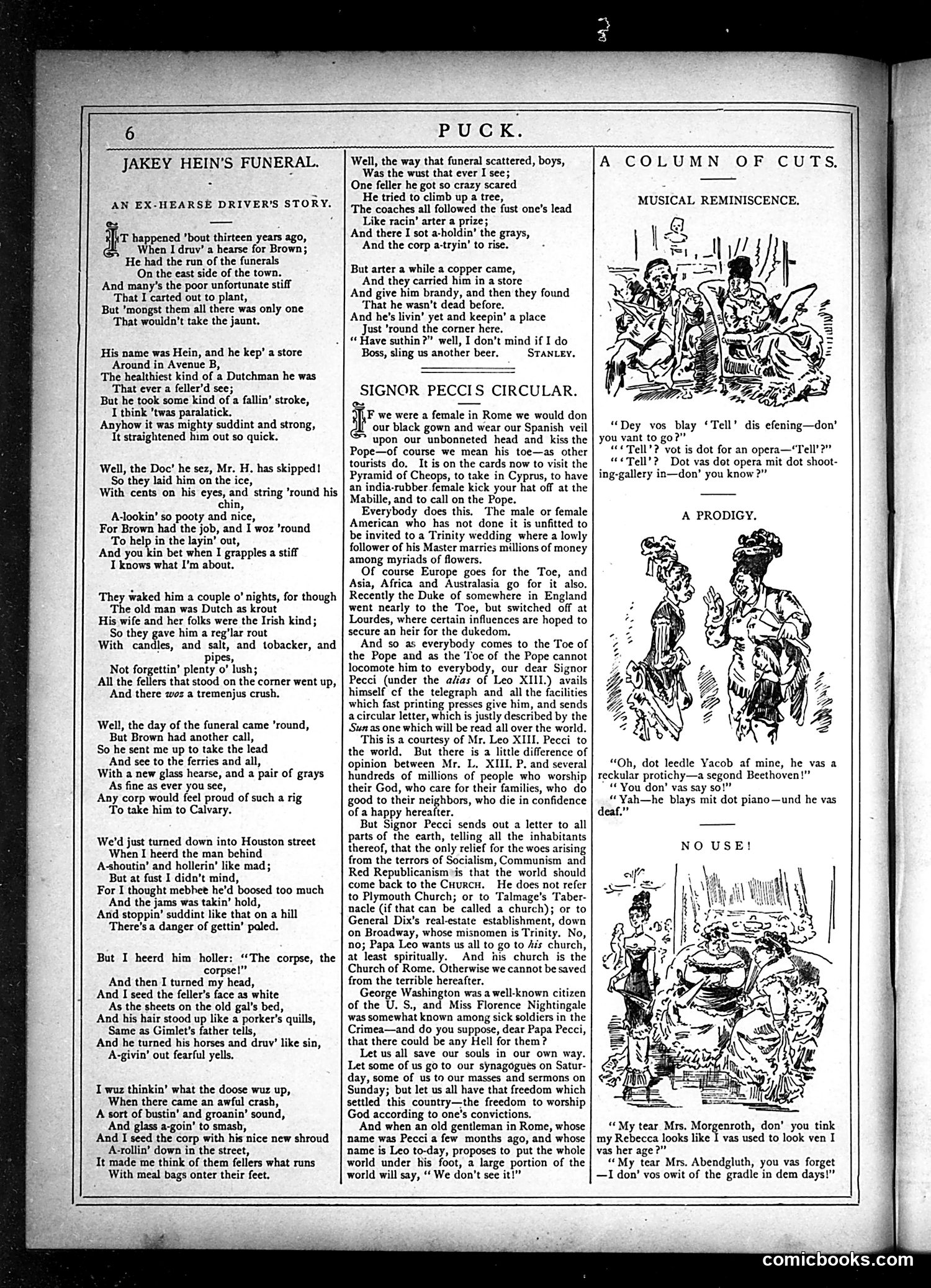
This page contains three distinct sections: 1. **"Jakey Hein's Funeral"** - A humorous ex-hearse driver's story about a funeral that scattered, with the corpse ending up in various locations before being found alive in a saloon. 2. **"Signor Peccis Circular"** - A satirical piece mocking Pope Leo XIII's circular letter about social issues. It ridicules the Pope's attempts to address socialism, communism, and labor unrest by suggesting his solution—returning to the Church—is ineffective and naive about modern problems. 3. **Illustrations** - Two cartoon vignettes labeled "Musical Reminiscence" and "A Prodigy," and "Nouse!" showing domestic or social scenes with accompanying humorous captions. The Pope piece represents typical Puck anti-Catholic satire common to American Protestant publications of this era.
This page contains **Puck's Questions** (a reader Q&A column) and **correspondence sections** rather than political cartoons. The content consists of humorous questions submitted by readers and editorial responses. The questions range across trivial topics (why certain animals behave as they do, etymological origins of phrases) and historical/geographical trivia. Some appear designed to trick answerers—for instance, asking "When will the railway between New York and London be completed?" to which the answer is "never." The **"Nice Correspondents"** section features letters from readers in New York and Chicago offering answers to previous questions, with editorial commentary. This is primarily a **text-based humor page**, not illustrated satire. The humor relies on wordplay, absurdist questions, and reader participation rather than political commentary or caricature.
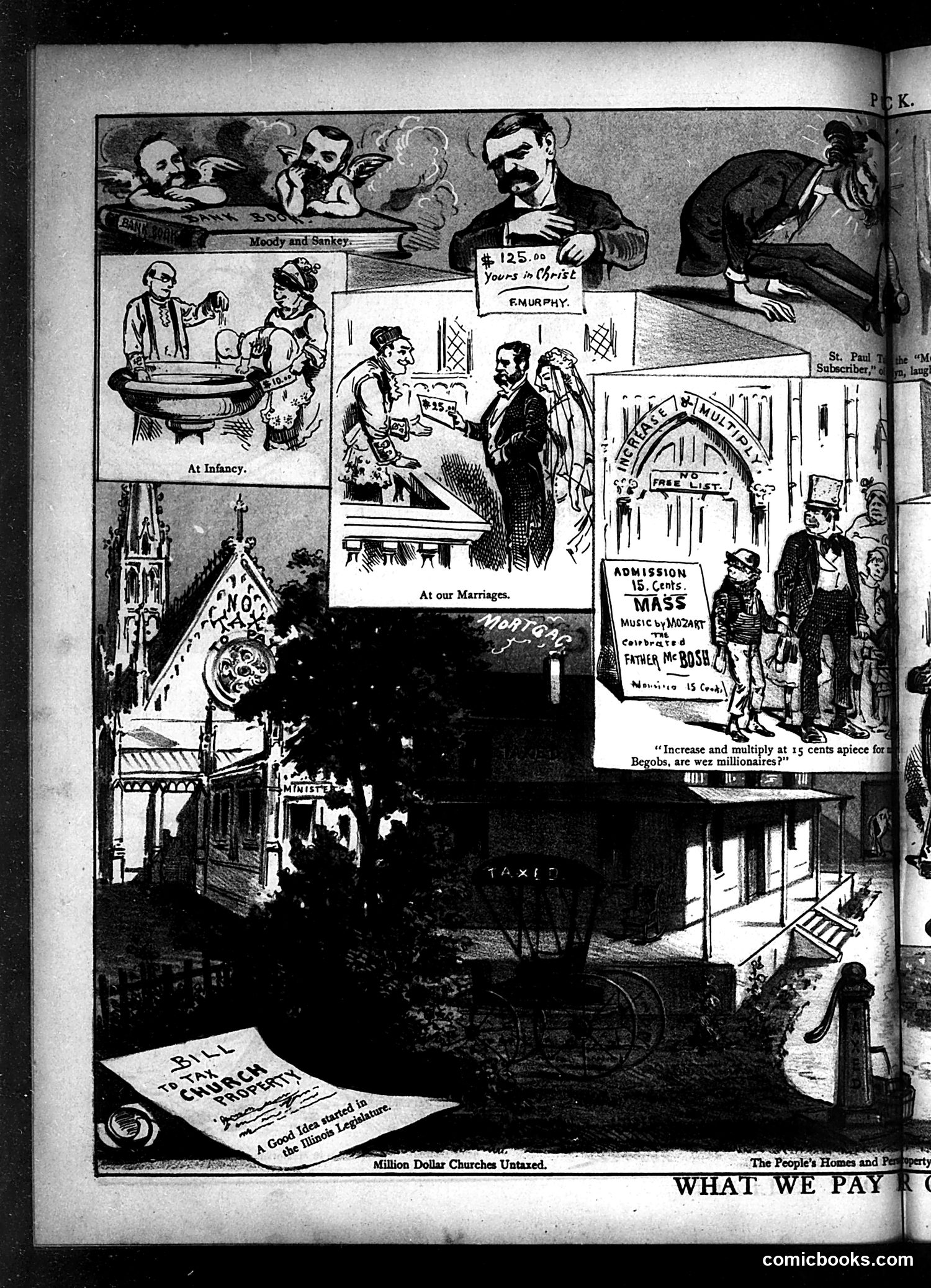
This page satirizes tax-exempt church property and wealth accumulation. The central image shows a large church labeled "Million Dollar Churches Untaxed" alongside "The People's Homes and Property" — contrasting religious institutions' financial power against ordinary citizens' modest dwellings. The upper cartoons mock how churches profit from life events: "At Infancy" (baptisms), "At our Marriages" (wedding fees), with one panel showing "$125.00 Yours in Christ — E. Murphy," suggesting clergy charge substantial fees. The bottom caption questions: "Increase and multiply at 15 cents apiece for Begobs, are wez millionaires?" — sarcastic commentary on churches accumulating wealth through routine religious services while remaining exempt from taxation that burdens regular citizens. The satire critiques institutional religious hypocrisy and economic inequality.
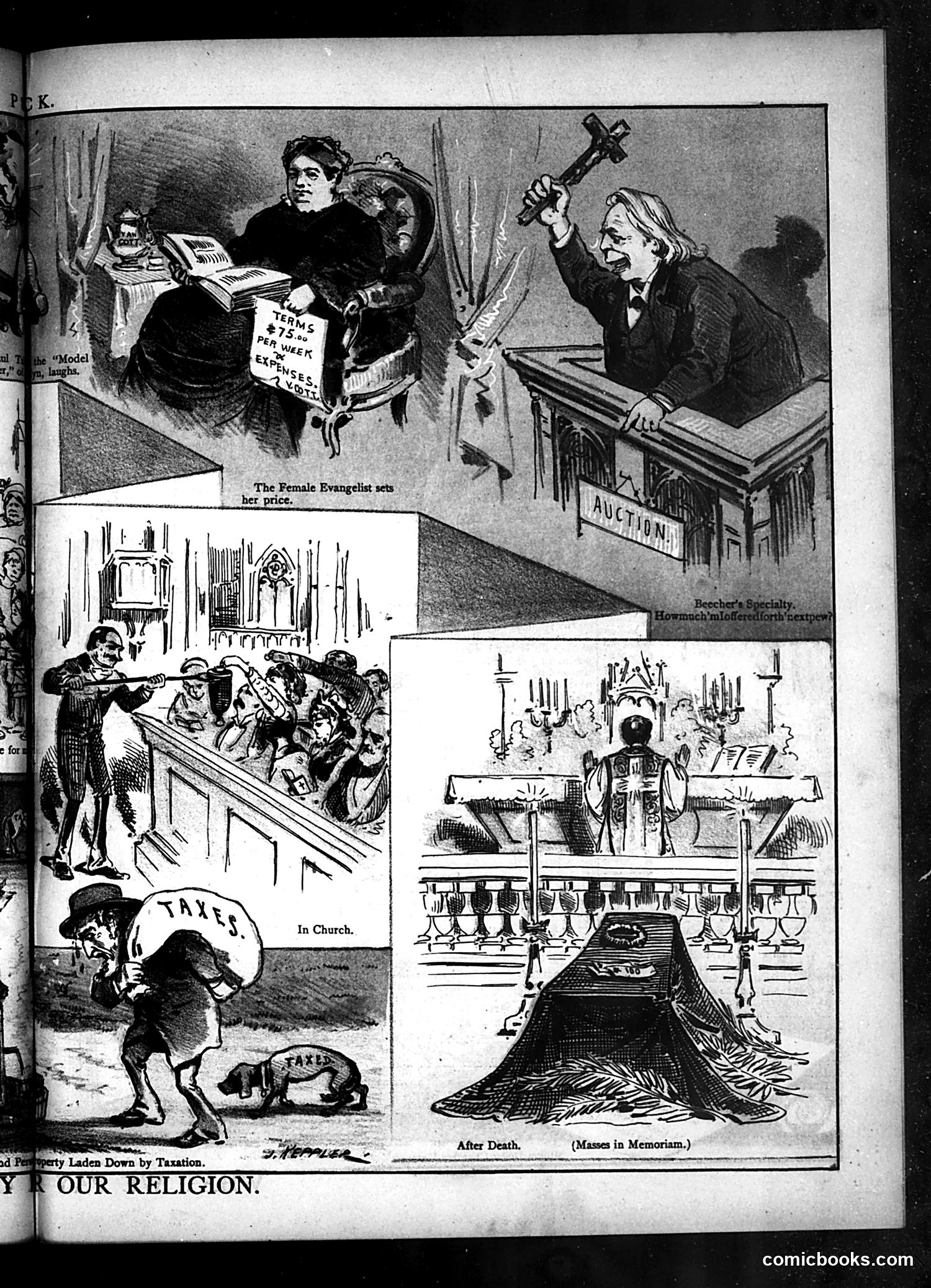
This page satirizes religious hypocrisy through four interconnected scenes: **Top panels**: A "Female Evangelist" auctions her services to the highest bidder, holding a document labeled "TERMS $500 PER WEEK EXPENSES" — mocking televangelists who profit from faith. **Bottom left**: "Taxes in Church" shows a poor person being squeezed financially within a church setting, suggesting the institution extracts money from the vulnerable. **Bottom right**: "After Death (Masses in Memoriam)" depicts a wealthy funeral with elaborate church ceremony, implying the religious establishment profits from death rituals. **Overall message**: Puck attacks organized religion's commercialization—from exploitative evangelists to how churches extract money from congregants across their lifespans, treating spirituality as a commodity rather than genuine faith.
This page contains political commentary and theater reviews rather than illustrated cartoons. The main satirical content appears in sections labeled "PUCK'S ESSENTIAL OIL OF CONGRESS" and "SENATE." The pieces mock Congressional figures, including criticism of Representative Mr. Tilden for allegedly accepting bribes ("bought anything in his life...would offer to purchase votes"). Senator Blaine is questioned about naval spending, and Senator Beck is criticized regarding account-keeping under Secretary Robeson. The "SENATE" section mocks Senator Kerman's support for Brazilian steamship subsidies, presenting it as corrupt favoritism. The page also includes theater reviews and a reader's letter praising Puck's recent satirical work on Madison Square's "Dickens' Dream" production. The overall tone is typical Gilded Age political satire targeting corruption and questionable fiscal practices.
This page presents a short story (not a political cartoon) about Monsieur Pascal Fénis, a wealthy Parisian jeweler who faces financial ruin. The narrative describes how his once-luxurious life—built on displaying artistic taste and employing skilled craftspeople—collapses when he goes bankrupt. The story satirizes the hollowness of wealth and status among Paris's elite. Fénis's elaborate lifestyle, his patronage of artists, and his carefully curated image prove fragile; his financial collapse exposes that his fortune, not genuine achievement or character, sustained his social position. The text suggests that appearances of refinement masked underlying vulnerability and moral emptiness—a common Puck theme critiquing the wealthy class.
This page contains a serialized story ("The Necklace," to be continued) rather than political cartoons. The narrative centers on Monsieur Pascal, an artist, and a valuable necklace belonging to the Archduchess Stephanie. The plot involves Pascal's conflict over a special Friday viewing of the necklace—apparently tied to Archduchess politics and artistic reputation. The story explores themes of artistic integrity, social ambition, and romantic entanglement, with characters debating whether Pascal should compromise his principles for social advancement. The right column contains unrelated satirical proverbs ("Puck's Briefings"), offering cynical observations on society—typical of Puck's humor style. Without identifying specific historical figures, the Archduchess reference suggests European aristocratic context, but the narrative is primarily fictional entertainment rather than direct political satire.
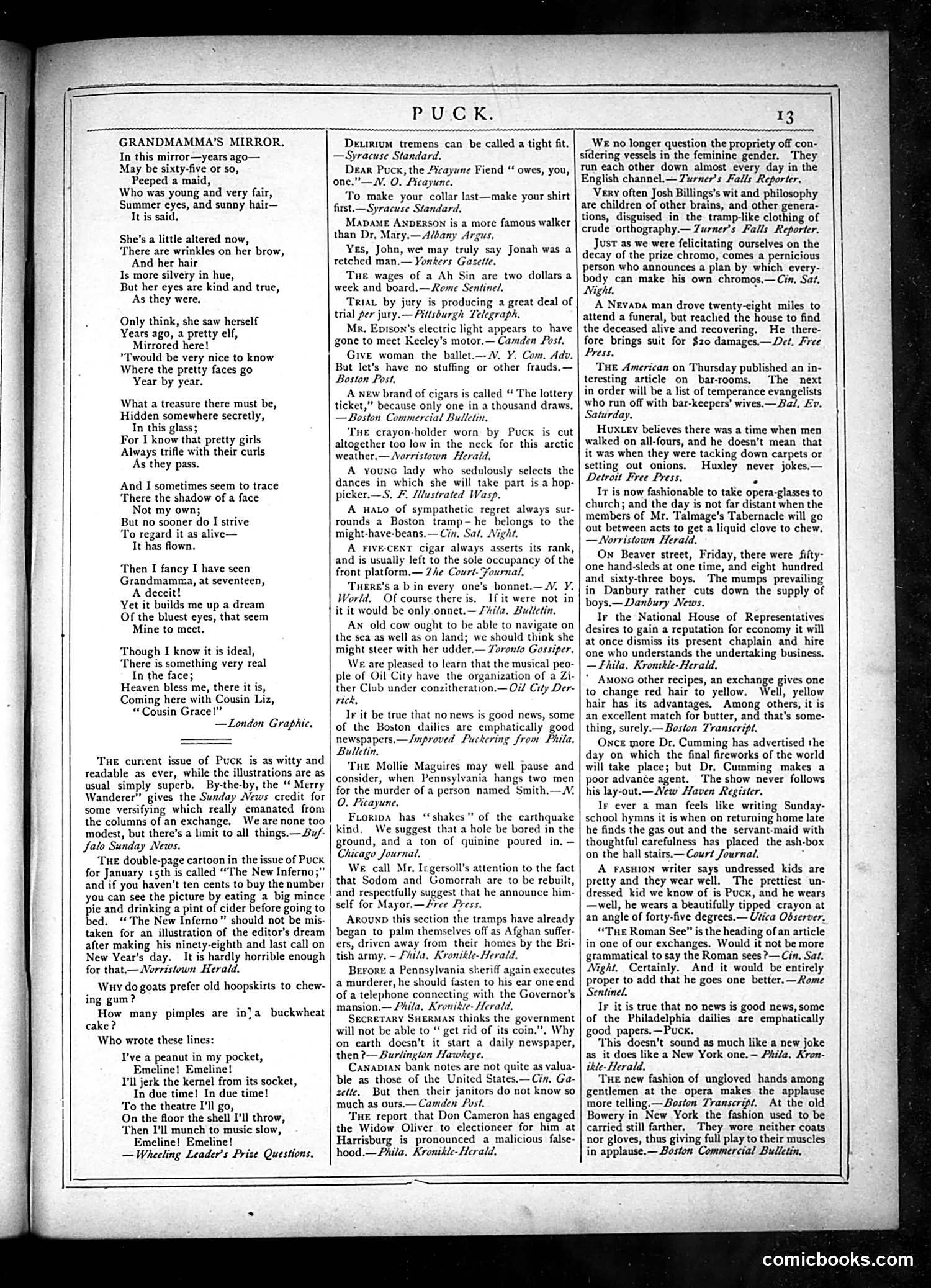
This page is primarily a poem titled "Grandmamma's Mirror," accompanied by miscellaneous short satirical items and notes from Puck's editors. The poem itself appears to be a romantic or sentimental piece about a young woman admiring herself in an old mirror, with the conceit that the mirror reflects not just her present beauty but also traces of her grandmother's youth. The text emphasizes the continuity of feminine beauty across generations. The surrounding editorial snippets mock contemporary issues: cigar brands, tram accidents, electrical innovations, fashion, and various social pretensions. One note mocks temperance evangelists; another ridicules men who walk arm-in-arm in public. Without visible illustrations accompanying the poem, the specific satirical targets and caricatures remain unclear from the image alone.
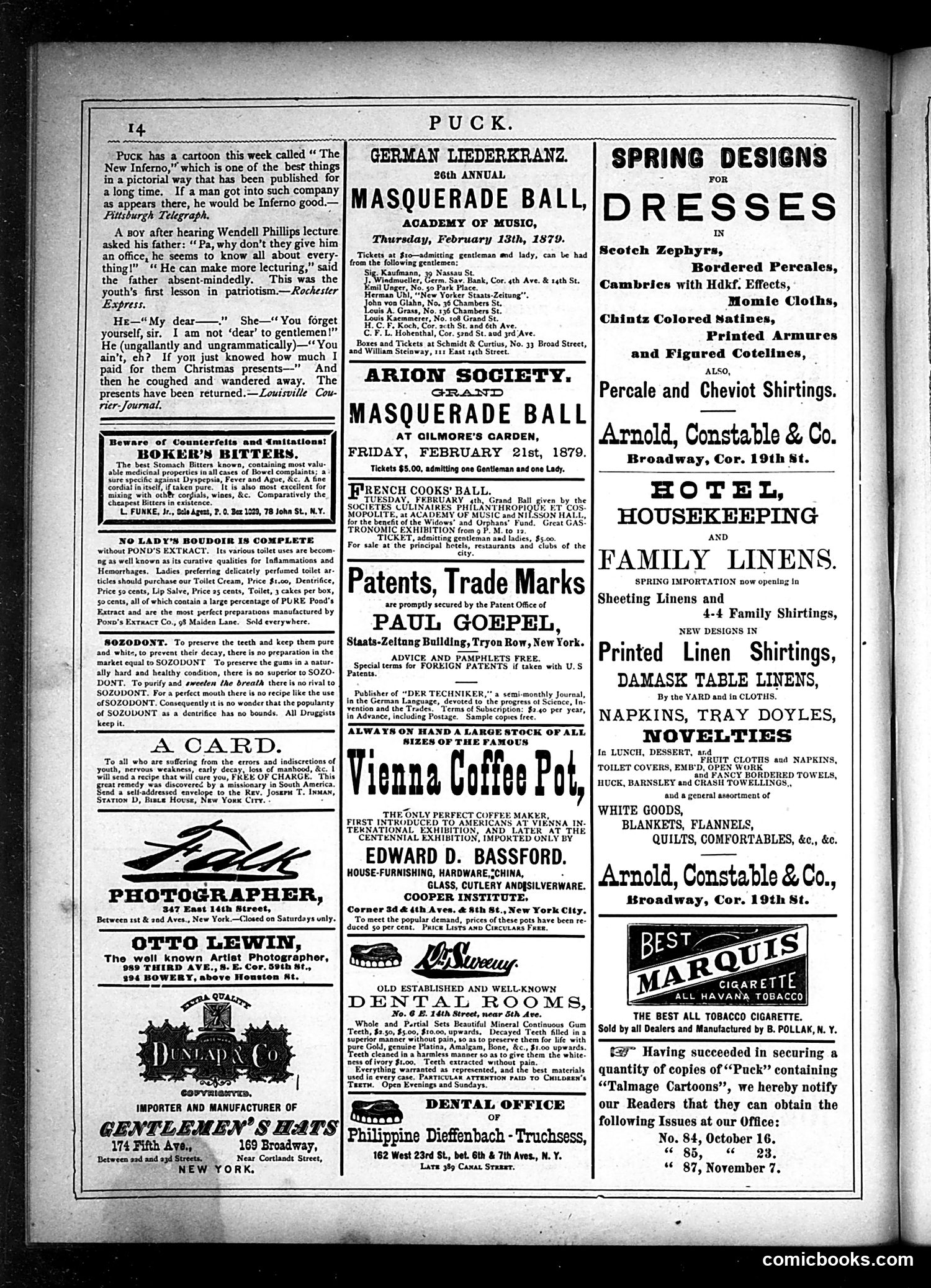
This is primarily an **advertising page** from Puck magazine (page 14), dated February 1879. It contains no political cartoons or satirical commentary visible in the image. The page features advertisements for various goods and services typical of the era: masquerade balls, coffee makers, photographers, dentists, haberdashery, linens, and other consumer products. There is **one brief editorial note** at the top mentioning Puck's cartoon "The New Inferno" and a humorous anecdote about a boy at a Wendell Phillips lecture, but these occupy minimal space and appear to be filler content rather than the page's primary purpose. The layout demonstrates how 19th-century magazines monetized space through dense advertising while maintaining minimal editorial content.
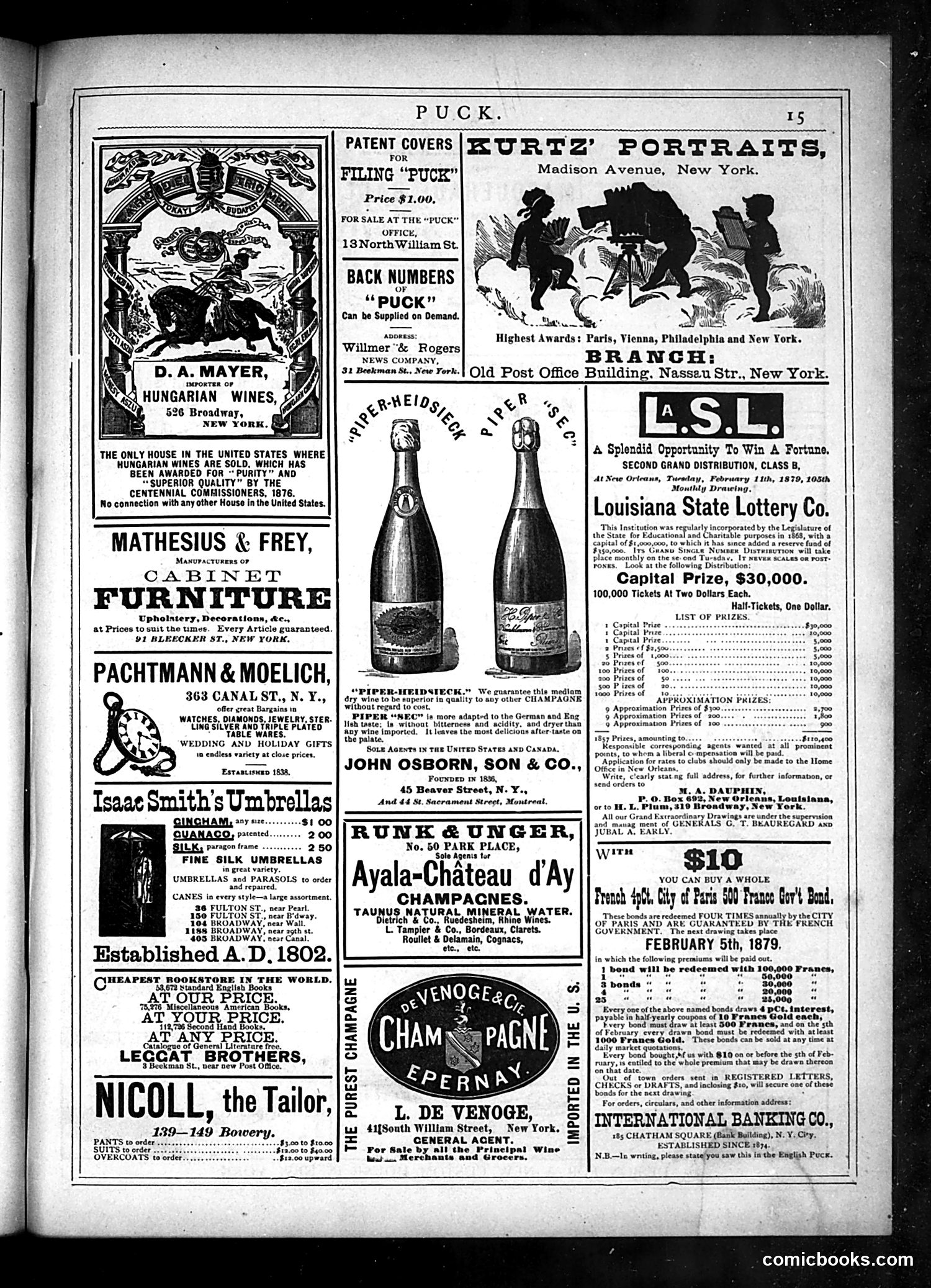
This appears to be primarily an **advertising page** from Puck magazine, rather than a satirical cartoon page. It contains numerous 19th-century commercial advertisements for products and services including: - Hungarian wines (D.A. Mayer) - Cabinet furniture (Mathesius & Frey) - Watches and table wares (Pachtmann & Moelich) - Umbrellas (Isaac Smith's) - Champagne brands (Piper-Heidsieck, Ayala-Château d'Ay, Devenoge & Co.) - Banking services (International Banking Co.) - Tailoring (Nicoll, the Tailor) There is also a small lottery advertisement for the Louisiana State Lottery featuring a capital prize of $30,000. The page demonstrates how 19th-century magazines funded publication through extensive paid advertising rather than relying solely on editorial content.
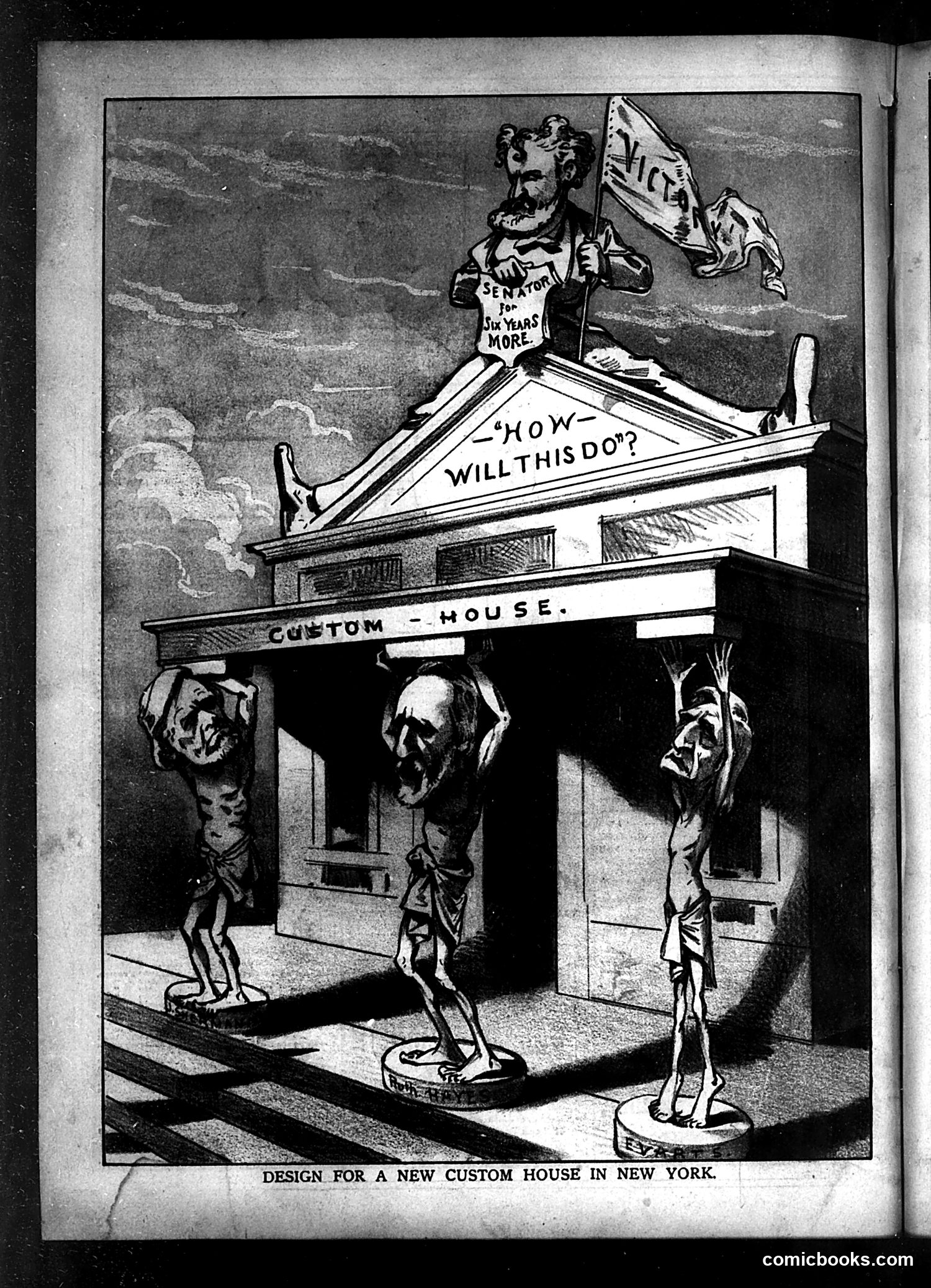
This political cartoon satirizes corruption in New York's Custom House. A rotund senator—labeled with text indicating he seeks "six years more" (likely seeking reelection)—stands atop a building's roof waving a flag marked "NICK" (possibly a person's name or slur). He asks "How will this do?" Below, three emaciated, skeletal figures support the structure on their backs, appearing to strain under its weight. These likely represent taxpayers or workers exploited by the corrupt system. The satire suggests that the Custom House—a patronage-filled institution—is built upon the backs of ordinary citizens, with corrupt officials like the senator profiting while the public suffers. The cartoon criticizes how political appointments to the Custom House enriched politicians at public expense.