
Puck, 1879-01-29 · page 12 of 16
Puck — January 29, 1879 — page 12: what you’re looking at
What you’re looking at
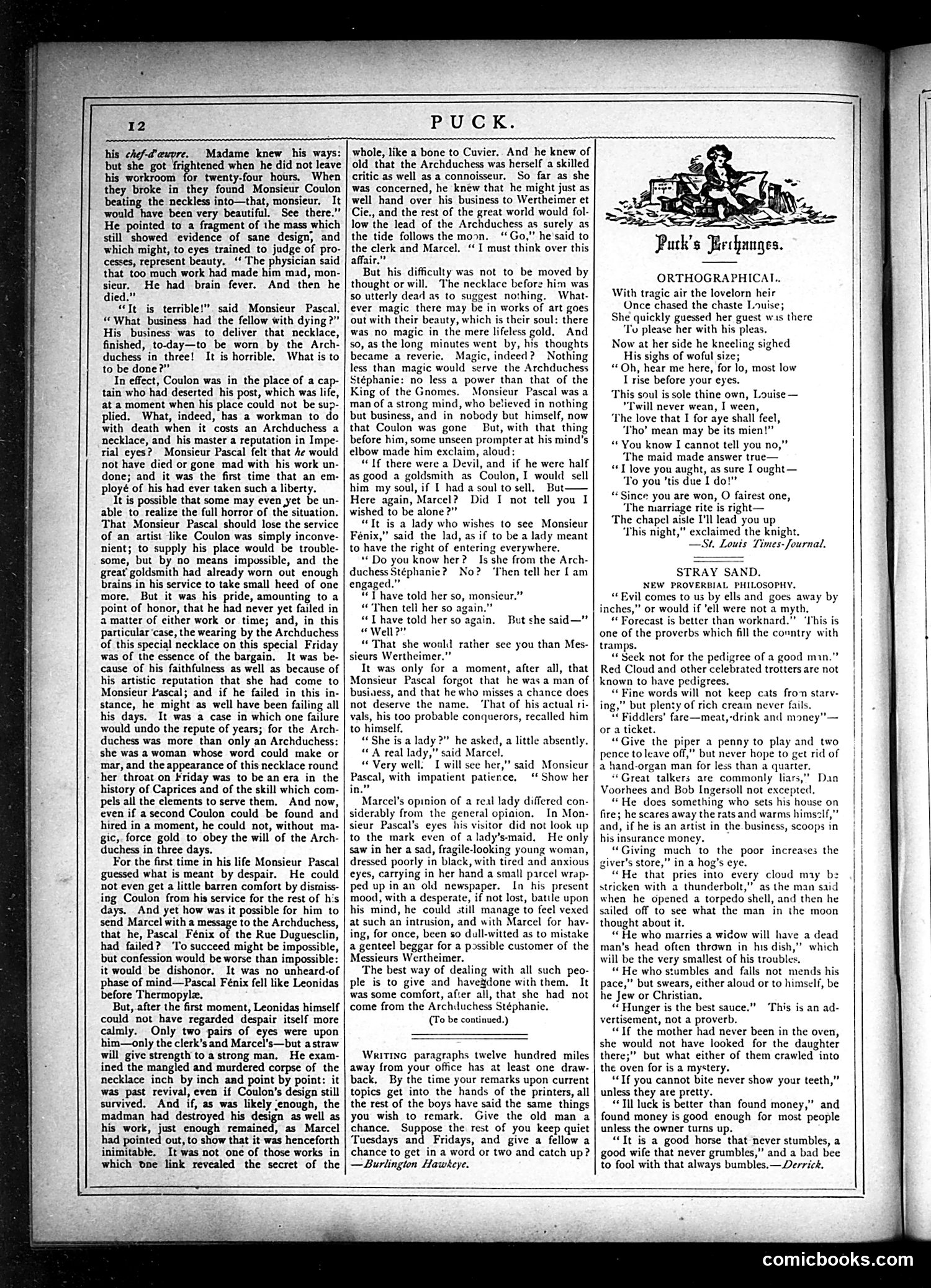
This page contains a serialized story ("The Necklace," to be continued) rather than political cartoons. The narrative centers on Monsieur Pascal, an artist, and a valuable necklace belonging to the Archduchess Stephanie. The plot involves Pascal's conflict over a special Friday viewing of the necklace—apparently tied to Archduchess politics and artistic reputation. The story explores themes of artistic integrity, social ambition, and romantic entanglement, with characters debating whether Pascal should compromise his principles for social advancement. The right column contains unrelated satirical proverbs ("Puck's Briefings"), offering cynical observations on society—typical of Puck's humor style. Without identifying specific historical figures, the Archduchess reference suggests European aristocratic context, but the narrative is primarily fictional entertainment rather than direct political satire.
📄 Transcribed text from this page (OCR, searchable)
Machine-transcribed from the original scan — historical spelling and the odd misread are preserved.
12 his chef-d'eupre. Madame knew his ways: but she got frightened when he did not leave his workroom for twenty-four hours. When they broke in they found Monsieur Coulon beating the neckless into—that, monsieur. It would have been very beautiful. See there.” He pointed to a fragment of the mass which still showed evidence of sane design, and which might, to eyes trained to judge of pro- cesses, represent beauty, ‘‘ The physician said that too much work had made him mad, mon- sieur. He had brain fever. And then he died.” “Tt is terrible!” said Monsieur Pascal. “What business had the fellow with dying?” His business was to deliver that necklace, finished, to-day—to be worn by the Arch- duchess in three! It is horrible. What is to to be done?” In effect, Coulon was in the place of a cap- tain who had deserted his post, which was life, at a moment when his place could not be sup- plied. What, indeed, has a workman to do with death when it costs an Archduchess a necklace, and his master a reputation in Impe- rial eyes? Monsieur Pascal felt that he would not have died or gone mad with his work un- done; and it was the first time that an em- ployé of his had ever taken such a liberty. It is possible that some may even yet be un- able to realize the full horror of the situation. That Monsieur Pascal should lose the service of an artist like Coulon was simply inconve- nient; to supply his place would be trouble- some, but by no means impossible, and the great goldsmith had already worn out enough brains in his service to take small heed of one more. But it was his pride, amounting to a point of honor, that he had never yet failed in a matter of either work or time; and, in this particular‘case, the wearing by the Archduchess of this special necklace on this special Friday was of the essence of the bargain. It was be- cause of his faithfulness as well as because of his artistic reputation that she had come to Monsieur Pascal; and if he failed in this in- stance, he might as well have been failing all his days. It was a case in which one failure would undo the repute of years; for the Arch- duchess was more than only an Archduchess: she was a woman whose word could make or mar, and the appearance of this necklace round her throat on Friday was to be an era in the history of Caprices and of the skill which com- pels all the elements to serve them. And now, even if a second Coulon could be found and hired in a moment, he could not, without ma- gic, force gold to obey the will of the Arch- duchess in three days. For the first time in his life Monsieur Pascal guessed what is meant by despair. He could not even get a little barren comfort by distniss- ing Coulon from his service for the rest of h's days. And yet how was it possible for him to send Marcel with a m ¢ to the Archduchess, that he, Pascal Fénix of the Rue Duguesclin, had failed? ‘To succeed might be impossible, but confession would be worse than impossible: it would be dishonor. It was no unheard-of phase of mind—Pascal Fénix fell like Leonidas before Thermopylz. But, after the first moment, Leonidas himself could not have regarded despair itself more calmly. Only two pairs of eyes were upon him—only the clerk’s and Marcel’s—but astraw will give strength to a strong man, He exam- ined the mangled and murdered corpse of the necklace inch by inch and point by point: it was past revival, even if Coulon’s design still survived. And if, as was likely ‘enough, the madman had destroyed his design as well as his work, just enough remained, as Marcel had pointed out, to show that it was henceforth inimitable. It was not one of those works in whole, like a bone to Cuvier. And he knew of old that the Archduchess was herself a skilled critic as well as a connoisseur. So far as she was concerned, he knew that he might just as well hand over his business to Wertheimer et Cie., and the rest of the great world would fol- low the lead of the Archduchess as surely as the tide follows the moon. “Go,” he'said to the clerk and Marcel. ‘I must think over this affair.” But his difficulty was not to be moved by thought or will. The necklace before him was so utterly dead as to suggest nothing. What- ever magic there may be in works of art goes out with their beauty, which is their soul: there was no magic in the mere lifeless gold. And so, as the long minutes went by, his thoughts became a reverie. Magic, indeed? Nothing less than magic would serve the Archduchess Stéphanie: no less a power than that of the King of the Gnomes. Monsieur Pascal was a man of a strong mind, who believed in nothing but business, and in nobody but himself, now that Coulon was gone But, with that thing before him, some unseen prompter at his mind's elbow made him exclaim, aloud: “If there were a Devil, and if he were half as good a goldsmith as Coulon, I would sell him my soul, if I had a soul to sell. But—— Here again, Marcel? Did I not tell you 1 wished to be alone?” “Tt is a lady who wishes to see Monsieur Fénix,” said the lad, as if to be a lady meant to have the right of entering everywhere. “Do you know her? Is she from the Arch- duchess Stéphanie? No? ‘Then tell her Lam engaged.” “T have told her so, monsieur,” “Then tell her so again.” “Thave told her so again. “Well?” “That she would rather see you than Mes- sieurs Wertheimer.” It was only for a moment, after all, that Monsieur Pascal forgot that he was a man of business, and that he who misses a chance does not deserve the name. ‘hat of his actual ri- vals, his too probable conquerors, recalled him to himself. “She is a lady ?” he asked, a little absently. “A real lady,” said Marcel. “ Very well. I will see her,” said Monsieur Pascal, with impatient patience, * Show her in.” But she said—"” Marcel’s opinion of a real lady differed con- siderably from the general opiaion. In Mon- sieur Pascal's eyes his visitor did not look up to the mark even of a lady’smaid, He only saw in her a sad, fragile-looking young woman, dressed poorly in black, with tired and anxious eyes, carrying in her hand a small parcel wrap- ped up in an old newspaper. In his present mood, with a desperate, if not lost, battle upon his mind, he could still manage to feel vexed at such an intrusion, and with Marcel for hav- ing, for once, been so dull-witted as to mistake a genteel beggar for a possible customer of the Messieurs Wertheimer. The best way of dealing with all such peo- ple is to give and have&done with them. It was some comfort, after all, that she had not come from the Archiluchess Stéphanie. (To be continued.) Waritine paragraphs twelve hundred miles away from your office has at least one draw- back. By the time your remarks upon current topics get into the hands of the printers, all the rest of the boys have said the same things you wish to remark. Give the old man a chance. Sup, the rest of you keep quiet Tuesdays and Fridays, and give a fellow a chance to get in a word or two and catch up? Puck's Brchanges. ORTHOGRAPHICAL.. With tragic air the lovelorn heir Once chased the chaste Louise; She quickly guessed her guest was there ‘Tu please her with his pleas. Now at her side he kneeling sighed His sighs of woful size; “Oh, hear me here, for lo, most low I rise before your eyes. This soul is sole thine own, Louise — "Twill never wean, I ween, ‘The love that I for aye shall feel, ‘Tho’ mean may be its mien!” “You know I cannot tell you no,” ‘The maid made answer true— “*T love you aught, as sure I ought— ‘To you 'tis due 1 do!” ce you are won, O fairest one, ‘The marriage rite is right— The chapel aisle I'll lead you up ‘This night,” exclaimed the knight. —St, Louis Times-Journal. STRAY SAND. W PROVERBIAL PHILOSOPHY, “Evil comes to us by ells and goes away by inches,” or would if ’ell were not a myth. “ Forecast is better than worknard.”” ‘This is one of the proverbs which fill the conntry with tramps. “ Seek not for the pedigree of a good min.” Red Cloud and other celebrated trotters are not known to have pedigrees. “Fine words will not keep cats fron starv- ing,” but plenty of rich cream never fails. “« Fiddlers’ fare—meat,-drink and money” — or a ticket. “Give the piper a penny to play and two pence to leave off,” but never hope to get rid of a hand-organ man for less than a quarter. “Great talkers are commonly liars,” Voorhees and Bob Ingersoll not excepted. “He does something who sets his house on fire; he scares away the rats and warms himszlf,”” and, if he is an artist in the business, scoops in his insurance money. “Giving much to the poor increases the giver’s store,” in a hog’s eye. “He that pries into every cloud may be stricken with a thunderbolt,” as the man said when he opened a torpedo shell, and then he sailed off to see what the man in the moon thought about it. “He who marries a widow will have a dead man's head often thrown in his dish,” which will be the very smallest of his troubles, “He who stumbles and falls not mends his pace,” but swears, either aloud or to himself, be he Jew or Christian. “ Hunger is the best sauce.” vertisement, not a proverb, “If the mother had never been in the oven, she would not have looked for the daughter there;” but what either of them crawled into the oven for is a mystery. “If you cannot bite never show your teeth,” unless they are pretty. “Til luck is better than found money,” and found money is good enough for most people unless the owner turns up. “It is a good horse that never stumbles, a good wife that never grumbles,” and a bad bee to fool with that always bumbles.—Derrick. Dan This is an ad- which One link revealed the secret of the | —Burlington Hawkeye. comicbooks.com