
Puck, 1879-01-29 · page 2 of 16
Puck — January 29, 1879 — page 2: what you’re looking at
What you’re looking at
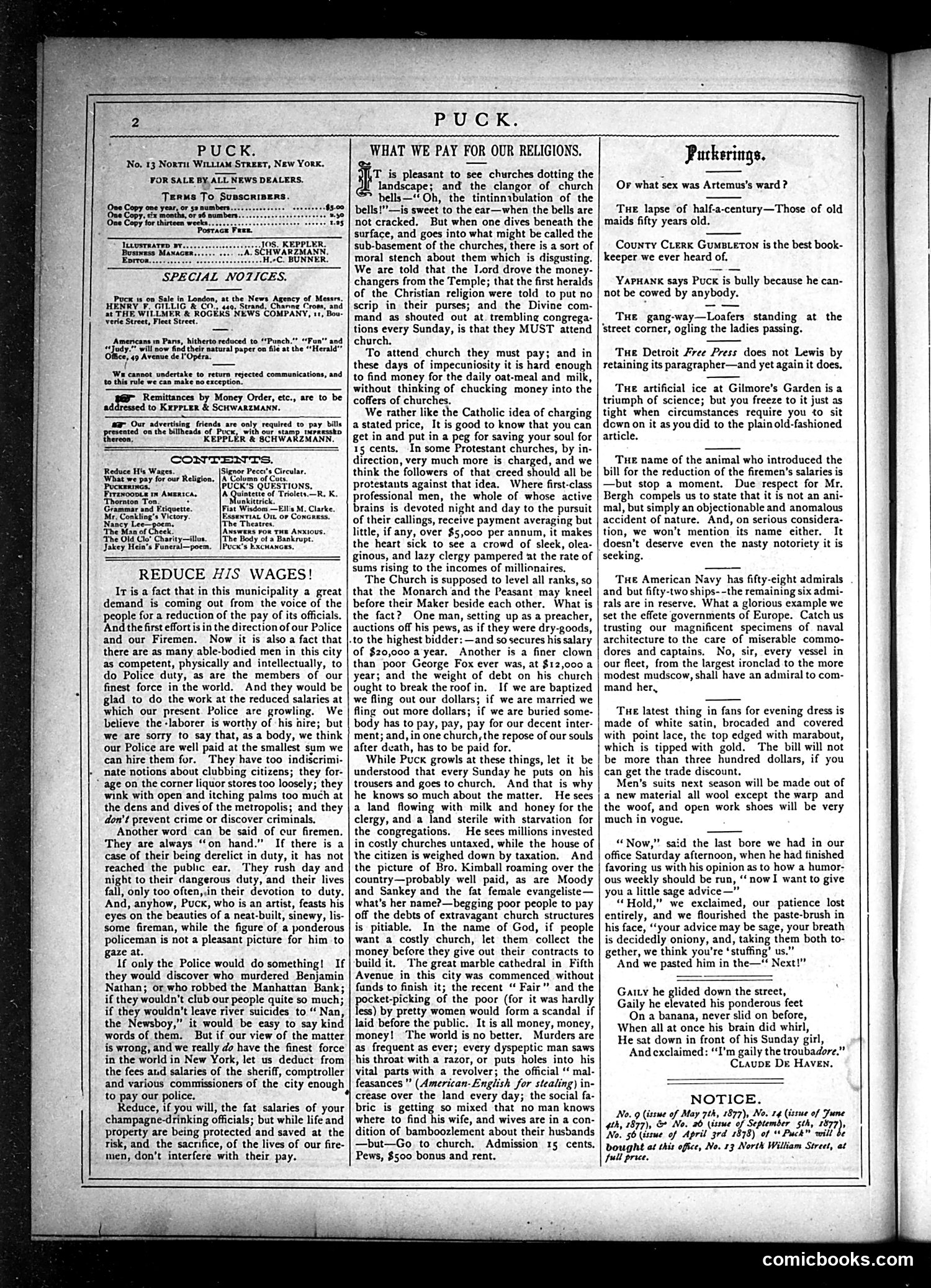
This page is primarily **text-based content** rather than political cartoons. The main articles address: 1. **"What We Pay for Our Religions"** - A lengthy critique of church finances, arguing that organized religion extracts excessive money from congregants while church leaders live lavishly. The piece contrasts wealthy clergy with starving congregations. 2. **"Reduce His Wages!"** - Satire attacking police corruption and arguing officers are overpaid relative to their duties. It suggests reducing police salaries would eliminate misconduct. The satire targets **institutional hypocrisy**: churches preaching charity while hoarding wealth, and corrupt police claiming financial hardship. The rhetoric is sharply class-conscious, championing poor workers against privileged institutions. No specific historical figures are identifiable in this text-heavy layout.
📄 Transcribed text from this page (OCR, searchable)
Machine-transcribed from the original scan — historical spelling and the odd misread are preserved.
PUCK. PUCK. No, 13 Nort WiLiaM IAM.STRERT, New York. WOR SALE BY,ALLN NEWS DEALERS. Terms To Susscrisers. SPECIAL NOTICES. Js 00 Sale in London, at the News HENRY PGILLIG. & Gl, cao. Strands Choe. roms and at THE WILLMER & ROGERS NEWS COMPANY, 11, Bou- ‘Street, Fleet Street. cy of Messrs. m Pans, hitherto reduced to ‘*Punch.”* “Fun and ‘fudy.” will now fed their patural paper on fle atthe “Herald” + 49 Avenue de I'Opéra. t — ‘We cannot undertake to return rejected communications, and to this rule we can make no exception. caf, Remittances ty Money Order, ce., are to be to Kupper & SCHWARZMANN. Qut advertising fends are only required to, pay bills preted ‘on the billheads of Puck, with out stamp turgasskD REPPLER @ SCHWARZMANN, CONTENTS. Signor Peces’s Circular. A Column of Cuts. PUCK?S| QUESTIONS, of Triolets.—R. K. Reis Reduce H's Ws ‘What we pay for our Religion. Pockssincs. Frrewoopus m Amznica. ‘Thornton Ton, Grammar and Esiquette. Mr. Conkling’s Victory. Nancy Lee ‘The Man of Cheek: ‘The Old Clo” Charity—illos. Jakey Hein’s Funeral—poem. REDUCE H/S WAGES! Iris a fact that in this municipality a great demand is coming out from the voice of the people for a reduction of the pay of its officials. And the first effort is in the direction of our Police and our Firemen. Now it is also a fact that there are as many able-bodied men in this city as competent, physically and intellectually, to do Police duty, as are the members of our finest force in the world. And they would be glad to do the work at the reduced salaries at which our present Police are growling. We believe the -laborer is worthy of -his hire; but we are sorry to say that, as a body, we think our Police are well paid at the smallest sum we can hire them for. They have too indiscrimi- nate notions about clubbing citizens; they for- * age on the corner liquor stores too loosely; they wink with open and itching palms too much at the dens and dives of the metropolis; and they don't prevent crime or discover criminals, Another word can be said of our firemen. They are always ‘‘on hand.” If there is a case of their being derelict in duty, it has not reached the public ear. They rush day and night to their dangerous duty, and their lives fall, only too often,,in their devotion to duty. And, anyhow, Puck, who is an artist, feasts his eyes on the beauties of a neat-built, sinewy, lis- some fireman, while the figure of a ponderous policeman is not a pleasant picture for him to gaze at. If only the Police would do something! If they would discover who murdered Benjamin Nathan; or who robbed the Manhattan Bank; if they wouldn't club our people quite so much; 1g ithe wouldn't leave river suicides to “ Nan, lewsboy,” it would be easy to say kind aun of them. But if our view of the matter is wrong, and we really do have the finest force in the world in New York, let us deduct from the fees and salaries of the sheriff, comptroller [The Body of a Bankrupt. Puck's Rxchances. and various commissioners of the city enough | to pay our police. Reduce, if you will, the fat salaries of your champagne-drinking Officials; but while life and property are being rotected and saved at the risk, and the sacrifice, of the lives of our fire- men, don’t interfere with their pay. WHAT WE PAY FOR OUR RELIGIONS. T is pleasant to see churches dotting the landscape; and the clangor of church bells—‘‘Oh, the tintinnabulation of the bells!” —is sweet to the ear—when the bells are not cracked. But when one dives beneath the surface, and goes into what might be called the sub-basement of the churches, there is a sort of moral stench about them which is disgusting. We are told that the Lord drove the money- changers from the Temple; that the first heralds of the Christian religion were told to put no scrip in their purses; and the Divine com- mand as shouted out at. trembling congrega- tions every Sunday, is that they MUST attend church, To attend church they must pay; and in these days of impecuniosity it is hard enough to find money for the daily oat-meal and milk, without thinking of chucking money into the coffers of churches. We rather like the Catholic idea of charging astated price, It is good to know that you can get in and put in a peg for saving your soul for 15 cents, In some Protestant churches, by in- direction, very much more is charged, ‘and we think the followers of that creed should all be protestants against that idea. Where first-class professional men, the whole of whose active brains is devoted night and day to the pursuit of their callings, receive payment averaging but little, if any, over $5,000 per annum, it makes the heart sick to see a crowd of sleek, olea- ginous, and lazy clergy pampered at the rate of sums rising to the incomes of millionaires. The Church is supposed to level all ranks, so that the Monarch and the Peasant may kneel before their Maker beside each other. What is the fact? One man, setting up as a preacher, auctions off his pews, as if they were dry-goods, .to the highest bidder: —and so secures his salary of $20,000 a year. Another is a finer clown than poor George Fox ever was, at $12,000 a year; and the weight of debt on his church ought to break the roof in. If we are baptized we fling out our dollars; if we are married we fling out more dollars; if we are buried some- body has to pay, pay, pay for our decent inter- ment; and, in one church, the repose of our souls after death, has to be paid for. While Puck growls at these things, let it be understood that every Sunday he puts on his trousers and goes to church, And that is why he knows so much about the matter. He sees a land flowing with milk and honey for the clergy, and a land sterile with starvation for the congregations, He sees millions invested in costly churches untaxed, while the house of the citizen is weighed down by taxation. And the picture of Bro, Kimball roaming over the country—probably well paid, as are Moody and Sankey and the fat female evangeliste— what's her name?—begging poor people to pay off the debts of extravagant church structures is pitiable. In the name of God, if people want a costly church, let them collect the money before they give out their contracts to build it, The great marble cathedral in Fifth Avenue in this city was commenced without funds to finish it; the recent “ Fair” and the pocket-picking of the poor (for it was hardly less) by pretty women would form a scandal if laid before the public. It is all money, money, money! The world is no better. Murders are as frequent as ever; every dyspeptic man saws his throat with a razor, or puts holes into his vital parts with a revolver; the official ‘ mal- feasances ” (American-English for stealing) in- crease over the land every day; the social fa- bric is getting so mixed that no man knows where to find his wife, and wives are in a con- dition of bamboozlement about their husbands —but—Go to church, Admission 15 cents. Pews, $500 bonus and rent, Parkerings. Or what sex was Artemus’s ward? Tue lapse of half-a-century—Those of old maids fifty years old. County Crerx Gumsteton is the best book- keeper we ever heard of. YAPHANK says Puce is bully because he can- not be cowed by anybody. Tue gang-way—Loafers standing at the ‘street corner, ogling the ladies passing. Tue Detroit Free Press does not Lewis by retaining its paragrapher—and yet again it does, Tue artificial ice at Gilmore's Garden is a triumph of science; but you freeze to it just as tight when circumstances require you to sit down on it as you did to the plain old-fashioned article, Tue name of the animal who introduced the bill for the reduction of the firemen’s salaries is —but stop a moment. Due respect for Mr. Bergh compels us to state that it is not an ani- mal, but simply an objectionable and anomalous accident of nature. And, on serious considera- tion, we won't mention its name either. It doesn’t deserve even the nasty notoriety it is seeking. Twe American Navy has fifty-eight admirals and but fifty-two ships--the remaining six admi- rals are in reserve. What a glorious example we set the effete governments of Europe. Catch us trusting our magnificent specimens of naval architecture to the care of miserable commo- dores and captains, No, sir, every vessel in our fleet, from the largest ironclad to the more modest mudscow, shall have an admiral to com- mand her, Tue latest thing in fans for evening dress is made of white satin, brocaded and covered with point lace, the top edged with marabout, which is tipped with gold. ‘The bill will not be more than three hundred dollars, if you can get the trade discount. Men's suits next season will be made out of a new material all wool except the warp and the woof, and open work shoes will be very much in vogue. “Now,” said the last bore we had in our office Saturday afternoon, when he had finished favoring us with his opinion as to how a humor- ous weekly should be run, “now I want to give you a little sage advice—” “Hold,” we exclaimed, our patience lost entirely, and we flourished the paste-brush in his face, “your advice may be sage, your breath is decidedly oniony, and, taking them both to- gether, we think you're ‘stuffing’ us.” And we pasted him in the— Next!" Gatty he glided down the street, Gaily he elevated his ponderous feet On a banana, never slid on before, When all at once his brain did whirl, He sat down in front of his Sunday girl, And exclaimed: “I’m gaily the troubadore,” Ctaupe De Haven. NOTICE. No. 9 (issue of May 7th, 1877), No. 14 (issue of June gth, 1877), & No. 26 (issue of September sth, i577), No. 56 (isswe of April 3rd 1878) of ** Puck” will Bought at this ofice, No. 13 North William Street, Se full proce comicbooks.com