
Puck, 1879-01-29 · page 3 of 16
Puck — January 29, 1879 — page 3: what you’re looking at
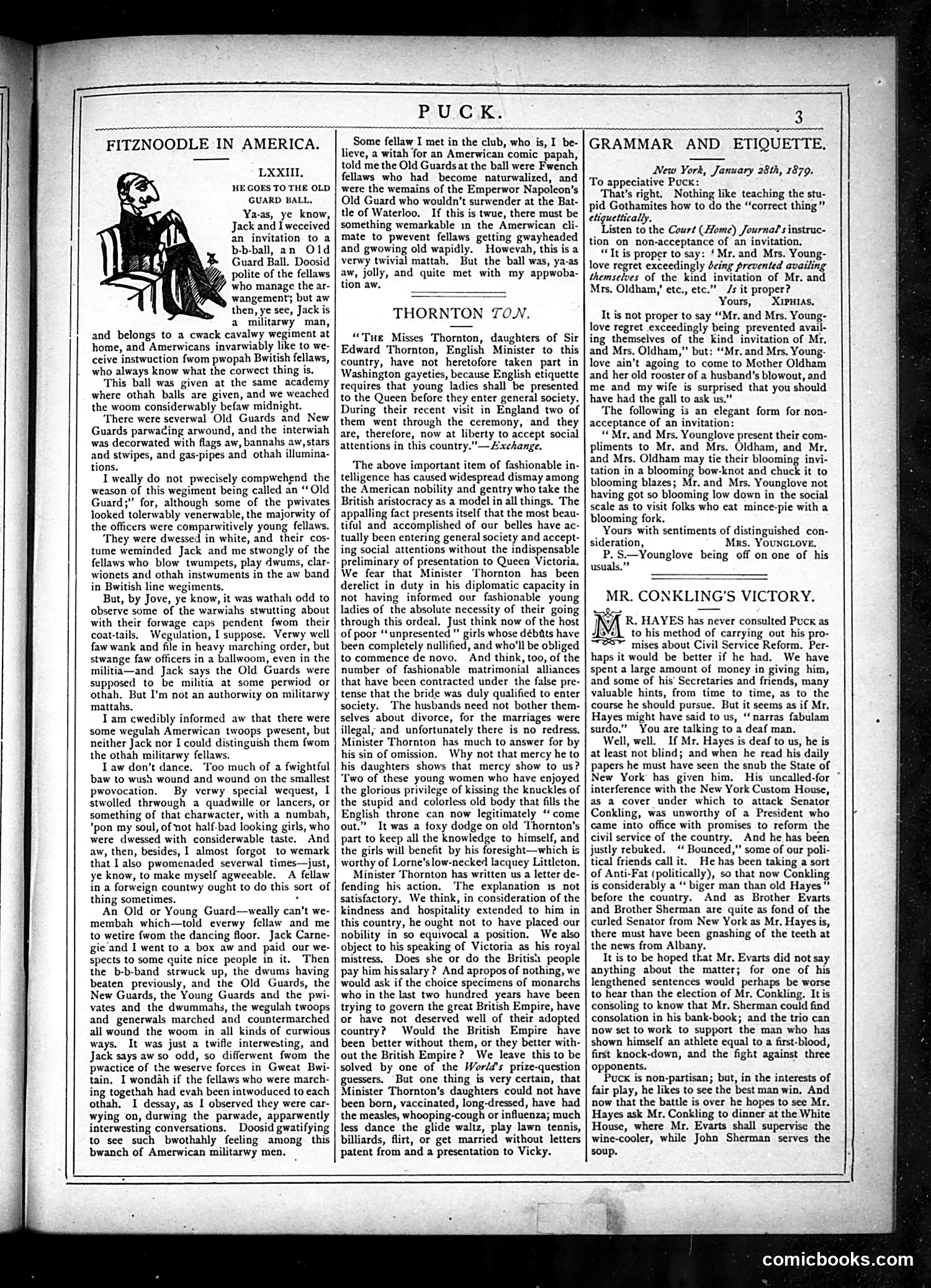
A restored page from Puck, 1879-01-29. Page through the whole issue in the reader above.
📄 Transcribed text from this page (OCR, searchable)
Machine-transcribed from the original scan — historical spelling and the odd misread are preserved.
PUCK. 3 FITZNOODLE IN AMERICA. LXXIill, HEGOES TO THE OLD GUARD BALL, Ya-as, ye know, Jack and iweceived an invitation to a b-b-ball, an Old Guard Ball. Doosid polite of the fellaws who manage the ar- wangement; but aw then, ye see, Jack is a militarwy man, and belongs to a cwack cavalwy wegiment at home, and Amerwicans invarwiably like to we- ceive instwuction fwom pwopah Bwitish fellaws, who always know what the corwect thing is. ‘This ball was given at the same academy where othah balls are given, and we weached the woom considerwably befaw midnight. ‘There were severwal Old Guards and New Guards parwacing arwound, and the interwiah was decorwated with flags aw, bannahs aw, stars and stwipes, and gas-pipes and othah illumina- tions. I weally do not pwecisely compwehend the weason of this wegiment being called an “Old Guard;” for, although some of the pwivates looked tolerwably venerwable, the majorwity of the officers were comparwitively young fellaws. ‘They were dwessed in white, and their cos- tume weminded Jack and me stwongly of the fellaws who blow twumpets, play dwums, clar- wionets and othah instwuments in the aw band in Bwitish line wegiments. But, by Jove, ye know, it was wathah odd to observe some of the warwiahs stwutting about with their forwage caps pendent fwom their coat-tails, Wegulation, I suppose. Verwy well faw wank and file in heavy marching order, but stwange faw officers in a ballwoom, even in the militia—and Jack says the Old Guards were supposed to be militia at some perwiod or othah, But I’m not an authorwity on militarwy mattahs. I am cwedibly informed aw that there were some wegulah Amerwican twoops pwesent, but neither Jack nor I could distinguish them {wom the othah militarwy fellaws. I aw don’t dance. ‘Too much of a fwightful baw to wush wound and wound on the smallest pwovocation, By verwy special wequest, I stwolled thrwough a quadwille or lancers, or something of that charwacter, with a numbah, *pon my soul, of not half-bad looking girls, who were dwessed with considerwable taste. And aw, then, besides, I almost forgot to wemark that Lalso pwomenaded severwal times—just, ye know, to make myself agweeable. A fellaw in a forweign countwy ought to do this sort of thing sometimes. : An Old or Young Guard—weally can’t we- membah which—told everwy fellaw and me to wetire fwom the dancing floor. Jack Carne- gie‘and I went to a box aw and paid our we- spects to some quite nice people in it. Then the b-b-band strwuck up, the dwums having beaten previously, and the Old Guards, the New Guards, the Young Guards and the pwi- yates and the dwummahs, the wegulah twoops and generwals marched and countermarched all wound the woom in all kinds of curwious ways, It was just a twifle interwesting, and Jack says aw so odd, so differwent fwom the pwactice of the weserve forces in Gweat Bwi- tain. I wondah if the fellaws who were march- ing togethah had evah been intwoduced to each othah, I dessay, as I observed they were car- wying on, durwing the parwade, apparwently interwesting conversations. Doosid gwatifying to see such bwothahly fecling among this bwanch of Amerwican militarwy men. Some fellaw I met in the club, who is, I be- lieve, a witah for an Amerwican comic papah, told me the Old Guards at the ball were Fwench fellaws who had become naturwalized, and were the wemains of the Emperwor Napoleon's Old Guard who wouldn’t surwender at the Bat- tle of Waterloo. If this is twue, there must be something wemarkable in the Amerwican cli- mate to pwevent fellaws getting gwayheaded and gwowing old wapidly. Howevah, this is a verwy twivial mattah, But the ball was, ya-as aw, jolly, and quite met with my appwoba- tion aw. THORNTON TON. “Tue Misses Thornton, daughters of Sir Edward Thornton, English Minister to this country, have not heretofore taken part in Washington gayeties, because English etiquette requires that young ladies shall be presented to the Queen before they enter general society. During their recent visit in England two of them went through the ceremony, and they are, therefore, now at liberty to accept social attentions in this country.”—Z xchange, ‘The above important item of fashionable in- telligence has caused widespread dismay among the American nobility and gentry who take the British aristocracy as a model in all things. The appalling fact presents itself that the most beau- tiful and accomplished of our belles have ac- tually been entering general society and accept- ing social attentions without the indispensable preliminary of presentation to Queen Victoria. We fear that Minister Thornton has been derelict in duty in his diplomatic capacity in not having informed our fashionable young ladies of the absolute necessity of their going through this ordeal. Just think now of the host of poor ‘‘unpresented ” girls whose débats have been completely nullified, and who'll be obliged to commence de novo. And think, too, of the number of fashionable matrimonial alliances that have been contracted under the false pre- tense that the bride was duly qualified to enter society. The husbands need not bother them- selves about divorce, for the marriages were illegal, and unfortunately there is no redress. Minister Thornton has much to answer for by his sin of omission. Why not that mercy he to his daughters shows that mercy show to us? ‘Two of these young women who have enjoyed the glorious privilege of kissing the knuckles of the stupid and colorless old body that fills the English throne can now legitimately “come out.” It was a foxy dodge on old Thornton's part to keep all the knowledge to himself, and the girls will benefit by his foresight—which is worthy of Lorne'slow-necked lacquey Littleton. Minister Thornton has written us a letter de- fending his action. The explanation 1s not satisfactory. We think, in consideration of the kindness and hospitality extended to him in this country, he ought not to have placed-our nobility in so equivocal a position, We also object to his speaking of Victoria as his royal mistress. Does she or do the British people pay him his salary ? And apropos of nothing, we would ask if the choice specimens of monarchs who in the last two hundred years have been trying to govern the great British Empire, have or have not deserved well of their adopted country? Would the British Empire have been better without them, or they better with- out the British Empire? We leave this to be solved by one of the World's prize-question guessers, But one thing is very certain, that Minister Thornton’s daughters could not have been born, vaccinated, long-dressed, have had the measles, whooping-cough or influenza; much less dance the glide waltz, play lawn tennis, billiards, flirt, or get married without letters patent from and a presentation to Vicky. GRAMMAR AND ETIQUETTE. New York, January 28th, 1879. To appeciative Puck: That's right. Nothing like teaching the stu- pid Gothamites how to do the “correct thing” etiquettically. Listen to the Court (Home) Journal sinstruc- tion on non-acceptance of an invitation, “It is proper to say: ‘Mr. and Mrs. Young- love regret exceedingly being prevented availing themselves of the kind invitation of Mr. and Mrs. Oldham,’ etc., etc.” Zs it proper? Yours, -XIPHIAS. It is not proper to say “Mr. and Mrs. Young- love regret exceedingly being prevented avail- ing themselves of the kind invitation of Mr, and Mrs. Oldham,” but: ‘Mr. and Mrs, Young- love ain’t agoing to come to Mother Oldham and her old rooster of a husband's blowout, and me and my wife is surprised that you should have had the gall to ask us,” The following is an elegant form for non- acceptance of an invitation: “Mr, and Mrs. Younglove present their com- pliments to Mr. and Mrs. Oldham, and Mr. and Mrs. Oldham may tie their blooming invi- tation in a blooming bow-knot and chuck it to blooming blazes; Mr. and Mrs. Younglove not having got so blooming low down in the social scale as to visit folks who eat mince-pie with a blooming fork. Yours with sentiments of distinguished con- sideration, Mrs. Younciove. P. Younglove being off on one of his MR. CONKLING'S VICTORY. spe =a IN: R. HAYES has never consulted Puck as to his method of carrying out his pro- mises about Civil Service Reform. Per- haps it would be better if he had. We have spent a large amount of money in giving him, and some of his’ Secretaries and friends, many valuable hints, from time to time, as to the course he should pursue. But it seems as if Mr. Hayes might have said to us, “narras fabulam surdo.” You are talking to a deaf man. Well, well. If Mr. Hayes is deaf to us, he is at least not blind; and when he read his daily papers he must have seen the snub the State of New York has given him. His uncalled-for ~ interference with the New York Custom House, as a cover under which to attack Senator Conkling, was unworthy of a President who came into office with promises to reform the civil service of the country. And he has been justly rebuked. ‘ Bounced,” some of our po! tical friends call it. He has been taking a sort of Anti-Fat (politically), so that now Conkling is considerably a “ biger man than old Hayes” before the country. And as Brother Evarts and Brother Sherman are quite as fond of the curled Senator from New York as Mr. Hayes is, there must have been gnashing of the teeth at the news from Albany. It is to be hoped that Mr, Evarts did not say anything about the matter; for one of his lengthened sentences would perhaps be worse to hear than the election of Mr. Conkling. Itis consoling to know that Mr. Sherman could find consolation in his bank-book; and the trio can now set to work to support the man who has shown himself an athlete equal to a first-blood, first knock-down, and the fight against three opponents. Pucx is non-partisan; but, in the interests of fair play, he likes to see the best man win. And now that the battle is over he hopes to see Mr. Hayes ask Mr. Conkling to dinner at the White House, where Mr. Evarts shall supervise the wine-cooler, while John Sherman serves the soup. comicbooks.com