
Puck, 1879-01-29 · page 11 of 16
Puck — January 29, 1879 — page 11: what you’re looking at
What you’re looking at
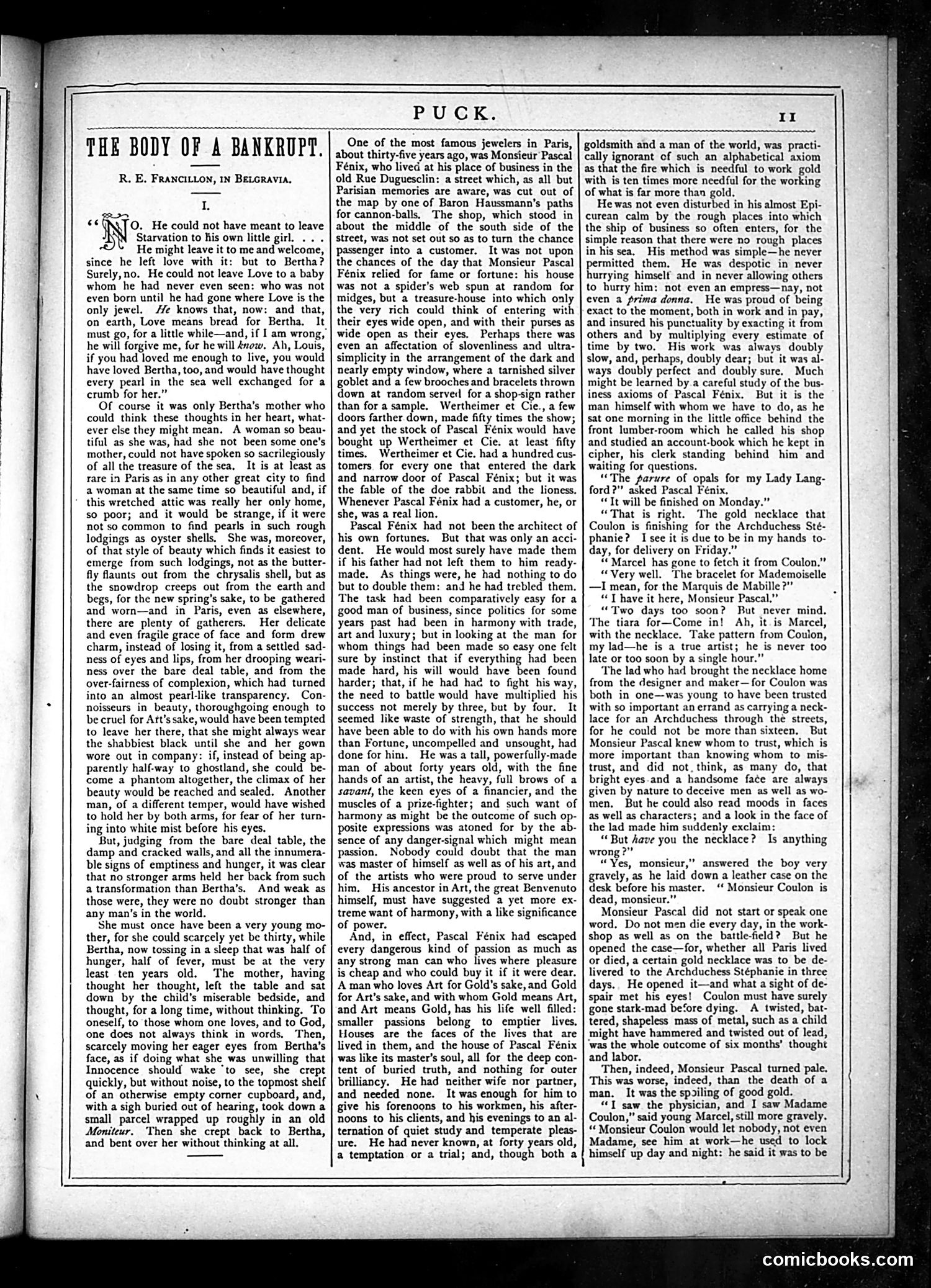
This page presents a short story (not a political cartoon) about Monsieur Pascal Fénis, a wealthy Parisian jeweler who faces financial ruin. The narrative describes how his once-luxurious life—built on displaying artistic taste and employing skilled craftspeople—collapses when he goes bankrupt. The story satirizes the hollowness of wealth and status among Paris's elite. Fénis's elaborate lifestyle, his patronage of artists, and his carefully curated image prove fragile; his financial collapse exposes that his fortune, not genuine achievement or character, sustained his social position. The text suggests that appearances of refinement masked underlying vulnerability and moral emptiness—a common Puck theme critiquing the wealthy class.
📄 Transcribed text from this page (OCR, searchable)
Machine-transcribed from the original scan — historical spelling and the odd misread are preserved.
PUCK. II THE BODY OF A BANKRUPT. R. E. FRANCILLON, IN BELGRAVIA, IL Gh O. He could not have meant to leave Starvation to his own little girl. . . . He might leave it to me and welcome, since he left love with it: but to Bertha? Surely,no. He could not leave Love to a baby whom he had never even seen: who was not even born until he had gone where Love is the only jewel. He knows that, now: and that, on earth, Love means bread for Bertha. It must go, for a little while—and, if I am wrong, he will forgive me, fur he will Anow. Ah, Louis, if you had loved me enough to live, you would have loved Bertha, too, and would have thought every pearl in the sea well exchanged for a crumb for her.” Of course it was only Bertha’s mother who could think these thoughts in her heart, what- ever else they might mean. A woman so beau- tiful as she was, had she not been some one's mother, could not have spoken so sacrilegiously of all the treasure of the sea, It is at least as rare in Paris as in any other great city to find a woman at the same time so beautiful and, if this wretched attic was really her only home, so poor; and it would be strange, if it were not so common to find pearls in such rough lodgings as oyster shells. She was, moreover, of that style of beauty which finds it easiest to emerge from such lodgings, not as the butter- fly aunts out from the chrysalis shell, but as the snowdrop creeps out from the earth and begs, for the new spring’s sake, to be gathered and worn—and in Paris, even as elsewhere, there are plenty of gatherers. Her delicate and even fragile grace of face and form drew charm, instead of losing it, from a settled sad- ness of eyes and lips, from her drooping weari- ness over the bare deal table, and from the over-fairness of complexion, which had turned into an almost pearl-like transparency. Con- noisseurs in beauty, thoroughgoing enough to becruel for Art's sake, would have been tempted to leave her there, that she might always wear the shabbiest black until she and her gown wore out in company: if, instead of being ap- parently half-way to ghostland, she could’ be- come a phantom altogether, the climax of her beauty would be reached and sealed. Another man, of a different temper, would have wished to hold her by both arms, for fear of her turn- ing into white mist before his eyes, One of the most famous jewelers in Paris, about thirty-five years ago, was Monsieur Pascal Fénix, who lived at his place of business in the old Rue Duguesclin: a street which, as all but Parisian memories are aware, was cut out of the map by one of Baron Haussmann’s paths for cannon-balls, The shop, which stood in about the middle of the south side of the street, was not set out so as to turn the chance passenger into a customer. It was not upon the chances of the day that Monsieur Pascal Fénix relied for fame or fortune: his house was not a spider's web spun at random for midges, but a treasure-house into which only the very rich could think of entering with their eyes wide open, and with their purses as wide open as their eyes. Perhaps there was even an affectation of slovenliness and ultra- simplicity in the arrangement of the dark and nearly empty window, where a tarnished silver goblet and a few brooches and bracelets thrown down at random served for a shop-sign rather than for a sample. Wertheimer et Cie., a few doors farther down, made fifty times the show; and yet the stock of Pascal Fénix would have bought up Wertheimer et Cie. at least fifty times. Wertheimer et Cie. had a hundred cus- tomers. for every one that entered the dark goldsmith and a man of the world, was practi- cally ignorant ef such an alphabetical axiom as that the fire which is needful to work gold with is ten times more needful for the working of what is far more than gold. He was not even disturbed in his almost Epi- curean calm by the rough places into which the ship of business so often enters, for the simple reason that there were no rough places in his sea, His method was simple—he never permitted them. He was despotic in never hurrying himself and in never allowing others to hurry him: not even an empress—nay, not even a prima donna. He was proud of being exact to the moment, both in work and in pay, and insured his punctuality by exacting it from others and by multiplying every estimate of time by two. His work was always doubly slow, and, perhaps, doubly dear; but it was al- ways doubly perfect and doubly sure. Much might be learned by.a careful study of the bus- iness axioms of Pascal Fénix. But it is the man himself with whom we have to do, as he sat one morning in the little office behind the front lumber-room which he called his shop and studied an account-book which he kept in cipher, his clerk standing behind him and waiting for questions. and narrow door of Pascal Fénix; but it was the fable of the doe rabbit and the lioness. Whenever Pascal Fénix had a customer, he, or she, was a real lion. Pascal Fénix had_ not been the architect of his own fortunes. But that was only an acci- dent. He would most surely have made them if his father had not left them to him ready- made. As things were, he had nothing to do but to double them: and he had trebled them. The task had been comparatively easy for a good man of business, since politics for some years past had been in harmony with trade, art and luxury; but in looking at the man for whom things had been made so easy one felt sure by instinct that if everything had been made hard, his will would have been found harder; that, if he had hac to fight his way, the need to battle would have multiplied his success not merely by three, but by four. It seemed like waste of strength, that he should have been able to do with his own hands more than Fortune, uncompelled and unsought, had done for him. He was a tall, powerfully-made man of about forty years old, with the fine hands of an artist, the heavy, full brows of a savant, the keen eyes of a financier, and the muscles of a prize-fighter; and such want of harmony as might be the outcome of such op- posite expressions was atoned for by the ab- But, judging from the bare deal table, the damp and cracked walls, and all the innumera- ble signs of emptiness and hunger, it was clear that no stronger arms held her back from such a transformation than Bertha’s. And weak as those were, they were no doubt stronger than any man’s in the world. She must once have been a very young mo- ther, for she could scarcely yet be thirty, while Bertha, now tossing in a sleep that was half of hunger, half of fever, must be at the very least ten years old. The mother, having thought her thought, left the table and sat down by the child's miserable bedside, and thought, for a long time, without thinking. To oneself, to those whom one loves, and to God, one does not always think in words. Then, scarcely moving her eager eyes from Bertha’s face, as if doing what she was unwilling that Innocence should wake “to see, she crept quickly, but without noise, to the topmost shelf of an otherwise empty corner cupboard, and, with a sigh buried out of hearing, took down a small parcel wrapped up roughly in an old Moniteur. Then she crept back to Bertha, and bent over her without thinking at all. sence of any danger-signal which might mean passion. Nobody could doubt that the man was master of himself as well as of his art, and of the artists who were proud to serve under him. His ancestor in Art, the great Benvenuto himself, must have suggested a yet more ex- treme want of harmony, with a like significance of power. And, in effect, Pascal Fénix had escaped every dangerous kind of passion as much as any strong man can who lives where pleasure is cheap and who could buy it if it were dear. A man who loves Art for Gold's sake, and Gold for Art's sake, and with whom Gold means Art, and Art means Gold, has his life well filled: smaller passions belong to emptier lives. Houses are the faces of the lives that are lived in them, and the house of Pascal Fénix was like its master’s soul, all for the deep con- tent of buried truth, and nothing for outer brilliancy. He had neither wife nor partner, and needed none. It was enough for him to give his forenoons to his workmen, his after- noons to his clients, and his evenings to an al- ternation of quiet study and temperate pleas- ure. He had never known, at forty years old, a temptation or a trial; and, though both a “The parure of opals for my Lady Lang- ford?” asked Pascal Fénix, “Tt will be finished on Monday.” “That is right. The gold necklace that Coulon is finishing for the Archduchess Sté- phanie? I see it is due to be in my hands to- day, for delivery on Friday.” “Marcel has gone to fetch it from Coulon.”” “Very well. The bracelet for Mademoiselle —I mean, for the Marquis de Mabille?”” “T have it here, Monsieur Pascal,” “Two days too soon? But never mind. The tiara for—Come in! Ah, it is Marcel, with the necklace. Take pattern from Coulon, my lad—he is a true artist; he is never too late or too soon by a single hour.” ‘The lad who had brought the necklace home from the designer and maker—for Coulon was both in one—was young to have been trusted with so important an errand as carrying a neck- lace for an Archduchess through thé streets, for he could not be more than sixteen, But Monsieur Pascal knew whom to trust, which is more important than knowing whom to mis- trust, and did not. think, as many do, that bright eyes.and a handsome fae are always given by nature to deceive men as well as wo- men. But he could also read moods in faces as well as characters; and a look in the face of the lad made him suddenly exclaim: “But have you the necklace? Is anything wrong ?”” “Yes, monsieur,”” answered the boy very gravely, as he laid down a leather case on the desk before his master. ‘ Monsieur Coulon is dead, monsieur.”” Monsieur Pascal did not start or speak one word. Do not men die every day, in the work- shop as well as on the battle-field? But he opened the case—for, whether all Paris lived or died, a certain gold necklace was to be de- livered to the Archduchess Stéphanie in three days.. He opened it—and what a sight of de- spair met his eyes! Coulon must have surely gone stark-mad before dying. A twisted, bat- tered, shapeless mass of metal, such as a child might have hammered and twisted out of lead, ‘was the whole outcome of six months’ thought and labor. Then, indeed, Monsieur Pascal turned pale. This was worse, indeed, than the death of a man. It was the spoiling of good gold. “I saw the physician, and I saw Madame Coulon,” said young Marcel, still more gravely. “ Monsieur Coulon would let nobody, not even Madame, see him at work—he used to lock himself up day and night: he said it was to be comicbooks.com