
Puck, 1879-01-29 · page 5 of 16
Puck — January 29, 1879 — page 5: what you’re looking at
What you’re looking at
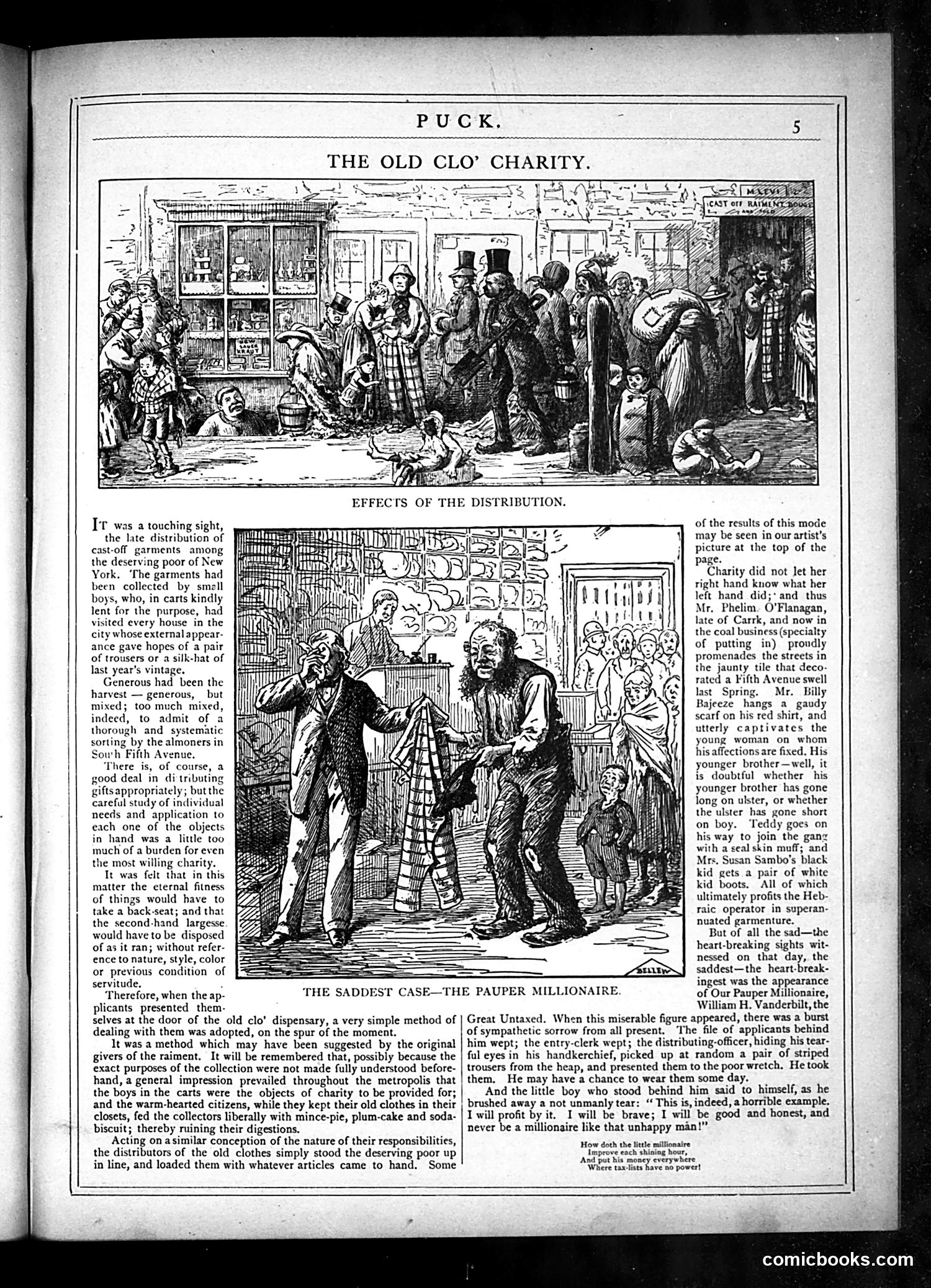
This satirical piece critiques the distribution methods of charitable clothing to New York's poor. The top illustration shows a street scene where deserving poor receive garments from a charity dispensary. The satire centers on the "Pauper Millionaire" cartoon below: a wealthy man in fine dress weeps upon receiving shabby donated clothes, while poor recipients accept them gratefully. The text mocks how the charity's distribution system fails to properly assess individual needs—clothes are given indiscriminately regardless of who deserves them. The joke exposes the inefficiency and absurdity of mechanized, impersonal charity: the system distributes identical items without considering whether recipients actually need them, potentially giving fine clothes to the undeserving while truly poor families receive rags. It's a critique of charity without genuine compassion or thoughtful administration.
📄 Transcribed text from this page (OCR, searchable)
Machine-transcribed from the original scan — historical spelling and the odd misread are preserved.
PUCK. THE OLD CLO’ CHARITY. Ir’ was a touching sight, the late distribution of cast-off garments among the deserving poor of New York. ‘The garments had been collected by smell boys, who, in carts kindly lent for the purpose, had visited every house in the city whose external appear- ance gave hopes of a pair of trousers or a silk-hat of last year’s vintage. Generous had been the harvest — generous, but mixed; too much mixed, indeed, to admit of a thorough and _ systematic sorting by the almoners in Sowh Fifth Avenue, There is, of course, a good deal in di tributing giftsappropriately; butthe careful study of individual needs and application to each one of the objects in hand was a little too much of a burden for even the most willing charity, Tt was felt that in this matter the eternal fitness of things would have to take a back-seat; and that the second-hand largesse would have to be disposed of as it ran; without refer- ence to nature, style, color or previous condition of servitude, s Therefore, when the ap- plicants presented them- selves at the door of the old clo’ dispensary, a very simple method of dealing with them was adopted, on the spur of the moment. It was a method which may have been suggested by the original givers of the raiment. It will be remembered that, possibly because the exact purposes of the collection were not made fully understood before- hand, a general impression prevailed throughout the metropolis that the boys in the carts were the objects of charity to be provided for; and the warm-hearted citizens, while they kept their old clothes in their closets, fed the collectors liberally with mince-pie, plum-cake and soda- biscuit; thereby ruining their digestions. Acting on asimilar conception of the nature of their responsibilities, the distributors of the old clothes simply stood the deserving poor up in line, and loaded them with whatever articles came to hand. Some THE SADDEST CASE—THE PAUPER MILLIONAIRE. of the results of this mode may be seen in our artist’s picture at the top of the page. Charity did not Jet her right hand know what her left hand did;* and thus Mr. Phelim. O’Flanagan, late of Carrk, and now in the coal business (specialty of putting in) proudly promenades the streets in the jaunty tile that deco- rated a Fifth Avenue swell last Spring. Mr. Billy Bajeeze hangs a gaudy scarf on his red shirt, and utterly captivates the young woman on whom his affections are fixed, His younger brother—well, it is doubtful whe i younger brother has gone long on ulster, or whether the ulster has gone short on boy. ‘Teddy goes on his way to join the ganz with a seal skin muff; and Mrs, Susan Sambo's black kid gets a pair of white kid boots. All of which ultimately profits the Heb- raic operator in superan- nuated garmenture. But of all the sad—the heart-breaking sights wit- nessed on that day, the saddest—the heart-break- ingest was the appearance of Our Pauper Millionaire, William H. Vanderbilt, the Great Untaxed. When this miserable figure appeared, there was a burst of sympathetic sorrow from all present. ‘The file of applicants behind him wept; the entry-clerk wept; the distributing-officer, hiding his tear- ful eyes in his handkerchief, picked up at random a pair of striped trousers from the heap, and presented them to the poor wretch. He took them. He may have a chance to wear them some day. i And the little boy who stood behind him said to himself, as he brushed away a not unmanly tear: “ This is, indeed, a horrible example. I will profit by it. I will be brave; I will be good and honest, and never be a millionaire like that unhappy man!” How doth the little millionaire Improve each shining hour, And put his money everywhere ‘Where taxlists have no power! comicbooks.com