
A complete issue · 16 pages · 1879
Puck — January 22, 1879
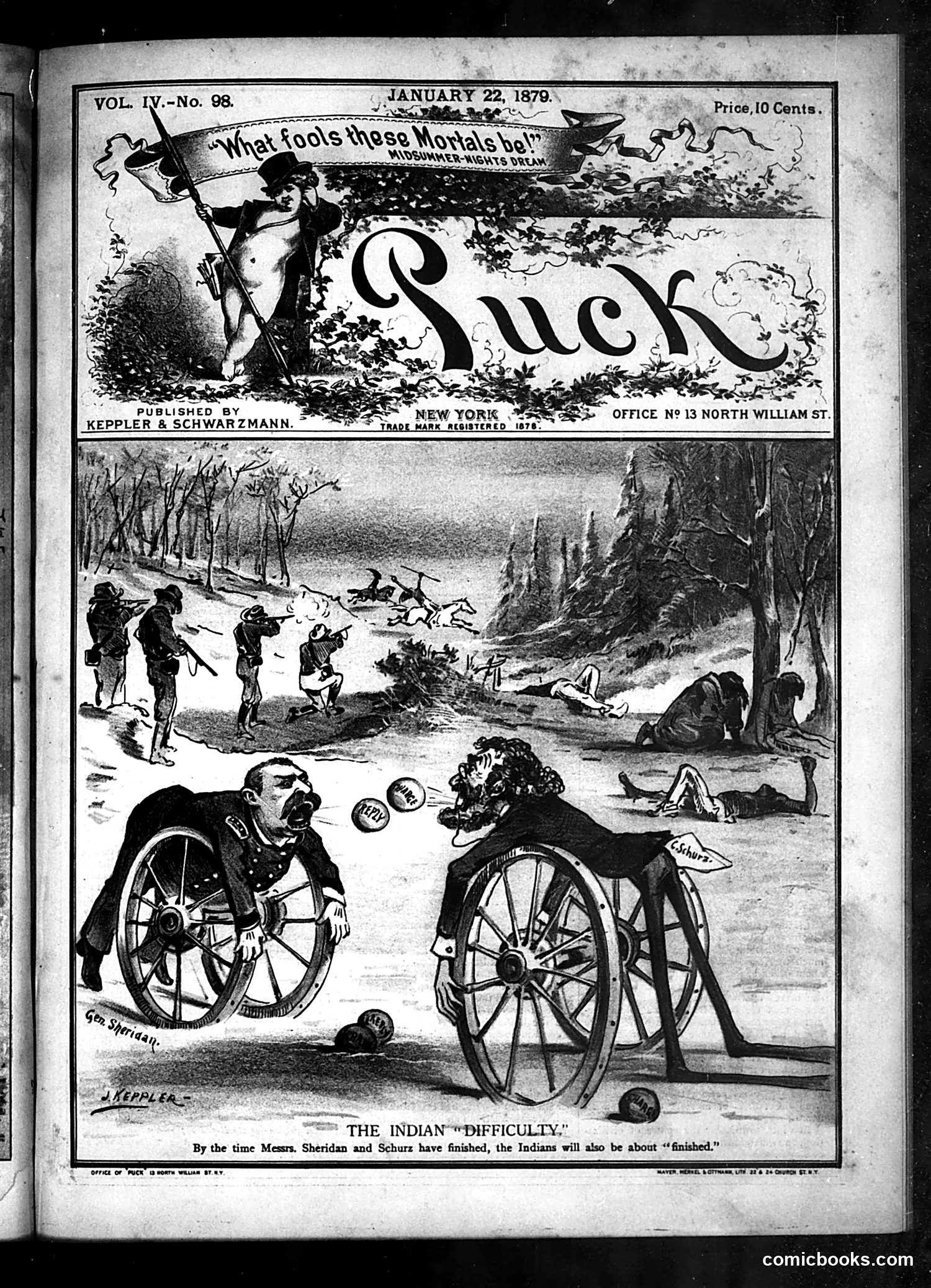
This cartoon satirizes the U.S. military campaign against Native Americans. Two caricatured military officers (likely Generals Sheridan and Schurz, named in the caption) are depicted as wheels—a metaphor suggesting they're mechanically grinding forward with their Indian policy. The caption states: "By the time Messrs. Sheridan and Schurz have finished, the Indians will also be about 'finished.'" The background shows Native Americans being attacked and killed by soldiers in a winter landscape. The cartoon mocks the military's brutal approach to the "Indian problem," suggesting that Sheridan and Schurz's strategy amounts to extermination rather than genuine resolution. The wheel imagery implies relentless, dehumanized destruction.
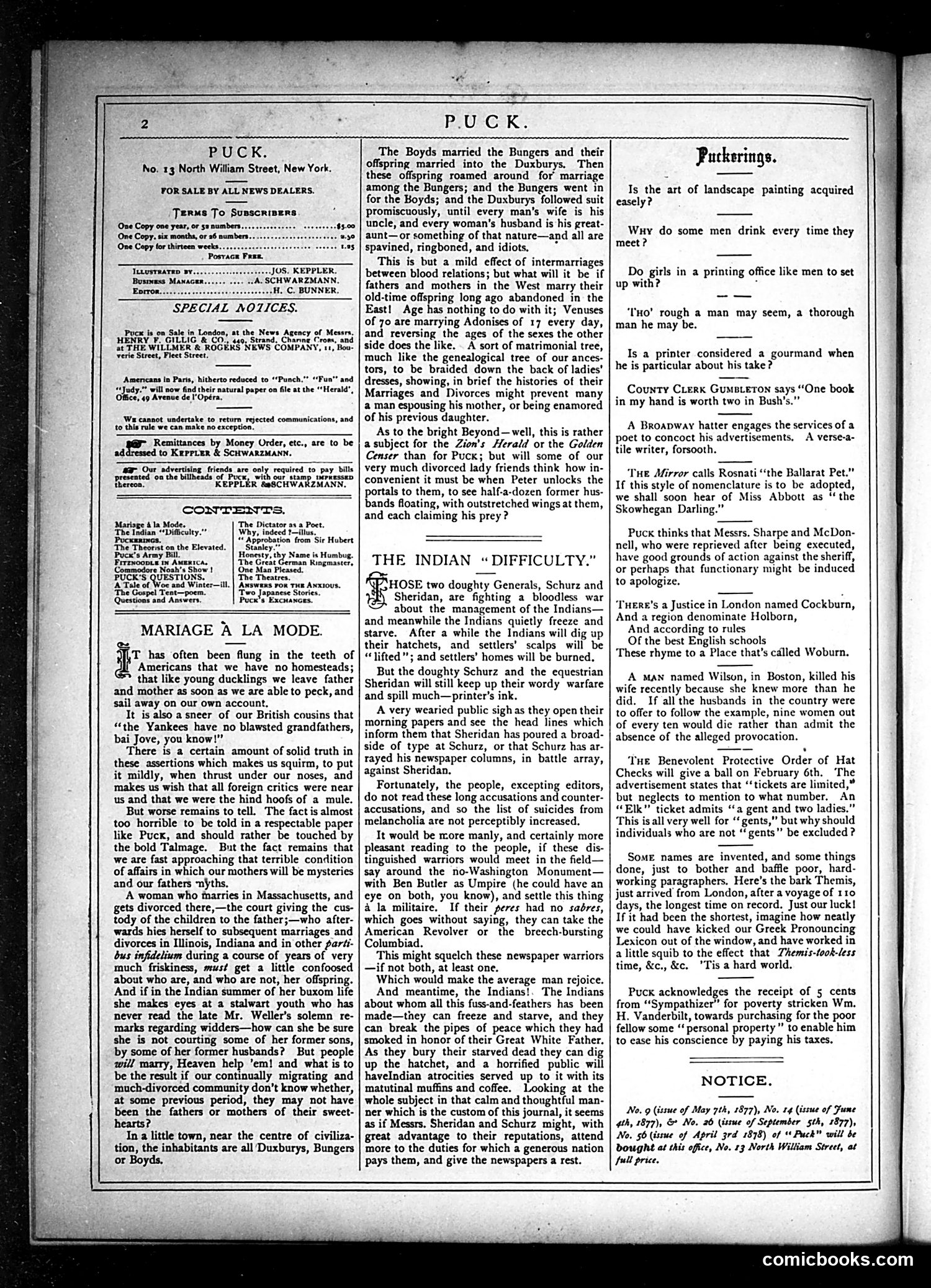
This page contains primarily **editorial content and advertisements** rather than political cartoons. The main article, "Marriage à la Mode," satirizes **American attitudes toward intermarriage between old-money Eastern families (Duxburys, Boyds) and nouveau-riche Western families (Bungers)**. The satire critiques how Eastern society families' genealogical pride becomes absurd when they must accommodate marriages to wealthy Western "outsiders." The piece mocks both the pretentiousness of genealogical obsession and the hypocrisy of accepting "inferior" families when money is involved. The "Puckerings" section offers brief satirical quips on contemporary life—printers, hats, and society gossip. A separate article discusses **inflammatory newspaper coverage of conflicts with Native Americans**, criticizing sensationalism that inflames public opinion rather than informing it.
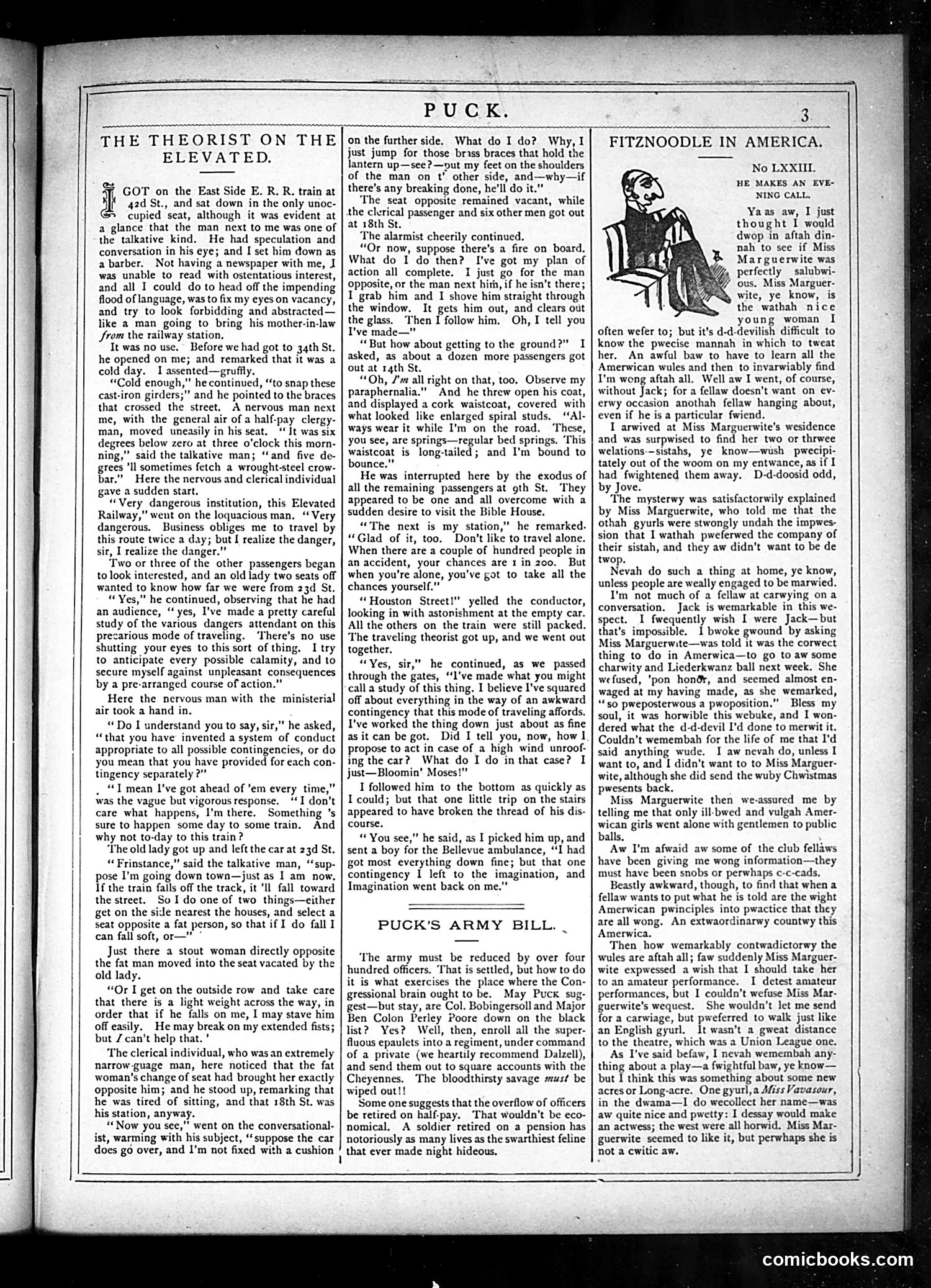
This page contains two distinct pieces: **Left column** ("The Theorist on the Elevated"): A humorous anecdote about a nervous passenger on an elevated train (the E.R.R. at 42nd St.) who becomes increasingly anxious about various safety hazards. The narrator patiently explains contingencies for each imagined disaster—suggesting the piece satirizes modern urban anxiety and overthinking. **Right column** ("Fitznoodle in America," No. LXXIII): A serialized humor column following an apparent Irish character's observations of American life and customs. The excerpt discusses Miss Marguerite and American courtship practices, treating transatlantic cultural differences as comedic material. The page primarily contains **text-based humor** rather than illustrated cartoons, typical of Puck's satirical approach during this era.
This page is primarily **editorial content rather than political satire**. The main article celebrates "Commodore Noah's Show," describing an actual historical menagerie voyage aboard the steamship "Ark." Commodore James G. Noah transported exotic animals (elephants, kangaroos, ostriches, parrots) from Africa to Australia via Port Ararat in 1856. The text humorously recounts voyage difficulties—storms, seasickness among animals, escaped birds—treating the enterprise as adventurous spectacle rather than social commentary. The bottom section features "Puck's Questions"—a standard editorial quiz format with answers printed elsewhere, covering topics from the journey (who killed the red reckoning? what did Cecil Dreeme dream?). This appears to be **straightforward journalism mixed with trivia**, not political satire.
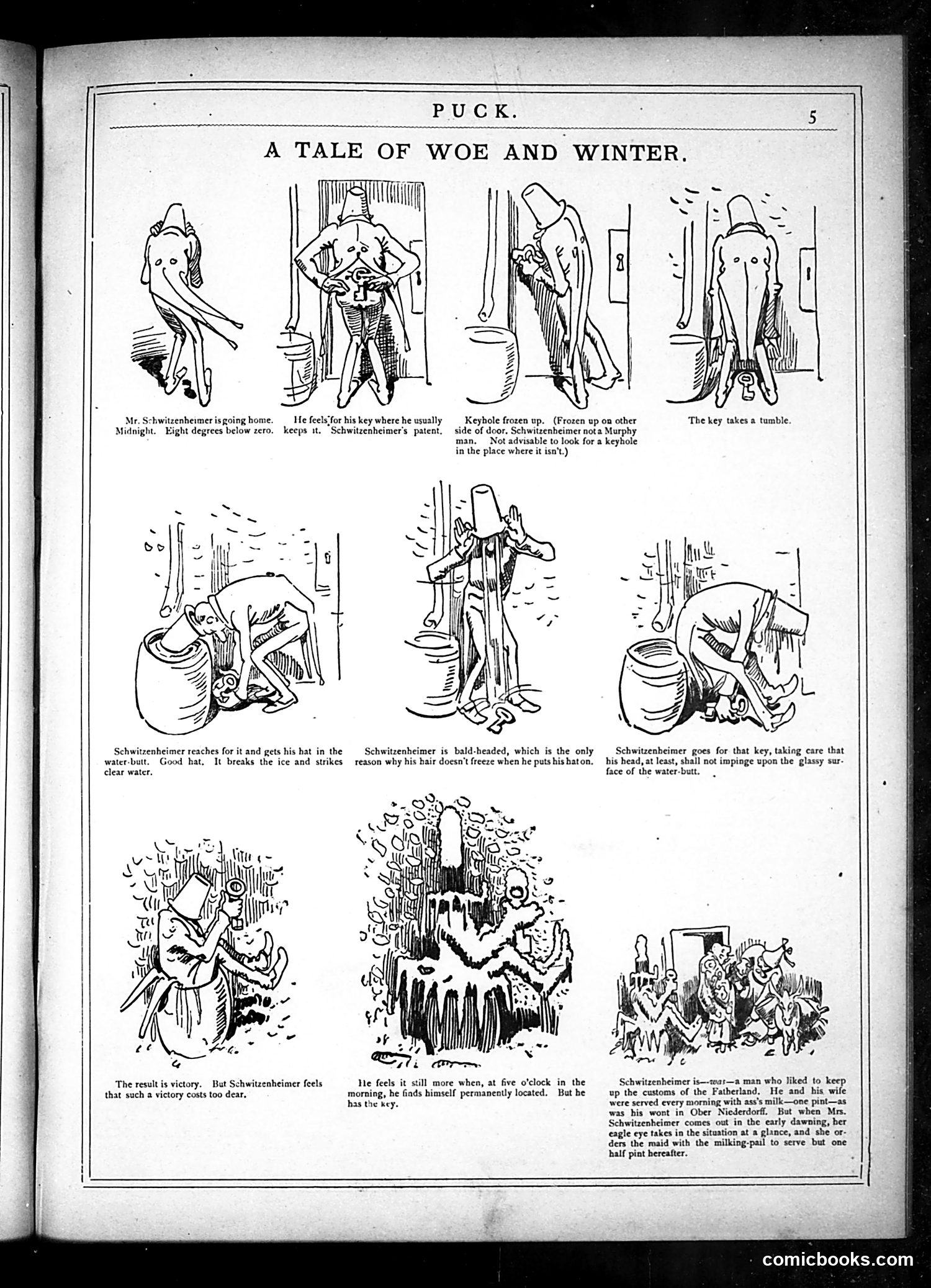
This Puck cartoon satirizes **Mr. S. Schwitzenberger**, a man dealing with winter's hardships in what appears to be a German-American community (suggested by the German name and "Ober Niedersdorf" reference). The humor follows Schwitzenberger's escalating misfortunes: his key freezes in the lock, he searches desperately for it, then retrieves it from an icy water butt. The climax shows him permanently frozen to his location by morning, finding himself "bald-headed" due to his hair freezing. The final panel reveals darker irony: Mrs. Schwitzenberger, discovering his frozen predicament at dawn, apparently decides to replace him rather than rescue him—she's found his "woe" too costly. The satire mocks both winter's brutality and domestic indifference with darkly comedic exaggeration.
This page contains primarily **letters to the editor and reader responses** rather than political cartoons. The content includes: **"The Gospel Tent"** — a humorous poem mocking religious revival meetings and their theatrical emotionalism. **"Questions and Answers"** — Reader correspondence addressing Puck, including debates about Irish immigration ("the wrongs of bleeding Ireland"), Canadian identity, and social etiquette. One letter discusses whether Ireland should address its own problems before emigrating to America. **"Rapid Transit"** — Commentary on Mr. Cyrus Field's ambitious transportation schemes, likely referring to elevated railways or similar infrastructure projects. **"The Canadian Chesterfield"** — A note about publishing extracts from a book on court etiquette. The page reflects **1879 American concerns**: immigration debates, Irish nationalist sentiment, technological progress, and social respectability. No significant political cartoons are visible on this particular page.
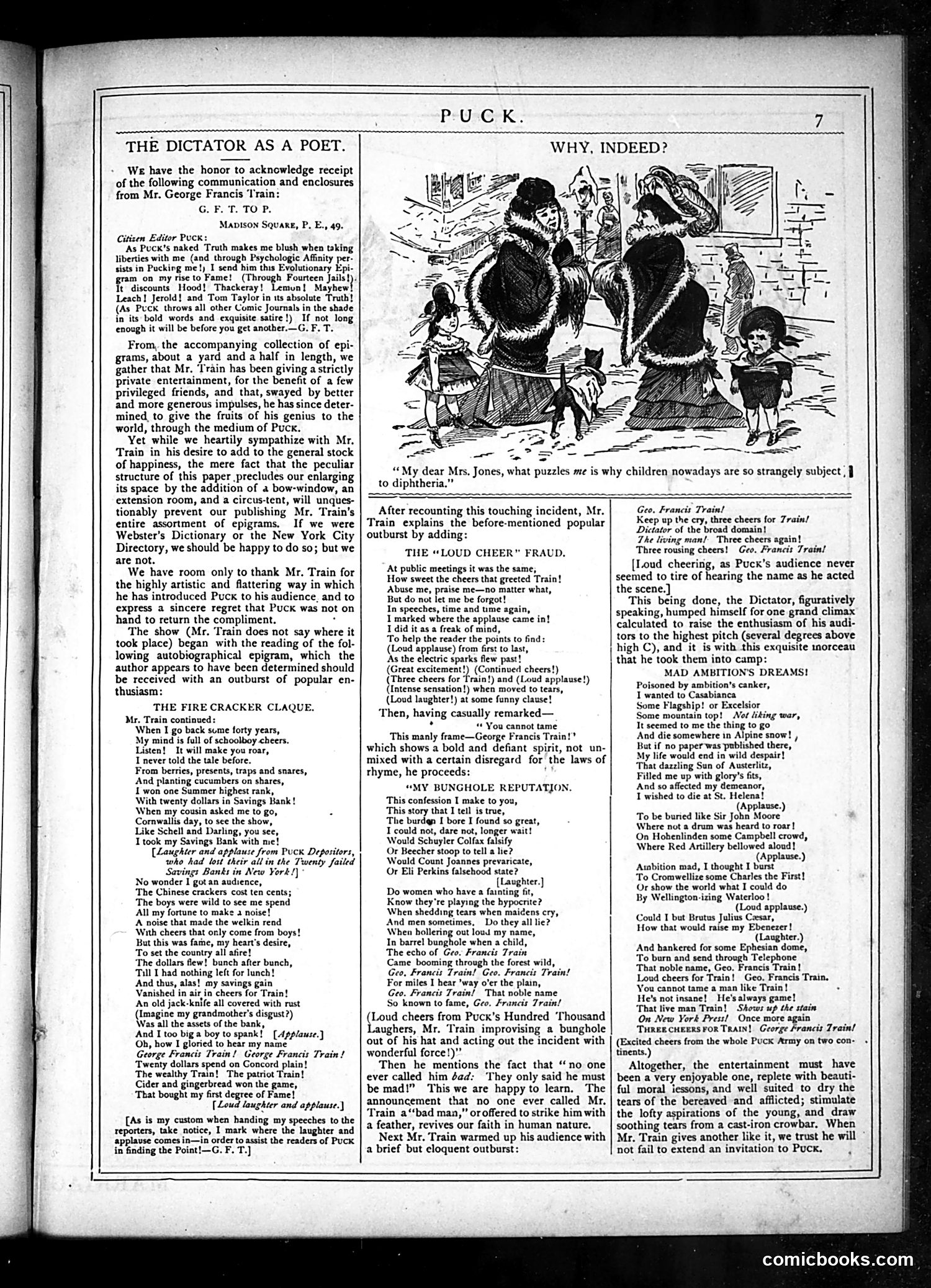
This cartoon satirizes **George Francis Train**, a famous 19th-century eccentric lecturer and entertainer. The image shows Train addressing a crowd while children appear distressed or ill, with the caption: "My dear Mrs. Jones, what puzzles me is why children nowadays are so strangely subject to diphtheria." The satire appears to mock Train's public speaking style and questionable medical knowledge—he's obliviously unaware that his performances might be causing actual harm. The accompanying text references Train's "Loud Cheer Fraud," suggesting he artificially manufactured audience enthusiasm through manipulative tactics. The joke: Train's bombastic public entertainment and rhetorical flourishes are presented as absurdly disconnected from reality and potentially dangerous to public health, particularly children.
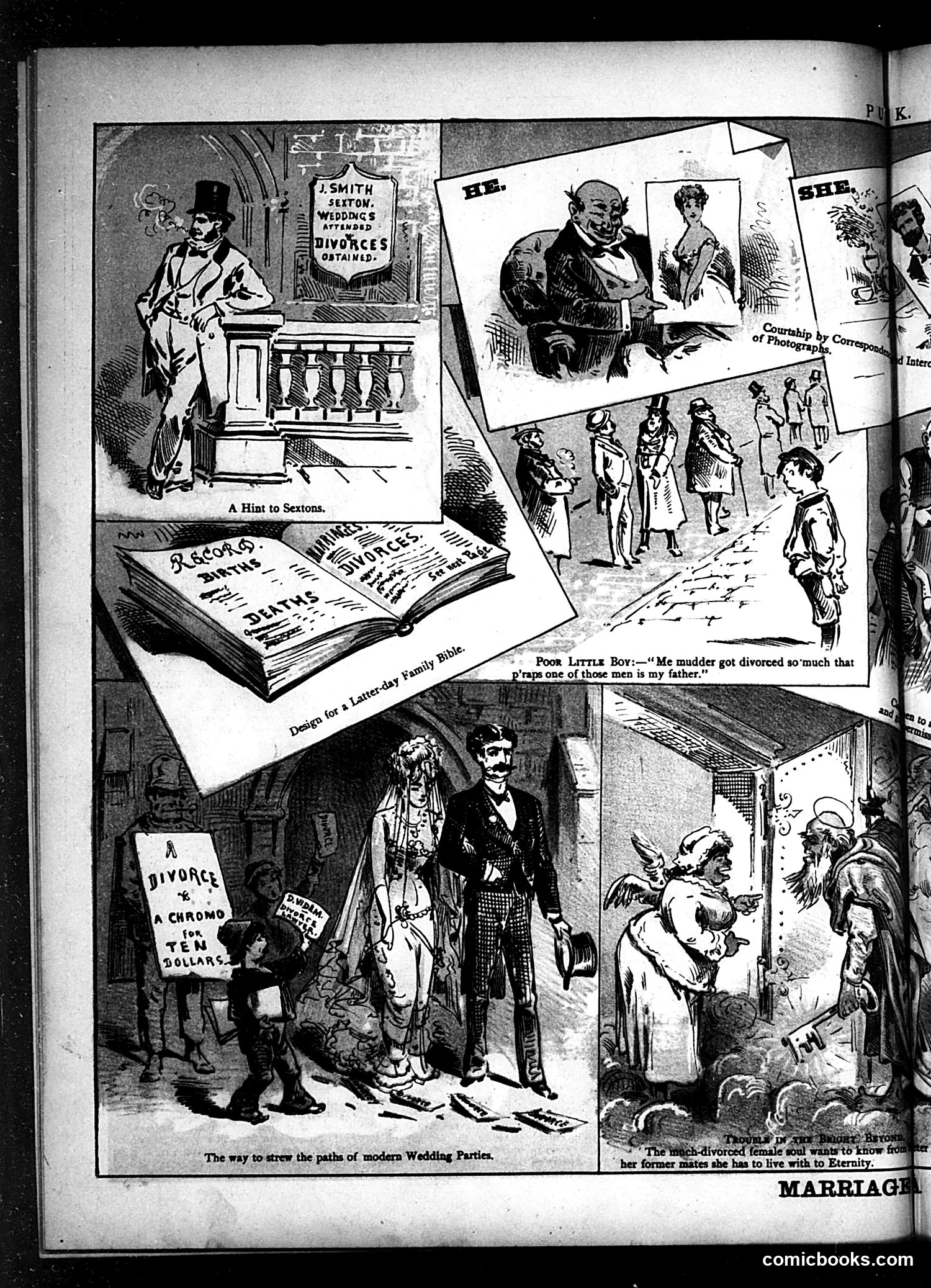
This page satirizes divorce in late 19th-century America through multiple cartoon vignettes: **Top left:** "A Hint to Sextons" shows a well-dressed man at a church displaying a sign advertising "Divorces Obtained" — mocking how easily divorce has become commercialized, with churches now seemingly complicit. **Center:** A book titled "Births and Deaths" with "Divorces" added, suggesting divorce rates rival vital statistics. **Bottom left:** "The way to strew the paths of modern Wedding Parties" depicts a child holding a "Divorce $100 Dollars" sign, satirizing how divorce is now casual and available. **Right panels:** Show the social consequences — abandoned families and children questioning their paternity — critiquing how modern divorce undermines family stability and legitimacy. The overall message criticizes the era's growing divorce accessibility and its social costs, particularly for women and children.
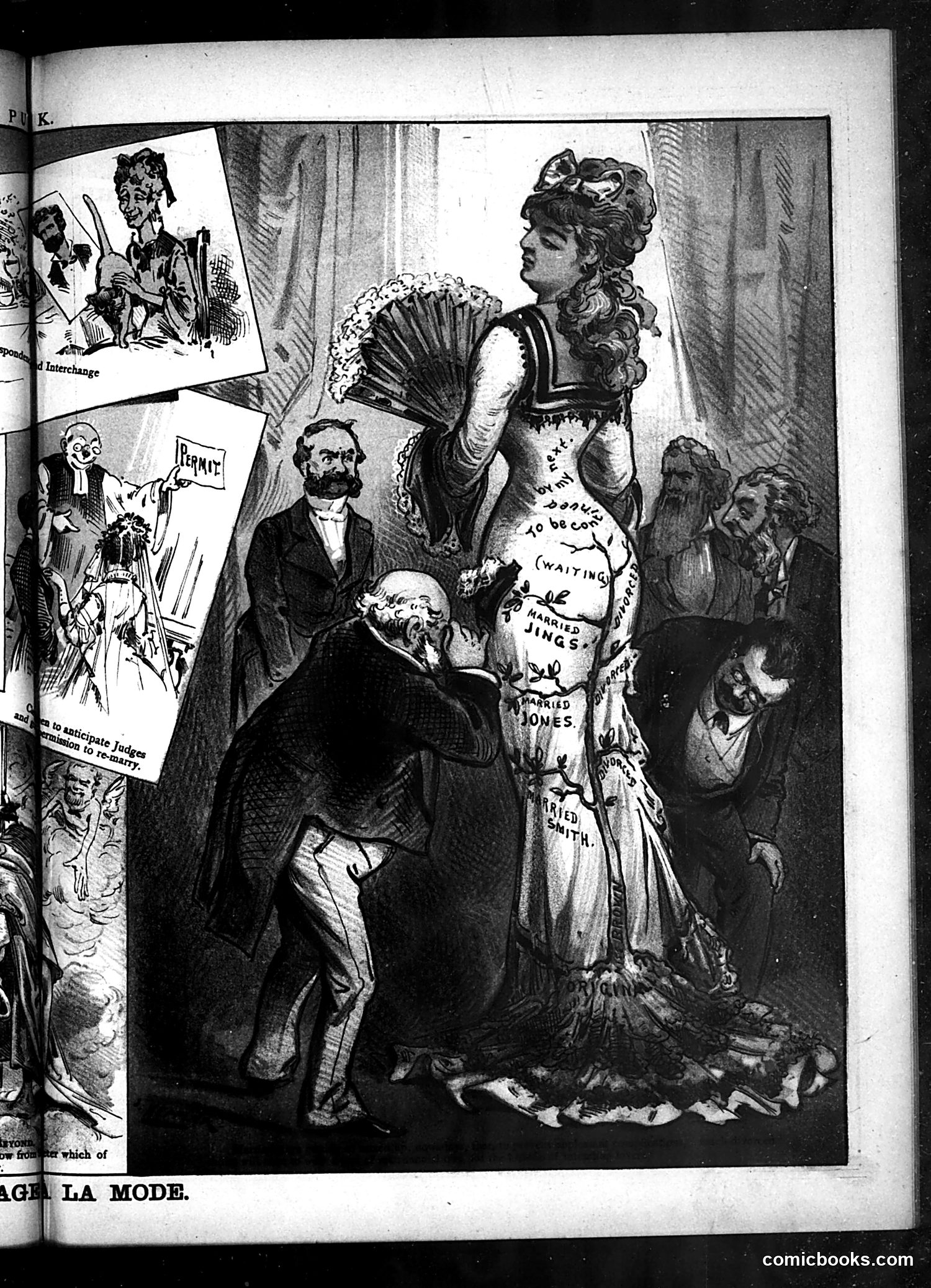
This satirical illustration, titled "À LA MODE" (visible at bottom), depicts a fashionable woman displayed like merchandise being examined by well-dressed men. Her dress is literally labeled with marriage-related text including "WAITING," "MARRIED JONES," and "MARRIED SMITH," suggesting she's a woman of questionable marital history or dubious reputation. The satire appears to target Victorian-era attitudes toward women's fashion and marriage prospects. The woman is presented as a commodity on display, while the men inspect her with interest—critiquing both the superficiality of fashion obsession and the transactional nature of marriage in society. The smaller vignettes on the left side appear to provide additional satirical commentary on related social topics, though specific details are difficult to discern.
This page contains editorial commentary and theater reviews rather than political cartoons. The main illustrated item, "Approbation from Sir Hubert Stanley," shows a small decorative vignette but the primary content is textual. The page discusses journalism standards, praising a San Francisco contemporary for high-quality cartooning while critiquing sensationalism in New York papers. It defends Puck's satirical approach as stemming from Christian principles rather than vulgarity. Theater reviews cover "H.M.S. Pinafore" at the Standard Theatre and "Les Fourchambault" at the Broadway, with detailed critical commentary. A final section addresses reader questions. The overall tone emphasizes Puck's editorial sophistication and moral foundation for its satirical mission.
This page from *Puck* contains **two short fictional stories** rather than political cartoons. The heading "TWO MODERN JAPANESE STORIES" indicates the content focuses on narrative humor about Japan. The first story, "I. A Regular Mess," appears to satirize Western attitudes toward Japan during a period of increased foreign contact. It describes a foreigner's chaotic interactions in a Japanese village, highlighting cultural misunderstandings—particularly around Western goods (pistols, kerosene lamps, medicines) being introduced to traditional communities. The second story, "II. Paddling his own Canoe," continues this theme with a protagonist named Takezawa navigating foreign business innovations. These stories likely reflect late 19th-century American curiosity and condescension toward Japan, using humor to explore the friction between traditional Japanese society and Western modernization.
This page contains **three separate satirical poems** rather than political cartoons. "**Puck's Brijmages**" mocks a fashionable woman's complexion and vanity. "**Threnody**" appears to be a sardonic poem about labor and death. "**Is a Lady Meets a Lady**" satirizes women's social interactions and fashion obsessions. The bottom section contains miscellaneous humorous observations about human behavior—questioning why men punch each other, why women call dogs "she," and why newspapers publish trivial domestic gossip. The small illustration at top shows Puck, the magazine's mascot character. These pieces target late 19th-century social conventions, particularly women's fashion-consciousness, vanity, and the triviality of society pages—typical Puck satire of the era.
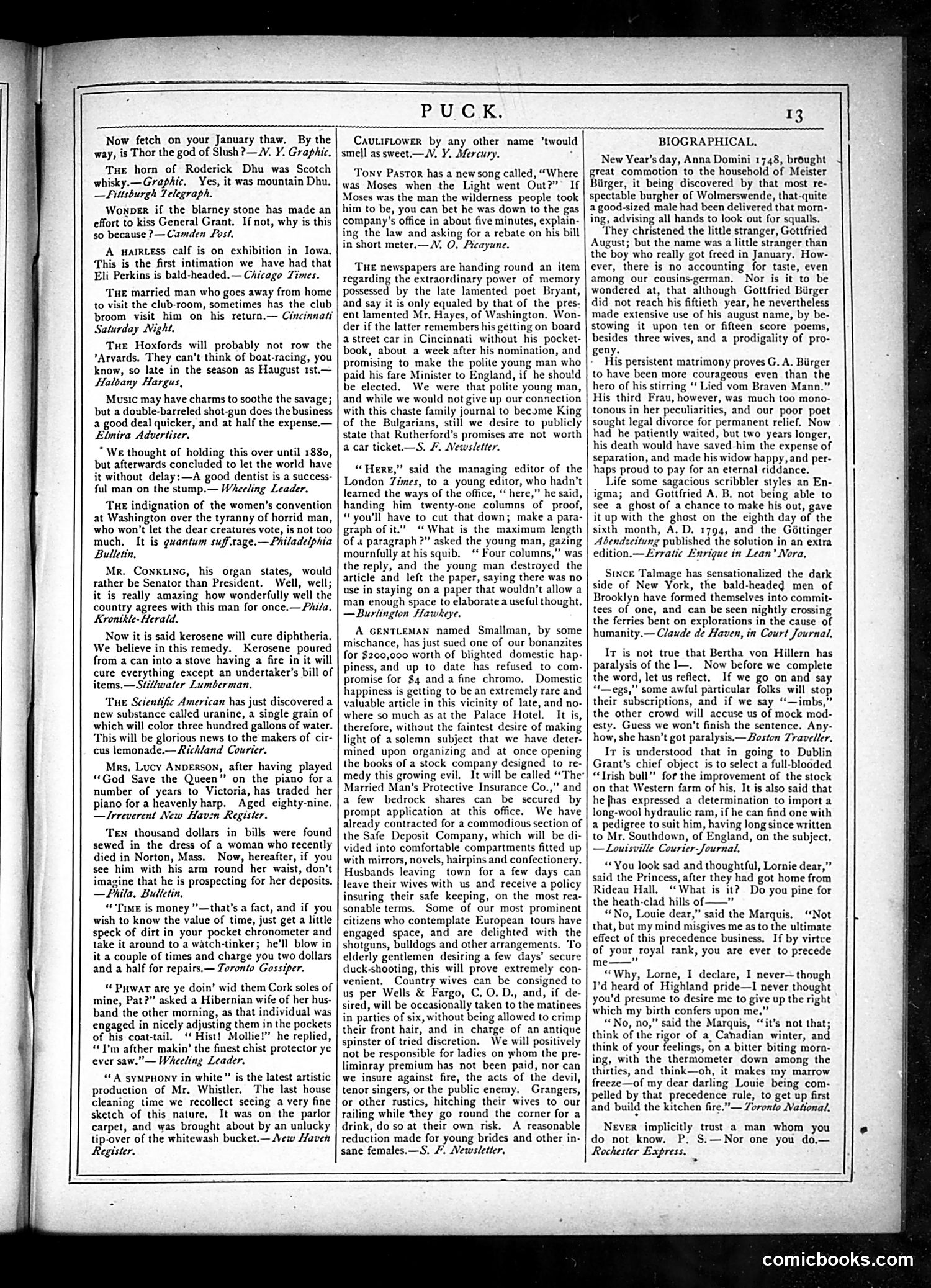
This is primarily a **text-based gossip and humor column** rather than a political cartoon page. It contains brief satirical items about contemporary social figures and events, written in the witty, gossipy style typical of Puck's "Amusements" section. The content includes: - Jokes about fashions and social customs - Anecdotes about public figures (names are mentioned but unclear in context without additional research) - Commentary on current events like newspaper scandals - Humorous observations about marriage, society, and urban life The tone is **light social satire** targeting manners, pretension, and absurdities of upper-class life rather than serious political critique. Without identifying specific individuals or dates from the text alone, the page demonstrates Puck's characteristic blend of gossip, puns, and observations about American social life.
This page is primarily **advertising and notices** rather than political satire. The main content includes: - Multiple ads for Arnold, Constable & Co. department store (India shawls, fabrics, housekeeping linens) - A photographer advertisement - Best Marquis cigarette ad - Text snippets from "Puck" magazine's satirical content (left column), though the actual cartoons are not visible The visible Puck text discusses Byron, false teeth laws in Kentucky, opera troupes, and other miscellaneous social commentary typical of the magazine's humor. However, **without seeing the actual cartoon illustrations**, I cannot identify specific caricatures or explain the satirical intent. The page appears to be from February 1879 based on the masquerade ball notice dates shown.
This is primarily an **advertising page** from Puck magazine, not a satirical cartoon section. The page displays numerous commercial advertisements from late 19th-century New York businesses, including: - Vienna Coffee Pots and house furnishings - Dental services and rooms - A tailor (Nicoll) - Gentlemen's hats (Dunlap & Co.) - Champagne and umbrella vendors - Patent and trademark services - Cabinet furniture makers There is **one small illustration**: a locomotive or steam engine at the top right, likely advertising railway-related services or products. The page demonstrates how Puck financed itself through paid advertisements rather than relying solely on editorial content, mixing commercial pitches with the magazine's satirical mission.
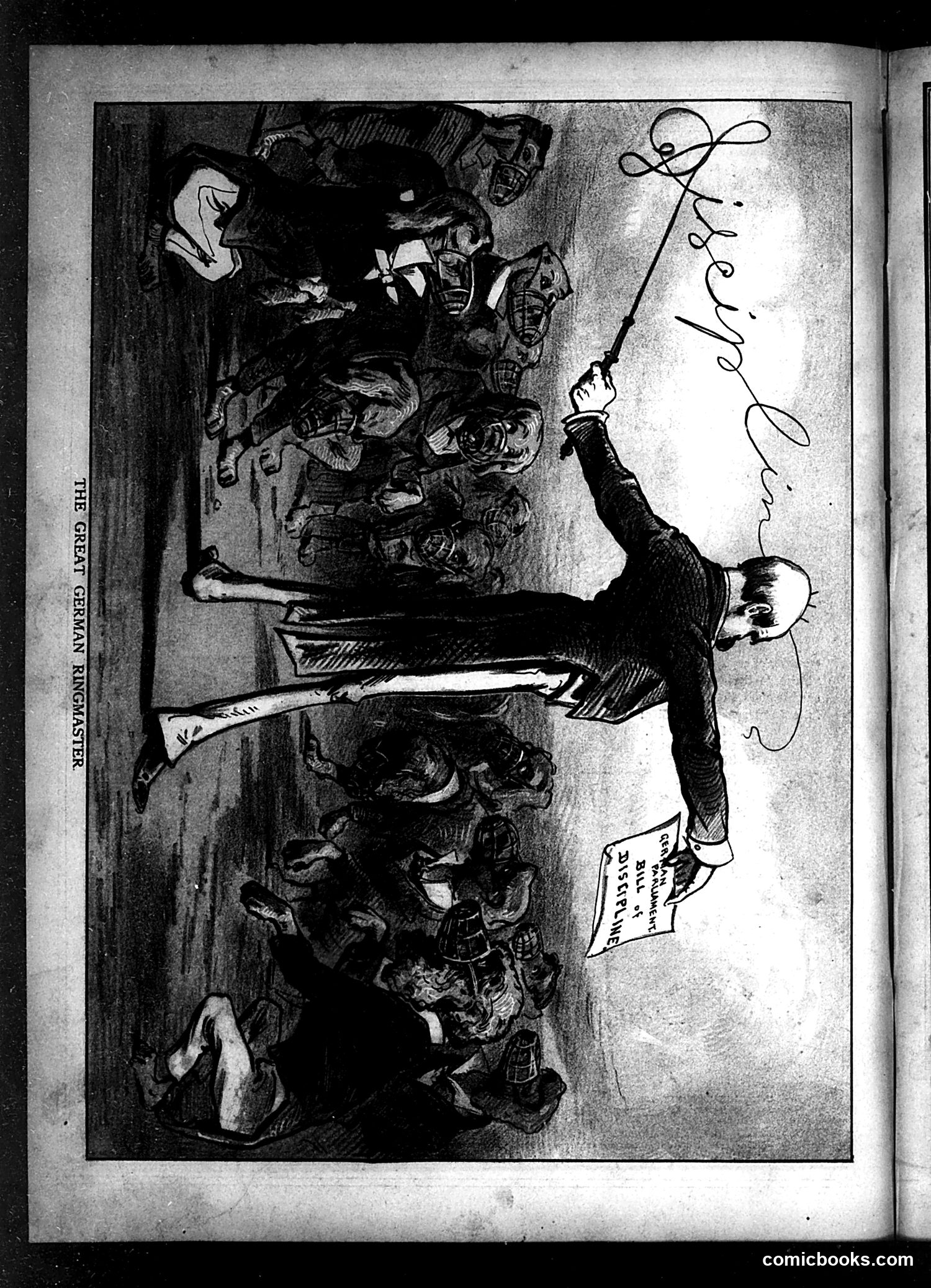
This political cartoon depicts a figure in formal dress conducting an orchestra of what appear to be German military officers or "junkers" (Prussian aristocratic military class). The conductor wields a baton labeled with cursive text (likely a name, though unclear in this reproduction). The satire suggests that a particular political figure—likely a German leader or diplomat of the era—is manipulating or "conducting" the German military establishment like an orchestra. The "junkers" were historically the Prussian landed gentry who dominated German military and political institutions. The cartoon critiques either German militarism, authoritarian control, or the subordination of military interests to civilian political leadership, depending on Puck's specific editorial stance at publication.