
Puck, 1879-01-22 · page 3 of 16
Puck — January 22, 1879 — page 3: what you’re looking at
What you’re looking at
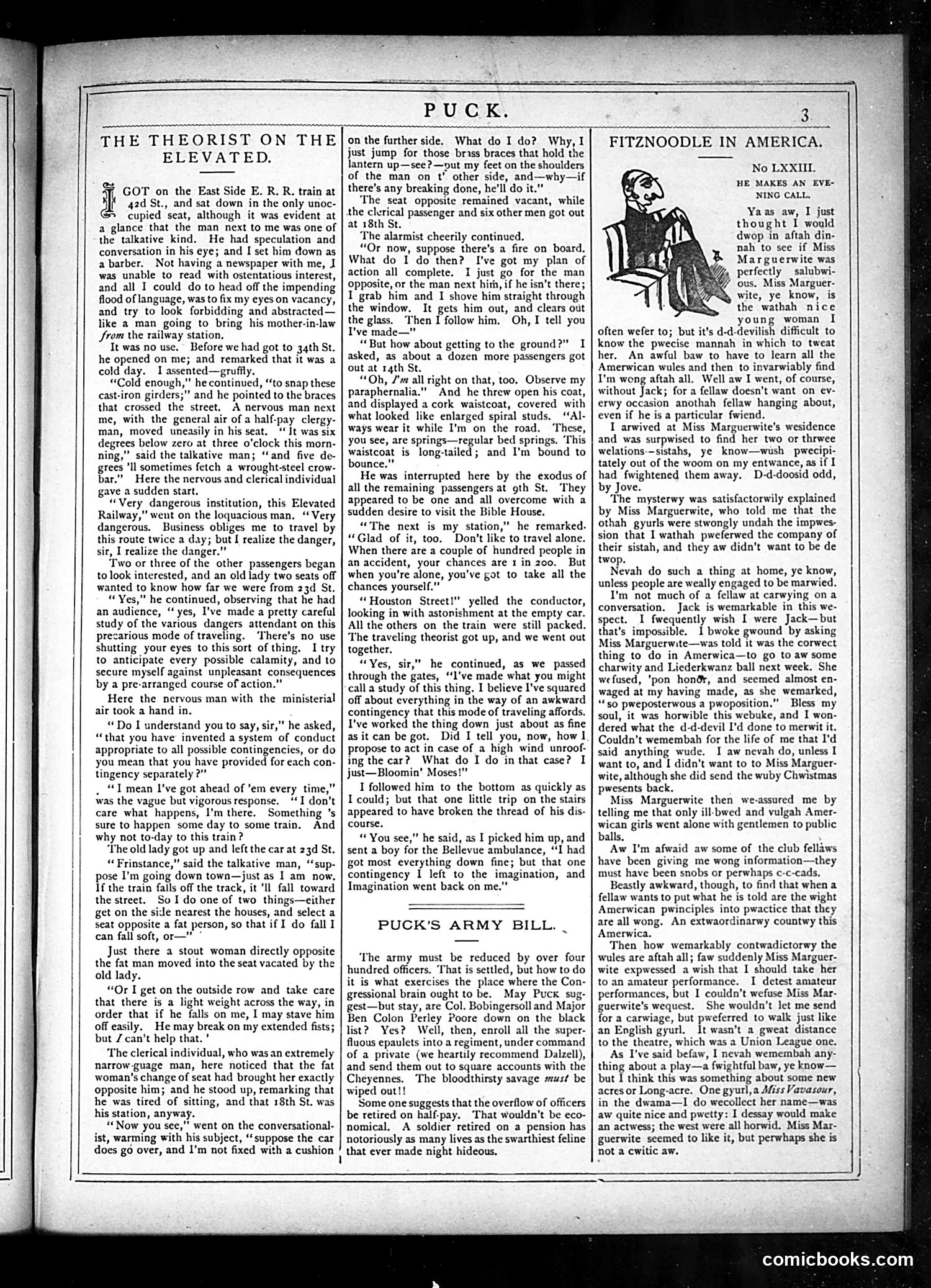
This page contains two distinct pieces: **Left column** ("The Theorist on the Elevated"): A humorous anecdote about a nervous passenger on an elevated train (the E.R.R. at 42nd St.) who becomes increasingly anxious about various safety hazards. The narrator patiently explains contingencies for each imagined disaster—suggesting the piece satirizes modern urban anxiety and overthinking. **Right column** ("Fitznoodle in America," No. LXXIII): A serialized humor column following an apparent Irish character's observations of American life and customs. The excerpt discusses Miss Marguerite and American courtship practices, treating transatlantic cultural differences as comedic material. The page primarily contains **text-based humor** rather than illustrated cartoons, typical of Puck's satirical approach during this era.
📄 Transcribed text from this page (OCR, searchable)
Machine-transcribed from the original scan — historical spelling and the odd misread are preserved.
THE THEORIST ON THE ELEVATED. GOT on the East Side E. R. R. train at Ner4ad St, and sat’down in the only unoc: cupied seat, although it was evident at a glance that the man next to me was one of the talkative kind. He had speculation and conversation in his eye; and I set him down as a barber. Not having a newspaper with me, J was unable to read with ostentatious interest, and all I could do to head off the impending flood of language, was to fix my eyes on vacancy, and try to look’ forbidding and abstracted— like a ‘man going to bring his mother-in-law Srom the railway station, It was no use, Before we had got to 34th St. he opened on me; and remarked that it was a cold day. I assented—gruffly. “Cold enough,” he continued, ‘to snap these cast-iron girders;” and he pointed to the braces that crossed the street. A nervous man next me, with the general air of a half-pay clergy- man, moved uneasily in his seat, “ It was six degrees below zero at three o'clock this morn- ning,” said the talkative man; ‘‘and five de- grees 'll sometimes fetch a wrought-steel crow- bar.” Here the nervous and clerical individual gave a sudden start, “Very dangerous institution, this Elevated Railway,” went on the loquacious man. “Very dangerous. Business obliges me to travel by this route twice a day; but I realize the danger, sir, I realize the danger.” Two or three of the other passengers began to look interested, and an old lady two seats off wanted to know how far we were from 23d St. “Yes,” he continued, observing that he had an audience, “yes, I've made a pretty careful study of the various dangers attendant on this precarious mode of traveling. ‘There’s no use shutting your eyes to this sort of thing. I try to anticipate every possible calamity, and to secure myself against unpleasant consequences by a pre-arranged course of action.” Here the nervous man with the ministerial air took a hand in. “Do I understand you to say, sir,” he asked, “that you have invented a system of conduct appropriate to all possible contingencies, or do you mean that you have provided for each con- tingency separately ?” . “I mean I’ve got ahead of ’em every time,” was the vague but vigorous response. “I don’t care what happens, I’m there. Something ’s sure to happen some day to some train, And why not to-day to this train? ‘The old lady got up and left the car at 23d St. “Frinstance,” said the talkative man, “sup- pose I’m going down town—just as I am now, If the train falls off the track, it 'Il fall toward the street. So I do one of two things—either get on the side nearest the houses, and select a seat opposite a fat person, so that ifI do fall 1 can fall soft, or—” * Just there a stout woman directly opposite the fat man moved into the seat vacated by the old lady. “Or I get on the outside row and take care that there is a light weight across the way, in order that if he falls on me, I may stave him off easily. He may break on my extended fists; but / can’t help that.’ ‘The clerical individual, who was an extremely narrow-guage man, here noticed that the fat woman’s change of seat had brought her exactly opposite him; and he stood up, remarking that he was tired of sitting, and that 18th St. was his station, anyway. ‘*Now you see,” went on the conversational- ist, warming with his subject, “suppose the car does go over, and I’m not fixed with a cushion on the further side. What do I do? Why,I just jump for those brass braces that hold the lantern up—see?—put my feet on the shoulders of the man on t’ other side, and—why—if there’s any breaking done, he'll do it.’ ‘The seat opposite remained vacant, while the clerical passenger and six other men got out at 18th St. The alarmist cheerily continued. “Or now, suppose there’s a fire on board, What do I do then? I’ve got my plan of action all complete. I just go for the man opposite, or the man next hith, if he isn’t there; I grab him and I shove him straight through the window. It gets him out, and clears out the glass. Then I follow him. Oh, I tell you I've made—"" “But how about getting to the ground?” I asked, as about a dozen more passengers got out at r4th St. “Oh, /'m all right on that, too, Observe my paraphernalia.” And he threw open his coat, and displayed a cork waistcoat, covered with what looked like enlarged spiral studs. ‘“Al- ways wear it while I'm on the road. These, you see, are springs—regular bed springs. ‘This waistcoat is long-tailed; and I’m bound to bounce.” He was interrupted here by the exodus of all the remaining passengers at gth St. They appeared to be one and all overcome with a sudden desire to visit the Bible House. “The next is my station,” he remarked. “Glad of it, too, Don’t like to travel alone. When there are a couple of hundred people in an accident, your chances are 1 in 200. But when you're alone, you've got to take all the chances yourself.” “Houston Street!" yelled the conductor, looking in with astonishment at the empty car. All the others on the train were still packed. The traveling theorist got up, and we went out together. “Yes, sir,” he continued, as we passed through the gates, “l've made what you might call a study of this thing. I believe I've squared off about everything in the way of an awkward contingency that this mode of traveling affords. I've worked the thing down just about as fine as it can be got. Did I tell you, now, how 1 propose to act in case of a high wind unroof- ing the car? What do I do in that case? I just—Bloomin’ Moses!”” I followed him to the bottom as quickly as I could; but that one little trip on the stairs appeared to have broken the thread of his dis- course. “You see,” he said, as I picked him up, and sent a boy for the Bellevue ambulance, ‘I had got most everything down fine; but that one contingency I left to the imagination, and Imagination went back on me,” PUCK'S ARMY BILL. | ‘The army must be reduced by over four hundred officers, That is settled, but how to do it is what exercises the place where the Con- gressional brain ought to be. May Puck sug- gest—but stay, are Col. Bobingersoll and Major Ben Colon Perley Poore down on the black list? Yes? Well, then, enroll all the super- fluous epaulets into a regiment, under command of a private (we heartily recommend Dalzell), and send them out to square accounts with the Cheyennes. The bloodthirsty savage must be wiped out!! Some one suggests that the overflow of officers be retired on half-pay. ‘That wouldn't be eco- nomical. A soldier retired on a pension has notoriously as many lives as the swarthiest feline 1 that ever made night hideous. FITZNOODLE IN AMERICA. No LXXIII. HE MAKES AN EVE- NING CALL, Yaas aw, I just thought I would dwop in aftah din- nah to see if Miss Marguerwite was perfectly _salubwi- ous. Miss Marguer- 4 wite, ye know, is the wathah nice young woman I often wefer to; but it’s d-d-devilish difficult to know the pwecise mannah in which to tweat her. An awful baw to have to learn all the Amerwican wules and then to invarwiably find I’m wong aftah all. Well aw I went, of course, without Jack; for a fellaw doesn’t want on ev- erwy occasion anothah fellaw hanging about, even if he isa particular fwiend. I arwived at Miss Marguerwite’s wesidence and was surpwised to find her two or thrwee welations--sistahs, ye know—wush pwecipi- tately out of the woom on my entwance, as if I had fwightened them away. D-d-doosid odd, by Jove. The mysterwy was satisfactorwily explained by Miss Marguerwite, who told me that the othah gyurls were stwongly undah the impwes- sion that I wathah pweferwed the company of their sistah, and they aw didn’t want to be de twop. Nevah do such a thing at home, ye know, unless people are weally engaged to be marwied. I’m not much of a fellaw at carwying ona conversation. Jack is wemarkable in this we- spect. I fwequently wish I were Jack—but that’s impossible. 1 bwoke gwound by asking Miss Marguerwite—was told it was the corwect thing to do in Amerwica—to go to aw some charwity and Liederkwanz ball next week. She wefused, ‘pon hondr, and seemed almost en- waged at my having made, as she wemarked, “so pweposterwous a pwoposition.” Bless my soul, it was horwible this webuke, and I won- dered what the d-d-devil I'd done to merwit it. Couldn’t wemembah for the life of me that I'd said anything wude. I aw nevah do, unless I want to, and I didn’t want to to Miss Marguer- wite, although she did send the wuby Chwistmas pwesents back. Miss Marguerwite then we-assured me by telling me that only ill-bwed and vulgah Amer- wican girls went alone with gentlemen to public balls, Aw I’m afwaid aw some of the club fellaws have been giving me wong information—they must have been snobs or perwhaps c-c-cads, Beastly awkward, though, to find that when a fellaw wants to put what he is told are the wight Amerwican pwinciples into pwactice that they are all wong. An extwaordinarwy countwy this Amerwica. Then how wemarkably contwadictorwy the wules are aftah all; faw suddenly Miss Marguer- wite expwessed a wish that I should take her to an amateur performance. I detest amateur performances, but I couldn’t wefuse Miss Mar- guerwite’s wequest. She wouldn’t let me send for a carwiage, but pweferred to walk just like an English gyurl. It wasn’t a gweat distance to the theatre, which was a Union League one. As I’ve said befaw, I nevah wemembah any- thing about a play—a fwightful baw, ye know— but I think this was something about some new acres or Long-acre. One gyurl,a Miss Vavasour, in the dwama—I do wecollect her name—was aw quite nice and pwetty: I dessay would make an actwess; the west were all horwid. Miss Mar- guerwite seemed to like it, but perwhaps she is not a cwitic aw, comicbooks.com