
Puck, 1879-01-22 · page 13 of 16
Puck — January 22, 1879 — page 13: what you’re looking at
What you’re looking at
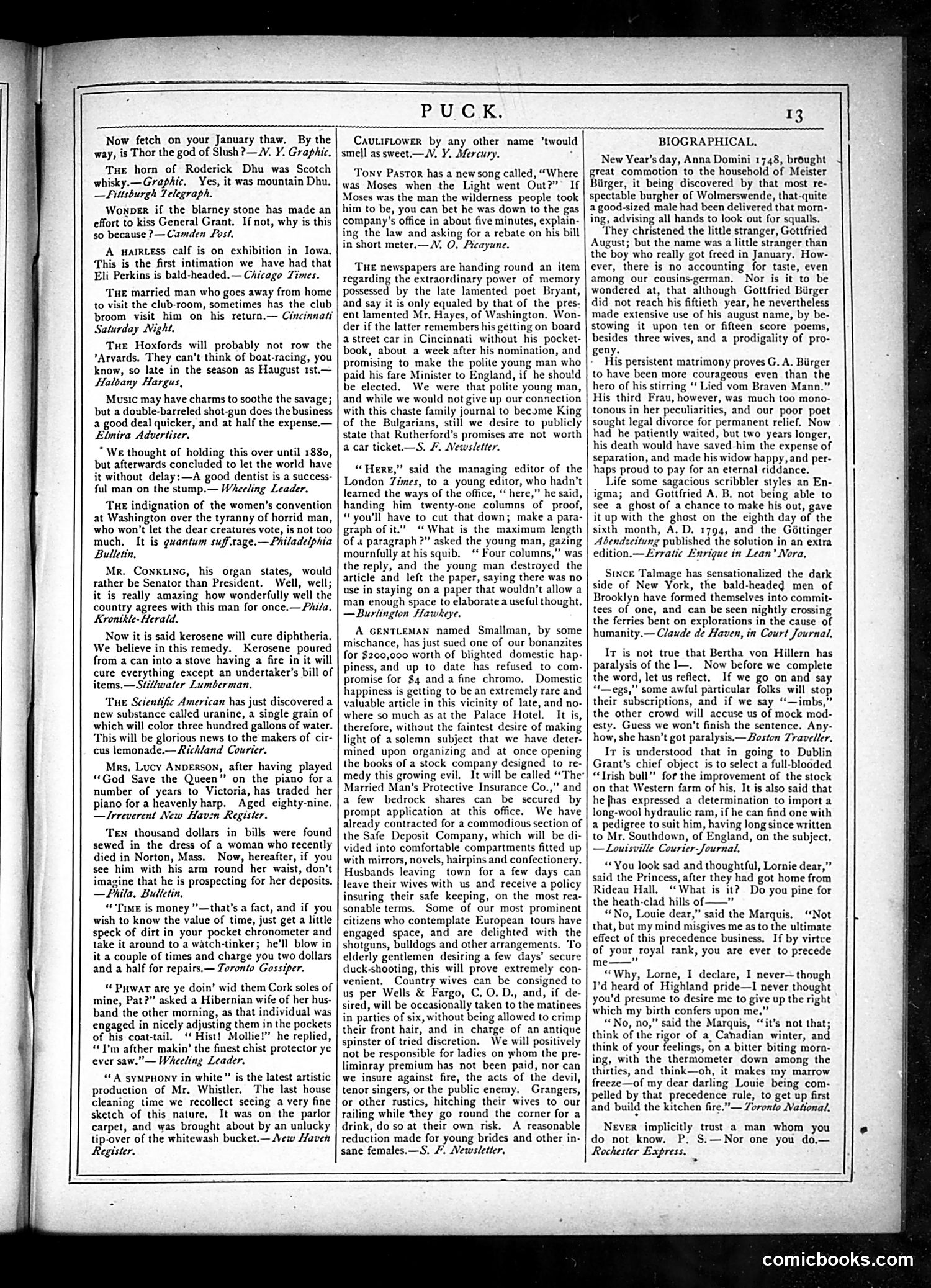
This is primarily a **text-based gossip and humor column** rather than a political cartoon page. It contains brief satirical items about contemporary social figures and events, written in the witty, gossipy style typical of Puck's "Amusements" section. The content includes: - Jokes about fashions and social customs - Anecdotes about public figures (names are mentioned but unclear in context without additional research) - Commentary on current events like newspaper scandals - Humorous observations about marriage, society, and urban life The tone is **light social satire** targeting manners, pretension, and absurdities of upper-class life rather than serious political critique. Without identifying specific individuals or dates from the text alone, the page demonstrates Puck's characteristic blend of gossip, puns, and observations about American social life.
📄 Transcribed text from this page (OCR, searchable)
Machine-transcribed from the original scan — historical spelling and the odd misread are preserved.
PUCK. Now fetch on your January thaw. By the way, is Thor the god of Slush?—W. Y. Graphic, Tue horn of Roderick Dhu was Scotch whisky.—Graphic. Yes, it was mountain Dhu. —Fitlsburgh Telegraph. Wonper if the blarney stone has made an effort to kiss General Grant. If not, why is this so because ?—Camden Post. A waitess calf is on exhibition in Iowa, This is the first intimation we have had that Eli Perkins is bald-headed.— Chicago Times. ‘Tue married man who goes away from home to visit the club-room, sometimes has the club broom visit him on his return.— Cincinnati Saturday Night. Tue Hoxfords will probably not row the *Arvards. They can’t think of boat-racing, you know, so late in the season as Haugust 1st.— Halbany Hargus, Music may have charms to soothe the savage; but a double-barreled shot-gun does the business a good deal quicker, and at half the expense.— Elmira Advertiser, * We thought of holding this over until 1880, but afterwards concluded to let the world have it without delay:—A good dentist is a success- ful man on the stump.— Wheeling Leader. Tue indignation of the women’s convention at Washington over the tyranny of horrid man, who won’t let the dear creatures vote, is not too much. It is quantum suffrage.—Philadelphia Bulletin, Mr. Conxtinc, his organ states, would rather be Senator than President. Well, well; it is really amazing how wonderfully well the country agrees with this man for once.—ui/a. Kronikle- Herald. Now it is said kerosene will cure diphtheria. We believe in this remedy. Kerosene poured from a can into a stove having a fire in it will cure everything except an undertaker’s bill of items.— Stillwater Lumberman, Tue Scientific American has just discovered a new substance called uranine, a single grain of which will color three hundred gallons of water. This will be glorious news to the makers of cir- cus lemonade.— Richland Courier, Mrs. Lucy ANpeRsoN, after having played “God Save the Queen” on the piano fora number of years to Victoria, has traded her piano for a heavenly harp. Aged eighty-nine. —Irreverent New Hav:n Register. ‘Ten thousand dollars in bills were found sewed in the dress of a woman who recently died in Norton, Mass. Now, hereafter, if you see him with his arm round her waist, don’t imagine that he is prospecting for her deposits. —Phila, Bulletin. “Time is money "—that's a fact, and if you wish to know the value of time, just get a little speck of dirt in your pocket chronometer and take it around to a watch-tinker; he'll blow in it a couple of times and charge you two dollars and a half for repairs.— Toronto Gossiper. “ Puwat are ye doin’ wid them Cork soles of mine, Pat?” asked a Hibernian wife of her hus- band the other morning, as that individual was engaged in nicely adjusting them in the pockets of his coat-tail. ‘‘ Hist! Mollie!” he replied, “I'm afther makin’ the finest chist protector ye ever saw.” — Wheeling Leader. “A syMpHony in white" is the latest artistic production of Mr. Whistler. The last house cleaning time we recollect seeing a very fine sketch of this nature. It was on the parlor carpet, and was brought about by an unlucky tip-over of the whitewash bucket.— Aew Haven Register. CauLirLoweR by any other name 'twoul smell as sweet.—W. Y. Mercury. . Tony Pastor has a new song called, “Where was Moses when the Light went Out?” If Moses was the man the wilderness people took him to be, you can bet he was down to the gas company’s office in about five minutes, explain- ing the law and asking for a rebate on his bill in short meter.—. O. Picayune. Tue newspapers are handing round an item regarding the extraordinary power of memory possessed by the late lamented poet Bryant, and say it is only equaled by that of the pres- ent lamented Mr. Hayes, of Washington. Won- der if the latter remembers his getting on board a street car in Cincinnati without his pocket- book, about a week after his nomination, and promising to make the polite young man who paid his fare Minister to England, if he shou!d be elected. We were that polite young man, and while we would not give up our connection with this chaste family journal to become King of the Bulgarians, still we desire to publicly state that Rutherford’s promises are not worth a car ticket—S, F. Newsletter, “Here,” said the managing editor of the London Zimes, to a young editor, who hadn't learned the ways of the office, “ here,” he said, handing him twenty-one columns of proof, “you'll have to cut that down; make a para- graph of it.” “What is the maximum length Of a paragraph 2” asked the young man, gazing mournfully at his squib.“ Four columns,” was the reply, and the young man destroyed the article and left the paper, saying there was no use in staying on a paper that wouldn’t allow a man enough space to elaborate a useful thought. —Burlington Hawkeye. A GENTLEMAN named Smallman, by some mischance, has just sued one of our bonanzites for $200,000 worth of blighted domestic hap- piness, and up to date has refused to com- promise for $4 anda fine chromo. Domestic happiness is getting to be an extremely rare and valuable article in this vicinity of late, and no- where so much as at the Palace Hotel. It is, therefore, without the faintest desire of making light of a solemn subject that we have deter- mined upon organizing and at once opening the books of a stock company designed to re- medy this growing evil. It will be called “The Married Man’s Protective Insurance Co.," and a few bedrock shares can be secured by prompt application at this office. We have already contracted for a commodious section of the Safe Deposit Company, which will be di- vided into comfortable compartments fitted up with mirrors, novels, hairpins and confectionery. Husbands leaving town for a few days can leave their wives with us and receive a policy insuring their safe keeping, on the most rea- sonable terms. Some of our most prominent citizens who contemplate European tours have engaged space, and are delighted with the shotguns, bulldogs and other arrangements. ‘To elderly gentlemen desiring a few days’ secure duck-shooting, this will prove extremely con- venient. Country wives can be consigned to us per Wells & Fargo, C. O. D., and, if de- sired, will be occasionally taken to the matinees in parties of six, without being allowed to crimp their front hair, and in charge of an antique spinster of tried discretion, We will positively not be responsible for ladies on whom the pre- liminray premium has not been paid, nor can we insure against fire, the acts of the devil, tenor singers, or the public enemy. Grangers, or other rustics, hitching their wives to our railing while they go round the corner for a drink, do so at their own risk. A reasonable reduction made for young brides and other in- sane females.—S. F. Newsletter. BIOGRAPHICAL, New Year’s day, Anna Domini 1748, brought great commotion to the household of Meister Birger, it being discovered by that most re- spectable burgher of Wolmerswende, that-quite a good-sized male had been delivered that morn- ing, advising all hands to look out for squalls. They christened the little stranger, Gottfried August; but the name was a little stranger than the boy who really got freed in January. How- ever, there is no accounting for taste, even among our cousins-german, Nor is it to be wondered at, that although Gottfried Birger did not reach his fiftieth year, he nevertheless made extensive use of his august name, by be- stowing it upon ten or fifteen score poems, besides three wives, and a prodigality of pro- geny. His persistent matrimony proves G. A. Birger to have been more courageous even than the hero of his stirring ‘‘ Lied vom Braven Mann.” His third Frau, however, was much too mono- tonous in her peculiarities, and our poor poet sought legal divorce for permanent relief. Now had he patiently waited, but two years longer, his death would have saved him the expense of separation, and made his widow happy, and per- haps proud to pay for an eternal riddance. Life some sagacious scribbler styles an En- igma; and Gottfried A. B. not being able to see a ghost of a chance to make his out, gave it up with the ghost on the eighth day of the sixth month, A, D. 1794, and the Géttinger Abendzeitung published the solution in an extra edition.—Erratic Enrique in Lean’ Nora, Since Talmage has sensationalized the dark side of New York, the bald-headeqd men of Brooklyn have formed themselves into commit- tees of one, and can be seen nightly crossing the ferries bent on explorations in the cause of humanity.— Claude de Haven, in Court Journal, Ir is not true that Bertha von Hillern has paralysis of the 1—. Now before we complete the word, let us reflect. If we go on and say “—egs,” some awful particular folks will stop their subscriptions, and if we say ‘‘—imbs,” the other crowd will accuse us of mock mod- esty. Guess we won't finish the sentence. Any- how, she hasn't got paralysis.— Boston Traveller. It is understood that in going to Dublin Grant’s chief object is to select a full-blooded “Trish bull” for the improvement of the stock on that Western farm of his. It is also said that he fhas expressed a determination to import a long-wool hydraulic ram, if he can find one with a pedigree to suit him, having long since written to Mr. Southdown, of England, on the subject. —Louisville Courier-Journal, “You look sad and thoughtful, Lornie dear,” said the Princess, after they had got home from Rideau Hall. “What is it? Do you pine for the heath-clad hills of —-” “No, Louie dear,” said the Marquis. ‘Not that, but my mind misgives me as to the ultimate effect of this precedence business. If by virtce of your royal rank, you are ever to precede een “Why, Lorne, I declare, I never—though I'd heard of Highland pride—I never thought you'd presume to desire me to give up the right which my birth confers upon me.” “No, no,” said the Marquis, “it’s not that; think of the rigor of a, Canadian winter, and think of your feelings, on a bitter biting morn- ing, with the thermometer down among the thirties, and think—oh, it makes my marrow freeze—of my dear darling Louie being com- pelled by that precedence rule, to get up first and build the kitchen fire.”— Zoronto National, Never implicitly trust a man whom you do not know. P. S.—Nor one you do,— Rochester Express. comicbooks.com